
When the wallet starts embedding the new interactive paradigm of AI Agent:ERC-8211, why should it be of interest
IT IS NOT AN AI STANDARD PER SE, BUT IT IS LIKELY TO BE A CRITICAL IMPLEMENTATION INFRASTRUCTURE IN THE "AI+ WALLET" ERA. 。
Starting in 2025, many people may have started to get used to a new way of interacting: saying to GPT or Gemini, "Help me plan my trip to Hong Kong next week and recommend a suitable airline hotel," it will do a series of quiet search of information, filtering, route selection, price comparisons, etc. in the backstage, and then only give you confirmation of the results。
It's just that bringing the same expectations to the chain is completely different。
For example, when you give a directive to a DeFi Agent, "Replace the ETH in your wallet with USDC, cross the Base chain, and fully store it in Aave," objectively speaking, today's Agent does not have to do with "understanding needs" and "planning paths," and the real fault appears at the implementation level:
You are still likely to gradually complete your signature, authorization, convert, cross-chain and deposit operations, and each step is exposed to the risk of a slide point change, Gas fluctuations, bridge delay and chain state change, which means that if there is a loop in the middle that deviates from expectations, the movement before is not necessarily withdrawn, the movement behind is likely to fail, and then remains on the chain, often as a half-finished process。
The problem is not that AI is not smart enough, but that there is still a lack of a truly Agent expression in the chain executive。
That is why, in early April 2026, Biconomy, together with the Etherwood Foundation, published the ERC-8211 to address the issue of "static restrictions" in the current implementation of smart contracts, to provide a more performing layer for AI agents and complex DeFi streams, and to try to fill this missing puzzle.
I. The "last fault" on the AI Agent access chain
Over the past one to two years, the encryption industry has been focusing its attention from L2 amplification, RWA mobility, to the rather subversive choice of how AI Agent can really take over the chain。
Objectively, we have also seen a number of practices in recent years, ranging from "multi-step DeFi strategies in natural languages" to "involving autonomous Agent to host an entire cross-chain portfolio," and most of the ideas have matured at the demo level, whether it is the nature language that generates multi-step DeFi strategies, autonomous rebalancing, automatic income migration, cross-chain-class adjustments, or even more complex portfolio management。
FROM THE POINT OF VIEW OF REASONING AND ORGANIZATION, AI'S ABILITY HAS RUN PRETTY FAST, EXCEPT THAT WHEN IT IS ACTUALLY PUT INTO THE PRODUCTION ENVIRONMENT, THE EXECUTIVE PANEL IS BECOMING MORE VISIBLE。
And to get to the production environment, this short sheet can be summed up in one sentence: DeFi is dynamic, but most of today's bats are still static.
BOTH THE ERC-8211 OFFICIAL NETWORK AND THE DISCUSSION NOTES MAKE THIS CLEAR THAT THE EXISTING ERC-4337 AND EIP-5792 HAVE INDEED MOVED THE OLD MODEL OF "ONE SIGNATURE AGAINST ONE CALL" TO A NEW PHASE OF "ONE SIGNATURE AGAINST MORE THAN ONE CALL" BUT THAT THE PARAMETERS IN THESE CALLS ARE STILL LARGELY FROZEN AT THE MOMENT OF SIGNING。
This means that the amount, target value, expected output that the user fills in when signing is not automatically adjusted by changes in the state of the chain when it is actually implemented。
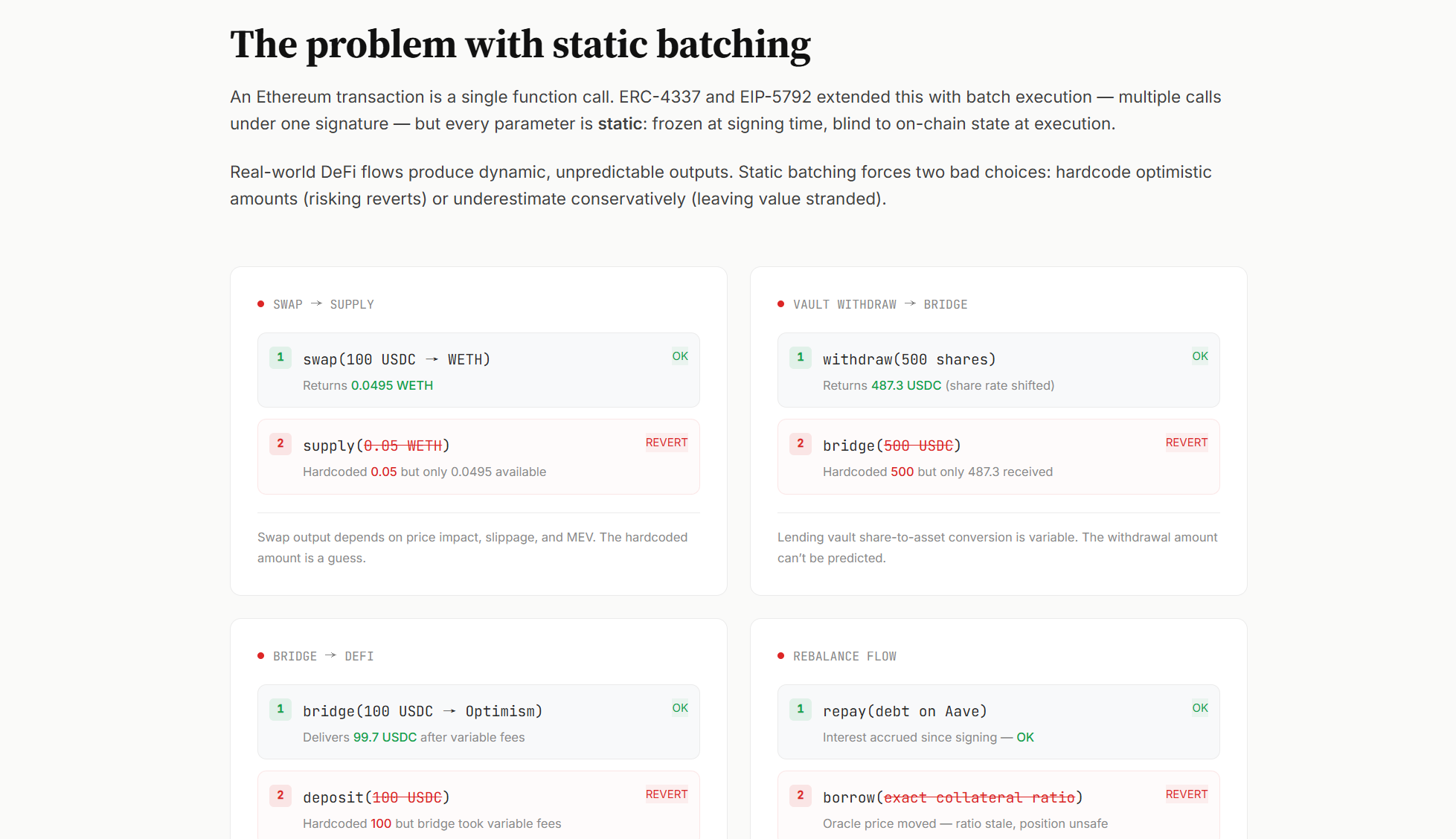
But DeFi itself is full of uncertainty. The actual output of a Swap depends on the implementation of the slide point and liquidity in that block; the timing and final amount of a Bridge will depend on the mechanism and cost of the bridge itself; and the loan agreement or the Share-to-Aset ratio of Vault will also change。
After all, the values that either the user or Agent sees when signing are, in many cases, only an estimate at the moment, not a real result at the time of execution。
To understand what ERC-8211 has solved, one of the most typical examples is the assumption that Agent wants to do something that looks pretty ordinary -- swapping ETH in the account for USDC, and fully depositing it into Spark for interest。
Under the current static watch processing model, Agent has to estimate how much USDC will get before signing, often forcing you to write in advance the amount of the second step of your signature, which is too high, the number of actual entries is insufficient, the whole batch is rolling back; too low, leaving a portion of the money idle in your wallet。
in other words, there is basically a so-called dilemma of taking the risk of failure or taking the opportunity cost. that is why many of the seemingly uncomplicated chain processes, once steps are taken up to five, eight or even two, quickly become fragile, not because the strategy itself is so complex to describe, but because the existing implementation paradigm relies too much on pre-mortem parameters.
In short, static battling caps, in fact, determine the tactical caps that Agent can really safely implement。
From this point of view, it's not how AI Agent makes a decision, but when Agent makes a decision, is there a more natural, stable, safer way to implement it in the chain? So that the chain of execution has a first expression designed for the original AI Agent.
II. ERC-8211
The core breakthrough of ERC-8211 is not to shove more steps into a signature, but rather to upgrade the bat processing of a dead transaction sequence from a single parameter to a "parameter for a procedure to value the live dynamic".
It does sound abstract, but it's not hard to understand. The official term is used to describe it: From transfers to problems。
This means that the ERC-8211 no longer views the watch as a sequential list of actions, but rather as an implementation procedure with a running value and safety condition, which, if dismantled, is achieved in three combinations:
- Fetchers (value takers): Defines where this parameter is taken, it can be a search of the current balance of an address, making the parameter no longer a snapshot at the time of signature, but a real-time reading taken from the state of the chain at short notice
- (a) Constraints (constraints): Once the parameters have been removed, they are subject to internal binding checks - e.g., "the USDC in exchange is at least 2500" or "the slide point cannot exceed 0.5%" - which are verified before the value is moved by road to the next call, either not passed and the whole batch is rolled back immediately
- Predicates (trigger): it can be understood as a gatekeeper between steps, not responsible for producing value, but responsible for determining whether or not to proceed, for example, in the cross-chain scene, where a watch on the side of the Taifeng is held by predicate on the condition that "WETH has arrived across the chain" and is not submitted until the account is entered;
In this design, each parameter answers two questions: first, where this value should come from when it is being executed; and secondly, what conditions need to be met before it is actually called upon, so that after a combination of three, a batch is no longer just a transaction sequence but a embedded security check。
At the end of the day, the static-batch process mental model is a list - the sequenced A, B, C three steps; the ERC-8211 mental model is a conditional program - A, the real output of A as input of B; B, the bounds are met before entering C; any step does not meet expectations, the whole roll back。
In fact, we can simply interpret it as a "smart batch" mechanism designed specifically for AI Agent and complex DeFi operations, because in traditional chain operations, the completion of a complex DeFi strategy often requires multiple independent transactions: Draws money from a loan agreement, converts it into a currency and deposits it in another agreement (extension readingEncryption AI Panorama: How to build a new operating system for AI Agent from the Ether's main battlefield)
Each step requires a separate signature and confirmation, which is already cumbersome for human users and a further bottleneck for AI Agent, which requires a high-frequency autonomous operation, while the ERC-8211 solution allows multiple block-chain operations to be carried out in a single transaction, with each step being implemented dynamically deciphering the actual values and meeting predefined conditions before proceeding.
An Agent, for example, can be completed in a signed transaction: withdrawal of funds from Aave to exchange the amounts actually received for Uniswap to deposit the exchange results in Compund -- all atomized, without the need for a new smart contract。
iii. why does it have more to do with wallets, especially smart wallets & nbsp;
The ERC-8211 deserves the attention of the wallet industry not only because it is suitable for Agent, but also because it redefines the location of the wallet in the interactive link。
Past wallets, more like a secure signer, whose role is to keep the private key, display the transaction, get the user to confirm it, then send the signature. This role is important enough in the EOA era and continues to be established in the abstract years of accounts, but the role of wallets will become even more central and heavy if more and more chains are used by Agent in the future。
The simple reason is that when the user no longer moves through the chain of manipulation, but starts authorizing an Agent to execute a set of objectives, the wallet must be capable of taking on such a higher-level interactive object, showing no longer just a contractual address and a calldata, but an entire "intent-value-based-conditional-final" execution program.
The future wallet, therefore, needs to be understood not only as a transaction but as a procedure。IT IS ON THIS LEVEL THAT ERC-8211 PROVIDES A CLEARER GRIP ON THE WALLET, BECAUSE IT IS WRITTEN INTO THE CODING STRUCTURE IN EXPLICIT TERMS, WHICH CONTAINS PARAMETERS FROM WHERE THEY COME FROM, WHAT CONDITIONS THEY HAVE TO MEET, WHEN THEY CONTINUE AND WHEN THEY ROLL BACK, WHICH IS NOT A BLACK BOX HIDDEN IN A BACK-END LOGIC, BUT A SUBJECT THAT CAN BE INTERPRETED, SIMULATED AND DISPLAYED BY THE WALLET。
From a wallet point of view, this whole set of mechanisms ultimately points to the same thing:The user is no longer signing a series of bottom calls that it is difficult to read fully, but is signing an implementation procedure that is result-oriented, border clear and verifiable:
- AI Agent is responsible for understanding the user ' s intentions and generating paths
- The wallet is responsible for presenting the path in a clearer way to users for review
- (a) relayer is only responsible for submitting the results when the conditions are established and does not have the authority to tamper with the results
This is why non-trust execution is considered an Agentic DeFi premise, because intelligent bodies can be involved, but sovereignty, restraint, and final settlement remain on the chain, and this is where ERC-8211 really fits with smart wallets, and it puts the matter of "safe expression of complex intent" in the protocol hierarchy。
It is worth mentioning that ERC-8211 is fully compatible with the abstract framework of accounts ERC-4337, EIP-7702, ERC-7579, which is not a substitute for the abstract of accounts, but rather an addition to the abstract of accounts by adding a programmable semantic for Agent.
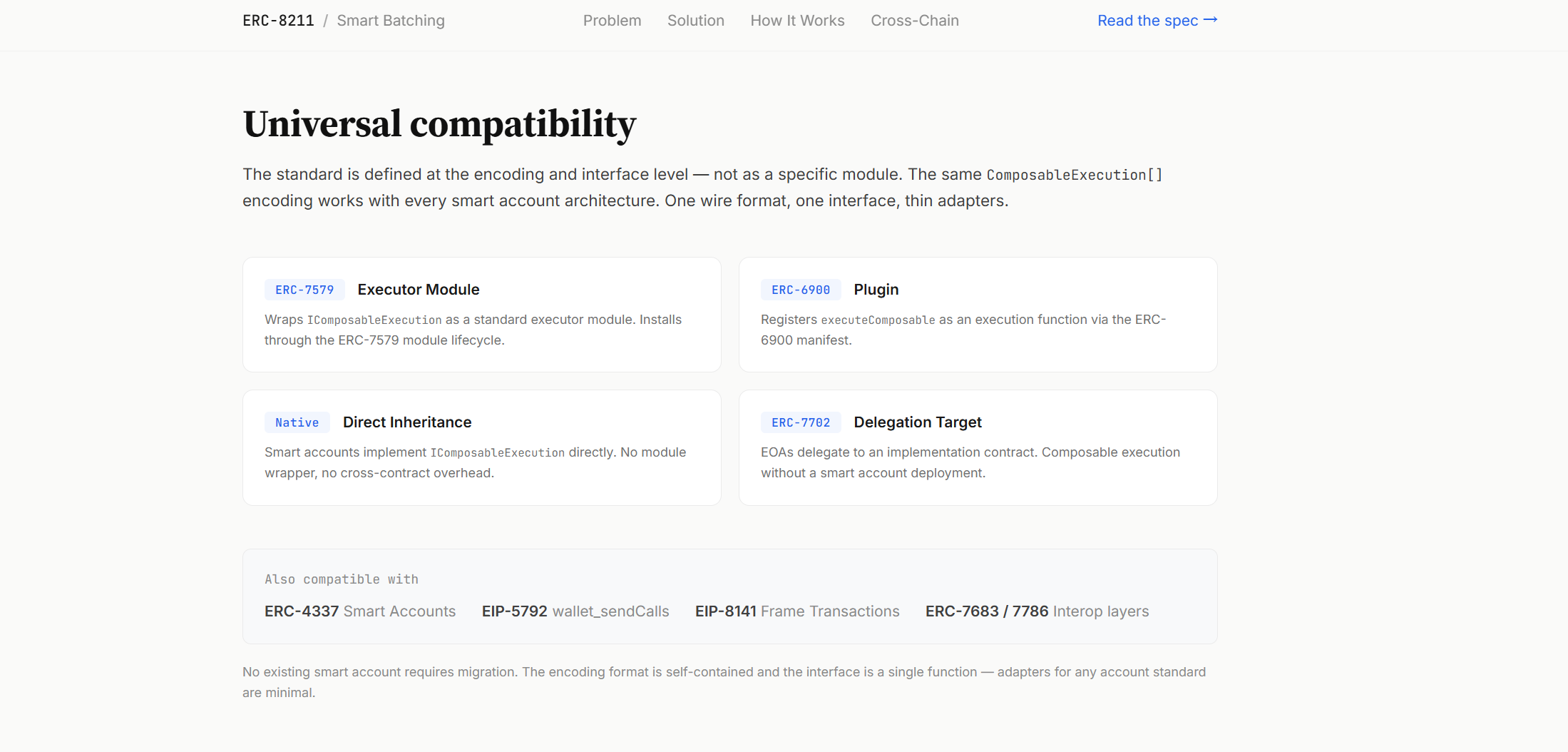
IF ERC-4337 SOLVES "WHO CAN START A DEAL ON MY BEHALF," EIP-7702 SOLVES "HOW DO YOU GET A SMART CONTRACT? "Once Agent started working for me, could it complete a whole decision chain in one signature。
Looking back at the evolution of the interactive paradigm on the 10-year chain:
- PHASE 1: ONE SIGNATURE = ONE FUNCTION CALL (EOA AGE)
- PHASE 2: ONE SIGNATURE = GROUP OF STATIC PACKAGE CALLS (ERC-4337, EIP-5792)
- PHASE III: ONE SIGNATURE = A DYNAMIC INTENT PROCEDURE (ERC-8211)
Each leap means that users (or Agents representing users) can express more complex objectives with less friction。
While ERC-8211 is still in the draft phase, technical discussions are still ongoing, and large-scale protocol access will take time, it is clear enough that when AI Agent really begins to make chain decisions, it needs a matching, original implementation syntax.
