
Cobie's latest interview: The encryption market is experiencing a "K-type divide"
THE K-TYPE DIVIDE, THE IMBALANCE IN WEALTH DISTRIBUTION AND THE ABSENCE OF A NEW NARRATIVE。
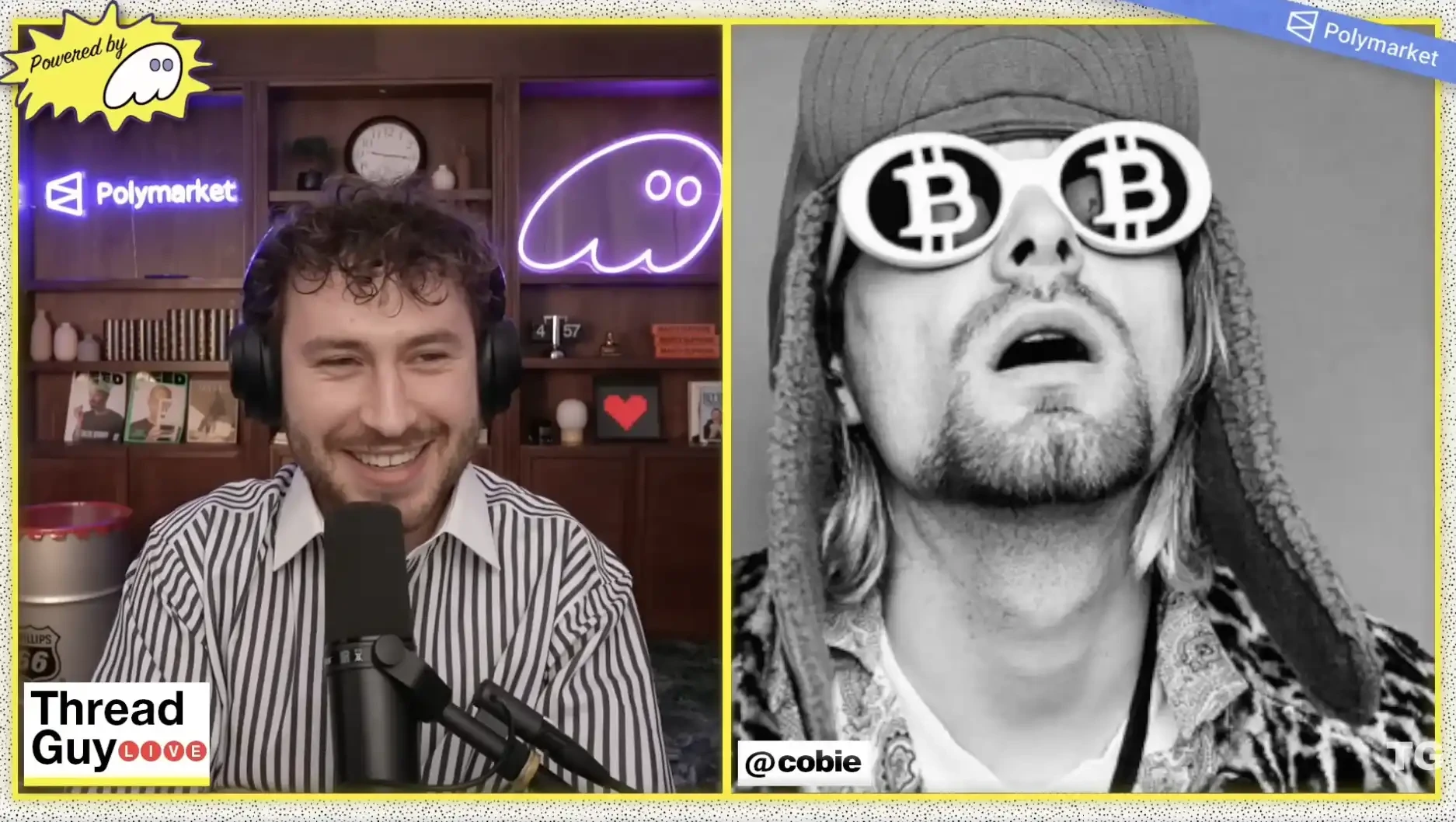
Video title: An Unfielded Conference with Cobie-Crypto, Markets, AI, Coinbase
Video by Thread Guy
Photo by Peggy Block Beats
This post is part of our special coverage of the World Summit on Sustainable Development。
Cobie (@cobie) is one of the representative market narratives in the encrypted community, co-chairing a well-known podcast, UpOnly. He is known for his understanding of the market cycle, his trading experience and his relatively restrained but penetrating style of expression, and has developed a stable opinion within the industry. The platform it created in 2025, Echo, was acquired by Coinbase。
Thread Guy is active in the encryption ecology of content-product intersections, operating a number of projects, including CounterpartyTV, Phantom and Polymarket, with dual roles for content creators and builders。
This conversation has received high community attention and has been evaluated on several occasions as a “long and long-term, long-term, long-standing interview”. The discussion did not stop at a case-by-case or short-term transaction judgement, but turned to a more fundamental issue: Why does the market still lack growth dynamics when the technological capabilities and systems of the encryption industry are expected to materialize? And, at this structural fault, how individuals can re-route themselves。
This conversation can be understood on three levels。
First, the fragmentation of structures. Cobie offers a full-blown judgment: the encryption industry is experiencing a clear "K-type divide". On the one hand, currency stabilization, forecasting markets, chain trading, etc. applications are entering the real economy, using a growing landscape and the size of users; on the other hand, token assets, in which ordinary investors can participate, are showing weak performance and falling demand。
This misapplication of "appliance in growth and asset failure" separates the fundamentals of the industry from the sense of the market and is a central source of current depression. For investors, the question is not whether there is progress, but whether it belongs to itself。
Secondly, there is the repetition of the path. Retrospect the expansion path of the encryption market over the last decade or so can see a highly consistent cycle: From altcoin in 2013, ICO in 2017 to DeFi and NFT in 2021 and, more recently, meme coin, each round of user influx depends on the same mechanism. The general population receives significant gains in a short period of time and thus spreads。
The narrative is constantly changing, but the driving force remains stable. In this perspective, the current rise of AI is not a competitive relationship with crypto, but more like an attachment to the same mechanism: a new technical narrative + lower threshold + imagination of "quick enrichment." The migration of capital and talent is essentially a natural flow of cycles rather than a failure of a single track。
Thirdly, there is the reconfiguration of distribution. More profound changes than cyclical and emotional fluctuations occur in value distribution structures. As companies such as OpenAI and SpaceX complete their large-scale accumulation of value in the private sector phase, it is becoming increasingly difficult for ordinary investors to participate in the real wealth creation process. Open markets are gradually declining to liquid exports rather than starting value. Against this background, the "open participation" narrative, which had been sent to Crypto, began to run the risk of being absorbed or even re-formed by the traditional system。
But at the same time, Cobie pointed out a potential path: Crypto may still be an institutional experiment to counter this trend if the air-dropping mechanism on the current chain is extended to a more general "user value feedback" approach, whereby users receive a distribution of interests in participating in and contributing to the growth of the product。
Beyond all the structural discussions, Cobie's conclusions are the most straightforward: If the long-term value of the industry is no longer believed, it should be left; if its importance within five to ten years is still appreciated, it should be configured on the basis of this judgement, rather than consumed by short-term fluctuations。
The encryption market was never a stable wealth generation system, but was closer to a series of repeated experiments. Each cycle of narratives and wave cycles is re-engineered in the way participants and proceeds are distributed. When the short-term path is no longer clear, the question is no longer what happens next, but whether you still believe that the system is worth participating at some point in the future。
The following is a summary of the discussions (the original text has been consolidated for ease of reading):
TL;DR
- at the moment, crypto is in a "misplaced state"。While truly valuable applications (stable currency, forecast markets, chain transactions) are developing rapidly, the inability of ordinary investors to access the corresponding income exposures has led to a deep depression。
- Every round of user influx in history comes essentially from the same mechanism — ordinary people making money in a short time。From 2013 attcoin, 2017 ICO, 2021 NFT to meme coin, the narrative is different, but the underlying logic is the same。
- THE MARKET HAS BECOME "K"-TYPEDon the one hand, applications and infrastructure are becoming more real and more important; on the other hand, the price of assets such as token, meme, currency of governance is weak and investors feel worse。
- The most neglected risk at this time isThe value of crypto can be “take over” and privatized in the traditional financial system, and ordinary people cannot participate in real wealth creation (e.g. OpenAI, SpaceX, etc.)。
- The counterintuitive iscrypto often acts best at the worstAND WHEN IT COMES TO ALL GOOD RETURNS (REGULATION, ETF, INSTITUTIONAL ENTRY), IT IS MORE LIKE A STAGED TOP。
- for individuals, if you no longer believe in the long-term value of crypto, you should leave rather than continue to consume yourself hereIf you believe that it's still important after 5-10 years, you should allocate assets in this judgement, not try to be rich in the short term。
- The true long-term success is not the most radical trader, but rather the one with independent judgement, continuous perception and “satisfaction”。
- crypto still has a potential long-term value:It could become a new distribution mechanism that allows users to generate value while at the same time receiving returns (similar to "the top-link equity/airborne economy " )。
- Final conclusions:crypto is not a short-term enrichment tool, but a cyclical and repetitive system experiment。As long as wealth and narrative can be created, people will return。
Interviews
Thread Guy:
Yo, what's up
Cobie:
I was actually a little mistaken. I was on Twitter and I thought you were driving Space, and I wanted to hear it. Turns out you're on live. I didn't know Twitter could play like this. I was like, "Oh, my God, I'm a 40-year-old who's watching Theread Guy live。
Thread Guy:
A lot of people are watching, not just you. Those rich people are watching. So how are you? You're quiet。
Cobie:
I'm not laughing. But it's okay. It's okay。
Thread Guy:
Everybody's asking UpOnly when you're coming back. What have you been doing
Note: UpOnly is an encrypted podcast co-chaired by Cobie and Ledger from 2020 to 2022. The programme, which was conducted mainly in the form of interviews, focused on market narratives, trading experiences and industry perspectives, was highly influential during the Bullsville period in 2021 and was seen as one of the important discussion platforms of the crypto community at that time。
Cobie:
Work, real work。
Thread Guy:
You mean, like at Coinbase's
Cobie:
To be honest, I am doing more work now than I have for a long time. I actually wanted to join Coinbase a couple of years ago, even on a zero pay basis, but they didn't want me. From my point of view, there are some things in this industry that can change the whole trajectory, and that's one of them, so I'd like to try。
And you think that I've been on Twitter for 10 years, and I have to do something more challenging and exciting than think about it every day。
Note: Cobie tried to join Coinbase in the early years, but after the platform he created in 2025, Echo was bought by Coinbase, he re-entered the core institution in a way that was “incorporated”。
Thread Guy:
I have a bunch of questions for you, but let's talk about the encryption market. It's not very interesting to tell the truth about Arbitrum, Aave, LayerZero and Drift's problems. What do you think of Crypto, especially DeFi? What's next
Cobie:
I think we're probably on the edge of DeFi 2.0。
One of the things that worries me most now is that some models like Anthropic (or AI) seem to be ready to start "participating" these systems. This makes DeFi a kind of "financial hunting grounds." But, on the other hand, once these models are distributed more widely, not only by the attackers, but also by those who build the system, the situation is completely different. So I think this is a turning point, and the future DeFi version is really exciting。
DeFi's emotions are really low, except for a few projects like Hyperliquid, Trade.xyz, which are basically not very interesting. But these examples themselves are very cool — really cool。
Thread Guy:
You're trading oil now, aren't you
Cobie:
You're trading oil? That's good. I'm happy for you。
Thread Guy:
Did you see that bear from my background
Cobie:
You're starting to set things up now. It's a little American。
Thread Guy:
Yeah, the crude oil deal。
Cobie:
So you moved to New York to be a oil dealer? This life path is interesting。
K-TYPE DIFFERENTIATION: APPLICATION IN GROWTH BUT ASSETS FAIL
Thread Guy:
You just said DeFi 2.0 and there's AI for these things, and now many people even think you're AI. But back to the point, why are you still interested in Coinbase? Aren't you being cynical about the future of crypto? Many people actually feel that way, including me — I'm trading in crude oil, looking at stocks and making traditional assets。
Cobie:
you're actually trading non-crypto assets with crypto infrastructure, right
I think there's a kind of "K" split happening now. On the one hand, there is an outbreak of "encryptic applications" and more successful than ever before, but these successes are not reflected in the prices of assets that ordinary investors can buy。
Polymarket, for example, has done a great job, predicting that the market has become a real track, and has now even developed a dual oligarchy of Kalshi and Polymarket; stabilization coins have really become widely used, like Doordash, to settle drivers with stabilization coins. These things actually happen in the real world and they are important。
But the problem is, as an investor, you can't buy these things. You can't buy Stripe's equity, it's still a private company; you can't buy Polymark; you can't buy these really good things. At the same time, the demand and attention of encrypted assets themselves is declining. So you find it frustrating, because you ask yourself, "What shall I buy?"
Actually, crypto is doing a lot of what it promised to do. Hyperliquid, Trade.xyz, various chain markets, for example, are very cool and can even predict the price of openings on Monday, with only dozens of basis points. It's already a "real market" and it's running on the chain。
but the problem is that there is a disconnect between market performance and real progress. meme coin doesn't go up, government token doesn't go up, so everyone thinks it's all bad. but it's just because you can't get the "open" for what's really good。
more macrowise, i'm looking at more crypto. if more and more capital enters the chain, then sooner or later another cycle of fanaticism, with excitement, bubbles and a bit of "dumb." but it's inevitable。
Thread Guy:
You sound optimistic now. It's a little out of line。
Cobie:
I've always been optimistic. To be honest, I've had a lot of pessimism in my life, but never really benefited from it。
MAYBE IF I WERE A LITTLE MORE PESSIMISTIC ABOUT THE FTX, IT WOULDN'T BE THAT BAD; MAYBE IF I WERE A LITTLE MORE PESSIMISTIC ABOUT THE NFTS IN 2021, I WOULDN'T BUY THEM。
Overall, pessimism has not made me more successful。
Thread Guy:
Well, let me ask you a more realistic concern. Bitcoin's performance is not as strong as its assets, such as gold. You should have discussed its value, its risk resistance, but now the market is only discussing how much bitcoin is held by Saylor and MicroStrategy。
Do you think this is a real risk
Cobie:
I wasn't worried until one day I went to the dentist. My dentist asked me, "Do you buy stocks?" I said, "I don't know much about investment." He said, "Have you heard of MicroStrategy?" And I was a little freaked out。
He was about 70 years old and said he only held two shares: 80 per cent was MicroStrategy; 20 per cent was Palantir. I was thinking, "Well, I might have to change the dentist."。
That's the first time I realized that this thing had broken the circle. Most of the people who used to care about MicroStrategy were crypto or Twitter. But now it's in the real world。
sometimes i even wonder if crypto doesn't exist, as if it's just a world i fantasize about. until that moment i realized, no, it was real and everyone else knew it。
Of course, it's possible that I'm even a dentist。
Thread Guy:
So now you're really worried about Saylor and his strategy
Cobie:
Nor can it be said to be particularly worried, but it does feel that it is beginning to turn into a "suspension." You used to think that Saylor was a buy-in, a profit; but now it's more like a guard。
But it's really price-oriented. When the price fell, people said, "Oh, it's Saylor in the bottom," and when the price went up, it became "Cow." Think about it, like, the last time, like, six months ago. The market mood was completely different。
i've always thought that the amazing thing about crypto is that you're going to be so real and you're going to feel "no other way." but three months ago, you'd find it completely opposite。
Personally, I feel that pessimism does not help me much, so I prefer to take a long time to look at the issue and be optimistic. Maybe I'm wrong, but at least that's what I've been doing。
Thread Guy:
Have you seen Saylor in reality
Cobie:
I taped the podcast with him for about two and a half hours. And my friend sent me a message before the tape, saying, "What do you want to talk about?" And I said, "Shall we ask -- is Bitcoin?" Then Saylor will speak for himself for three hours
That's what happened. We barely said anything. He was alone for hours. But it was fun. I tried to invite him to my New Year's party, but I didn't do it myself。
Thread Guy:
You're barely going out now
Cobie:
Honestly, I'm barely going out now. I might go if I did, but stay home most of the time。
Thread Guy:
Are you the kind of guy who's totally "endlined"
Cobie:
It's not completely, sometimes for a walk — just in your own garden. Mostly try to avoid meeting others。
Why is UpOnly Stop
Thread Guy:
Is that why UpOnly isn't coming back? People really want to know。
Cobie:
Did you know there's a word called "second album spell"? It's common for some bands to lose their first album, but the second one goes down. I think I'm in this state right now。
Every time I think about restarting podcasts, I wonder if I can be as interesting as I was before, what to talk about, who to invite, and many of the guests I've invited have gone to prison, and now I have to think about one more layer。
More importantly, UpOnly happened at a "best market" stage: People were trapped in their homes during the epidemic; bitcoin rose from $4000 to a little higher; the Etherwood rose from 80 to 4000, followed by NFT Cow. It was a period of great optimism and money for all. So you remember UpOnly very well, not just because of the show itself, but because it happens to be in the best days of the market。
And now, the market is colder, less emotional, more anxious and easier to attack each other. What is done in this environment is completely different. So I think it might be more appropriate to do it in a good time。
Thread Guy:
But you didn't do UpOnly, actually left a vacuum. Now nobody knows who to listen to。
I remember the day the FTX crashed, I was in Spaces, and everybody was asking you what you thought. You said, "This is bad," and the whole chat room was changing. So it's not just about the show itself, it's about you representing a "industry voice." Now you don't have it, you don't have it, you don't have it, and Hasu is doing something else, and it feels like a new phase。
Note: GCR (Gigantic Rebirth) is one of the most legendary anonymous traders in the encrypted market, active in the 2021-2022 cycle, known for its many precision judgements on top and macro turns. Its trading style is characterized by high-risk, highly subjective judgement and psychological competition, often leading market sentiment in the opposite direction through public statements, and is seen as a "top-level macro-trader" in crypto Twitter。
Hasu is a well-known researcher and strategic analyst in the encryption industry and has long been active in institutions such as Paradigm and Flashbots, with major areas of study including the Bitcoin economic model, market structure and MEV. It is well known for its rigorous and systematic writing and is one of the opinion leaders of a minority "academic/institutional analysis" in the encryption industry。
Cobie:
On the one hand, we're old. I don't really want to be the kind of guy who's been doing podcasts like Gary V。
Note: Gary V (Gary Vaynerchuk) is a prominent American entrepreneur and content creator, known for his high frequency output and his personal brand name, and has been involved in NFT and Web3 projects in recent years。
But more importantly, the environment has changed. You will read every word you say too much. This was not the case before, and now it's very stressful. For example, I sent a tweet of a funny nature, which resulted in a lot of people reading it very carefully and sending angry private letters。
But the reality is, if you go through all my tweets, about five percent is right, 95 percent is wrong. It's just that nobody used to be so emotional about these things. It's different now. Markets are harder to do, many people are losing money, income is more divided, overall emotions are worse, and people are more anxious and sensitive. In that case, you'll be less talkative。
Onboarding's Nature: Making ordinary people earn for a short time Money
Thread Guy:
By the way, I really think you could actually cut Jeff's issue and Shayne Coplan's issue out and redo it。
but i'd like to ask you a few questions about crypto's black pill。
Note: Jeff Dorman deals with early encrypted investment perspectives, and Shayne Coplan corresponds to a new generation of applications such as forecast markets, which are considered classic collections in UpOnly。
"black bill" was a concept in the internet culture, blue pill (blue pill) expressed a preference to believe in surface narratives, red pill (red pill) expressed a sense of reality, black pill (black pill) indicated a "insolvency / pessimism" conclusion after seeing reality
One of them is, when I started trading Top Shot and NFT in 20, 21, I thought that the Internet people who did the drop-shipping, fried shoes would flow to crypto. Because all the most gifted people at the time, the most exciting opportunities, the latest hottest games, were in crypto。
But now I'm thinking, in 2026, what happens when the most dynamic and talented generation of the younger generation is drawn back by crypto? Because now it feels like we've completely lost these new people. Now, whether it's a project or a product, it's like we're getting leftovers. Instead, many of the smartest and brightest people are going to go to AI, or they're going to go to the Fintech platform and do something that doesn't belong directly to crypto。
but in 2021, 2022, these people were supposed to come to crypto. do you think this will change? what do you think is going to happen to crypto to get the new talent back? what is it that brings new talent back to this business
Cobie:
i think, basically... you look back on a few major events in history. in 2013, there was a big round of quid pro quo, and for me, at least, it was the first time i was really involved. the first wave of large-scale altcoin, about a hundred. it's the first time i remember a real "alt season" that brought a new wave of capital and made a lot of people interested in these things for the first time。
Note: Onboarding = the node of a large-scale "new user entering the encrypted market"; Altcoin (alternative coin) refers to encrypted assets other than bitcoin, usually more volatile and narrative-driven, which are considered risk and speculative assets in the encrypted market。
And that's when you wanted to buy a banknote, if you had to hold a bitcoin first, because there was no stable coin, and the centralized exchange had a base deal. By 2017, it was the ICO season. You have to hold the Ether House in that round because it's the base trade. In 2021, you had DeFi Summer, and then the NFT wave. And then the meme coin version, probably from 2023 to now... It's probably almost over now, right
Thread Guy:
No, it's over。
Cobie:
Dude, I think it's over there in Melania。
Note: Melania coin refers to meme coin in the image or narrative of Melania Trump
Thread Guy:
That's almost the last kiss. Of course you can say it died in Ben Pasternak there, but I think the real end is Melanie. After all, you can't make a bigger meme coin than Trump, can you? That is clearly the end of this narrative and cannot go beyond it。
Note: Ben Pasternak, an entrepreneur who enters the encryption industry from the consumer Internet, is involved in individual branding and attention-driven experiments, which are often seen as a landmark node for meme coin narratives moving from an anonymous culture to “personalization”
Cobie:
right. sometimes i see some people before that set of things that are really deep all-in, super-sighting, especially believing in that set. as a result, they are now coming out to make market reviews and analyze something else. there's only one thought in my head: are you serious about this right now? are you telling the truth or are you just talking
Thread Guy:
I mean, I was excited for weeks。
Cobie:
yeah. but if you look back at all these moments onboarding, you find that they have one thing in common: that a lot of people make a lot of money in a very short time and that ordinary people can get involved。
I think it's a little like this now that AI's giving people a feeling. And you'll think, "I buy a Mac, I put on something, Claude, something, and then I run out of business, and I make a lot of money, like the machine automatically helps me make a deal." "Get money on a new financial/Internet hobby in amateur time," which is actually growing。
as for crypto, the next turning point, is it that it's been hit too hard? but i prefer to be optimistic: history repeats, and there is no reason not to。
And people are very creative. Some have invented DeFi food farm; some have created a variety of things that are so messy that they can really get up; then I will admit that others will invent new things in the future。
Note: "food farm" refers to the "food named food" profit farm project in DeFi in the summer of 2020
If someone really made a new thing, and you made a lot of money on it, then there'll be a big wave of chasers. Brands, emotions, market positioning, these things actually get very fast. A thing that is "unusual" today, "the public hates" and "all lies" may soon be wrapped up in "a little different new thing."。
My feelings about NFT are quite obvious. I had a lot of friends who bought ICO in 2017, and then I classified the whole crypto in my head as a hoax. In the end, they didn't deliver the flying car。
And as soon as the NFT came out, they said, "No, no, no, it's different. I'm collecting art. To them, in a way, this is something else. The "I won't touch crypto anymore" complaints were washed away by the purchase of Art Blocks and NFTs。
so i'd prefer a simple judgment: as long as people start making money and having fun, they'll come back and crypto will be cool again。
Thread Guy:
NFT was really special. I didn't go through 2017, but for me, for the first time, NFT really made me feel like there's a whole new bunch of depoyer -- whether you call them creators, artists, buyers, traders or whatever -- into crypto because of NFT. And I think the next time this happens, it's actually the 2024 wave of AI。
And of course it was a disaster that didn't last long, but there were three months in which a group of AI developers would seriously think, "If I put something on Solana, I'd probably earn a lot more than start my own business. The feeling went on for months。
And then, when Trump coin came to the end, I remember particularly: Trump coin came out the next day and I started live, and there were a lot of new viewers. You see now Twitch may be just 600 people, but a lot of people came that day. They didn't know what Phantom's wallet was, and they came in and said, "What is it?" They didn't know you, nor did they know me, nor did they know what had happened before. They only came in for the first time because they saw Trump coin on the line。
so i think every three years or so, there's a "crypto influx of new people."。
What do you think of the next one? Chained stocks, tokenized stocks, can you do that? Could Hyperliquid's contract last? The model of using high leverage on the chain as an asset, like Hyperliquid, Trade.xyz, will it be the next big story? Crypto, is there a new game that's being picked up or is already on its way
Cobie:
I particularly like Trade. xyz and Hyperliquid because they bring a whole new set of capital into the chain。
This is a group of people who may not have touched the chain before, but are now used to working on it. And once a large amount of capital is actually gathered in the chain and the volatility of traditional assets slowly descends, the money will naturally begin to look for new destinations. And that's often when food farm, DeFi, or something new comes out。
I don't think the people who invented DeFi, NFT, Wonderland, TEME would end up just buying a little tokenize。
but i still think it's cool because it can do a more important thing: bring people to the chain。
With more wealth on the chain, people begin to use block chains to do things that are slightly more relevant to the real economy than just to be in a self-directed, high leverage sandbox。
But honestly, I never guess what the next thing is。
If you told me in 2020 that the next big chance would be a picture of a monkey, I would say, "That sounds wrong."
if you told me in 2019 that the next thing would be food farm, i'd say, "this doesn't sound right."
if you told me in advance that there was fire, i'd say, "this doesn't sound right."
So I never knew what the next thing was。
my own mind model for this thing is more like, in crypto, you're going to isolate the risks and try something really new. not everything。
if you chase everything, you'll end up chasing a bunch of fork and falling into a lot of crap. but if there's one thing that's really new, instead of trying to figure out why it won't work, let's try it。
If that's what you did to Hyperliquid, you might end up becoming a millionaire because of airdrops. So is friend.tech. Monkey heads are like that wave。
Every time a new thing comes out, the first reaction of most people is: "It's stupid, it's pointless, it's impossible." But you really need to turn that line: What if it does? Isn't that cool? Should I buy something, try it, or use it
I'm basically doing it myself. Every time I see something strange, I try to see if it really is an important new direction。
Cobie:
AS FOR AI THAT SEASON BROTHER, IT'S LIKE GIVING THEM MEDALS THAT DON'T BELONG TO THEM TO SAY THEY'RE DEVELOPERS。
Thread Guy:
There are still a couple of real people。
Cobie:
Maybe。
Thread Guy:
True, Ruth Terminal was interesting
Note: Truth Terminal is a pilot project combining AI anent with encrypted narratives, participating in market discussions by automatically generating content, and is considered a short-term attempt to merge AI with crypto in 2024。
Cobie:
Can't。
Thread Guy:
Don't you want to admit it? Goat was cool。
Cobie:
Ugh, man..
Thread Guy:
well, i have one last negative question about crypto. it's not negative, it's the kind of "black pill" problem with crypto. i'm not going to say that word after this. i have something else to ask you. and that's it: if you came in 2021 like me, you'd find that almost all the crypto lydos that you could have imagined were actually in effect。
Trump stood up on the stage and shouted that the United States was going to buy the rest of the bitcoin; there was a strategic bitcoin reserve; Gensler left; there was the GENIUS bill, and hopefully a clearer regulatory framework soon; there were ETFs; there were institutions to buy and there were bulk purchases; and almost all major technology companies were talking about chaining stock and asset monetization。
it's like, with the exception of speculation, all the elements that you can think of as many crypto are now almost at the same time. and ironically, for crypto, the missing part is speculation。
So in the end, you can't help but wonder, would crypto, from the beginning to the end, be just a tradfi tool to put your assets in the chain? Only bitcoin is really important, and everything else that we have created later — Yamayaco, meme, NFT, DeFi, and all these experiments in the middle — is in fact a total failure。
The world will continue to move on, except that it will not take these. Projects like Tempo, and other similar "wall gardens", which will be chained to their own terms; and we end up with only these remnants. Is that what you'll think
Cobie:
THIS IS ACTUALLY THE "K-TYPE DIVIDE" I JUST MENTIONED。
We built all these technologies, first a self-cycled, highly leveraged sandbox; the regulators spent 10 years trying to kill it; and suddenly, these things became "admissible" and "cool." Then the big companies came in and took away all their value, essentially to privatize it。
i think it's a real risk, and it's already happening in part. at the same time, crypto's original batch of stuff, which has been going through a tough couple of years. in order to pursue income, they have started to take on more risks。
but there's a counterintuitive: when all conditions are perfect, it's like a good exit point. for example, if you have $10 billion in bitcoin in your hand, and you've been taking it for years. and now there's a president who supports crypto, and all the conditions that you just said seem perfect for this asset。
And the anti-intuitive idea would be: is it better to start here? Should it be sold now
it seems to me that when crypto has always been the best, it's when people ask, "can it be worse?" "this is so bad. how can it be worse?"
Thread Guy:
It's the kind of time when it's bad enough。
Cobie:
right. crypto is often the best performer in difficult times. because at that point, people's inner faith would be stronger, and they'd think, "this is a great opportunity. then people start trading "good days" in advance。
But when the good days come, you'll agree that prices should go straight up. But the new buyer may not really feel that way, but the old owner will start thinking, "Is it possible that it would be better?"
in my head, crypto actually needs a clearer "anti-winding environment." a clearer opposite is needed. for example, the stronger the crypto army, the better it is to bring us together. people are more optimistic when faced with bad luck and despair。
But in the end, I don't know. Many may think that I would draw some kind of world view conclusion based on a particularly advanced analytical framework. But reality is easier -- I just think it's cool。
I feel good now. I'm happy and optimistic about the future. So I'll keep watching more. I've been on top since 2012。
Thread Guy:
YOU ALWAYS MENTION THIS K-TYPE SPLIT. WHAT IF IT'S YOUNG PEOPLE
I have recently come up with an article about the capitalist state of the late American Empire: the most powerful in their hands are rushing toward that "broadhorn" to extract as much value as possible before all is over。
You'll see the Trump family's meme coin; Donald Trump Jr. bought a drone company before the war; Pete Hegseth investigated defense-related issues before the war; and then there's a bunch of companies that can be privately owned as long as they can. By the time SpaceX was on the market, the valuation could have been 1.5 trillion dollars; and, like Evan Spiegel, the Snap stock price had dropped by 99 per cent, and he still had $20 billion in his own pocket, depending on continuous dilution。
ALL OF US HAVE THE SAME FEELING: YOU HAVE TO GET TO THE TOP -- NOT JUST THE TOP 20 PER CENT, BUT THE FRONT 0.1 PER CENT -- AS FAST AS YOU CAN, AS MUCH AS YOU CAN, AND THEN GO. WHAT ABOUT YOUNG PEOPLE IN THIS K-SHAPED WORLD
Cobie:
Now the coolest thing in the world is that you can start a business on your own and possibly make a very amazing result within six months. It's getting more common now。
Of course, an example like OpenClaw is the most exaggerating: a person could get billions of dollars in a month. For those who are creative, who can carry things, the constraints of the past are often: you have to form a team; you don't know the right people; you need capital to feed those people; you're not born in Silicon Valley。
But it's different now. I would say that a huge "equal opportunity machine" has emerged. Everyone now has an additional opportunity to do what was previously impossible。
I THINK IN THE NEXT FEW YEARS THERE'S GONNA BE A WAVE OF YOUNG PEOPLE DOING AI-DRIVEN COMPANIES, AND THESE COMPANIES ARE REALLY GOING TO MAKE A LOT OF MONEY. I EVEN FEEL THAT THE NUMBER OF UNICORNS BORN IN ONE YEAR MAY BE GREATER IN THE COMING YEARS THAN IN ANY PERIOD OF HISTORY。
This has changed the economics of being an early employee. Used to be an early employee, kind of like a scam. Because you take the risk of being close to the founder's rank, but the return may be only one in 20, or even one in 50。
but now, companies need fewer people, burn less money, dilute less, and exit faster. so if you're a founding employee, or a very early employee, that risk gain is much more cost-effective. because you'll know more quickly if this company will succeed. if i were your age-- how old are you now
Thread Guy:
Twenty-four。
Cobie:
Almost。
If I were your age, I'd probably do one of two things: either I'd do something myself or with a few friends. Those things that used to take between 10 and 20 people to do, three might be enough now. Either that or I'll go to the smartest guy I know, and then I'll do whatever it takes to join his company, whatever role it takes。
i would say, "i can do anything. i almost said "fluffer," and i'm actually saying "fixer." anyway, it's kind of like, let me help you get things done and let the company work。
I think I'll do one of these two things。
as for financial markets, i used to think that crypto would be more and more like a market; but now, in turn, traditional markets are more and more like crypto markets. now it's all crazy。
So I think there are a lot of inefficiencies in the market, and there are plenty of opportunities for people who are willing to think and think。
The evolution of traditional markets: everything began to be traded like Crystal
Thread Guy:
well, i'd like to give you a little guidance, because one of my favorite topics is that everything starts to be a crypto deal. and you can see that now, right
the way oil prices went during this war, for example, and the way silver and gold were traded a few months ago, is really becoming more like crypto. plus the "cut-in-the-gold" influence that trump now has, one word can shake the market back and forth: there's bad news after friday closing, good news two minutes before opening, and another bad news just after the market closed. some of these days have been marked by a 700 per cent increase in the stock, and the empty head has been squeezed particularly hard. it feels like almost everything is increasingly traded like crypto。
How do you understand the evolution of the market from the moment you started trading to the present
Cobie:
To be honest, I'll try to stay away from these markets. I always felt like a fish in that market -- and the stupidest money on the table. So unless it's a long-term configuration, I don't usually touch it. For example, I bought a lot of gold years ago。
I've been asked in previous years what the five largest warehouses besides crypto are. I remember gold, Palantir, and so on. In short, if it were a long-term configuration, I would be more confident in my own asset allocation judgement。
But once these things start trading like crazy, I try not to touch them. Like the Trump coin -- oh no, you were there。
Thread Guy:
Dude, do you want to say that in front of a thousand people
Cobie:
I was wrong. Are you crazy
Thread Guy:
If that's true, you should have seen the video. People who haven't seen it should really look at it。
Cobie:
I'm kidding. But imagine, if you're just an ordinary person, you see Libra one day in a dentist's clinic, and you think, "Wow, Libra's up, I should buy a little." And then it fell down, and you'd just ask yourself, "What happened?"
To be honest, that's what I feel in traditional markets. I'm like the one who bought Libra and couldn't figure out what was going on. So if it's a trade, I hardly touch those markets。
I think every market actually has its own character, and I'm more familiar with bitcoin. That sounds a little weird, but I think I know how bitcoin moves and how it reacts in what circumstances. But once you see a new market, you have no idea what its character is. And it's going to do something extraordinary, and you're going to think, "Well, I might not be able to play this."
SO I PREFER TO STAY IN WHAT I KNOW. IF I REALLY WANT FOMO TO TOUCH SOMETHING ELSE, I'LL LIMIT THE RISK VERY LITTLE。
Essentially, I'm going to open a very small warehouse, so I don't have to rush. As for those who are truly full-time, in-depth participants -- the groups you know know know better than me, or at least I'm like I did 10 years ago. I think this environment should be quite profitable for them now。
But what I think most of all is the kind of "treachery" in the private market. I really feel that companies like SpaceX, Anthropic, OpenAI, which have gone from zero to $1 trillion, or even trillions of dollars, and ordinary people simply can't share in the creation of this kind of wealth, which is a terrible thing。
This kind of nepotism, the old friends' club model, is that the proceeds are privatized to the little group of Silicon Valley, or that as long as you're in that circle, you're entitled to throw these things; you're not in that circle. The loss, the cost, is socialized for everyone else。
The open market is becoming more and more like a "last switch for liquidity" and it's more and more like a crypto. The same thing has happened before: the VC round raised the valuation, the project just closed to $100 million, and two days later token went online and was valued directly at $16 billion. So it feels that some social commitment has been broken。
What you believe is that you work hard and earn money at work, and then you can invest that money in companies that generate wealth and share the rewards of their growth. But now this is not happening。
If you were in the 1970s, assuming you thought apples were a cool company, you could buy apple shares. If you're right and you're smart, you can share the wealth of apples。
And now? You might have to go on a platform, buy an Anthropic derivative position, and that doesn't even really work to the bottom; or you can make some sort of permanent contract slot on eventuals。
In short, it is very difficult for ordinary people to access the wealth that is really being created. And you're looking at three more "generational" companies. In a sense, it's almost $5 trillion worth, and it's been privatized。
And I think that things like this tend to lead to social revolutions. Almost every period of history has been the same: first, a period of peace; then the elite began to disengage from the general public; then society began to destabilize; and then the masses overthrowed the elite — either by eating it or by hanging it up, which is probably the story。
So I often think about it, especially when looking at private markets. Because it looks almost like a complete betrayal of the capitalist system itself. It's become "capitalism works for you only if you're friends with those people in Silicon Valley."。
Of course, if I were a friend of those Silicon Valley guys, I'd love to. So don't get me wrong. I'm not saying I'm gonna eat you. I won't talk about this right now if you can put some project shares on me. We can make a deal。
Thread Guy:
Deal. What if you're an ordinary person and you're trading in a mobile market
Cobie:
If I'm ordinary? I don't know。
Thread Guy:
For example, those who are listening now will think, "Cobie, please, tell me what to do. For the vast majority of those who do not have a share of the Anthropic A, they can only trade in the mobile market。
But the environment is now: the best thing can be privately owned until it can't be delayed; when ordinary people can touch it, it's probably 1.5 trillion dollars, and it can only be leveraged。
What would you do in the market? You're not playing? Do you want to do something else or do something about it
Cobie:
I'm probably just not playing. Yeah, I didn't get my early share of Anthropic, so I guess I wouldn't。
The hard part about this is, Anthropic this kind of company is really special. They almost define an entirely new way of working, and the way in which companies operate today is completely fragmented。
So in a sense, you could look back 50 years later and say, "Oh, my God, you didn't buy it when it was only $1 trillion? Isn't that the same thing you didn't buy God? What were you thinking?"
Looking back at it, it may be particularly absurd. And your answer may have been nothing but: because I was buying Terminal Token. Ah, I thought the hat dog would come back, so I put the money there
So, yes, Anthropic is the kind of thing that makes me think, "Maybe I should buy a little before I really want to buy a warehouse."
Thread Guy:
WHAT ABOUT THE "SOCIAL CONSEQUENCES"? DO YOU THINK PEOPLE AT THE BOTTOM OF THE K-SHAPED DIVIDE REALLY COULD TRIGGER SOME KIND OF SOCIAL REVOLUTION? THE ANSWER WAS PRETTY STRONG。
Cobie:
I mean, this has happened repeatedly in history. First, there is a period of peace; then, because of the gap between rich and poor, societies begin to destabilize; then the elite is overthrown. This cycle is repeated。
So it happens again, and it seems to me almost inevitable. The only uncertainty is: how much longer。
AND IN MY OPINION, AI'S PRESENCE IS NOT SLOWING THE PROCESS, IT'S LIKE ACCELERATING IT。
OF COURSE, YOU CAN ARGUE THE OTHER WAY AROUND. YOU CAN SAY THAT AI WILL BRING A TIME WHEN EVERYONE IS MORE EQUAL; YOU CAN SAY THAT AI WILL ONLY MAKE THE SLANT OF K MORE STEEP AND EXAGGERATED. IT TURNS INTO AN ELITE AND A BOTTOM CLASS。
but what's interesting is that there's actually a vortex crypto logic in it. because the way we're doing airdrops is kind of ridiculous: you pretend you want to use a product you don't really want to use, just to get some token later and sell it. you don't really look at it much and you don't really want to use it. it's just that everybody pretends they're good at it, and then they wait for token。
And, of course, sometimes there's something like Hyperliquid: people really look good, so get token and don't want to sell. It would be interesting if you pushed this model outside of the real world to start-ups。
You imagine a world in which the value is actually created by the user, and that value will eventually flow back to the user。
In the early days of Facebook, for example, if you're an early user, you actually create a lot of value for Facebook: you help it start cold; you give feedback on its products; you bring early dissemination and growth to your social network, you're valuable to Facebook, but you end up getting the "use of Facebook itself," nothing else。
i can only imagine a world that is more like today's crypto airdrop logic, but that is applied to more real-life companies' business of entrepreneurship and consumption。
This means that the value created by the user is given back to the user in some form when the company is listed. In a sense, this can even be seen as a response from capitalism to “basic income for all”. You use the product, you're a heavy user, you get a part of the value return. In other words, as long as you are involved in economic activity, the value goes back to the participants themselves。
it's an interesting crypto lydo narrative. because crypto is really good for this and global. of course, this will require a very brave company to really push it。
Thread Guy:
What's that threshold? How can this really happen
Cobie:
Yeah, that's what I think: Do you think if Hyperliquid hadn't made the airdrops, there would have been anything like this today
Thread Guy:
I mean, maybe, after all, it's actually too strong. But I think that one of the key effects of airdrops is that you're going to have a lot of preachers, and these are the top traders, the ones who bring the most money, and they're going to endorse your product. So, strictly speaking, without airdrops, at least not today。
Cobie:
I mean, of course this is not going to give a definitive answer. After all, the product itself is really good, and they really do do good. But at the same time, many of these "people's foundations", supporters, loyalty, and, I think, from this design of shared ownership, shared access to space。
So in my mind, Hyperliquid is almost a true flagship success story in airdrop mode. Because before that, I can't even think about it。
So you're going to think about what's going to happen to the next business that can do something like that? In other words, its outcome has to rely to some extent on an air drop or, in the case of traditional companies, on some kind of distribution of equity. Without such a step, it might not have grown at all。
I don't know, but it's really worth thinking about. Why didn't we do that
i can think of five reasons immediately. first of all, once you send token, token's equivalent income model is usually very jumpy, very weird, and it's not necessarily right for you token. and for example, do you want to be a "token founder"? such issues need to be taken seriously。
We actually thought about doing IPO on a chain. In other words, instead of dropping token, real equity is placed on the chain and distributed in a similar manner. These possibilities have been seriously considered. It's just that the company was probably not mature enough to actually implement these things。
Mergers then come earlier than expected. And from what the company was at, that was actually a good result. So I'm also thinking, if I start a business again later, would I seriously consider this pattern from Day 1
Of course, I may be too old to start a business. I'm over 30 now, and I don't know if I have a fire like that in me. I think that power sometimes goes out and comes back。
But if I did do it again, I'd really like to think: Should I take this as part of the plan from day one? And what kind of business is it
and i think it probably won't be a crypto project. it's strange because the coin holding structure and game dynamics of crypto are so strange. for me, this model is better suited to a non-crypto consumer business。
But at the same time, when you really run a company, you're just thinking about how to get your income up, how to get your money down, how to get the user to be more satisfied. These big architecture designs, in many cases, look like giant jamming objects。
Cobie, legend Buy Wall
Thread Guy:
well, the question is completely off the hook, but since you're here, i've always wanted to ask. can you tell the story behind that big wall tweet? i've been really curious to know, as long as you can. that happened before i went into circles. can you tell the whole story again
Note: Buy Wall took place in March 2020 (near the outbreak crash/ "312 Crash" ), when the market collapsed (BTC fast down), Cobie judged it close to the bottom, hung a big buy, then sent a tweet (high, emotional) and went to bed. As a result, the market was almost at the bottom, and the price rebounded quickly
Cobie:
You mean the Covid buy wall
Thread Guy:
Yes, that's it. Please, tell the whole story. Start at the beginning — what were you doing, what was your estimated net asset, what was the whole process. I really want to know。
Every time I meet an OG in a crypto circle, I ask this story, and everyone tells it differently。
Cobie:
To be honest, the reality version is not so divine, it's not as cool as the one you've built up. But I'll tell you what, but the version you imagined, it's more handsome。
Thread Guy:
All right, tell me, please。
Cobie:
I was at home in London. The market went down that day, and I was in full-time trading, so I had a lot of price alerts, and as soon as the market went down, I woke up。
I remember that day around 1:00, the alarm woke me up. I went downstairs to make a cup of tea and went back to bed to watch the disc. Looks like a huge red line that fell right outside the screen. My first reaction was: it looked like a bottom. So I hung up a bill, about 2-3 percent below the current price, about $4,600。
how big is the list? it's basically all i had at the time. in other words, almost all of my money in crypto. not all of my net assets, but basically all the funds held in united states dollars in my chain at the time. i'll just hang this money into a wall and go back to bed。
When I woke up the next day, it was about 5%. The price never returned to my position. I was thinking, "It's over, I missed the whole bottom." I hung up and went to bed, and the next day I woke up and the price was already 50%; in two days, it was almost 60%。
But I didn't even get a deal for that. And I'm about 80% of the deal, and the rest of it I'm gonna have to go after, buy it directly. It doesn't matter anymore。
Thread Guy:
When was that tweet sent
Cobie:
I'm gonna go to bed. That list started within minutes of my push, but I'm not even awake. I remember myself lying down half-slept, looking at a cell phone once in a while, sending one more. It's basically just getting lost。
BUT EVERY TIME A SINGLE K LINE FALLS 50%, 60%, I'M REALLY EXCITED. I'LL BE VERY EXCITED AT ONCE. BECAUSE, IN MY OPINION, IT'S NOT A REAL SALE. NO ONE SITS THERE AND SAYS, "OKAY, I'M GOING TO SELL IT." THEY WERE FORCED TO SELL YOU。
In other words, you have a very rare opportunity: You're buying from someone who doesn't even want to sell it, but he was forced to sell it to you。
So I was particularly excited, and that's probably why the tweet was all capital letters. And I have relatively high confidence in that position, and I think it's probably the bottom of the macro-cycle. Even if it falls back, I think it's a good deal。
So, basically, I pushed in five minutes near the exact low point of the market. And my bill, theoretically, is almost at the bottom. But you're always going to devolve it. It's really just luck. I didn't have much at the time, and my net assets weren't very high。
so it's not the kind of story you think "a super-buyer saved the market." it was just all the money i had on the chain, and i didn't even have a deal. so, in my opinion, it's not as if there's aura, even a little reverse。
Cobie:
By the way, I don't think the word "aura" anymore. Because when people of my age, my type of friend, have learned to say "aura" naturally — that means it's gone completely overboard. I'm using that word right now, even checking Urban Dictionary to make sure I'm not wrong. But once this stage is reached, it means it's over. So we can't say that word again。
Thread Guy:
Okay, then I'll update you on a new set of words。
Cobie:
My client is still talking about falling。
Thread Guy:
I've been thinking about a problem: a lot of the first people in the crypto Twitter group are not really here anymore, right? Like you're still here, but it's not that bad; the GCRs aren't so bad; a lot of that generation either disappears or doesn't speak or is later exposed to fraud. So a lot of OG crypto twitter stuff seems to be gone. It's not written in history, it's not made into a documentary, it's not a play. A lot of early things just disappeared。
It's actually kind of weird. I know I'm late, but I'd think if I came in 2020 -- when I was 19. For me, crypto Twitter is like giving me an education. So I've always had a little feeling about it。
So who do you think is the greatest crypto dealer ever? I'm talking about the kind of crypto Twitter that's born, not yourself, but you think it's the best. Or, in the fifth place, who do you think was the strongest dealer in the crypto circle
Cobie:
I think it's kind of like what I said about the album -- everybody has their own season. It's like a play, the third season is special, but the fourth season suddenly sucks. I think Su Zhu's peak is probably 2020, 2021. That guy really sold it at the top. The result was that it was too early to know why and it was too early to buy it back and then it went down to liquidation. So you're gonna feel ... Ugh。
The GCR, of course, also counts, and the GCR could be like some kind of intelligent biological asset. He's good at psychological warfare. In many cases, he will deliberately say something that is not true, because he hopes that some rumours about himself will come out so that he can see something else. I don't know. I wouldn't be surprised if I finally found out he was a CIA, or a former CIA, where he was shitpost doing this。
THERE ARE PARTICULARLY MANY RUMOURS ABOUT THE GCR. AND A LOT OF DESTRUCTIVE RUMOURS, WHICH HE DID ON HIS OWN WILL, WERE TO LEAVE HIM ALONE OR MAKE HIM FEEL LESS COOL。
Thread Guy:
Really
Cobie:
He's really weird。
Thread Guy:
Are there specific examples
Cobie:
Yes。
For example, on one occasion, he deliberately told me he was using Binance's internal information. Because then, there was a group of people in the circle that focused on the exchange. If you have some kind of access to information, you certainly don't want anyone else to know, or someone else will rob with you and your Alpha will be compressed. For example, you found information that an API revealed that an asset might be on the exchange in advance. If people know you found this path, they'll look for the same hole, and then you'll have more competitors。
So he'll say he's on the inside. Instead, the competitors would not follow the information path that he really used。
And in fact, he's probably just staring at the details on one of the exchange's pages, seeing a number change, and then deduced that another asset was on the shelf, and then pulled API to see what it was. But he made it look like he had an insider to protect his Alpha。
And now everyone's talking behind him about ByteDance inside. But he doesn't care。
So if you ask me, 2021, 2022 is the strongest, I'll definitely say GCR. There's another person named Advice BTC. He's the kind of guy who makes a lot of money and then blows it up. He died in 2020。
Thread Guy:
JESUS. RIP。
Cobie:
Yeah, it's really RIP. In fact, many of the people I'm talking about have this in common: they dare to take the risks I can't take. I admire this kind of person. But they tend to explode。
So I sometimes think, "Well, maybe it's not bad for me to be a little more conservative, a little more boring."。
I think Light is actually more active in crypto now than ever. And according to what I know, 2025 might still be the best year for him. So I'll put Light in a very forward line. There are other people who don't actually have a "personal face" or a public image. And I think that "there's a persona" is a kind of reverse choice。
Thread Guy:
What about DegenSpartan? A lot of people worship him。
Cobie:
Everyone thought it was me. And once I took a picture of my hat and sent it to him to help me, because people used to joke about it, saying we were the same person. But he came out himself。
Thread Guy:
He's kind of stable since he came out。
Cobie:
I don't really overlap with DegenSpartan. I didn't really know him until about 2021. And I wasn't in the ring where he was. So to be honest, I don't know exactly what he did。
There are other people who sometimes think he's smart and scary, but sometimes you wonder: Is this the biggest fool on Earth? I really can't tell. Is he doing this on purpose or is he really doing this? Because he does the smartest thing you've ever seen in your life, and the next second makes you completely suspicious of life。
And Shoku of Trade.xyz, I think he's the kind of "generational" genius. He has done a number of very different things at the same time. I'm actually gonna be sick of this kind of guy -- that kind of polymasth。
Thread Guy:
I don't even know what that word means。
Cobie:
It's the kind of person who's "general." It can be multilingual, it can do a lot of different things and it can all be at a particularly high level. And I'm gonna think, man, I'm not even going to be able to do one or two things。
So someone like Shoku really bothers me because he seems to be better than me in everything. Of course, it's not really that annoying。
Thread Guy:
so what do these people really do -- let's say crypto traders -- do they have anything in common? perhaps not the last ones to blow up, but those who actually earn and hold. what do they have in common? how the hell do you make $100 million in crypto
Cobie:
And I think the most common thing about them is that they are all very self-excited and have a strong sense. They're not the kind of guy who brushes crypto Twitter and thinks, "That's what people say, so what do I do?" They all have their own judgment and are active thinkers。
They'll start with the principle of first sex and think about how this will affect the market. Why? Then they write down their judgment and look back at the final result。
LIKE TRAINING AI, YOU HAVE TO KEEP ADDING TRAINING DATA TO YOURSELF TO FIGURE OUT WHAT I DID RIGHT, WHAT I DID WRONG, WHY. THEN WE'LL DO IT NEXT TIME。
The strongest of these people have this closed circle: they're curious, creative, think about the first principle, and they're constantly upgrading their own mental models of the world。
as for those who eventually burst, the question is usually simple: they take too many risks. and those who earn and hold on to it, it's kind of like i think i might have preferred it myself. i'm a little timid. when i'm really "risk-on" in my life, it's like four or five times. and i've been out of leverage for half a decade or so。
I think those who earn and hold usually have one thing in common: They will be satisfied with what they already have。
in crypto, in financial markets, a situation can easily arise: you are already a millionaire, or a millionaire, or at least six-digit asset, but you still feel, "i'm poor, i'm poor." the reason is that there are more people next to you。
I remember 2021 was obvious. Like Three Arrows, they were basically 2019, 2020 or so. And I've been doing crypto since 2012. In just one year, their net assets threw me away; in a few days, it might be 15 times the difference, 100 times the difference。
I couldn't help but wonder, "Are I a fool?" Not smart enough? Not operational enough?" And then you start to have that jealous, comparative mentality. It was the best year of my financial life, but all I thought was, "Why do people earn more than me?"
I think this mentality is very toxic. And I'm glad I got out of that situation。
You have to learn to be grateful for what you already have, not to take excessive risks by chasing the "place where others are" you imagine, or the "if I'm doing everything right, I'm supposed to be."。
And you can't always use your "imagining net asset history high" as a benchmark. For example, if I could make 80% this year, that would be an excellent result. Even if you make 20 percent of your annual steady, that's the best investor in history. So, if someone earns 50 times more a year and is unhappy, it's ridiculous to me。
And most of the people I know who actually earn and hold are usually simply satisfied with what they already have and happy that they can have it。
Thread Guy:
Do you think you're thinking about becoming Cobie on the Internet? Do you regret being at this level, Cobie? Because I'd think that if I'd been recognized on the street, if you'd been on the streets of New York, you'd be quite easily recognized。
And as you just said, you are not ready to make your own ideas now, because it has a lot of second- and third-tier implications — it changes people's judgment and even influences their financial decisions, which are not the result of what you really want to do when you make a joke or when you say things。
So you'll regret becoming Cobie
Cobie:
Actually not. Because a lot of things in my life now are because I started that stupid Twitter account. So if I went to regret it, it would be very ungrateful。
But sometimes I regret being a podcast. To be honest, I don't think it's necessary for me, and I'm not sure what it's brought me. A lot of times I'd think that that thing was more downright for me. There were, for example, a lot of strange people, even a few of them a little bit like stalkers, running to my old house。
You asked me why I was doing it? The epidemic, man. I stayed at home bored all day. I had nothing to do. And there were no good podcasts at the time, and everyone had to listen to Banks。
Cobie:
But you're probably better recognized than I am because your face and hair are weird。
Thread Guy:
That's why you let me start the Discord video, right? I don't know why you have to do that. I think you just want to see what I look like。
Cobie:
Right. Do you know what Shrek was like when Shrek was human? You're kind of like that, so you might think, "I seem to have seen this man somewhere," and suddenly you think, "Oh, yes, he's kind of like that," and in reality I've been recognized three or four times. It doesn't happen very often。
Of course, I didn't go out much, and I spent a lot of time in some countries where no one looked at UpOnly. And I cut my hair, so now I'm barely recognized. Yeah, I've cut it all。
Thread Guy:
Wow, congratulations. It's a big life decision. It's not easy。
Cobie:
Time to grow up. It's time to grow up, time to cut it all. But I've had my luck since I finished. And every time I open a warehouse, I turn in the opposite direction, and every time I try, I get hit in the face. Feels like something disappeared with the hair。
Thread Guy:
That really looks like an era is over. I understand why you feel that way。
Cobie:
But now no one knows what I look like。
and then a little bit more face and look atsmaxing, that's even more thorough。
Thread Guy:
Is this Coinbase's request? Can't you have a beard or something
Cobie:
Look at Brian and you'll know. You basically have to become Brian's clone. So if Brian wants to step back, there's a new Brian who can go right in. No, I'm kidding. I'm kidding。
Note: Refers to Coinbase CEO Brian Armstrong
But seriously, I don't regret becoming Cobie. Sometimes you regret something you've written or sent. When I was your age, I thought I'd regret more than you. But you look much older than I was 24, 25 years old。
Thread Guy:
What were you doing when you were 24
Cobie:
Do drugs, I don't know。
Thread Guy:
A lot
Cobie:
right. i wasn't very good at it. that was about seven years ago, about 12 years ago. almost when i first got into crypto, maybe even earlier, maybe i was wandering around about 22. anyway, i was a little out of my mind, doing a bunch of startup, doing some shit, but i didn't really know what i wanted to do or why。
and crypto was so attractive to me because it was like a fun financial hobby. it makes me feel like a game, and i can go on and learn to be good at it. it's kind of like putting my mind around something that i really find interesting。
I'm sure I wasn't like you at the time: in a New York apartment with a shirt, a professional camera, a bucket of oil on the table, and the sponsorship of Polymarket and Phantom。
Thread Guy:
This shirt is new, by the way. I'm still working on this thing。
Cobie:
You look a little bit like an aunt in an American school canteen。
Thread Guy:
just the kind in cafeteria
Cobie:
Yeah, what do you call that
Thread Guy:
i don't know, maybe just lunch lady。
Cobie:
Yeah, you're feeling that now。
Thread Guy:
Okay. Let me ask you this: What is the first time you buy more than $5,000, assuming you're back in 2014, 2016, or whatever year, after you earn money? What's your first real big consumption
Cobie:
Honestly, I don't usually buy much. You're asking the wrong person, and I'm really bored about it. I used to go with a wave of Mac Mini hyppes and buy a few Mac Minis for OpenClaw, but it's no use anymore。
Thread Guy:
Is the tweet true? Is it not true
Cobie:
Of course not. You know I was bullshitting。
But I did buy something recently. My monitor flashed a couple of days ago, so I went to buy two XDRs or something, and I don't know how much. Oh, it's Studio Display。
There's no reason. They're almost the same as my original monitor. They're nothing different. But one of them blinked a little, and I immediately thought, "Okay, I obviously need two new monitors."
Anyway, that's it. Besides, I'm really bored to buy something。
Individual policy: how to select a path in an uncertain cycle
Thread Guy:
Okay, then I'll ask you two questions and let you go。
First, really thank you for coming. This is a legend. I'm not exaggerating, but thank you. I think a lot of people haven't heard your voice in a long time。
do you have anything to say to crypto? it's not goodbye, it's the kind of thing you want to leave in this circle. many people now know what they're going to do, like they're hitting a wall. do you have a final judgment, or a summary idea, about what happens next
Cobie:
That's right, you ask like you're writing me a eulogy or a crypto. In the last few years, especially after the FTX, I've felt that we've all become more short-lived, more anxious, more frightened。
The possible reason is the lack of opportunities in the market for sustained and easy earning. Now, as soon as the market falls, it's like, "It's over. This time it's over." And every time the market goes up, they can't really enjoy it, because it's like, "Shall I sell it now?" This state of affairs may be useful for some, but it is quite exhausting for most。
My own point of view is to bring the perspective to five, ten years. If you think there's something in this industry that's probably going to be important in five or ten years, then you should set up a part of the funding according to your own judgment。
But if you're really blind about all of this, and you're only here because you're missing the "easy money." Now you can play Pokémon, a ball card, a pirate king card, or get an AI agent or something。
Why are you still here if you're really blind about everything in this business and you're only upset and unhappy about being here every day? If you don't believe in the future, then don't waste time here. But if you believe that they're important in the future, then let's do this。
crypto can easily create a illusion: "i will soon be rich. it will be too easy for me to become a billionaire in three months." but the reality is that it is a good way of accumulating wealth, just not as fast as you think. as soon as you see it, you've been in this business for years, and then you're starting to make some progress。
If you didn't believe what you were doing, it would be a terrible thing to spend four or five years here. Because you suspect yourself every day. So you have to judge for yourself -- not listen to what people on the Internet say, especially those with heads like cats, hair like broccoli, or a Coke bottle。
Thread Guy:
That's great。
Okay, one last question, I asked a little selfish. I don't want to be too much of a compliment, but to be honest you're kind of my role model。
in the crypto, few people can do this: they earn money while keeping it safe; they can end up without losing the bottom line and with dignity. many people stay long enough to become very cynical, because they see liars win and cheat. but you're a few of them, and it's one thing to say, but you're the one who's "cleaner" than that。
And you helped me a lot. I've never talked about this on the air, but you did give me a lot of advice when I was a little confused in 2025. Whatever I was doing, what I was doing, what I was doing better, and what I was going to do in the future, you helped me a lot. So I really appreciate it。
So what I'm asking is, can you give me some personal advice? And how do you think this whole package of "financial media + live + trade + content creation" will go forward
Cobie:
I think there are two points. First, I think it's good in itself to help others. Although this is actually one of the shortcomings of my life: I'm kind of like a golden dog -- I'm sure everyone is kind. I would feel like everyone wants to do the right thing and do the right thing; if anyone wants to be my friend, it's just because I'm not bad。
But the reality is not. I have also been betrayed and buried several times. But even so, I felt that I would be grateful if someone could give me some advice when I was at some stage. So I would prefer to reach out and help others. I think that this way of being kind and open to strangers only makes your life richer and more interesting。
So on the whole, I still feel that being optimistic, willing to help others, willing to connect with people is a good way of life。
AS FOR WHAT YOU SAID ABOUT "FINANCIAL MEDIA + CONTENT", I THOUGHT IT WAS INTERESTING. YOU SHOULD HAVE SEEN THE KIND OF RECENT IA PODCAST COMPANY ACQUIRED。
Now there's an obvious layer: one that's kind of super-flowing podcasts, like Call Her Daddy, with millions of listeners. But the question is, the value of each user is really low -- what can you sell them? The perfume? Even at a scale like Joe Logan, he's got a lot of users, but every user could be worth a few dollars。
But on the other side, it's a very vertical financial content. For example, the start-up company that was just acquired by OpenAI, whose few users could be worth $10,000 per user. So you'll find that the number of users and the value of the vs are two completely different models。
These high-value users are also often the first to enter a certain trend. So they themselves are a very good growing crowd. I think that in the next three to five years, there will probably be a "financial top figure." Just like Andrew Tate represents a style in a track, there will be someone who will be the representative of "public trading, public display of his profit and his life."。
Many of the people who are watching live now are actually going through this life — but no one has ever really made it into content. A young man may appear in the future to express this in a cooler way. And not only does he have good content, he's very powerful in the market - a bit like Magnus Carlsen in the financial market。
It's both personality and really strong. I even started to wonder if it might be the Leopold。
Thread Guy:
That guy's been really crazy lately。
Cobie:
Yeah, he's obviously a very talented guy. It's just that he hasn't gone too far。
So what's going to happen is whether a media company is going to interview these people, or whether these people themselves are content themselves — it's hard to say now。
It is certain, however, that more and more people want to make money in their own way and that such people tend to gather around content creators。
Think about Bitboy. In 2021, he did millions of fans from zero, actually for only one year. And to be honest, he's not really the best. If there is one person in the future: a better content, a better timing, a better market environment, it is likely that there will be a "ten-fold" phenomenon. It may even trigger some kind of market-level volatility. Of course, it's possible that the last person would go to prison。
So, if you interview such a person later, remember to state in advance that you only provide a platform, and that doesn't mean you support him. Or one day I'm going to do a scam, you'll get involved. I don't know why, but that's how I got involved。
Thread Guy:
I'll find Brian if something happens. Dude, really thank you. This is amazing. This cobie interview always comes just fine. You're so good. Anything else you want to say? Last sentence
Cobie:
I love you too。
Thread Guy:
Good man, see you later。
I'm telling you, he's so right — everybody wants to trade, everybody wants to make money, everybody wants to be involved in speculation. That's what we're doing. This is the center of speculation. Everyone wants to find a way to "do it" on the Internet. That's why we're here。
