
WHAT'S THE "CIVILIAN VC" USVC OF NAWAL
An art about getting out of mobility
Original title: The Art of Exit Limited
This post is part of our special coverage Syria Protests 2011
Photo by Peggy Block Beats
According to the editor: In recent days, Navar Ravikant, author of the Navarre Monument, a prominent investor in Silicon Valley, launched an investment product called USVC (U.S. Venture Capital) in social media, featuring a basket of high-growth start-up companies, including OpenAI, Anthropic, XAI, Vercel, etc., with "no qualified investor qualification, $500." Its narrative is clear and familiar: it allows ordinary investors to enter risk-based investment markets, which are otherwise for a few, and to "democratize opportunities"。
But the question is, when this "entry" is really open, is it sharing growth or taking over the leverage that has already been priced
From this seemingly progressive product, this paper goes back to the key set of "social pacts" implicit in US capital markets over the past decades — stock markets are not only a financing tool, but also a de facto distributional role. Through pension systems and index funds, ordinary workers have been able to participate indirectly in the growth of their businesses, thus allowing them to share in the value added of capital while inequality is widening。
However, as companies become increasingly marketed at night and value accumulates at the private sector stage, the mechanism is undergoing structural changes: open markets are no longer a place for value creation but a destination for value distribution; index funds are no longer merely a tool for spreading risks, but may instead become passive buyers of high-value chips。
IN THIS CONTEXT, WHETHER USVC OR THE SYSTEM DESIGN AROUND INDEX WEIGHTS, IPO MECHANISMS, THE COMMON FEATURE IS NOT “EXPANDING PARTICIPATION”, BUT RATHER PROVIDING A MORE EFFICIENT EXIT ROUTE FOR ALREADY EXISTING HOLDERS。
When the line between "involving more people" and "involving more people" becomes blurred, a deeper question emerges: when the way ordinary people participate in the market, the shift from "share growth" to "take-out" is taking place, whether this implicit contract, which sustains the stability of capital markets, is still in place。
The following is the original text:
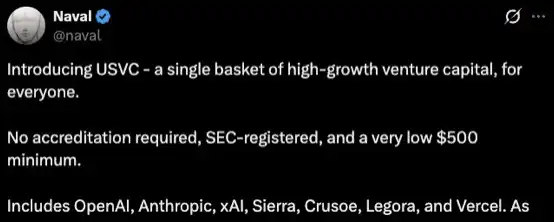
Navar Ravikant (Navar) is promoting an investment product called USVC (U.S. Venture Capital), essentially to do one thing: to wrap up a "basket" that could be bought by an ordinary person, with a risk investment (VC) that would otherwise involve only a small number of people. Underlying assets include top-level AI/tech companies such as OpenAI, Anthropic, XAI, Vercel
You may have noticed that after pushing the valuation of a group of private companies to trillions of dollars, these venture capital institutions are finally preparing to withdraw. The problem is that they still need to find a "deficit liquidity" to take the chips。
The point is: I'm not accusing San Francisco of something illegal. I accuse them of doing an act that is extremely morally suspicious and is eroding the commitment of the capitalist society。
The deal。
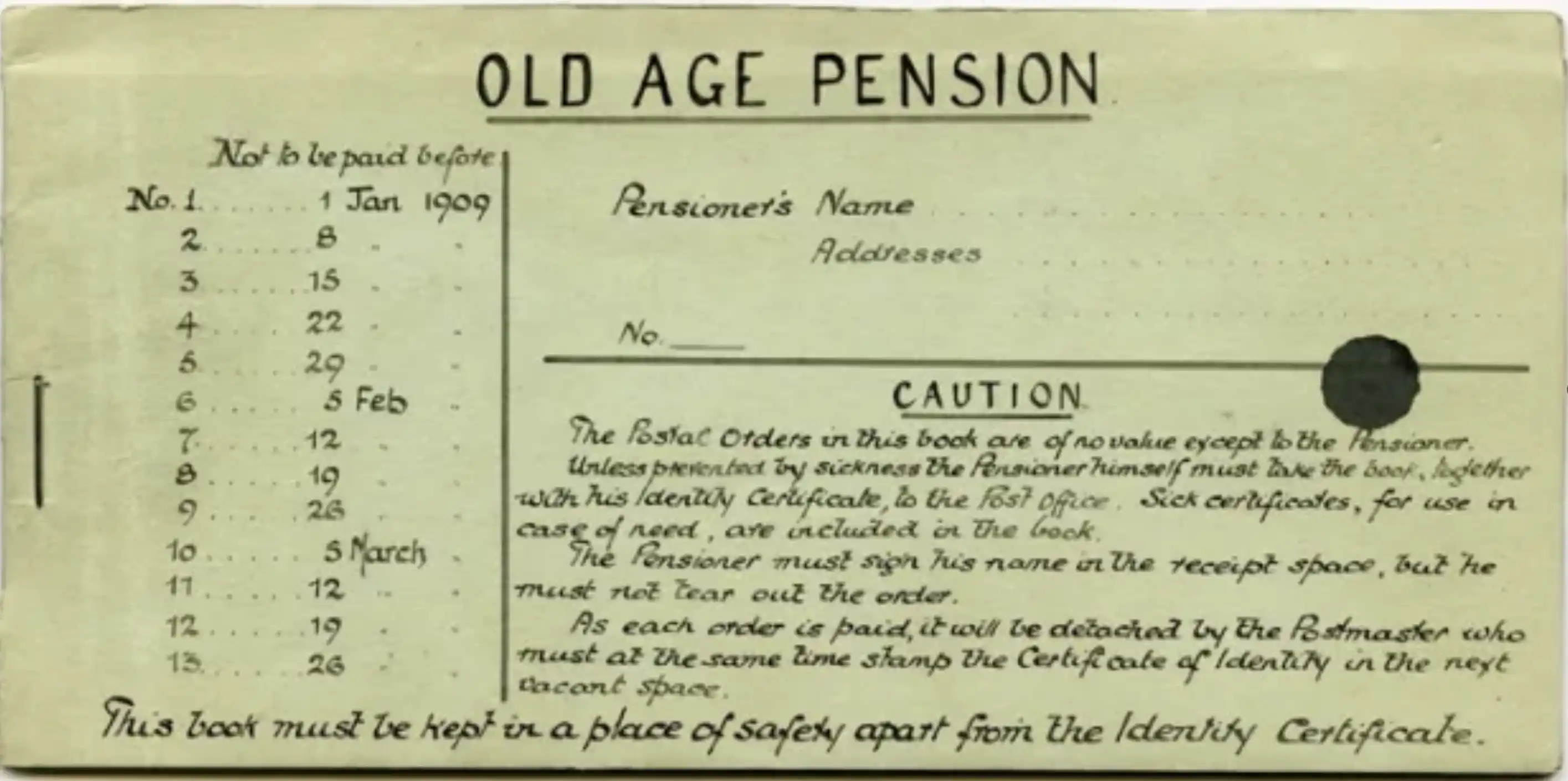
The baby boom generation is the last to really eat this dividend。
The United States does not have a European-style welfare State and has never intended to follow that path from the outset. The deal is that the stock market will assume the role of the welfare state. The fixed-income pension is gradually giving way to a fixed contributory pension; the traditional pension is replaced by a 401(k) account; and social security becomes a “bottom line” on which no one can expect to live。
An implicit alternative is that every worker will become a shareholder and that the capital lift will be carried with the worker. Wages can stagnate and inequality can widen, as retirement accounts continue to grow at a backstage, with all people operating on the same track — the end result will be roughly “good”。
it is this mechanism that allows the inequality in the united states to remain politically “affordable”. as long as your 401(k) rises along the same curve as the boss's assets, you can accept that the boss earns 400 times as much as you. the passive indices fund is the purest expression of the deal: cashiers, teachers, plumbers can "go hitchhiker" and, depending on the price to be paid by professional capital, find a return on the whole market and then rest assured of their lives. the market, in a sense, is a "public resource"。
But the deal is conditional: the open market must remain the place where the value is actually created; the gains from the rise must be widely accessible; the “marginal dollar” formed by the new capital must be the dollar that index funds can hold. These conditions were long established, but they are no longer in place。
That's exactly what they took from you。
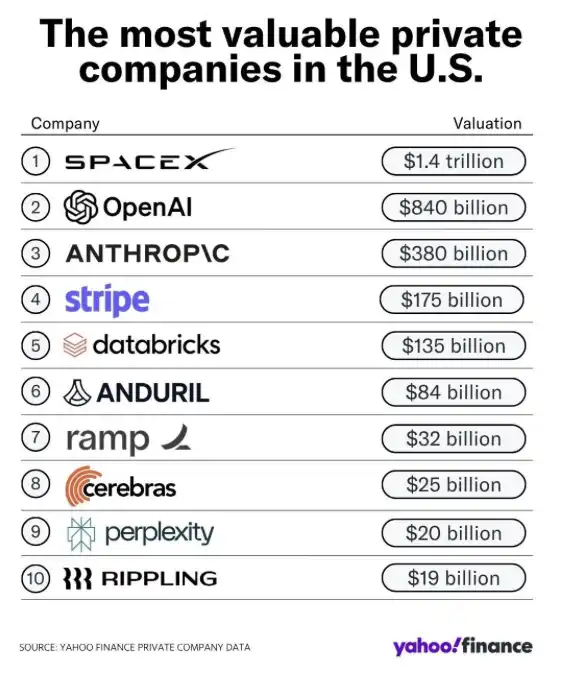
When companies grow to the trillions of United States dollars in the private sector before they become marketed, the open market is no longer where value is created, but where value is realized. What happens now in the open market is "distribution" and not "hush growth." In the past, every percentage point of return that should have been attributed to passive retirement funds in the company ' s growth has now been directed to those who had been on the shareholders ' roll long before the company ' s valuation reached $200 billion。
After Figma came on the market, stock prices fell by 50 per cent in just a few weeks compared to its private valuation; Klarna fell by 90 per cent. Unfortunately, the system is "design-driven."。
The industry also noted that the structure was excluding the diaspora, which had proposed solutions — allowing the diaspora to participate in the private market. That is what they say: democratization, open access and closing the gap。
But what is really offered is at the top of a decade-long private-market expansion cycle to buy a warehouse that was built by insiders as long as one in a thousand of these companies’ valuations. The so-called USVC (United States venture capital channel) is not "open access " , but a channel for distributing assets that have increased by one round. Even Naval's own statements have admitted this。
Designed exit mechanism
As always, the encryption industry was the first to figure out how to play it。
This happens when some foundations find themselves in possession of a large number of locked token assets, while the original bulk demand is depleted, the nodes of the locks are near, and there is no connection. The solution would be to wrap these locket coins into the stock carrier, with the participation of the traditional financial (TradFi) buyers, who are regulated。
THE TOKENS THAT WOULD OTHERWISE NOT BE DIRECTLY PURCHASED BY THE DIASPORA ARE "PACKAGED" INTO STOCKS — INSTITUTIONS CAN BUY THROUGH COMPLIANCE CHANNELS AND THE BULK CAN PARTICIPATE THROUGH THE VOUCHER ACCOUNT. THE CHIPS HAVE BEEN DISTRIBUTED. THE SUPERVISORY AUTHORITY (SEC) DID NOT DO SO. THE FOUNDATION SUCCESSFULLY WITHDREW. THE EQUITY BUYERS, ON THE OTHER HAND, WERE GIVEN A BOTTOM ASSET THAT WAS "DESIGNED TO BE SOLD TO THEM"。

By the way, Navar Ravikant was also in the encryption industry long ago。
THE RISK INVESTMENT SYSTEM IN SAN FRANCISCO SAW THE FEASIBILITY OF THIS MECHANISM AND REALIZED THAT IT COULD BE EXTENDED TO " TRILLIONS OF DOLLARS". USVC IS A DOOR, NASDAQ RULES ADJUST TO ANOTHER DOOR。
NASDAQ is proposing that the weight in the index be calculated at five times its circulation ratio (up to a maximum of full weight) and recalculated every quarter at the time of the repositioning. For example, if a company (e.g. SpaceX) were to be listed at a 5 per cent share in circulation, valued at $1.75 trillion, passive funds would be forced to buy on the market 15 days later at a weight equal to $438.0 billion — almost no “observation period”。
At the same time, locking periods can be accurately scheduled to expire around the next index node. At that point, the index weight will automatically rise to “full weight” and passive funds will be forced to buy shares in large numbers at a point where the insiders can just legally lose. The SpaceX goal is to be listed in mid-June, and the next important adjustment is in December -- the "mathematics" set up。
the index fund, which was supposed to serve as an instrument for the fight against internal games, is now the mechanism by which internal games can be completed. your 401(k) is being "paced."。
the structure of the two pathways is the same: the insiders accumulate positions in markets in which the bulkers cannot participate; the warehouse is mature; the natural needs of the primary market are not sufficient to cover the target price; then a "package layer" (wrapper) is designed to allow the other category of funds to participate - usually through retirement accounts or passive inflows. these funds are “price-insensitive” because they are bought according to rules, not on the basis of judgement. as a result, the insiders finished their exit and the new entrants were connected。
All of this is "legal" because the structure itself is designed to be legal; and the regulatory body is not moving because — this "rule of the game" is itself within the system。
Consequences
This explains in part why people like Sam Altman are subjected to extreme protests, why the Waymo vehicle is attacked and why the data centre is targeted。
Those who ignited the flame did not need a theory of "exit mobility". All they have to do is look at their lives: there are a group of people who come early, and another group who come late, and the gap between the two is widening at a faster rate than any "dissemination of effort, ability or timing" can explain。
The technocratic sector is creating a visible and sustained evidence that ordinary capital is being "recovered" to realize the excess gains of those who are already in a privileged position。
THE "K" DIVIDE WILL ONLY INCREASE. WHAT HAPPENS NEXT IS NOT JUST A SIMPLE MARKET ADJUSTMENT。
Adjustments only occur in systems where participants still believe in the rules. And burning flames are essentially political issues。
[ Chuckles ]Original Link]
