
Dragonfly Partner: Dispersed, Institutional Tides, where is the next wave of the encryption market
Collapse & Compiled: Deep tide TechFlow
Guest: Haseeb Qureshi, Dragonfly Managing Partner
Moderator: Miles Deutscher
Podcast source: Miles Deutscher Finance
Original title: This Interview Made My Next Cripto Buys Obvious
Date broadcast: 26 April 2026
Original link: https://www.techflowpost.com/zh-CN/article/3135
Statement: For the purpose of reproduction, readers can obtain more information by linking to the original language. If the author has any objection to the reproduction, please contact us and we will proceed with the modifications requested by the author. Reproduction for information-sharing purposes only does not constitute any investment proposal and does not represent the views and positions of Wu。
Summary of highlights
In this programme, Dragonfly Management Partner Haseeb Qureshi discussed with the moderator, Miles Deutscher, the real state of the current encryption market: scattered households leave after a significant retreat and institutional funds become the base of Bitcoin. Haseeb argues that Bitcoin does not need much new narratives, more like mature financial assets over the next 15 to 20 years; what really needs to be narratives are Shankico and broader encrypted assets。
With a $650 million fund around Dragonfly, Haseeb stressed that encrypted real product market convergence remains money and finance, including DeFi, stabilization currency, exchange, forecast market and RWA。
The second half of the show focused on Crystal X AI: Haseeb, who did not think that encryption was designed for existing human interactions, but it might be well suited to AI Agent, which in the future would become the first level of interface between users and chain finance and promote more low-risk preference groups into the chain world。
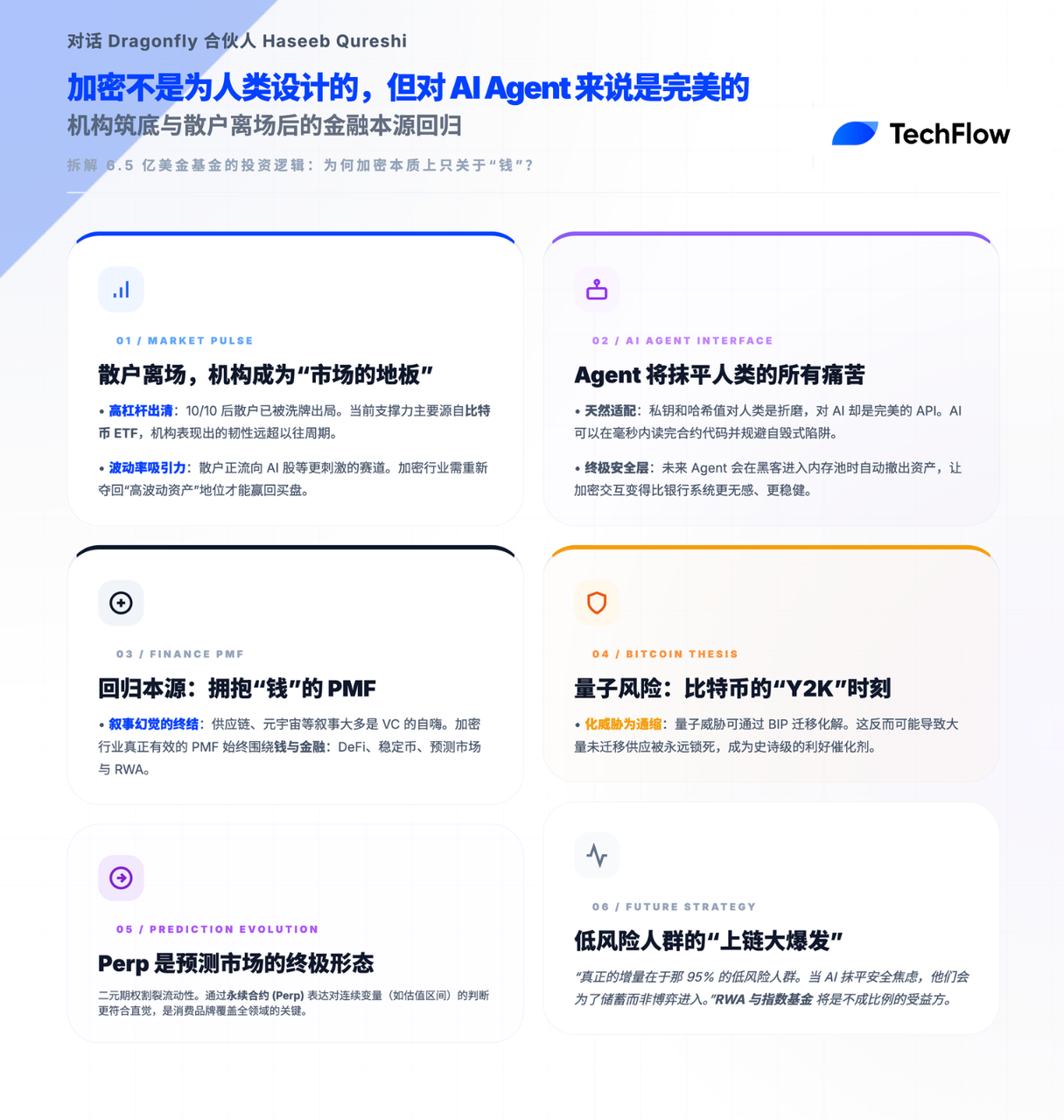
Summary of outstanding views
With regard to the current market: the diaspora and institutional infrastructure
- “Since last October, it has become clear that the bulk has largely withdrawn from the market, and the participation of the bulk is now very low. The majority of the losses were borne by the family. Who would hold large amounts of mountain coins that crashed at that time like a "thermal nuclear reaction"? The answer is to be dispersed."
- “THE INSTITUTION IS STILL IN EXISTENCE. ETF'S PERFORMANCE IS RELATIVELY SMALL ... THIS MEANS THAT THE INSTITUTION IS STILL, THEY'RE THE FLOOR OF THE MARKET, THEY'RE THE LAST BUYER, AND THAT BITCOIN DOESN'T FALL 70%, 80% OF THE VOLATILITY BUFFER AS IN PREVIOUS CYCLES."
- "THE ENCRYPTION IS NO LONGER THE MOST EXCITING GAME ON THE MARKET." IRONICALLY, GOLD, AI STOCKS, AND STOCKS OF CHIPS ARE NOW EVEN MORE VOLATILE THAN ENCRYPTED ASSETS. ENCRYPTION MARKETS NEED TO REGAIN THEIR STATUS AS `HIGH-VOLATILE ASSETS' IN ORDER TO BE ABLE TO REGAIN THEIR APPEAL TO THE DIASPORA.”
On bitcoin: narrative retreat and mature financial assetization
- “To be honest, I don't think bitcoin needs too much narrative. People believe that bitcoin will always exist and that it will not disappear.”
- "bitcoin is more like an asset that will grow in the next 15 to 20 years. For these younger generations, bitcoin is already an established thing. They will not question the legitimacy or value of Bitcoin as they did in previous generations.”
- "THE PROBLEM OF QUANTUM COMPUTATION MAY BE THE SAME AS THE Y2K PROBLEM OF THE YEAR. AFTER FOUR YEARS, ALL OLD ADDRESSES WILL BE LOCKED IN BITCOIN, WHICH CANNOT BE MOVED AGAIN. RATHER, IT MAY BE IN THE INTEREST OF BITCOIN: BECAUSE OF THE PERMANENT ELIMINATION OF LARGE UNDISPLACED SUPPLIES OF BITCOIN.”
The essence of encryption is money and finance
- “The essence of encryption is about money and finance. The stories about block chain supply chain tracking, auditing, meta-cosms, games, social media are not what consumers tell us they really need, but are the narratives that the industry has created itself.”
- “The whole industry is a little ‘self-recreational’ and beginning to believe that these stories will come true. I was skeptical from the beginning ... I personally used and experienced these products, and I don't think they were good games.”
- “It is interesting to predict what is happening in the area of markets. The function of a lasting contract is introduced because in many markets it is more appropriate to allow users to express the judgement of a continuous variable than traditional binary options (yes or no)
About Crystal x AI: Encryption is designed for AI
- "THE ENCRYPTION IS NOT DESIGNED FOR HUMANS, AND IT MAY BE MORE SUITABLE FOR AI INTELLIGENCE. IT IS NATURAL FOR A MACHINE TO HAVE AN INTUITIVE PRIVATE KEY, A SYMGRAPHY, A HASH. THE MACHINE UNDERSTANDS THE API KEY AND CAN EASILY HANDLE HIGH-PRECISION DECIMAL POINTS."
- "ALL FUTURE OPERATIONS WILL BE BROKERED AND PROCESSED BY AI INTELLIGENCE. THE FUTURE AI SMART BODY WILL MONITOR YOUR ASSETS IN REAL TIME, AND IT WILL AUTOMATICALLY WITHDRAW FUNDS FROM THE AGREEMENT ONCE THE RISK IS DETECTED, AND WILL INFORM YOU THAT "I HAVE REMOVED THE FUNDS SAFELY."
- "THE REAL DIFFERENCE BETWEEN BANKING AND ENCRYPTION IS "SMART." BANKS RELY ON SYSTEMS AND MANPOWER TO MAKE SURE YOU DON'T MAKE MISTAKES, AND IN THE FUTURE, YOUR AI INTELLIGENCE WILL PLAY A SIMILAR ROLE."
With regard to the future winner: the influx of low-risk people
- “By contrast to bitcoin, it needs a stronger narrative to attract the diaspora. Unless you're a project like Hyperliquid, you can generate income on a continuous basis and create value by buying back and destroying tokens.”
- “THE REAL POTENTIAL LIES WITH PEOPLE AT LOW RISK AND PREFERENCE. NOW ONLY 5% OF THE LOW-RISK PREFERENCES ARE ON THE CHAIN. IF ENCRYPTION BECOMES SAFER IN THE FUTURE, AI INTELLIGENCE MAKES EVERYTHING EXTREMELY SIMPLE, AND THESE LOW-RISK PREFERENCES WILL ENTER THE CHAIN ON A MASSIVE SCALE."
- “IF THE SIZE OF THE LOW-RISK POPULATION INCREASES TENFOLD, THE LARGEST BENEFICIARIES ARE MAINSTREAM ASSETS (E.G., BITCOIN) AND SAVINGS-TYPE ASSETS SUCH AS STABILIZATION CURRENCY AND RWA. SAVINGS BEHAVIOUR IN THE CHAIN IS CURRENTLY VERY RARE AND WOULD BE AN EXPLOSIVE DIRECTION.”
Current market situation
Moderator Miles Deutscher: It is a great honour for us to meet Haseeb Qureshi, the managing partner of Dragonfly. Haseeb, welcome to the show! First question, how do you feel about the encryption market? What do you think the market is at
We can break the discussion down into several parts: bitcoin, Yamashita and the participation of the diaspora. Let's start with bitcoin. The market has recently rebounded following fluctuations caused by events related to Iran and risks in the Straits of Hormuz, and the stock market has reached new heights. What do you think of the current market situation
Haseeb Qureshi:
The market seems to be back on its feet。But I think that since last October, it has become clear that the bulk has largely withdrawn from the market, and the bulk participation is now very low. And if you talk to the founders of some of the exchanges, they'll tell you that there's already been a significant drop in the bulk activity, leaving only a fraction of the hottest part of the market in 2025. In fact, we have also seen this phenomenon in previous cycles, and it is easy to access markets。
When looking at core indicators measuring the attention of the bulk, such as search volumes, bulk-oriented exchange transactions, and App Store downloads, these can be very direct measures of the dispersion of emotions and participation. These indicators have collapsed after 10/10, so we know that the family has gone。
But the question is, who's holding the market? The answer is institution。IT'S STILL THERE. IF YOU LOOK AT BITCOIN ETF DATA, YOU'LL FIND THAT THE ETF RETREAT IS ACTUALLY RELATIVELY SMALL, AND I REMEMBER THAT AT BITCOIN PRICES, THE ETF RETREAT WAS ABOUT SEVEN PERCENT. OF COURSE, THE ETF PRICE WILL FOLLOW THE MARKET, BUT THE ACTUAL FLOW FROM ETF IS MUCH SMALLER THAN THE AMOUNT OF BITCOIN. THAT MEANS..The agency is still, they're now the market floor, the last buyer, and the bitcoin that didn't fall 70%, 80% of the volatility buffer like the previous cycle。
ETF'S OVERALL PERFORMANCE STATEMENTSmart money didn't lose confidence in the industry, they didn't think encryption would disappear。BUT IT DOES, AND IT'S IMPORTANT FOR THE MARKET, EVEN FOR THE BITCOIN ETF. BITCOIN ETF ALSO HAS A LARGE NUMBER OF DISPERSED HOUSEHOLDS, BUT IT'S NOT THE KIND OF SHORT-LINE, HIGH-SPECULATION, HIGH-LEVERAGE QUICK-DISPERSION, AND IT'S THESE PEOPLE WHO REALLY LEFT。
Why did the family leave the encryption market
Haseeb Qureshi:
To understand the market, you need to answer two questions:Why are these people leaving? When are they coming back
And say, "Why did they leave?"。THE MAJORITY OF THE LOSSES WERE BORNE BY THE FAMILY. WHO'S GONNA BE FLATTENED IN A HIGH LEVERAGE POSITION? WHO WOULD HOLD LARGE AMOUNTS OF MACKEREL COINS THAT COLLAPSED LIKE A THERMONUCLEAR REACTION? THE ANSWER IS TO BE DISPERSED. INSTITUTIONAL INVESTORS DON'T USE HIGH LEVERAGE TO MAKE A LOT OF MONEY LIKE ATOM, WHICH IS LARGELY BORNE BY SCATTERED HOUSEHOLDS. SO IT CAN BE SAID THAT LAST OCTOBER 10TH WAS THE CRASH, THE LARGEST VICTIM. THERE ARE, OF COURSE, BUSINESSES AND INSTITUTIONS AND LIQUIDITY FUNDS THAT HAVE SUFFERED LOSSES, BUT THE CENTRAL THING ISThe family was punched in 10/10。
The second point is that encryption is a highly anti-marketWe knew that long ago. Encryption relies heavily on momentum. When market momentum turns negative, this negative trend continues until a positive external shock pulls it back on track。
SO, WHERE DID IT GO AFTER THE SPLIT? THEY SHIFTED FUNDS TO OTHER ASSET CLASSES, SUCH AS GOLD, AI STOCKS, STOCKS OF CHIPS AND OIL. IRONICALLY, THESE ASSETS ARE NOW MORE VOLATILE THAN ENCRYPTED ASSETS. FOR EXAMPLE, THE VOLATILITY OF GOLD HAS NOW SURPASSED THAT OF BITCOIN. THIS MEANS THAT ENCRYPTION IS NO LONGER THE MOST EXCITING GAME ON THE MARKET。
The encryption industry has been able to attract a large part of the diaspora because of its high volatility. In contrast, stock and commodity markets are much less volatile. And the attraction of encryption once was its madness and volatility. If the encrypted market becomes as stable as low-variant assets, its attractiveness to regional bulk investors will decline significantly。
So, to some extent, encryption has to go up again, which is one of the conditions for attracting the diaspora back。We are now beginning to see signs that the encryption market may have reached its bottom. Of course, no one could be certain of what would follow, particularly geopolitical developments that would have a significant impact on all asset classes。
Another factor that needs attention is thatAI AND VOLATILITY IN COMMODITY MARKETSI don't know. At present, AI has very large volatility in related equities, as have gold and other large commodities. In the case of Iran, for example, we may see some decomposition in the future. By reference to Polymarket ' s market pricing, the probability of continuing the war at the end of this year is considered low, and the probability of reaching a comprehensive peace agreement by the end of the summer may even exceed 50 per cent. As a result, we are likely to enter a phase of relative stability in commodity prices and the macro-environment。
However, stock market volatility may continue for some time, especially if some heavy IPOs appear this year, such as Anthropic or OpenAI. If these companies were to be IPO by the end of this year, the stock market could be very crazy. Because the prices of these well-known companies are likely to experience sharp fluctuations once they can actually buy into them. Similarly, companies such as XAI and SpaceX would become “super narratives” for the bulk business。
Moderator Miles Deutscher: What do you think of the market for the rest of the year? Sounds like you think the stock market will be more volatile
Haseeb Qureshi:
This year will indeed be very volatile. But I think it may be more difficult in the coming year to overwhelm the encrypted market. My guess is that the encryption market will be gradually repaired as it is now。
MORE IMPORTANTLY, IF WE LOOK AT NEXT YEAR, AFTER THESE IPOS, I THINK THE ENCRYPTION MARKET IS MORE LIKELY TO EMBRACE A BROADER RECOVERY AND HAVE THE OPPORTUNITY TO RE-CHALLENGE HISTORICAL HEIGHTS. OF COURSE, IT'S JUST MY THEORY, AND I CAN'T BE 100 PER CENT SURE HOW IT'S GOING TO GO。
But there is a relatively clear logic:Encryption markets need to regain their position as “high-volatility assets” in order to be attractive to the diaspora。If encryption does not win back to the diaspora, agency buys alone will not be enough to push the market to historical highs and not enough money。
Bitcoin's next catalyst
Moderator Miles Deutscher: So what kind of narrative do you think brings the family back to the market? Is there some sort of catalyst that, without considering price trends, can rekindle market interest
Of course, prices themselves do drive narratives, but I think Bitcoin seems to have recently lost its “belief”. Personally, I still believe in Bitcoin, and I can build arguments for the logic of “digital gold”. But looking at the performance of gold, the performance of equities, together with the risk of quantum calculations and other issues recently discussed, Bitcoin did lose some of its supporters. What do you think of bitcoin? Do you still believe it? Do you think it has a clear future path as an asset
Haseeb Qureshi:
I THINK YOU MAY HAVE OVERESTIMATED THE IMPORTANCE OF THE BITCOIN NARRATIVE. TO BE HONEST, I DON'T THINK BITCOIN NEEDS TOO MUCH NARRATIVE. PEOPLE BELIEVE THAT BITCOIN WILL ALWAYS EXIST AND THAT IT WILL NOT DISAPPEAR. AND AS PEOPLE CAN SEE, BITCOIN IS GETTING ACCEPTED ON WALL STREET. ALTHOUGH BITCOIN ETFS ARE STILL YOUNG, THEY HAVE BECOME THE MOST TRADED CATEGORY OF ETFS IN THE MARKET, WHICH SUGGESTS THAT THE DEMAND FOR BITCOIN REMAINS VERY STRONG。
If you ask me what the bitcoin narrative is, I might answer:I don't think it needs a clear narrative, more like a real asset that will grow in the next 15 to 20 years。WITH THE PASSAGE OF TIME, THE BABY BOOM GENERATION GRADUALLY EXITS THE HISTORICAL STAGE AND THE DECISION-MAKING POWER OF CAPITAL GRADUALLY SHIFTS TO THE X GENERATION AND THE MILLENNIUM GENERATION. FOR THESE YOUNGER GENERATIONS, BITCOIN IS ALREADY AN ESTABLISHED THING. THEY WILL NOT QUESTION THE LEGITIMACY OR VALUE OF THE BITCOIN, AS THEY DID IN PREVIOUS GENERATIONS, BUT WILL NATURALLY ACCEPT IT AS PART OF THE WORLD, A FINANCIAL ASSET THAT WILL NOT DISAPPEAR。
So I don't think there will be any major event in the next two years to change the position of Bitcoin. Instead, I prefer to thinkBitcoin will continue to infiltrate the global financial system in a gradual manner, evolving into a more stable and widely accepted financial asset。
Problems with quantum calculations
Haseeb Qureshi:
QUANTIFICATION IS INDEED A REAL RISK, ESPECIALLY ON THE TIMESCALE OF THE NEXT THREE TO FIVE YEARS. TO REASSURE PEOPLE ABOUT THE REMATCHING OF TTS, IT IS NECESSARY TO HAVE A CLEAR BITCOIN IMPROVEMENT PROPOSAL (BIP) PUT FORWARD BY THE BITCOIN COMMUNITY, A BROAD CONSENSUS AROUND IT AND A CLEAR RELOCATION PLAN. ONCE WE HAVE SUCH A RELOCATION PLAN, BITCOIN'S CONFIDENCE WILL INCREASE SIGNIFICANTLY. ONCE THE MIGRATION IS COMPLETE, THE PROBLEMS ASSOCIATED WITH QUANTUM COMPUTING ARE LEFT BEHIND。
I AM QUITE CONFIDENT THAT THIS WILL EVENTUALLY HAPPEN. AS WE CAN SEE, THE BITCOIN COMMUNITY IS BEGINNING TO TAKE SERIOUSLY THE POTENTIAL THREAT OF QUANTUM COMPUTING AND IS ACTIVELY SEEKING SOLUTIONS. BUT IN THE LONG RUN, THE QUANTUM COMPUTATION PROBLEM MAY BE LIKE THE Y2K PROBLEM OF THE YEAR. QUANTUM COMPUTING IS A REAL RISK, AND ONE DAY A QUANTUM COMPUTER CAPABLE OF DECRYPTING THE ELLIPTICAL CURVE DIGITAL SIGNATURE ALGORITHM (ECDCSA) MAY BE MANUFACTURED. AT THAT TIME, THE KEY QUESTION WAS WHETHER THE CHAIN OF BLOCKS HAD BEEN RELOCATED。
IF THE RELOCATION IS COMPLETED, THE PROBLEM OF QUANTUM COMPUTATION IS NO LONGER A THREAT. IT WOULD BE LIKE THE Y2K PROBLEM: IT WOULD LOOK TERRIBLE AND COULD HAVE MAJOR CONSEQUENCES, BUT IT WOULD BE RESOLVED BY PREPARING AHEAD OF SCHEDULE, CARRYING OUT RELOCATIONS, REPAIRING LOOPHOLES AND EVENTUALLY BECOMING HISTORY. THE QUANTUM PROBLEM IS LIKELY TO EVOLVE IN A SIMILAR WAY。
So I think that, in looking back at this history in the future, the problem of quantum computation may be like a bitcoin block-size struggle. It was once a very important and controversial issue, but after a settlement, you will gradually stop talking about it. At that point, one might find it difficult to imagine why the matter had attracted so much attention as it was no longer a problem at all。
Moderator Miles Deutscher: I recall that you mentioned in your last podcast that the exchange could in fact block transactions at a specific address through certain mechanisms that would prevent unsettled supplies of bitcoin from entering the market. It was also mentioned that even if quantum calculations actually had an impact on the market, such an impact could be priced early in the market, and could even in turn become an upward catalyst. Can you tell me more about it
Haseeb Qureshi:
YEAH, ASSUMING WE CAN SEE A MIGRATION PATH. ASSUMING, FOR EXAMPLE, THAT NEXT YEAR THE BITCOIN COMMUNITY FINALLY AGREED TO ADOPT A BIP AND ESTABLISH A NEW SIGNATURE MECHANISM OR KEY STANDARD. THE COMMUNITY THEN ANNOUNCES A RELOCATION PLAN REQUIRING ALL USERS TO MOVE THEIR KEYS TO THE NEW FORMAT。
YOU HAVE THREE OR FOUR YEARS TO COMPLETE THE MIGRATION. AFTER FOUR YEARS, ALL OLD ADDRESSES WILL BE LOCKED IN BITCOIN, WHICH CANNOT BE MOVED AGAIN. THIS MEANS THAT BITCOIN IN AN OLD ADDRESS THAT HAS NOT BEEN RELOCATED IS ACTUALLY “BLACK HOLEIZED”. DURING THIS TIME, THE EXCHANGE, THE TRUSTEE AND THE BITCOIN ETF WILL TAKE THE LEAD IN COMPLETING THE RELOCATION AND ENSURING THE SECURITY OF THEIR ASSETS。
HOWEVER, THERE WILL ALWAYS BE USERS WHO HAVE NOT COMPLETED THE MIGRATION IN TIME FOR VARIOUS REASONS. SUPPOSE FIVE YEARS LATER, A QUANTUM COMPUTER THAT CAN DECIPHER ECDSA WAS FINALLY MADE. IF THINGS HAPPEN ACCORDING TO SUCH TIME LINES, THE PRESENCE OF QUANTUM COMPUTERS MAY BE BENEFICIAL TO BITCOIN. THERE ARE TWO REASONS FOR THIS:First, quantum computers did not appear before the relocation of bitcoin; second, large quantities of unmoved bitcoin supplies were permanently removedI don't know. Both could be a good factor for bitcoin。
Thus, in many possible situations, the threat of quantum calculation may eventually turn into a positive catalyst for a market rather than a negative blow。
The market prospects of the fortress
Moderator Miles Deutscher: What do you think about the market? It is clear that it remains highly relevant to the price trends of bitcoin. Although there have been some significant increases in the past few weeks, there still appears to be low interest among the diaspora. What's your overall view of the market? Also, I would like to hear your predictions about the big opportunities in the coming months or even years。
Haseeb Qureshi:
One advantage of the encrypted market is that its performance is relative. It has gone through a sharp decline before, so if the encryption market as a whole has a broader macro fix, it has rebounded from a low point of 30, 40, or even 50, or 100%, and does not require the world to refocus on the encryption market. Therefore, I believe that there is still considerable room for rebound in many assets in the Yamashita market。
But I also thinkIt might take some time for the occupant's interest to recoverI don't know. Unlike Bitcoin, it needs a stronger narrative to attract the attention of the diaspora. Bitcoin ' s position is relatively solid, and it is widely believed that it will last forever and eventually win. And for Ethereum, Solana and other mosaics, investors need a clear story about why these assets are important and why they have long-term potential。
Unless you are a project like Hyperliquid that can generate sustained income and create value through the buy-back of the destruction of tokens, most of the trade in banknotes is not based on current actual income, but on expectations for the future. Income-type tokens like Hyperliquid represent only a small part of the market. The vast majority of the value of this currency is based on expectations of possible future development. Therefore, if you want the diaspora to invest in the capital, you must tell them a clear and convincing story about the future。
I believe that this can certainly be done. We already have the necessary foundations to achieve that goal. But the point isPeople need to get back excited about the future of encryptionI don't know. This is not just about technology, but about faith and confidence. The core of the encryption industry has proved its persistence, and an increasing number of authorities and individuals have begun to accept and endorse the value of encryption。
For example, recently when Kevin Warsh was asked about encrypted money in a congressional hearing, he made it clear that he believed that encryption had become an integral part of the financial world, would not disappear and was important to the interests of the United States. Imagine, a few years ago, it was hard to imagine that high-ranking officials like Janet Yellen or Jerome Powell would make a public statement like that. And now we have entered a new era: the future Fed presidency candidate may publicly support encrypted currency, and this support will last for a long time。
In addition, we have seen a number of large technology companies active in the area of encryption. For example, there are reports that Meta plans to launch her own encrypted wallet later this year. These developments point in a clear direction:The encryption industry will continue to exist and may become more deeply integrated into the mainstream financial system。However, more specific narratives are still needed to bring the diaspora back to the market。
So, $650 million bet
Moderator Miles Deutscher: You mentioned in a tweet one of your important points this year: financial encryption is breaking out. You also talked about the decline in non-financial encryption assets. I would like to ask you to elaborate on this point, why do you think this is a great opportunity? I also noticed that Dragonfly recently completed a new round of fund-raising, and it is clear that you have invested a lot of capital in this field. I want to understand the logic behind you。
Haseeb Qureshi:
I always believed that the essence of encryption was aroundMoney and financeI don't know. If you look at projects in the encryption industry that are truly successful on a large scale, they are, without exception, closely linked to money and finance. Bitcoin is a “digital gold”, and the Ethershop allows users to write smart contracts around money. The rapid development of DeFi, the rise of the ICO as a capital formation and financing mechanism, the RWA, the stabilization of currencies, the forecasting of markets — all these things that really work in the encryption industry are related to money and finance。
OF COURSE, THE INDUSTRY HAS TRIED TO TELL MANY OTHER STORIES. FRANKLY, MOST OF THESE STORIES ARE WOVEN BY THE WINDFALL (VC) AND THE ENTREPRENEURS, AND ARE ENTHUSIASTICALLY DISSEMINATED BY INDUSTRY SUPPORTERS. FOR EXAMPLE, BLOCK CHAINS CAN BE USED FOR SUPPLY CHAIN TRACKING, AUDITING, META-COSMS, GAMES, SOCIAL MEDIA, ETC. BUT THE PROBLEM IS THAT THESE STORIES ARE NOT WHAT CONSUMERS TELL US THEY REALLY NEED, BUT ARE NARRATIVES MADE UP WITHIN THE INDUSTRY ITSELF. THE WHOLE INDUSTRY IS A BIT OF A “SELF-RECREATIONAL” AND IS BEGINNING TO BELIEVE THAT THESE STORIES WILL COME TRUE BECAUSE THEY SOUND REASONABLE。
IN 2020 AND 2021, I DEBATED THESE ISSUES WITH MANY VCS IN CLOSED MEETINGS. THE PREVAILING NARRATIVE WAS THAT ENCRYPTION WOULD DEVOUR EVERYTHING, INCLUDING SOCIAL MEDIA, GAMES AND OTHER INDUSTRIES。
Moderator Miles Deutscher: There was indeed a lot of excitement about the block chain game and the meta-cosm, and even Mark Zuckerberg was attracted to this story。
Haseeb Qureshi:
Exactly. But frankly, I was sceptical from the outset. I may be a little like an old man who keeps his money and always tends to be cautious. I saw a lot of wind throwing money at projects like Yuga Labs, Axie Infinity, but I never believed in the sustainability of these things. We didn't invest in these projects, we missed OpenSea and a lot of big block-chain games. Because I've used and experienced them myself, and I don't think they're good games. Likewise, I tried some decentrized social media platforms, but they didn't work. And finally, we went back to X. So the question is, what are we talking about
Therefore, I do not believe in these narratives. Looking back, I think my doubts are correct。The true convergence of encrypted product markets lies in its close connection to money and finance。 This is really needed by users and is the most valuable place in the encryption industry. For many years, therefore, we have focused on investing in these areas: DeFi, the stabilization currency, the exchange and the infrastructure associated with the core operation of encryption。
Now, some might be disappointed and ask why stories in other areas had not materialized. Or, how can they be achieved? And my point is, I don't think they will. We need to listen to the market. The market tells us that what is really valuable and what users really need is an application related to money and finance. We should accept that and cultivate deep around it。
IT IS THIS INVESTMENT PHILOSOPHY THAT ALLOWS US TO CONTINUE TO OBTAIN INVESTMENT AUTHORIZATIONS WHEN MANY VCS ARE OUT OF THE MARKET FOR FALSE PREJUDICIONS. INVESTORS WHO ONCE HAD A COLLECTIVE ILLUSION OF ENCRYPTION WERE ULTIMATELY NOT GIVEN THE OPPORTUNITY TO CONTINUE THEIR INVESTMENT。
Moderator Miles Deutscher: How do you fund now? Before recording, you mentioned that you were studying some areas. What kind of projects or entrepreneurs make you the most excited? What market opportunities are you focusing on? AI Intelligence? Or something else
Haseeb Qureshi:
We have indeed carried out in-depth studies in these areas. We're Polymarket's big investors. It is clear that many interesting things are happening in the area of forecasting markets, and we have devoted a great deal of time to that. I think the two main players now, Polymark and Kalshi, have a lot of uncovered market space。
Polymarket A permanent contract product had just been announced and, although it had not yet been officially online, they had opened the waiting list for users. They are clearly moving in the direction of a large consumer brand, trying to cover all the market areas they can reach。
One of the reasons why markets are expected to introduce the permanent contract function is that it allows users to express themselves more efficientlyContinuous variableThe judgment. Currently, most projected markets are designed for duality, such as “Will prices be higher than a certain level?” or “Will something happen?” However, if the user wishes to express a view of a continuum, such as an estimate of a value between 0 and 100, it is usually necessary to break down into multiple markets and ask, respectively, whether the value is higher or whether the value is lower. Such a mechanism would be very inefficient, as liquidity would be dispersed into multiple markets, resulting in lower capital efficiency and less intuitive for the diaspora。
For example, if you believe that OpenAI's valuation at IPO will reach $1.2 trillion or $2 trillion, you may need to express your views in multiple markets, each asking only “whether it is higher than a given valuation”. But this is not the natural way for the diaspora to express its views. What they really want is an asset that can fluctuate upwards and downwards. So, I think that's one of the important reasons why Polymarket launched a permanent contract product. This is not because they want to mimic other encrypted trading platforms, such as Hyperliquid, but because, in many markets they want to cover, lasting contracts are more appropriate than traditional dualist options。
As a result, there is much room for development in the area of forecasting markets. Companies like Polymarket and Kalshi will have more opportunities in the future to open up uncovered markets。
THE CHANGE OF ENCRYPTION INTEGRATION WITH AI
Haseeb Qureshi:
Next is the part about AI. A lot of interesting things are happening in the field of encryption and AI, and I've recently spent a lot of time studying this direction. Especially at Actic PaymentsMany new developments have emerged in the area of (smart payments). As you can see, transactions like x402 and MCP are growing rapidly。
We're also looking at a lot of API-type projects that allow your AI smarts to buy services directly through API. For example, you can get AI smart bodies into tools like Claude Code and then buy computing resources, browser sessions, authentication code solution services, temporary mailboxes, web searches, and even other large language models (LLLM) APIs using payment tools like ATXP or Sponge. There is no need for a registered account, e-mail or traditional cumbersome process for the whole process. All you have to do is pay through x 402, get ready for a little stabilizer, and then pay for the API call as required. This model is very interesting and the associated business is growing rapidly. This is one of the areas of my current focus。
Moderator Miles Deutscher: You have previously mentioned a point in tweets or dialogue with Banks: encryption is not designed for humans, and it may be more appropriate for AI intelligence. What do you think of that? How do you think this trend will evolve in the coming months or years
Haseeb Qureshi:
IT IS CLEAR THAT THE INTERACTION OF ALMOST ALL SOFTWARE WILL CHANGE. IF YOU'RE NOW USING SOME ADVANCED AI INTELLIGENT FRAMEWORK, YOU'RE ACTUALLY LIVING IN THE FUTURE. ALTHOUGH THE VAST MAJORITY OF PEOPLE TODAY HAVE NOT EXPERIENCED THAT FUTURE, THEY WILL DO SO IN A FEW YEARS。
What does that mean? For example, you can see from tools like Claude Design that PowerPoint is no longer the best interface for designing presentations. The same applies to Photoshop. Many of the existing modes of interaction are outdated, as the AI smart body will be the preferred entry point for processing the work。
Similar changes can be made in the area of encryption. Today, if you want to complete an encrypted transaction, you usually need to go through the following steps: you need to open an interface, click on a button, to confirm what you want to do; then you need to move assets from a bridge to another chain; then you need to check account balances, call RPC, check block browsers and confirm if the transaction is successful; you need to go to Twitter to see if there is any news of hacker attacks, or if there is an unusual notification; you might need to look for LinkedIn, the project founder, to confirm whether this person is credible; and finally, you need to read the contents of the transaction, to ensure that the signed transaction is consistent with expectations, and even the number of Tokens that may require transaction simulation to verify transfers。
This is the user experience of today. It's like it's still using Photoshop 20 years ago, instead of telling AI the tool "Put my face on this man and create a meme." In the future, these bad experiences will be completely subverted because all operations will be brokered and processed by AI intelligence。
FOR AI INTELLIGENCE, THE COMPLEXITY OF ENCRYPTION WILL NO LONGER BE A PROBLEM. TODAY, ENCRYPTION IS FILLED WITH INTUITIVE PLACES FOR HUMAN USERS, SUCH AS PRIVATE KEYS, ASSISTIVE WORDS, 15 DECIMALS OF CURRENCY PARTICLES, SMART CONTRACTS, AND SO ON. THESE DESIGNS ARE VERY UNFRIENDLY TO HUMANS. BUT FOR MACHINES, IT'S NATURAL. THE MACHINES UNDERSTAND THE API KEYS AND KNOW HOW TO PROTECT THEM FROM DISCLOSURE; THEY CAN ALSO EASILY HANDLE HIGH-PRECISION DECIMALS; AS FOR THE CODE OF SMART CONTRACTS, AI CAN READ AND UNDERSTAND LOGIC IN A FEW MILLISECONDS。
Imagine some recent hacking of a DeFi agreement. If you use aave, you may receive a notice on your cell phone that you may need to evacuate mobility. Then you need to open the computer, access the interface, access the information, understand what's going on and sign the deal manually. But the future AI smart body will monitor your assets in real time, and once the risks are detected, it will automatically initiate a transaction, withdraw your funds from the agreement and inform you after completion: "I have safely withdrawn the funds, and we can then analyse the situation further."
Not only that, AI smarts monitor mempool and observe the dynamics of transactions in the chain. For example, if a bottom asset is about to be staged on a cross-chain bridge and you hold the asset ' s liquid position, the smart body can prejudge the risk and quickly withdraw funds before the asset is reached by the target chain to avoid loss。
The only difference between today and the future isCountI don't know. The only way to prevent the above-mentioned future scenario from becoming a reality is through a lack of capacity. Once we have enough credit, all these scenarios can be realized in a moment. It won't be long before an AI model that is better at cybersecurity than any human being will be open to everyone. The use of this model will only require payment, possibly through Token or on an hourly basis。
WHEN THIS AI, WHICH IS SMART ENOUGH, FAST ENOUGH AND ABLE TO RESPOND IN REAL TIME, CAN MANAGE EVERYONE'S FINANCIAL LIFE, OUR RELATIONSHIP WITH ENCRYPTION CHANGES COMPLETELY。Today, the perception that encryption is dangerous and that we are even more willing to trust banks than to encrypt will change completely。
Why do many people now trust banks more than encryption? The answer is not because they think that bitcoin will be black, or that Etherum is not safe. People are really worried about the loopholes in smart contracts, the leakage of private keys or the loss of assets as a result of their own operational failures. In other words, people are not distrusting “airplanes”, but are afraid of making mistakes when they “drive”. Because human beings are limited, weary, make mistakes, and others can make mistakes. Aircraft are much safer than cars because they are highly automated and operated by professional systems and personnel。
Encryption will be similar in the future. Today, if your money is in the bank, the bank has a well-developed system to ensure that you do not make mistakes, such as transferring money to illegal accounts. If you try to transfer money to the DPRK in a United States bank account, it is almost impossible, even if you want to do so, the bank will stop you。
In the current encrypted world, such restrictions do not exist. You can easily transfer all funds to anyone, including the accounts of the DPRK, without any hindrance. But this will change。The real difference between banking and encryption is "smart."。& nbsp; Banks rely on systems and manpower to make sure you don't make mistakes, and in the future your AI intelligence will play a similar role。
Encryption will be similar in the future. Today, if your money is in the bank, the bank has a well-developed system to ensure that you do not make mistakes, such as transferring money to illegal accounts. If you try to transfer money to the DPRK in a United States bank account, it is almost impossible, even if you want to do so, the bank will stop you。
In the current encrypted world, such restrictions do not exist. You can easily transfer all funds to anyone, including the accounts of the DPRK, without any hindrance. But this will change。The real difference between banking and encryption is "smart."。& nbsp; Banks rely on systems and manpower to make sure you don't make mistakes, and in the future your AI intelligence will play a similar role。
Moderator Miles Deutscher: If this change really happens, my first reaction is that it will make encryption a financial instrument that billions of people can really use. And, of course, that means that millions or even billions of AI intelligent bodies are running. Although smarts can't open banks or complete KYC processes like humans, they can trade in encrypted currency. Trades can be made between smarts, between smarts and foundations, between smarts and shops. So you think this shift could be a major turning point for the whole industry
Haseeb Qureshi:
But I don't think that's going to happen soon, and the current AI intelligence is not mature enough. Today's smart body is not as smart as your bank. They are still “mute” and prone to being prompted to attack and may even be jailed。
Moderator Miles Deutscher: And now people do not trust them completely. For example, you're still laughing at the fact that GPT misspelled "strawberry" meme. As long as such problems persist, it is difficult to fully trust them。
Haseeb Qureshi:
They're hallucinating, making mistakes. But these problems will be solved as gradually as in the programming area. For example, today people are no longer afraid that tools like Claude Code will accidentally delete all files or damage the system. While in the past this concern has been justified, it is true that early tools did. I remember when the Cursor was used in 2022, it was very unstable, often caught in an endless cycle. At that time, using these tools was like tame a Mustang。
Now these tools are like a car that can go straight ahead and take you to your destination. They have become more reliable despite occasional problems. Next, we will enter a new phase in which these tools, like aircraft, not only fly, but also do not make mistakes or crashes。This stage of maturity is also required if encryption is to achieve the future I have just described。
ONCE THIS HAPPENS, THE NEXT CHANGES ARE ONLY A MATTER OF TIME. WHEN THE AI MODEL IS SMART, MATURE ENOUGH AND TRAINED IN ENHANCED LEARNING IN A BLOCK CHAIN ENVIRONMENT, YOU SEE A FUNDAMENTAL SHIFT IN PEOPLE'S PERCEPTION OF ENCRYPTION. TODAY, THE PERCEPTION THAT ENCRYPTION IS RISKY, DIFFICULT TO USE AND LESS RELIABLE THAN TRADITIONAL FINANCIAL SYSTEMS WILL CHANGE。AS AI JOINS, ENCRYPTION BECOMES AS SECURE, ROBUST AND TRUSTWORTHY AS TRADITIONAL FINANCIAL SYSTEMS。
A BIG WINNER WITH ENCRYPTION AND AI
Moderator Miles Deutscher: Who do you think is the greatest beneficiary in the future world of AI and encryption? In the field of encryption, is it bitcoin? Or the networks that handle transfers and the Layer 1 block chains? Or a new generation deal? Or DeFi, because the deployment of funds and the availability of revenues would be easier? Where do you think value comes from
Haseeb Qureshi:
I don't have a very complex answer. But my point is, if my hypothesis is true -- that isA LARGE NUMBER OF USERS BEGAN TO ENTER THE CHAIN BECAUSE AI INTELLIGENCE MADE ENCRYPTION SAFER AND MORE RELIABLE. LET'S GO– And that essentially means that more people will start using block chains。
For example, what would you buy if I told you that China would again allow the trade in encrypted currencyWHAT DO YOU CHOOSE TO INVEST WHEN A LARGE NUMBER OF NEW PEOPLE ARE READY TO ENTER THE CHAIN? MAYBE YOU'LL THINK ABOUT BUYING A NEO OR SOMETHING LIKE THE CHINESE VERSION OF THE TAIFENG. BUT THE MOST IMMEDIATE ANSWER IS THAT YOU CAN CHOOSE TO INVEST IN MANY OF THE EXISTING MAINSTREAM ASSETS BECAUSE THESE NEW USERS ARE LIKELY TO USE THE SAME INFRASTRUCTURE THAT WE ARE ALREADY USING. THEY HAVE NO REASON TO CHOOSE SOMETHING COMPLETELY DIFFERENT。
Moderator Miles Deutscher: So this may be an opportunity for high-quality assets or those already widely trusted. Bitcoin, and products like Hyperliquid. Of course, I'm not saying that I have to buy Hyperliquid, but it's a product that has been recognized by a lot of people。
Haseeb Qureshi:
Instead, I think Hyperliquid may not be the main beneficiary of this trend. Hyperliquid is a leverage platform for high-risk players. Leverage deals are essentially a “degen” product. If we see a large number of new users entering the chain because of the convenience of AI intelligence, their main purpose is not gambling. If they want to gamble, they can do it today. Why wait for the future
NO ONE WOULD GIVE THE MONEY TO A FUND AND ASK IT FOR LEVERAGE. IF SOMEONE GIVES THE MONEY TO AI'S SMART BODY AND LETS IT TRADE, IT'S LIKE GIVING IT TO A FRIEND TO GO TO A CASINO AND PLAY WITH A TIGER MACHINE FOR YOU. NO ONE WILL DO THIS BECAUSE IT MAKES NO SENSE。
Gambling is a psychological activity that brings an irritation of adrenaline and a sense of autonomy. If you outsource this to someone else, you lose your fun. People go to play with tiger machines to experience the process, not to let others play for them。
In addition, it is widely known that most people are not good at leverage transactions or gambling, and on average it is difficult to profit. Like playing poker, you sit at cards because you think you're stronger than any other player. But you won't give the chips to the people next to you and let them play cards for you。
Moderator Miles Deutscher: What if you believe your intelligence is stronger than others? Would that be a war between intelligent bodies
Haseeb Qureshi:
Yeah, that could turn into a game between intelligent bodies。
Moderator Miles Deutscher: Financial markets may really be moving in this direction. I've recently seen an idea that the future stock market might become a scenario where everyone would consult ChatGPT on investment proposals. Ultimately, all people get information from the same place, leading to a real marginal advantage being turned into a reverse operation, even a reverse mentality。
Haseeb Qureshi:
Yeah, it's like buying a Wall Street recommended stock. You might buy shares like GameStop. If you're doing a band transaction, following the kinetic operation, and then selling it when the kinetic reverses, this could be an effective strategy. But if it is held in the medium to long term, I will not recommend such an approach。
Moderator Miles Deutscher: Back to the case of Hyperliquid, what would happen if there was indeed a massive influx of new capital into the encrypted market in the future that had never entered the chain before? Suppose a lot of people suddenly have encrypted wallets with $10,000, $20,000 or even $30,000 in them. They're involved in gambling or using applications like Polymucket, so the threshold is much lower. Even old encrypted users like me sometimes want to bet on a horse at Polymark, but when they think about new wallets and transfers, they forget. If these processes become extremely simple in the future, for example, if only one gesture is required, will such convenience contribute significantly to the easy-to-use and good products of the whole ecosystem
Haseeb Qureshi:
Two key points need to be understood here。First of all& nbsp; If you go to Hyperliquid or Polymarket today to save your money, these platforms already provide access to French currency, and users hardly feel the involvement of encryption in the process. For instance, for Hyperliquid, because it's an exchange, you might be more aware that you're using encrypted currencies, using encrypted stabilizers like USDC. But for Polymarket users, many people do not even know that it runs on the Polygon block chain or that their positions are actually settled through the chain token。
From the point of view of user experienceIt doesn't really matter if you know you're using encrypted money。& nbsp; for example, if Hyperliquid is a central exchange, for many users its user experience (UX) and traditional financial platforms are not very different. All you have to do is get into the website, use the integrated Privy wallet, get in through the French currency, and then you can start trading. Therefore, I am not sure that the main reason why people are prevented today from using Hyperliquid or Polymark is “no confidence in encryption” or “no desire to use encrypted wallets”。
Of course, there are some users who may thinkThe encryption risk is highAnd choose not to participate. There was indeed some merit in the discussion of risk preferences. If you already have funds on the chain, then it will be easier to transfer to these platforms. This mechanism is similar to Robinhod, and if you already have money on Robinhod, you're more inclined to bet on a sports match. I agree that this is indeed a real mechanism。
Second If we divide potential users of the encrypted market into high-risk and low-risk preferences, it can be observed that high-risk preferences are disproportionately concentrated in the chain. It is assumed that 60% of the high-risk preferences have entered the chain because they themselves are “Degen”. Even if their countries did not allow the use of encrypted currency, they would find ways through VPN or other means, such as some Chinese users still trying to enter Hyperliquid to trade。
As a result, most high-risk users, or at least a significant proportion of them, are already connected. In the future, as encryption becomes simpler and safer, it does attract more high-risk users, but this group has relatively limited incremental space because they are already in the chain - These people are inherently more risky, willing to overcome obstacles and even venture into encryption。
The real potential is..Low risk preferencesTHE CROWD. NOW, MAYBE ONLY 5% OF THE LOW-RISK PREFERENCES ARE ON THE CHAIN. IF ENCRYPTION BECOMES SAFER IN THE FUTURE, HACKER ATTACKS ARE RARE, ALL INTERACTIONS ARE HANDLED BY AI INTELLIGENCE AGENTS, THERE ARE NO MORE PLACES THAT CAN BE EASILY “PUNCHED”, AND AI CAN MAKE EVERYTHING VERY SIMPLE, THEN THESE LOW-RISK PREFERENCES WILL ENTER THE CHAIN ON A MASSIVE SCALE。
If the size of the low-risk population increases tenfold, who will be the largest beneficiary? The answer is:Mainstream assets, and those low-risk users would choose the investment target, such as the stabilization currency and other low-risk assets。
Moderator Miles Deutscher: In this scenario, RWA is very interesting. Because people are familiar with the standard 500 assets. I can imagine that using AI smarts and $10,000 USDT purchasing index funds would be much simpler than opening a voucher account and waiting for two days to arrive. Of course, Robinwood and Apple Pay have made a lot of things easier. But if we are talking about larger, more serious investors, I think that the entire monetization of equity and the ecology of asset monetization platforms could offer great opportunities。
Haseeb Qureshi:
I totally agree. Today, the main behavior of most of the users in the chain isSpeculation or investmentHowever, almost no one uses encryption as a saving tool. Savings behaviour in the chain is rare. So, what kind of users are the savers? They are fundamentally different from speculators and investors. They pursue low risk and low returns and tend to hold certain assets for a long time, such as the Standard 500 Index。
Standard 500 is an index of such magnitude that its volume and attractiveness is based on a huge base: Over their lifetime, people have gradually allocated capital to the standard 500 as a long-term passive investment. Such passive investment is a very important way of managing wealth in the traditional financial system。
However, on the block chain, similar passive investment behaviour is virtually non-existent. With the exception of a few assets, such as national debt, the behaviour of the users of the chain is almost entirely concentrated on high-risk speculation and short-term investment。
I agree with you that this would be a direction that would explode。
