
AL BULL'S COUNTDOWN? WALL STREET TECHNOLOGY MASTER: THIS YEAR, LIKE 1997/98, COULD DROP 30-50% NEXT YEAR
Foams have not been punctured, but the danger is brewing。

Original by: Dragon Sword
Original source:See you on Wall Street
NOW IT'S AMAZING HOW IT WORKS, 1997-1998 -- WALL STREET TECHNOLOGY IS ALREADY COUNTING DOWN TO AI BULL。
On 11 May, Dan Niles, the founder of the Internet bubble-time chip analyst, received an interview from The Master Investor Podcast, setting out his judgement on the current AI story: AI Bullsville is not over, but predicts a major turnback early in 2027, and investors should start preparing now。
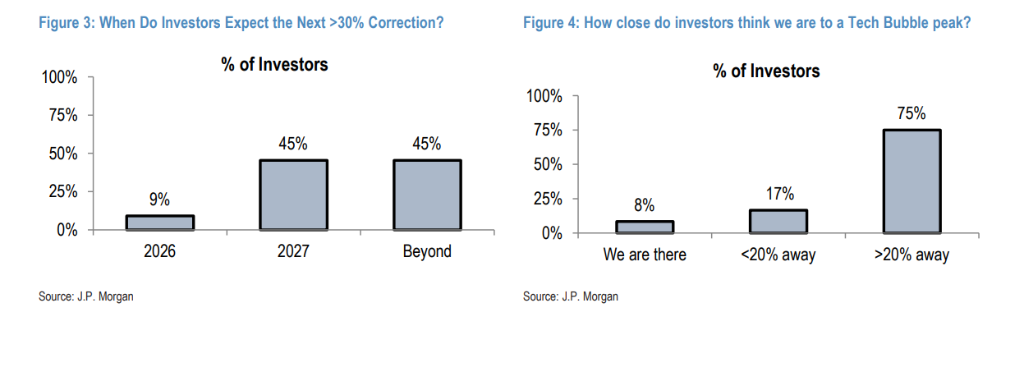
At the same time, Morgan Chase 56 global investors found that 54% of the people expected the US stock market to return more than 30% this year or next year, 45% of whom thought it would happen in 2027 -- a high match with Dan Niles
It's 1997-1998, not 1999 and not 2000
Niles compared the current pattern to the peak of the 1999-2000 bubble in 1997-1998, which many feared。
Logically, ChatGPT came online at the end of 2022, and AI infrastructure is now in its fourth year. The Internet age, Netscape Browser, was born in 1994 and 1997-1998 coincided with the third and fourth years。
IN 1997, THE THAI CURRENCY CRISIS BROKE OUT, WITH A DROP OF 11 PER CENT IN STANDARD 500 YEARS, BUT AN INCREASE OF 31 PER CENT THROUGHOUT THE YEAR. IN 1998, THE RUSSIAN BOND DEFAULT, THE COLLAPSE OF THE LONG-TERM CAPITAL MANAGEMENT COMPANY (LTCM), THE LARGEST DROP OF 19 PER CENT IN 500 YEARS, CONTINUED TO RISE 27 PER CENT THROUGHOUT THE YEAR。
Niles said, "In that time, the Internet infrastructure was in place, so every macro shock was a buy-in. Today too
In his view, the oil price shock caused by the war in Iran was “a man-made event” that was easier to resolve than the currency crisis and bond defaults of the year, so this was also a low-stage judgment。
Agentic AI: Drives the new fuel that continues in the wheeled cattle market
Niles puts the core driving force of this year's story in one word: Agenic AI。
In short, you used to ask ChatGPT a question, which gives you an answer, which is called "dialogue AI."。
Agentic AI is quite different. Dan Niles, for example, says, "This is Wilfred, go to the BBC website, get this data, go to the CNBC, pick up some other content, then sort out all the Excel forms." This series of operations requires a lot of calls, and consumes 10 to 100 times more token than chat AI。
This has been demonstrated by the data: two months before Open Claw was released, 20 per cent token growth; two months after publication, token growth exceeded 120 per cent。
This directly boosts the capital expenditure expectations of the super-large cloud service providers: the market is expected to increase by about 30 per cent in 2026, Q1 to 60 per cent after the financial returns and 70 per cent after the latest round。
Niles concludes that this is not a small change, it is a step-by-step shift that supports the continued rise in AI-related stocks。
HARDWARE PATTERN CHANGES: CPU TURNS OVER, GPU PRESSES
The architectural features of Agentic AI are quietly rewriting the competition patterns of the Agentic AI hardware。
Training large models is the same thing, GPU is good at doing it over and over again; chat AI's reasoning is good; but Agenic AI needs to manage multiple applications and coordinate multi-step tasks at the same time, which is essentially "formatting" , which is the strength of CPU。
Dan Niles said, "It used to be about eight GPUs with one CPU. Turning to Agenic, the ratio is close to one to one
THIS MEANS THAT INTEL AND AMD HAVE BENEFITED, WHILE INGWEIDA HAS "MARGINALLY AFFECTED ITS STOCK PRICE PERFORMANCE"。
But the semiconductor has gone too far
Dan Niles has a turn: short-term risks cannot be ignored. "In the short term, the extent of overpurchase is the worst since before the collapse in 2000 or 1995. That's for sure
IN PARTICULAR, HE NOTED THAT THE SEMICONDUCTOR ETF HAD INCREASED BY ABOUT 70 PER CENT DURING THE YEAR AND THAT THE IRANIAN WAR SHOCK HAD FAILED TO KEEP IT GOING。
But at the same time, he stressed that short-term over-buying does not amount to long-term logical destruction -- the demand for computing is real. He's willing to take the risk of a short-term drop of 15-20% in Intel because he thinks the stock will be even higher by the end of the year。
In 2027, where did 30-50% of the call come from
Dan Niles is already pushing for the next cycle。
The outbreak of Agenic AI began on January 30, 2026. On this basis, by early 2027, growth will begin to be higher than the base figure, and the rate will naturally slow considerably. What happens to the market then
"I think that these stocks could fall by 30 to 50 percent from the top of the position at that time. He says:。
The reference system is right in front of us: in 2022, Magnificent, on average, fell 46% - - It's just a consequence of the fall in the wave of technological construction during the epidemic, which is much smaller than the current AI boom。
Another potential trigger point is OpenAI. Dan Niles notes that OpenAI and Anthropic together account for about half of the super-large cloud factory backlog. From a combined annualization of about $7 billion at the beginning of 2025, the two companies now together are close to $70 billion (Anthropic about $45 billion, OpenAI about $24 billion) — an alarming increase, but it has to be squeezed out of the budgets of other companies。
“OpenAI claims to be committed to capital spending of US$ 1.4 trillion for the next eight years when it still stands at US$ 20 billion at the end of the year.” Where did you get the money? If OpenAI has a problem, it'll speed up the process
He also pointed out a structural pressure on liquidity: the IPOs of OpenAI, SpaceX, Anthropic and others are about to follow, and each family is likely to be valued at over trillions of dollars. “This money is going to flow from elsewhere, and the fund manager is not holding large amounts of idle funds, and they have to sell something else.”
Three signals at the same time: stock markets, oil prices, bonds
The first thing Dan Niles does in the morning is look at oil prices, bond yields, stock markets。
The combination now upsets him: the stock market is at a record high, oil prices are rising by about 60 per cent during the year, and the United States has a high return on its 10-year and 30-year national debt。
Historically, 10 of the 12 previous recessions have seen sustained increases in oil prices. If oil prices were to be maintained in the vicinity of $90 for one or two quarters, inflation would rise and consumer purchasing power would be eroded, and then a sharp reversal of the stock market would be inevitable. McDonald's recent financial report mentions pressure on low-end consumers to sell at the same store less than expected — a signal that you have to worry about。
HE ALSO MENTIONED THAT THE INCOMING FEDERAL RESERVE CHAIRMAN, KEVIN WALSH, TENDED TO LOWER INTEREST RATES AND VIEWED AI AS A DEFLATION FORCE, “WHICH IN THE SHORT TERM WAS A POSITIVE FACTOR DRIVING THE MARKET”. HE WARNED, HOWEVER, THAT IF THE RATE OF RETURN CONTINUED TO RISE OVER THE 10- OR 30-YEAR PERIOD, THE MARKET VALUATION WOULD BE UNDER REAL PRESSURE. HE CONCLUDED:
Equity markets, oil prices and bonds must be the wrong ones. When one of them is repricing, it may cause considerable market disruption。
His proposal had only one sentence: “It is time to hold large amounts of cash. At the end of March, I think it's a good time to be active. But now, I think it would be appropriate to hold large amounts of cash and to be vigilant about the final solution.”
Morgan Chase: 54% of institutional investors are expecting a big rebound in 2027
Dan Niles' warning, not alone。
According to the roadway feedback report released by the Morgan Chase Global Marketplace Strategy Team on 12 May 2026, the analyst Eduardo Lecubarri rate team visited five cities in Latin America and interacted with 56 institutional investors。
The core data in the report are as follows:
- Ninety-two per cent of the investors interviewed believed that the stock market returns would be positive throughout 2026, but none expected an increase of more than 20 per cent
- 54% of the investors interviewed expected a stock market return of over 30% between 2026 and 2027 (9% of which were expected in 2026 and 45% in 2027)
- Seventy-five percent of the investors interviewed thought that there was still more than 20 percent of the rise from the top of the technology bubble
- In the regional configuration, the investors interviewed had a high degree of convergence of views on Europe - 100 per cent lower than Europe and 100 per cent higher than the United States
- The industries most favoured by investors were science and technology, utilities and industry。
This is highly consistent with Dan Niles' 1998 logic: the cattle market is far from over, but the timetable for a big backlash has emerged in the market consensus。
Quantum calculations: huge potential, but no hurry
At the end of the interview, Dan Niles also talked about quantum computing. He is a strong long-term believer, "I am a strong believer in quantum, and I think we will end up there" — but he quotes Bill Gates: technology is often overestimated in the short term and underestimated in the long term。
"The first AI paper was written over 50 years ago, when did ChatGPT appear? End of 2022. Quantum calculations are probably a similar path. The arrival of IPOs in quantum calculations will bring back market attention, but a truly subversive application will take longer than most people think.”
Big tech companies divide: Google rides the dust
The technology giants of the last few weeks have made Dan Niles' judgment clearer。
GOOGLE CLOUDS: Q4 INCREASED BY 48 PER CENT OVER THE SAME PERIOD AND ACCELERATED TO 63 PER CENT IN THE LATEST QUARTER, ACCELERATING BY 15 PERCENTAGE POINTS。
AWS: FROM 24% TO 28%, AN INCREASE OF 4 PERCENTAGE POINTS -- THIS IS GOOD FOR THE LARGEST CLOUD MANUFACTURER。
Microsoft clouds: from 38% to 39%, almost in place。
"These figures tell you who's actually implementing and who's taking market shares. Dan Niles says:。
He came directly to the conclusion: "Who is the best layout in a big technology company in the next three to five years? Apparently Google. They have a full technology warehouse and should bet on them. Unless there is any radical change, they will continue to be winners, because they have everything and are supported by huge cash flows.”
Google's strengths are: self-study of the big language model Gemini, self-study of the AI chip (more than a decade old, the longest of three cloud manufacturers), strong cash flows supported by advertising, and Android ecology, which covers over 75 per cent of the world's smartphones. Microsoft relies on OpenAI and does not have its own large model; Amazon AI products have limited visibility。
The situation of Meta is relatively worrying. Dan Niles points out that Meta has no public cloud to sell excess computing power to outside firms; self-study of the ASIC chip is progressing late. More importantly, Meta has seen the first decline in the number of family of Apps users this quarter — two growth engines (user numbers and user unit prices) of the advertising-defunct mode, which has already turned around, “it should be feared”。
With apples, Dan Niles believes that the launch of AI version Siri and the foldable iPhone will drive a switch-- He took the example of the iPhone 6: the screen increased from 4 inches to 5.5 inches, pushing Apple Camp to increase from 7 to 28 per cent。
Stay flexible. Don't be greedy
Dan Niles sums up his market philosophy in one sentence: Be nimble. Strong faith, but loosely held.”
His judgement framework is that the short-term drive forward, Agenic AI, and the loose currency are expected to remain the two main engines; but at the beginning of 2027, these growth figures will start comparing the high base, and the explosive growth brought about by Agenic AI will enter into a weaker period, with the potential risks of OpenAI and the super-IPO liquidity shock, "a possible 30 to 50 per cent drop in stock prices from the top."。
What do we do now? There is an additional amount of cash to keep an eye on the three coordinates of oil prices, the rate of return on the national debt and the stock market each morning and to be ready for adjustment。
