
2026 U.S. dollar Encrypted Currency Block In-depth Report: Opportunities, Risks and Configuration Framework
In 2026, the United States-owned encrypted currency block was at a critical stage in the transition from "product innovation" to "ecological maturity"。

Definitions and evolutionary logic
The United States dollar encrypted currency block is essentially an investment class that trades money-related assets in the form of shares on traditional stock exchanges. Without having to hold a private key to encrypted currency directly, investors can participate in this high-growth track through familiar securities accounts. The evolution of this pattern reflects the entire journey of encrypted assets from "extreme circles" to "mainstream institutions"。
In the evolutionary phase, the growth of the plate went through three key nodes. The first stage, "Drilling Underground" (2017-2020), is represented by pure mining companies such as Riot Blockchain, MARA Purpose, with a single operation, a disorderly governance, a vague valuation logic, mainly traded in Pink Sheets, with very poor liquidity and little attention to such assets by mainstream institutions. Encrypted stocks during this period were highly tied to the encrypted currency itself, with volatility well above the bottom of assets, which the market called "leverage bitcoin"。
The second phase, "Conformity securitization period" (2021-2023), was marked by the direct listing of Coinbase (NASDAQ: COIN) and the large-scale Bitcoin accumulation plan of MicroStrategy (NASDAQ:MSTR). The emergence of the Compliance Exchange marked a normative move for the industry, and Coinbase, the only United States-owned encrypted exchange, had a landmark direct listing in NASDAQ in April 2021. At the same time, MicroStrategy acquired more than 150,000 bitcoins in 2020-2023, reshaping itself as Bitcoin Treasury Company, creating a completely new business valuation paradigm。
Phase three is "ETF Product Breakout" (2024-present), and the approval of Bitcoin spot ETF by the SEC marks the official entry of encrypted assets into the mainstream financial product system of the United States. The Beled iShares Bitcoin Trust (IBIT) accumulated tens of billions of dollars in assets in the months following its listing, making it the fastest ever growing ETF class. The central feature of this phase is productization — the risk-benefit feature of encrypted currency is encapsulated as a standardized financial product, lowering the compliance threshold for institutional entry and allowing bulk investors to obtain professional-level exposure management at lower cost。
Market structures and competition patterns
In terms of market structure, in 2026, the US-US-US-US-US-US-US-US-US-US-US-US-US-US-US-US-US-US-US-US-US-US-US-US-US-US-US-US-US-US-US-US-US-US-US-US-US-US-US-US-US-US-US-US-US-US-US-US-US-US-US-US-US-US-US-United States-US-US-US-US-US-US-US-US-US-US-US-US-US-US-US-US-US-US-US-US-US-United-United-United-United-United-United-United-United-United-United-United-United-United-United-United-United-United-United-United-United-United-United-United-United-United-United-United-United-United-United-United-United-United-United-United-United-United-United-United-United-United-United-United-United-United-。
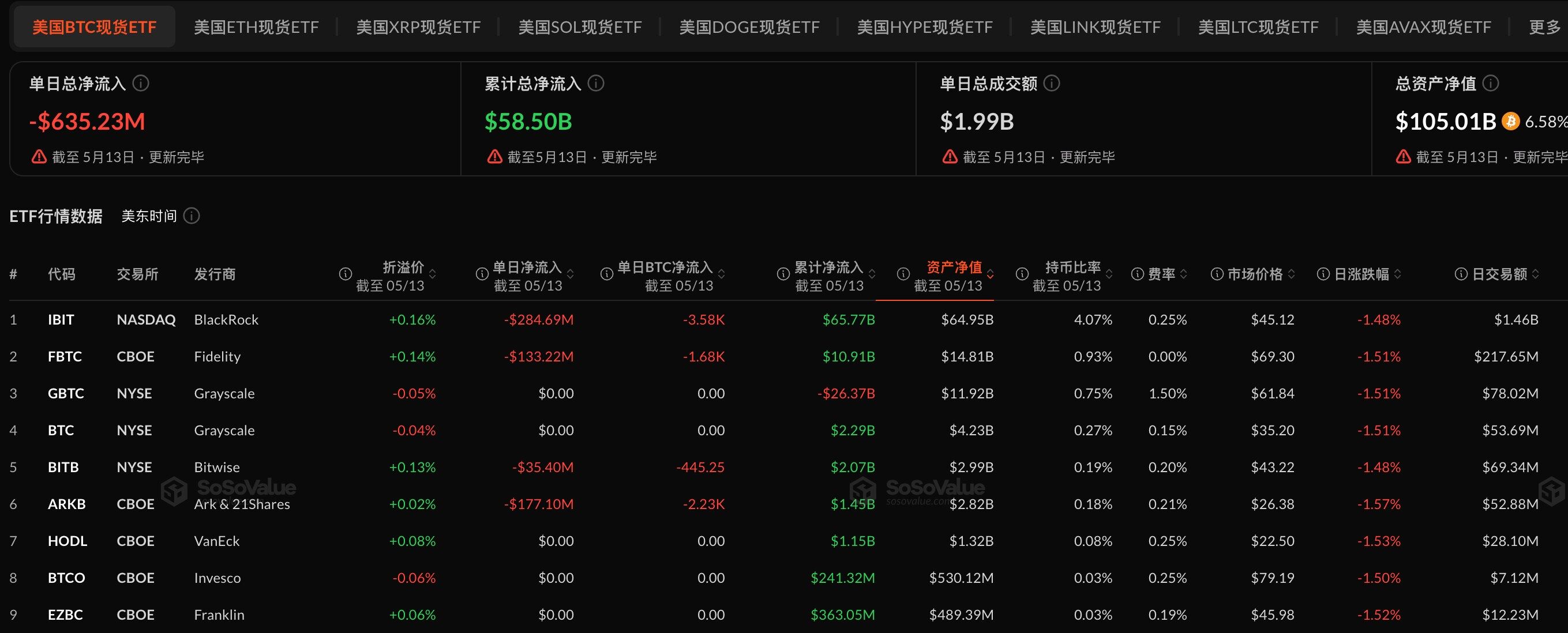
In the field of spot ETFs, the market is highly concentrated, with Bitcoin ETFs holding approximately 1.32 million BTCs, with a total current size of about $10.5 billion. The Beled iShares Bitcoin Trust (IBIT), which holds about 60 per cent of the market share of approximately $65 billion in asset size, has a 0.25 per cent management rate that is clearly competitive in the same product. The FBTC is about $14.8 billion in size, also using 0.25 per cent rates, and is the most direct rival of IBIT. The GBTC, which was the largest encrypted trust fund under the grey-scale flag, was under a high 1.5 per cent rate pressure after conversion to ETF, which is currently about $12 billion in size, while only 0.15 per cent of the BTC mini-trust (approximately $4.2 billion in size) has diverted funds that are sensitive to low rates. For new entrants, Morgan Stanley's MSBT was officially registered in April 2026, marking the official entry of traditional bank giants into encrypted ETF tracks, a signal of far-reaching industrial significance。
With regard to ETF, Belet's ETHA (approximately $7 billion) is leading, and ETHA is currently the largest single ETF product. It is interesting to note that the ETHB, introduced by Belet in 2026, supports the pledge proceeds for the first time, creating an advance for ETF to obtain raw encryption gains, an innovation that may or will reshape the ETF product design logic. Following regulatory reform in 2025, the XRP and Solana categories were able to attract approximately $1 billion each, and it is expected that in 2026 there will be more than 26 emerging stocks of ETFs (e.g. Dogecoin, Chainlink, etc.), and that encrypted ETF product lines will enter the era of "one super-strong" plethora。
In the area of encrypted public treasury and mining companies, structural divisions are taking place. MicroStrategy (MSTR), the founder of the Bitcoin Treasury model, currently holds about 700,000 bitcoins, the largest publicly listed company worldwide. However, with Bitcoin prices falling by about 18 per cent at the beginning of 2026 to date, near some companies ' warehouse cost lines, the growth of pure mining companies, represented by MARA, RIOT, has slowed considerably, and the sustainability of the treasury model has been questioned by the market. Unlike the "forced-sale" dilemma generally faced by Bitmine Treasury, the emerging Equivalent Treasury, represented by Bitmine Immersion Technologies (BMNR), has demonstrated a distinct business logic. BMNR, through its MAVAN pledge infrastructure, generates approximately $196 million per year in regular proceeds, which allows companies to cover operating expenses without selling encrypted assets and to create a truly "basic blood function". By 2026, BMNRR held approximately 4.8 million ETH with a market value of approximately $10.8 billion, representing 3.98 per cent of the global supply of ETH, with the strategic objective of holding 5 per cent of the global supply of ETH. Once this scale is realized, the BMNR will become a major currency holder in the ecology of the Taifung。
There are significant differences in product risk-benefit characteristics in terms of leverage, reverse and theme ETF, requiring careful investor screening. Leverage ETF evaporates about $1.5 billion of bulk assets, revealing the extreme risk of the product, two times more than MSTX and MSTU fell by about 80 per cent in the derivatives magnifying daily gains at the end of 2025. Main products include BITO (1 BTC times), ETHU (2 ETH times futures) and MSTZ (MSTR). The block chain thematic fund provides indirect exposure to robust investors - BKCH (Global X) Repository Coinbase and Core Minerals, BLOK (Amplify) covers approximately 80 block-chain-related shares, and STCE (Credit) rates are only 0.30 per cent, which include about 40 stocks, including MicroStrategy, Bitdeer, etc., which are suitable as a bottom tool for long-term configuration。
Core risk analysis
The dimensions of risk are equally complex and diverse behind the high growth characteristics of the dollar-encrypted currency block. Investors need to establish a clear understanding of the following four-fold risks before constructing configurations。
THE FIRST RISK IS THE DYNAMIC UNCERTAINTY OF THE REGULATORY FRAMEWORK. DESPITE THE ESTABLISHMENT OF THE FIRST FEDERAL STABILITY CURRENCY FRAMEWORK UNDER THE GENIUS ACT 2025, THE OFFICIAL ESTABLISHMENT OF THE UNITED STATES STRATEGIC BITCOIN RESERVE AND THE APPROVAL OF BANKS FOR ENCRYPTED HOSTING, THE OVERALL FRAMEWORK FOR THE REGULATION OF ENCRYPTED CURRENCY IS STILL EVOLVING. THE DIVISION OF JURISDICTION OVER ENCRYPTED ASSETS BETWEEN THE SEC AND THE CFTC IS NOT YET FULLY CLEAR, AND THERE IS STILL POLICY SPACE FOR FRICTION AT THE APPROVAL RHYTHM OF SOME OF THE ETFS. IN ADDITION, IF THE TRUMP GOVERNMENT REORIENTED ITS FINANCIAL REGULATION IN 2026, THERE ARE CERTAIN VARIABLES TO POLICY COHERENCE, AND THE SUSTAINABILITY OF THE REGULATORY DIVIDEND REMAINS TO BE SEEN。
THE SECOND RISK IS THE HIGH VOLATILITY OF THE BOTTOM ASSETS. THE ENCRYPTED CURRENCY MARKET IS KNOWN FOR ITS EXTREME VOLATILITY, AS EVIDENCED BY THE DECLINE OF THE BTC BY ABOUT 18 PER CENT IN EARLY 2026 TO DATE. THIS VOLATILITY IS CHANNELLED TO THE INVESTOR LEVEL THROUGH ETF AND STOCK PRODUCTS, AND BECAUSE OF THE COSTS OF FRICTION, SUCH AS THE EXISTENCE OF MANAGEMENT FEES, DISCOUNTS AND LIQUIDITY PREMIUMS FOR SOME PRODUCTS, ACTUAL LOSSES TEND TO EXCEED THE DIRECT DECLINE IN THE BOTTOM ASSETS. FOR INVESTORS WITH THIS BLOCK IN THE PORTFOLIO, THERE IS A NEED TO TREAT IT AS A HIGH-RISK ASSET, TO EXERCISE STRICT CONTROL OVER THE WAREHOUSE RATIO AND TO AVOID THE TAIL RISK ASSOCIATED WITH EXCESSIVE CONCENTRATION OF A SINGLE ASSET。
The third risk is the financial structure risk of encrypted Treasury. In the case of MicroStrategy, the central logic of its "treasury model" is to repurchase bitcoin by issuing convertible bonds and preferential equity financing, with the expectation that the increase in bitcoin will exceed the cost of financing. This model, however, has significant financial leverage — the continued decline in the value of the currency, which not only shrinks in its silo value, but will also be accompanied by interest payments and debt-servicing pressures at the finance end. While BMNR's pledge-proceed model is more resilient, the pledge-return rate itself is subject to price fluctuations in the Taifung and potential Slashing (failure) risks, and hold-up ETH may be subject to deduction in the event of malicious acts by the certifier. In allocating such assets, investors need to focus simultaneously on the financial structure of the company and the cyclical risks of the underlying encrypted assets。
The fourth risk is a product-level liquidity and tracking error. For leverage ETFs and some small encrypted shares, high fluctuations in the day could lead to depleted liquidity, increased price differentials and increased transaction costs. More importantly, the leverage ETF 'compunding Decay' mechanism means that even if the target is right, holding leverage for a long period of time can cause cumulative losses from rebalancing every day -- - The lessons of MSTX/MSTU at the end of 2025 are telling this. In addition, while the historical discount after the conversion to ETF has narrowed, the high management rate and the lack of income support on bets, compared to competitions such as IBIT, have significantly reduced its attractiveness to institutional funds。
IV. Innovative trends and track opportunities
Despite the risks, the US-owned encrypted currency plate showed several new trends of interest in 2026, which are reshaping its investment logic and product patterns。
The first trend is the advent of the ETF, the most breakthrough product innovation in 2026. Belet ETHB supports the pledge proceeds for the first time, meaning that ETF holders can indirectly obtain the pledge proceeds from the Taifung network by holding shares, without having to run the authentication node or pledge through the DeFi agreement. The innovation upgraded the ETF from a passive warehouse tool to an active revenue generator and significantly expanded the application landscape of the product. For institutional investors, ETHB provides a compliance, easy and easy ETH path without the need to host private keys, a demand that was almost unsatisfied in the traditional financial system. If ETHB is recognized in the market, it can be expected that more pledge ETFs based on other PS chains will be introduced and that the product boundaries of the ETF industry will be widened further。
The second trend is the emergence of a model dedicated to the Treasury of Tokyo. Compared to the Bitcoin Treasury's "buy-and-go" model, the Taicong Treasury generates primary gains through pledge, creating a commercial closed ring - even if the encrypted market enters the bear market, the pledge proceeds can cover operating expenses and the company need not be forced to sell holders. The BMNR strategic objective is "to hold 5% of the global supply of ETH", which, if achieved, will become a currency holder with systemic influence in the tooth ecology, and its strategic decision-making (e.g. participation in POS governance, pledge parameter adjustment, etc.) will have a substantial impact on the entire network. This model may lead to the emergence of more dedicated ETH Treasury companies, forming a completely new investment sub-section。
The third trend is the structural inflow of institutional funds and the rise of chain-based fixed-income assets. Data show that against a backdrop of a decline of about 18 per cent in Bitcoin at the beginning of 2026 and now, institutional funds are moving towards chain-based fixed-income assets. This trend is closely linked to the maturity of the eco-ecosystems by placing them on the table - projects such as EigenLayer, Pendle Finance have built the re-collateralization and proceeds monetization infrastructure, allowing the pledge proceeds to be structured, fragmented and even used as collateral into the DeFi ecology. BMNR and others, such as the stabilization gains from the MAVAN pledge, coincided with the strong demand of institutional investors for "inventory proceeds of encrypted exposure without currency risk"。
The fourth trend is the continued expansion and multi-chaining of ETF product lines. From BTC/ETH to XRP/SOL to the launch of the ETF, to the approval of emerging targets such as Dogecoin and Chainlink in 2026, ETF products are undergoing a fine upgrading from "main currency full coverage" to "precision track configuration". Chainlink’s predictive infrastructure, Solana’s high performance public chain positioning, and Dogecoin’s MEME cultural attributes correspond to different investment themes, such as DeFi, infrastructure, and community culture. Multi-chaining of ETF products will enable investors to more accurately express their judgment about a particular track, rather than passively hold the entire encrypted market。
Participatory strategies and investment logic
In the case of investors who are interested in having US stock encrypted currency blocks, the following provides a risk-based reference framework for investors to judge in their own context。
AT THE CORE BASE LEVEL, BTC AND ETH SPOT ETF (ESPECIALLY LOW-COST IBIT AND ETHA) ARE THE MOST RELEVANT INSTRUMENTS FOR PARTICIPATION. TAKING INTO ACCOUNT THE CURRENT SIZE OF BTC SPOT ETF OF ABOUT $86.9 BILLION, ETH ETF OF ABOUT $18 BILLION, AND THE BRAND ENDORSEMENT OF BELET, THE WORLD ' S LARGEST ASSET MANAGEMENT FIRM, THESE TWO PRODUCTS HAVE SUFFICIENT LIQUIDITY, LOW TRACKING ERRORS AND CLEAR REGULATORY COMPLIANCE. IT IS PROPOSED THAT THE "INDUSTRY BETA" CONFIGURATION BE CONFIGURED AS A COMBINATION, WITH A WAREHOUSE RATIO OF BETWEEN 1 AND 5 PER CENT, MAINLY ASSUMING EXPOSURE TO OVERALL TRENDS IN THE ENCRYPTION MARKET。
AT THE LEVEL OF INDUSTRY BETA, THE BLOCK CHAIN THEMATIC FUNDS (E.G. BKCH, BLOK) PROVIDE DECENTRALIZED OPENINGS COVERING EXCHANGES, MINERS AND INFRASTRUCTURE STOCKS. COMPARED TO HAVING A SINGLE ENCRYPTION COMPANY DIRECTLY, THEMATIC FUNDS CAN REDUCE THE IMPACT OF A BLACK SWAN EVENT WHILE SHARING THE SYSTEMIC DIVIDENDS OF AN OVERALL ENCRYPTED ECOLOGICAL GROWTH. THIS MAY BE THE MOST APPROPRIATE ENTRY POINT FOR LOWER-RISK INVESTORS. THE RELATIVELY LOW STCE RATE (0.30 PER CENT) IS SUITABLE FOR LONG-TERM BASE CONFIGURATION。
ON THE HIGH-RISK AND HIGH-RETURN LEVEL, THE TAIFUNG TREASURY BMNR AND BITCO NATIONAL TREASURY MSTR ARE SUITABLE FOR INVESTORS WILLING TO WITHSTAND HIGHER VOLATILITY IN EXCHANGE FOR THE POSSIBILITY OF EXCESS RETURNS. BMNR'S PLEDGE-PROCEED MODEL GIVES IT OPERATIONAL RESILIENCE OVER MSTRS, WHILE THE MSTR'S "RADICAL ACCUMULATION + LEVERAGE BUY-IN" STRATEGY SHOWS GREAT FLEXIBILITY IN CATTLE MARKETS. THE POSITION OF SUCH ASSETS IS PROPOSED TO BE CONTAINED AT 0.5 TO 2 PER CENT, AND THERE IS A NEED TO KEEP TRACK OF THE IMPACT OF CHANGES IN THE FINANCIAL STRUCTURE OF THE COMPANY AND THE PRICE MOVEMENTS OF ENCRYPTED ASSETS ON SOLVENCY。
AT THE TACTICAL CONFIGURATION LEVEL, LEVERAGE AND REVERSE ETFS (E.G., MSTX, MSTZ) ARE SUITABLE ONLY FOR PROFESSIONAL INVESTORS WITH SHORT-TERM TIMING CAPABILITIES, AND HOLDING PERIODS SHOULD BE IN THE FORM OF DAYS OR WEEKS AND LONG LINES SHOULD BE PROHIBITED. THE LEVERAGE ETF COMPOUND DECLINE MECHANISM MEANS THAT EVEN IF THE RIGHT DIRECTION IS JUDGED, THE REAL RETURNS HELD OVER THE LONG TERM MAY BE WELL BELOW THE PRICE CHANGE FOR THE TARGET. FOR MOST ORDINARY INVESTORS, RESTRAINT SHOULD BE EXERCISED IN THIS CATEGORY。
It is particularly important to emphasize that the above analysis is for information purposes only and does not constitute any investment proposal. Encrypted assets are extremely volatile and uncertain, and investors should make prudent decisions after fully assessing their own risk tolerance. The leverage product is subject to compound decline, pledge assets are at risk of forfeiture, and encrypted treasury companies are under financial leverage pressure — no single asset should be held at an excessive rate, and portfolio diversification is key to long-term survival。
VI. CONCLUSION AND VISION
TAKEN TOGETHER WITH THE ABOVE ANALYSIS, THE US STOCK ENCRYPTED CURRENCY BLOCK WAS AT A CRITICAL STAGE IN THE TRANSITION FROM PRODUCT INNOVATION TO ECOLOGICAL MATURITY IN 2026. BITCOIN SPOT ETF OPENED THE DOOR TO INSTITUTIONAL ENTRY, AND ETF AND ETA TREASURY ARE REDEFINING THE BUSINESS MODEL OF "CONFORMITY HOLDING ENCRYPTED ASSETS". THE REGULATORY FRAMEWORK ESTABLISHED BY THE GENIUS ACT 2025 PROVIDES UNPRECEDENTED POLICY CERTAINTY FOR THE INDUSTRY, AND THE FACT THAT BANKS HAVE BEEN GRANTED ACCESS TO ENCRYPTION HOSTING AND THE ESTABLISHMENT OF A FEDERAL STABLE CURRENCY FRAMEWORK MEANS THAT THE STATUS OF ENCRYPTED ASSETS IN THE UNITED STATES FINANCIAL SYSTEM HAS BECOME IRREVERSIBLE。
Looking ahead, there are several key observational indicators that deserve continuous tracking. First, the continued expansion of the collateral proceeds of Taifung Treasury determines the long-term viability of this business model; second, the inflow of the pledge ETF (ETHB), which will validate the market acceptance of the "ETF+raw gain" product as an innovation; third, the actual approval rhythm and initial fund-raising of the XRP, Solana and others, which will reveal the production space outside the mainstream currency; and fourth, the further clarification of the United States regulatory framework at the federal level, which will determine the sustainability of the long-term institutional dividend of this block。
