
Stabilized coins are just the bank's catfish, not the Terminator
Original title: How Banks Learned To Stop Working And Love Stablecoins
Original by Christian Catalini, Forbes
Photo by Peggy Block Beats
The author's press: The question of whether a stable currency would hit the banking system was one of the central arguments of the past few years. But as the data, research, and regulatory framework become clearer, the answer becomes calmer: the stabilization currency does not trigger large-scale outflows of deposits, but rather becomes a competitive force that drives banks to raise interest rates and efficiency, subject to a realistic “deposit sticky” constraint。
This paper re-understands the stable currency from a banking perspective. It is not necessarily a threat; it is more likely to be a catalyst for forcing the financial system to renew itself。
The following is the original text:

IN 1983, A FLASHING DOLLAR SYMBOL ON AN IBM COMPUTER MONITOR。
Back in 2019, when we announced the launch of Libra, the response of the global financial system, without exaggeration, was quite intense. The fear of a near-survival crisis lies in the fact that once the currency of stability can be used by billions of people immediately, will the control of banks over deposit and payment systems be completely broken? If you can hold a "digital dollar" in your cell phone that can be moved in a moment, why do you keep the money in a current account at zero interest rates, at a very high cost, on a weekend that is basically "stopped"
At that time, it was a perfectly reasonable question. For many years, mainstream narratives have been saying that the stabilization currency is "taking the job of a bank". There are fears that the “deposit” is imminent。
Once consumers realize that they can hold directly a digital cash that is supported by sovereign-grade assets, the base set for low-cost financing of the United States banking system will quickly collapse。
But a recent rigorous research paper by Professor Will Cong of Cornell University shows that the industry may be in a panic too early. By looking at real evidence rather than emotional judgment, Cong has come to the counterintuitive conclusion that, with proper regulation, a stable currency is not a spoiler of empty bank deposits, but rather a complementary presence of traditional banking systems。
It's a sticky deposit theory
The traditional banking model is essentially a wager based on friction。
since the current account (checking account) is the only truly interoperability hub of the funds, any transfer of value between external services will almost have to pass through the bank. the logic of designing the whole system is that as long as you don't have a current account, the operation becomes more troublesome — — the bank controls the only bridge that connects your financial life to each other's split islands。
Consumers are willing to accept the "passage fee" not because the current account itself is so superior, but because of the power of the "coupting effect". You put the money in the current account, not because it's the best place for money, but because it's a central node: mortgages, credit cards, straight pay, where they all work together。
If the assertion that banks are dying is true, we should have seen a large amount of bank deposits going to stable currencies. But that is not the case. As Cong has pointed out, although the market value of a stable currency has experienced a sudden increase, “there is little evidence of a clear correlation between the emergence of a stable currency and the loss of bank deposits”. The friction mechanism is still in force. So far, the spread of stable currency has not resulted in a substantial outflow of traditional bank deposits。
The warnings about “large-scale escapes from deposits” have proved to be more of a panicous projection by the vested interests of their own location, ignoring the most basic economic “physical laws” in the real world. The stickiness of deposits is an extremely powerful force. For most users, the “basket of services” is too convenient to be sufficiently high to allow them to transfer their life savings to a digital wallet simply for the benefit of a few base points。
Competition is a characteristic, not a systemic flaw
But real change is happening here. Stabilizing currencies may not be "killing banks", but it is almost certain that they will upset banks and be forced to become better. According to this study at Cornell University, even the very existence of a stable currency already constitutes a discipline that forces banks to move away from relying solely on user inertia and to begin providing higher interest rates on deposits and more efficient and sophisticated operating systems。
When banks are truly faced with a credible alternative, the cost of doing what they do is rapidly rising. They can no longer legitimately assume that your funds are “locked” but are forced to attract deposits at more competitive prices。
Within this framework, the stabilization currency does not "cake" but rather promotes "more credit and broader financial intermediation, leading to higher consumer welfare". As Professor Cong has said, "Stability coins are not intended to replace traditional intermediaries, but can serve as a complementary tool to expand the boundaries of operations in which banks are already good. I don't know
The threat of withdrawal itself has proved to be a powerful incentive for existing institutions to improve services。
Regulatory Unlock
of course, the regulators have every reason to worry about what they call 'em. — — that is, once market confidence is shaken, the reserve assets behind the stabilization currency may be forced to be sold, thus triggering a systemic crisis。
However, as noted in the paper, this is not an unprecedented new risk, but rather a standard risk pattern that has long existed in financial intermediation activities and is inherently highly similar to those faced by other financial institutions. We already have a well-established framework for dealing with liquidity management and operational risks. The real challenge is not to "invent a new law of physics" but to put existing financial engineering right into a new form of technology。
THIS IS WHERE THE GENIUS ACT PLAYS A KEY ROLE. BY EXPLICITLY REQUIRING THAT THE STABLE CURRENCY MUST BE FULLY HELD IN CASH, SHORT-TERM UNITED STATES TREASURY BONDS OR DEPOSITS, THE ACT MAKES MANDATORY SECURITY AT THE INSTITUTIONAL LEVEL. AS STATED IN THE PAPER, THESE REGULATORY COLUMNS " APPEAR TO BE ABLE TO COVER THE CORE VULNERABILITIES IDENTIFIED IN ACADEMIC RESEARCH, INCLUDING CROWDING AND LIQUIDITY RISKS"。
The legislation sets minimum statutory standards for the industry — — full reserve and enforceable foreclosure, but the specific operating rules are left to the banking supervisory authority for enforcement. Next, the Federal Reserve and the Monetary Supervisory Agency (OCC) will be responsible for translating these principles into enforceable regulatory rules to ensure that stable currency issuers take full account of operational risks, the possibility of hosting failures, and the complexities specific to the interface between large-scale reserve management and block chain systems。
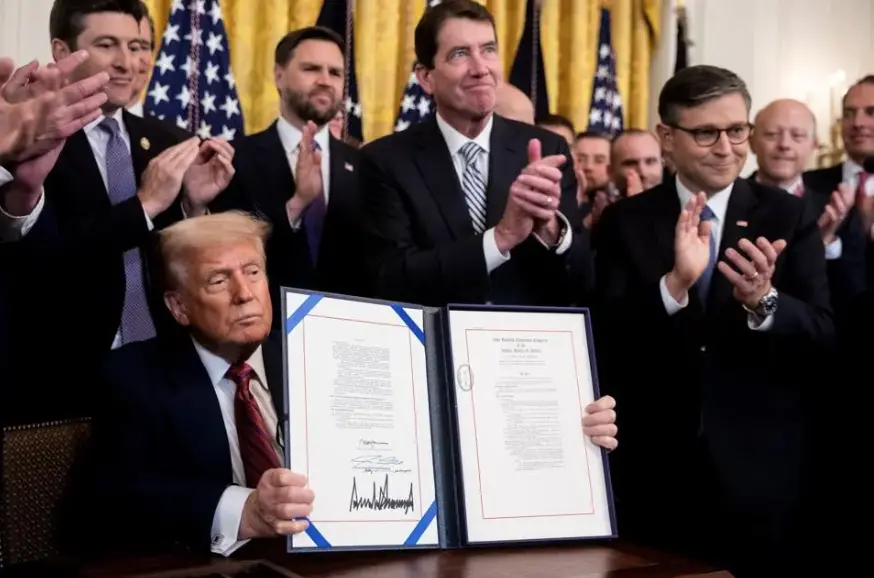
On July 18th, 2025 (Friday), United States President Donald & Middot; Trump presented the recently signed GENIUS Bill at a signing ceremony in the East Hall of the White House in Washington。
Efficiency dividend
Once we stop living in defensive thinking about the diversion of savings, the real top-up space will emerge: the "bottom pipeline" of the financial system itself has reached the stage where it has to be rebuilt。
the real value of tokenization is not just 7× 24 hours availability, but "atom class" — — achieving an instant transfer of value across borders in the absence of counterparty risk is a long-standing problem for the current financial system。
The current cross-border payment system is costly and slow, and funds often require several days of flow between multiple intermediaries to be finally settled. The stabilization currency condensed the process into a chain of ultimately irreversible transactions。
THIS HAS FAR-REACHING IMPLICATIONS FOR THE MANAGEMENT OF GLOBAL FUNDS: FUNDS NO LONGER NEED TO BE TRAPPED FOR DAYS ON THE ROAD, BUT CAN BE TRANSFERRED INSTANTANEOUSLY ACROSS BORDERS, FREEING UP THE CURRENT LIQUIDITY THAT HAS LONG BEEN OCCUPIED BY THE AGENCY SYSTEM. IN THE DOMESTIC MARKET, THE SAME EFFICIENCY GAINS ALSO BODE WELL FOR CHEAPER AND FASTER COMMERCIAL PAYMENTS. THIS IS A RARE OPPORTUNITY FOR THE BANKING SECTOR TO UPGRADE THE TRADITIONAL CLEARING INFRASTRUCTURE, WHICH HAS LONG BEEN DEPENDENT ON TAPE AND COBOL。
United States dollar upgrade
In the final analysis, the United States faces an alternative: either lead the technological development or watch the future of finance take shape in offshore jurisdictions. The United States dollar remains the most popular financial product in the world, but the “track” that sustains it has become significantly old。
THE GENIUS ACT PROVIDES A TRULY COMPETITIVE INSTITUTIONAL FRAMEWORK. IT HAS "LOCALIZED" THIS AREA: BY BRINGING THE CURRENCY OF STABILITY INTO REGULATORY BOUNDARIES, THE UNITED STATES HAS TRANSFORMED WHAT OTHERWISE BELONGS TO THE SHADOW BANKING SYSTEM INTO A TRANSPARENT AND ROBUST "GLOBAL DOLLAR UPGRADING PROGRAM" THAT WILL SHAPE A NEW OFFSHORE WONDER AND SHAPE THE CORE COMPONENTS OF DOMESTIC FINANCIAL INFRASTRUCTURE。
Instead of being concerned with competition itself, banks should start thinking about how to turn this technology into their own advantage. It's like the music industry was forced to move from the CD era to the media age of — — initially resisting, but eventually finding it to be a gold mine; — banks are resisting a transition that will eventually save them. When they realize that they can charge "speed" instead of relying on "delayed" profits, they really learn to embrace this change。

A New York University student downloaded music files from the Napster website in New York. On 8 September 2003, the American Association of the Record Industry (RIAA) filed a lawsuit against 261 users of documents downloading music files via the Internet; in addition, RIAA issued over 1,500 summonses to Internet service providers
