
a16z: When UI is no longer a product, what remains of the moat of software
Data, authority, business logic and implementation capacity
Editor: Over the past two decades, the SaaS moat has been largely built on UI. The dashboard, fields, approval streams and user habits, not only the interface, but also the organization ' s working methods and data order. UI is no longer necessarily the central interface for enterprise software when AI can directly access data, call tools, execute processes, relying on the muscular memory of humans to become less sticky。
THIS DOES NOT MEAN THAT THE RECORDING SYSTEM HAS LOST VALUE, BUT RATHER THAT ITS DEFENSIVE NATURE IS SHIFTING FROM UI AND USAGE HABITS TO DATA MODELS, SYSTEMS OF AUTHORITY, COMPLIANCE RESPONSIBILITIES, BUSINESS LOGIC, IMPLEMENTATION CLOSED LOOPS AND MULTI-STAKEHOLDER NETWORKS. A TRULY BARRIER-FREE SOFTWARE IN THE FUTURE MAY NO LONGER BE A DATABASE THAT RECORDS HUMAN WORK, BUT RATHER AN ACTION SYSTEM THAT CAPTURES CONTEXT, INITIATES MISSIONS, COORDINATES INTELLIGENCE AND PRODUCES NEW DATA ON AN ONGOING BASIS DURING IMPLEMENTATION。
as the software moves to headless (de-interfacing), the core issues of enterprise software change: the value is no longer just who owns the data, but who can organize around the data。
The following is the original text:
Last month, Salesforce announced that it would open the API and launch a headless product. In essence, this means that Salesforce is betting: in the Age of Agent, its core values are no longer primarily from UI, but rather from the data layer. This is a pretty smart repositioning exercise。
It also needs to be noted, however, that at the technical level, the publication does not seem to have brought much substantive change. Salesforce is now repackaged as a "headless products" API, which has been in existence for many years. In other words, it's more like a typical Salesforce marketing release。
The core idea of this new product is that Agent has direct access to the data in the recording system, without having to interact with the UI that is designed for humans. The role of traditional UIs is to help human users track processes, manage tasks and advance workflows; however, the need for this layer of interface has begun to decline after Agent has intervened。
What really deserves to be discussed in this release is not just what new products Salesforce has launched, but what is left of a record-keeping system if it strips off UI and opens only the bottom database? How much difference does it make between a Postgres database, a well-designed data set, and a set of APIs
Further, are the classic factors that once gave long-term defence to the recording system still valid? Or have new competition standards emerged
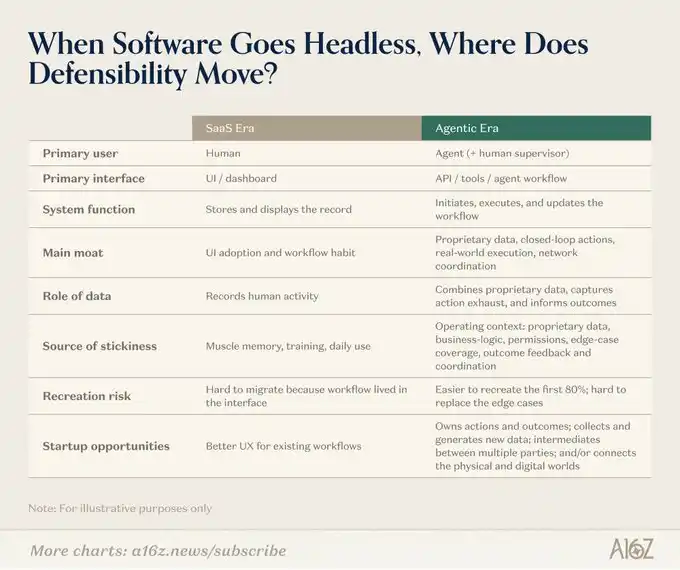
In the SaaS era, the record system had a moat because human users had long lived in its interface. The interface carries operating habits, organizational processes and data deposition, which also leads to high migration costs. But this advantage is being eroded in the Age of Age. A truly defensive hierarchy is sinking into data models, systems of authority, workflow logic and compliance on the one hand, and to network effects, proprietary data generation and real-world implementation capacity on the other。
where does the moat move when the software goes to headless
UI WAS THE PRODUCT ITSELF
The so-called system of records (System of Record, SoR) refers to an authoritative factual source of certain types of commercial data. It is an "official version" of customer relations, employee records or financial transactions and a central system for other tools to read and write back data. CRM is the recording system for income-related data, HRIS is the recording system for personnel-related data and ERP is the recording system for financial-related data。
The strength of these systems is not just because they store data, but because they ultimately become the "real version" on which the entire organization works together。
For the past two decades, Salesforce sold to customers, in fact, a way to help the sales manager manage the team. The dashboard, the sales pipeline view, the forecasting tool, the dynamic flow of information are the products that are actually purchased. Its business model is based on sales of seats to users, which essentially provide access to the above functions. While the bottom database is critical, it is more a hidden infrastructure in product experience。
THAT IS, THE REAL DRIVER OF USER VISCOSITY IS UI。
UI regulates data norms and shapes common language: clues, business opportunities, customer accounts. It allows thousands of sales representatives to keep entering data that they might not have been willing to enter. In the past, UI was the mechanism for maintaining data consistency and availability. Salesforce is so visceral that many sales executives are insisting on bringing Salesforce to the new company after jumping out of a slot, not because of how excellent its interface is, but because it has become a muscle memory。
But Agent is beginning to subvert this pattern. They no longer need to interact with software through UI, but can read and write to the bottom data directly. It has also generated new tools and alternatives that bypass traditional interfaces. Salesforce is not the only example: we have recently discussed that SAP is growing a whole ecosystem that is more suitable for AI calls。
At the same time, Agent, who is capable of operating computers, will make traditional human dimensions, such as preferences, training, undocumented context, less important over time. In other words, the conditions for becoming a permanent record-keeping system are changing。
Past rating criteria
Before discussing what is going to happen in the Age of Agent, it is necessary to return more precisely to the question: What made the record system sticky
THE FIRST FEW FACTORS ARE MAINLY RELATED TO HOW HUMANS USE SOFTWARE AND TO THEIR OWN PREFERENCES. THE DIFFICULTY IN REPLACING SOFTWARE RELIES HEAVILY ON UIS, USAGE HABITS, HUMAN WORKFLOWS, AND INSTITUTIONAL ARRANGEMENTS THAT ARE EMBEDDED IN ORGANIZATIONAL PROCESSES。
First, how often is it visited
CRM WILL BE USED DAILY BY THE GTM TEAM AND MORE RELATED DEPARTMENTS. IT IS THIS HIGH FREQUENCY THAT MAKES IT A CRITICAL INFRASTRUCTURE. THE HUMAN LAYER ON WHICH IT IS BUILT — SUCH AS TEAM MEETINGS, OPERATIONAL HABITS, ORGANIZATIONAL INERTIA THAT HAS EVOLVED OVER MANY YEARS — IS OFTEN THE HARDEST PART TO MOVE. THE REASON IS THAT IT IS NOT EVEN OFTEN IDENTIFIED AS SOMETHING THAT NEEDS TO BE MOVED。
Second, is it written only, or is it both read and written
A TRULY STICKY RECORDING SYSTEM, USUALLY A TWO-WAY READING-WRITING SYSTEM. IN THE CASE OF CRM, IT IS NOT A WRITE-UP SYSTEM THAT IS ONLY ARCHIVED, BUT IS READ ON AN ONGOING BASIS. EVERY CALL RECORD, EVERY PHASE UPDATE, EVERY TASK CREATED IS ENTERED BY A USER WHO USUALLY ALSO CARES HOW THESE DATA WILL BE USED。
This two-way flow means that any alternative must be capable of carrying real-time operational data, rather than simply exporting a historical data. There is hardly an absolute safe break point during the migration. As a result, once an enterprise has become online, it tends to remain permanently within the original supplier system。
ON THE CONTRARY, THE CANDIDATE TRACKING SYSTEM (ATS) IS USUALLY CLOSER TO THE "ONLY WRITING" SYSTEM. WHEN CANDIDATES ARE RECRUITED OR REJECTED, THERE ARE RELATIVELY LIMITED GROUNDS FOR ENTERPRISES TO RETURN TO USE THESE DATA。
THIRD, HOW MANY UNDOCUMENTED SOPS
the real key business context is often not written in any wiki, but in the workflow rules that administrators and system integrators have built over the years。
IN THE CASE OF THE SALES SYSTEM, THESE UNDOCUMENTED CONTEXTS MAY INCLUDE: BUSINESS-LEVEL TRANSACTIONS IN EXCESS OF $100,000 REQUIRING VP APPROVAL; TRANSACTIONS IN THE EMEA REGION SUBJECT TO PRIVACY REVIEW; AND DISCOUNTS FOR STRATEGIC CLIENTS THAT CAN BYPASS FINANCIAL CLEARANCE ONLY AT THE END OF THE QUARTER。
These contexts often determine whether a matter can be moved forward in a timely manner or whether it can be accomplished without compromising key processes. Migration systems imply the dismantling of every rule of automation; otherwise, the enterprise may lose some of its organizational memory directly。
Fourth, how complex is internal or external dependence
The central question is: How many internal systems, team processes or external stakeholders rely on this recording system
INTERNAL CONNECTIVITY REFERS TO HOW MUCH DOWNSTREAM SOFTWARE OR WORKFLOW DEPENDS ON IT. EXTERNAL CONNECTIVITY REFERS TO EXTERNAL SUBJECTS SUCH AS AUDITORS, ACCOUNTANTS, REGULATORS, ETC., WHICH REQUIRE DIRECT ACCESS TO THE DATA. ERP IS A TYPICAL EXAMPLE。
Whether internal or external, the more connected the movement becomes, the more complex the relationship that needs to be dismantled and rebuilt。
Fifth, how critical is the data from a compliance perspective
The central question here is simple: is the system key to compliance
KEY COMPLIANCE SYSTEMS SUCH AS THE PAYROLL SYSTEM, ERP AND HUMAN RESOURCES DATA MUST PROVIDE A LEGALLY VIABLE SOURCE OF FACTS AND HAVE STRICT ADMINISTRATOR AUTHORITY CONTROLS. ANY RELOCATION MAY REQUIRE THE DIRECT INVOLVEMENT OF AUDITORS AND REGULATORS. THIS MAKES THEM SIGNIFICANTLY MORE STICKY。
Such customer support tools as sales data and Zendesk are at the other end. Businesses, of course, are concerned with continuity and context, but in the event of data migration or access rights, usually do not immediately trigger regulatory risk。
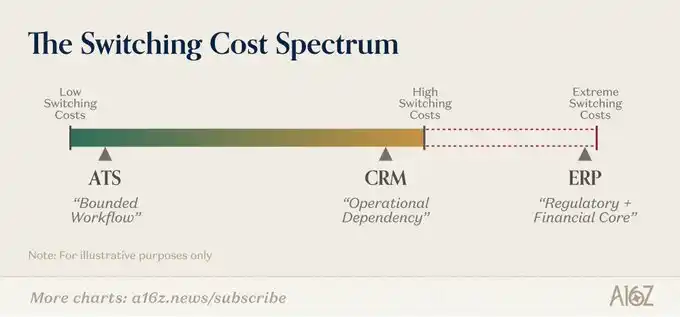
NOT ALL RECORDS SYSTEMS HAVE THE SAME LEVEL OF SWITCHING COSTS. COMPARE CRM AND ATS IN THE SAME GROUP DIMENSION, THE GAP IS VERY CLEAR。
ATS IS A WORKFLOW TOOL THAT SERVES A LIMITED NUMBER OF PROCESSES AND IS BUILT AROUND RECRUITMENT. ONCE CANDIDATES ARE RECRUITED OR REJECTED, MOST OF THE RELEVANT RECORDS ARE TRANSLATED INTO ONE-TIME DATA. IT HAS A NARROWER INTEGRATION AND A SMALLER AND MORE CONCENTRATED USER COMMUNITY。
ERP IS AT ANOTHER EXTREME. THE GENERAL LEDGER ITSELF WAS AN AUDIT TRACK, AND ACCOUNTANTS, AUDITORS AND REGULATORS WERE DIRECT STAKEHOLDERS IN THE MIGRATION PROCESS。
REPLACEMENT ATS IS PAINFUL, BUT STILL BEARABLE. REPLACE CRM LIKE IT'S OPEN CHEST SURGERY. THE REPLACEMENT OF THE ERP IS LIKE HAVING AN OPEN CHEST OPERATION WHILE THE PATIENT RUNS THE MARATHON。
Traditionally, record-keeping systems have not really used such moat sources as proprietary data, network effects; generally, the workflow itself is sufficient to create barriers. To a certain extent, the combination of tools and networks is more consumer-level business; historically SoR has not followed that path。
Proprietary data. Many record-keeping systems, although they contain large amounts of customer data, do not really provide for their in-depth use, and in many cases they are not allowed to do so under contract terms. Thus, while CRM has a wealth of data sets and theoretically can aggregate data from different clients and generate cross-client insights, it has never done so in a truly meaningful way. Of course, Salesforce Einstein has tried some of these products。
NETWORK EFFECTS. FOR THE RECORDING SYSTEM, THE OPTIMAL MOAT WOULD HAVE BEEN A NETWORK EFFECT: CRM, FOR EXAMPLE, IS MORE VALUABLE BECAUSE SOFTWARE SELLERS CAN FIND BUYERS IN IT. BUT, LIKE DATA, THE NETWORK EFFECTS OF RECORD-KEEPING SYSTEMS HAVE HISTORICALLY BEEN WEAK, IF NOT ALMOST NON-EXISTENT。
If UI disappears, what's left of the software after Agent arrives
Agent does not need a browser. What it needs is API, context, instructions, and the ability to execute actions. There are two things that make this possible: first, LLM already has a sufficiently strong reasoning capability, so Agent can now read the context, plan, select tools, execute actions and reset results, without human intervention in most missions; and second, MCP standardized tool access, providing Agent with a common interface for external access。
An Agent with MCP access is capable of large-scale completion of past human user operations on the platform in millisecond time without a browser. If the context is sufficient, Agent, who can operate the computer, can even directly use the existing software interface without necessarily needing an API。
In short, software buyers now have three paths:
First, continue to use and superimpose the existing system。
By using the existing systems, CLI and API, it is possible to use both the manufacturer's original Agent products, such as Salesforce's Agentforce, SAP's Joule, and build it on itself. Of course, it is assumed that the API is complete and available, and it ignores the complexity of "headlessization" in the actual operation。
Second, a fully self-established record-keeping system。
From scratch, enterprises can build their own data models, business logic, competency systems, audit tracking, system integration, and their own Agent warehouse. This path is likely to use third-party Agent to develop tools and database tools。
THIRD, BUY AN AI PRIMARY ALTERNATIVE。
Enterprises can also buy a new generation of software designed for the Age of Agent from the beginning. These products emphasize machine readability, with Agent organized as a first-class capability, rather than adding an AI function to the old system by patching. Such products may also be of the headless type。
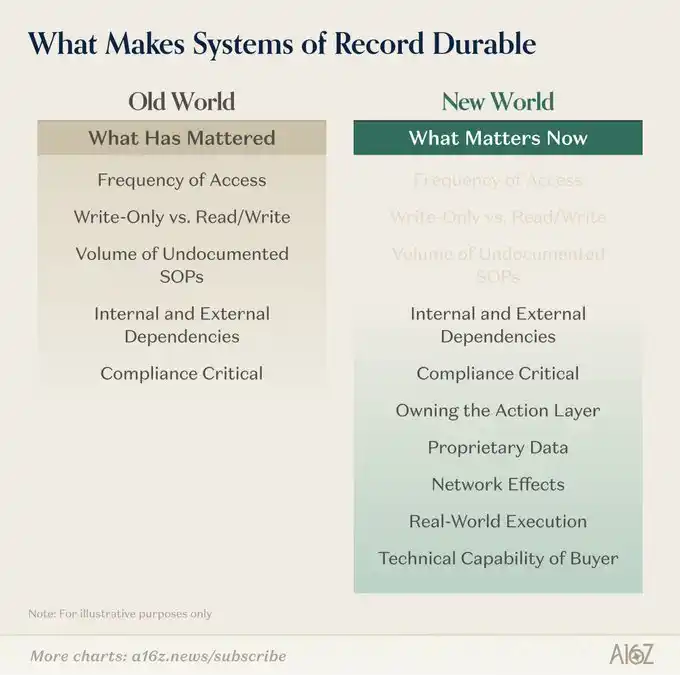
So which of the old rating criteria will be retained
Factors driven by human behaviour and preferences, such as frequency of access, reading and writing of two-way properties and other indicators related to human muscle memory, are gradually diminishing. Agent may weaken the value of "mustual memory" as a moat, but they will not eliminate the moat in operation logic and operational context. In a sense, they would make these logics even more important, as Agent had to rely on clear rules, competencies and process definitions to carry out his mandate safely。
UNDOCUMENTED SOP, STILL IMPORTANT IN THE SHORT TERM。
The institutional logic within the organization that settles in the workflow rules is exactly what Agent needs for you to do your job properly. At the same time, it is also the hardest part to rebuild. At least for the time being, it cannot be exported cleanly, especially when part of the process still requires human participation. However, capturing the context is becoming easier and the importance of this factor will diminish as Agent replaces more manual labour。
Connectivity is still difficult to dismantle and extends deeper。
The meaning of connectivity is changing. It is no longer just to complement human work, but rather to maintain a link between functions and software that have traditionally been cut off from each other。
A CRM Agent needs to link data and context from different points of sale, billing, customer success, etc. If your platform is also the node of the Agent transaction between a number of outside organizations, such as buyers, sellers, partners, through which they interact, then the dependency relationship will deepen。
It may be difficult to work smoothly between the basic objects and logic of the different bottom software when there is a manufacturer superimposed; enterprises may face similar problems if they rely on a self-built database and a set of Agents。
Key data for compliance remain important。
There is still a need for a single, credible source of factual data on regulatory bodies, regulatory or legal risks. If clients already trust existing products, they are less likely to switch systems。
In the case of remuneration and accounting data, for example, Agent may indeed need access to these data, but enterprises are generally less likely to choose to build and maintain such systems internally and permanently。
One of the most difficult questions in a fully agent world is: which ones are Agent mandated to do? Who are they acting on? How are these acts audited? If a record system can become an interactive identity and authority layer between Agent, it acquires a truly difficult structural role to replace. The barrier here is not just what data it holds, but what kind of trust structure it implements。
IN THE PAST, A NEW SET OF FACTORS WILL BECOME INCREASINGLY IMPORTANT FOR AI START-UPS AND DETERMINE WHETHER THEY CAN BE DEFENSIVE。
First, how hard is it to rebuild this recording system
Data will become more important at several levels。
FIRST, IN THE SHORT TERM, THE KEY IS THE EASE OF EXTRACTING AND RECONSTRUCTING DATA AT THE BOTTOM OF THE RECORDING SYSTEM. AI IS MAKING THIS EASIER, AND A NUMBER OF TOOLS ARE HELPING USERS TO COMPLETE SUCH MIGRATION AND RECONSTRUCTION。
In the short term, it is possible and likely to be difficult for existing manufacturers: they can make API difficult to use, restricted, incomplete, or economically uneconomical, even without providing API. However, as extraction tools continue to improve, especially as the capacity of Agent to operate computers increases, data reconstruction becomes easier。
At the same time, the new company is rebuilding a richer set of data from mail, telephone, voice Agent and internal files. AI reduced the cost of 80% before rebuilding a record system. The real distinction between a useful entry point and a real alternative is 20 per cent: anomalies, approval processes, compliance requirements, and work flow in the margins。
Secondly, is there really meaningful proprietary data
Second, the data themselves will become more valuable。
Real defensive data is not the data you import, but the data your product uniquely generates. We often say "data wall gardens": these data are either proprietary, regulated or continuously updated. A software provider that invests heavily in the collection of authoritative and complete data has a clear advantage over generic suppliers or competitors lacking such data。
There is another important direction for the data: whether it relies on actions generated within the product。
The best companies do not simply store data from elsewhere. They will continue to generate new data trails because they are in processes, such as observed behaviour, response rates, time patterns, process results, industry benchmarks, abnormal patterns, and implementation trajectories。
The point is: data are the context。
Third, do you master the action level
In the old world, storage records are enough in themselves. But in the new world, Agent will act directly and defensively may turn to products that can form a closed circle: from taking action to capturing results, to using feedback to optimize future decision-making。
IN THE CASE OF ERP, THIS MAY INCLUDE THE APPROVAL OF EXPENSES, THE TRIGGERING OF PAYROLL, THE RECONCILIATION OF INVOICES, THE DISPATCH OF NOTICES, ETC. PRODUCTS THAT CAN BE CLOSED ARE MORE DEFENSIVE BECAUSE THEY ARE EMBEDDED IN THE IMPLEMENTATION PROCESS AND NOT JUST AT THE OBSERVATION LEVEL. THEY GENERATE UNIQUE DATA THAT ARE CONTINUALLY IMPROVED AS THEY ARE USED, AND BECOME MORE DIFFICULT TO REPLACE BY DESTROYING THE WORKFLOW ONCE REMOVED。
Of course, as the context accumulates and the margin scenes are fully addressed, the value here will rise even further。
Fourth, does it include a real-world implementation link
Some business models are linked to the operation of the real world and these are not fully automated. The most obvious example is the company with an operating network, such as DoorDash. They are historically not part of the records system, but they are instructive here。
More broadly, any company that can extend software closed loops to services, performance, logistics, on-site operations or payment links has a defensive character different from that of pure SaaS. Such companies do not simply store records or recommend actions; they send personnel, move goods or perform specific services。
For entrepreneurs, this means that opportunities may arise in markets where software is increasingly able to make decisions and Agent is increasingly able to coordinate processes, but the last kilometre still requires implementation in the real world. For example, vertical software bound to field services is a typical direction。
Fifth, are there network effects
Historically, the network effects of most record systems have been weak, as they are mainly internal software. But in the Age of Age, if a system is embedded in multiple work streams, the network effect can become much more important。
If a system is responsible for reconciling repetitive interactions between multiple parties, such as buyers and sellers, employers and employees, companies and auditors, suppliers and customers, and payers and service providers, each additional participant may add value to the network for the next participant。
One way to do this is to share workstream synergies: the product becomes a place where the process parties trade, exchange context and deal with anomalies。
Another approach is benchmarking and intelligence: systems can be based on models observed in the network, presenting industry patterns, anomalies and proposals for action, which in turn reinforce the data values mentioned above。
The third approach is trust and standardization: once the counterparty begins to rely on the same track to complete approval, handover, compliance or payment, the product will no longer be a database but a synergetic infrastructure of the market itself, and will therefore be more difficult to replace。
Sixth, how strong is the buyer's technical capacity
In a world where everyone can theoretically build their own Agent, the real capacity-building available to different buyers is still very different. Especially in the vertical sector, as well as in functional buyers who did not have strong internal engineering resources in the past, the probability of building, maintaining and continuously improving databases, workflow logic, Agent bars and governance levels remains low。
THE COST HERE IS EQUALLY IMPORTANT. DEY MAY THEORETICALLY REDUCE SOFTWARE AUTHORIZATION COSTS, BUT IT TENDS TO SHIFT EXPENDITURE TO IMPLEMENTATION, MAINTENANCE AND INTERNAL COMPLEXITY。
This means that real opportunities still exist among those that operate in a complex but under-supply of technology. Examples include manufacturing, construction backstages, industrial processes, on-site service workflows, and accounting。
Other factors are equally important and will gradually become the basic threshold for software。
For example, the ontology needs to change. Many of the ideas of "self-build databases" underestimate the value of the object model itself. The software is designed for dashboards, reports and human users, and captures objects in the work stream, such as commercials, worksheets, candidates, etc。
But Agent-era schema needs to capture reasoning, movements, state tracking, anomalies, assignments, and cross-system synergies. Original object models may no longer be business opportunities, worksheets and candidates, but rather tasks, intentions, threads, strategies or outcomes。
Similarly, the system of competencies needs to be updated. It's not just about managing human users, it's about managing Agent. This includes: who can do what, through which Agent, what approvals are required, what audit tracks are left, and how rollbacks and anomalies are handled。
Of course, all this has to do with the cost, for example, how much it costs to build and maintain Agent and the database, and how much API access costs. This brings back to several core issues: how hard it is to rebuild data, how much dependence and how deep the system is embedded。
So what's the conclusion
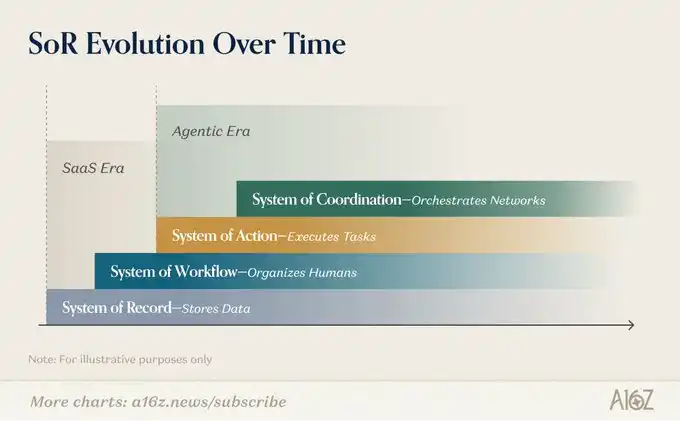
as established software manufacturers move to headless, they are in fact making an implicit note that the data layer will remain a core source of value. in some categories, particularly in highly regulated areas such as financial services, this bet may also take place over time and the process of windlessization may be slower。
For software entrepreneurs, however, the issue is changing as established manufacturers begin to de-interface, how to compete with them and how to build long-term defensive software。
The next generation of record-keeping systems has begun to take different forms: They are no longer just data repositories used to record human work, but are more Agent properties - capable of capturing context, initiating work on its own initiative and recording the tails of data generated during implementation。
Further, the most interesting companies will extend to the real world's executive level: They coordinate on-site staff, logistics service providers, service teams and physical assets, or they are in the middle of multi-party collaboration between multiple participants。
These companies will mix the many business models of the old world. The core of the traditional record-keeping system, namely, data, will gradually retreat backstage and become the bottom base that underpins the operation of the system as a whole。
[ Chuckles ]Original Link]
