
Web3 high walls and beyond: the Chinese entrepreneur's encryption trap and breaking codes
The nature of encryption without borders, the regulation of encryption and the claims of States to its benefits, both of which conflict with each other, will for a long time dominate the development of the encryption industry. 。

_Other Organiser
At a time when the encryption industry is increasingly being mainstreamed, Chinese entrepreneurs seem to be moving further and further away from the centre of the stage。
Once upon a time, Chinese-created projects have taken over half of the industry, including the well-known encrypted currency exchanges of Cheonan, OkX, Bybit, Bitget, Gate, HTX, Bitmart and others. This is particularly true of mining, where projects such as the Bit Continent, Kanan Ji-ji, and the Starfire Pool are important in the industry. What they all have in common is that they're basically created in 17-18 years or earlier。
Although Zhao Chang Peng, Xu Sing, Wu Zhuong, and Sun Woo are still at the forefront of the industry, a general consensus has emerged since 2020, following DeFi Summer’s boom: the visibility and voice of a new generation of Chinese entrepreneurs in the global encryption industry has declined, and so far there have been no leaders who can stand alongside the previous generation. What happened to Chinese entrepreneurs' ecology? Where are the future opportunities
Regulatory and geo-environmental re-engineering: the first severe impact of ecological faults
The most important factor over the past five years has been the dramatic change in the regulatory and geopolitical environment。
SINCE 2021, CHINA ' S EFFORTS TO REGULATE ACTIVITIES RELATED TO THE ENCRYPTION OF CURRENCY HAVE INCREASED SIGNIFICANTLY, AND THE SCENES OF TRADING AND MINING, WHICH WERE SCATTERED IN THE GREY ZONE, HAVE BEEN CUT OFF RAPIDLY. IN THESE FEW YEARS OF MARKET HOTSPOTS, ALMOST ANY RED-HOT CONCEPT WILL BE MATCHED BY REGULATORS’ ROLL-CALLS, FROM PREVIOUS ICOS, NFTS AND DIGITAL COLLECTIONS TO RECENT PAYMENTS, REAL-WORLD ASSETS, WHICH WILL UNDOUBTEDLY LIMIT TO SOME EXTENT THE FLOW OF HIGH-QUALITY RESOURCES TO CHINESE ENCRYPTED ECOLOGY。
These strikes have not only led to an accelerated out-migration of mining and exchange operations, but, more crucially, it has deprived Chinese entrepreneurs of a natural, networked, talent-density and capital-mapping local market and forced them to move to a foreign-born environment。
IN THE EARLY ENCRYPTED ECOLOGY, MANY OF THE EXPLOSIVE GROWTH CHINESE PROJECTS ARE RAPIDLY ACCUMULATING USERS UNDER THE MOBILIZATION MECHANISMS OF THE CHINESE INTERNET COMMUNITY: MICRO-INTELLIGENCE FISSION, KOL NETWORKS, MEDIA MATRICES, SUB-LINEAL GATHERINGS... THESE CHANNELS WERE ONE OF THE MOST EFFICIENT SYSTEMS OF ENCRYPTED NARRATIVE DISSEMINATION. HOWEVER, CHANGES IN REGULATORY POLICY HAVE LARGELY RENDERED THE SYSTEM INEFFECTIVE。
This was followed by a rapid transfer of the industrial power centres to Europe and the United States – the United States’ lead in compliance, the influx of institutional capital, and the growing maturity of regulatory frameworks – which began to shape an industry order different from that of 2017-2018. New narratives, new regulatory patterns and new capital structures are naturally more oriented towards the English-speaking market and more compliant entrepreneurial teams. An encrypted project such as the forecast market, which has a certain gaming nature, is difficult to create in a Chinese-language market environment that strictly regulates lottery。
In such an industry environment, a new generation of Chinese entrepreneurs also have more difficulty gaining access to global media, regulators, capital and users’ “default trust” – with more trial and error costs in marketing, compliance, etc. than similar European and American projects。
Capital preferences shift: secondary impact of ecological faults
If the systemic divide between regulation and geo-environment is the first shock, the "structural bias" from capital markets further exacerbates the marginalization of Chinese entrepreneurs in the new cycle。
IN TODAY ' S INDUSTRY ENVIRONMENT, WITHOUT STRONG VC FINANCIAL AND RESOURCE SUPPORT, THE PROJECT IS VULNERABLE AT THE LEVEL OF USER ACQUISITION, CURRENCY APPRECIATION, NARRATIVE, ETC., AND CHINESE ENTREPRENEURS ARE ALREADY AT A DISADVANTAGE IN THE FIRST PLACE ON THE FINANCIAL FRONT。
IN THE LAST TWO TO THREE YEARS, THE CHINESE BACKGROUND VC HAS LARGELY REDUCED THE FREQUENCY OF INVESTMENT, OR EVEN STOPPED IT ALTOGETHER. CHINESE ENTREPRENEURS ARE SEVERELY CONSTRAINED IN THEIR CHOICE OF SPACE, BOTH IN TERMS OF FINANCING AND EXIT ROUTES. IN THE FACE OF THE EUROPEAN-AMERICAN DOMINANCE OF THE VC, THE CHINESE PROJECT HAS ALSO SHOWN A DOWNWARD TREND IN THE AMOUNT AND VOLUME OF FUNDING IT HAS RECEIVED IN RECENT YEARS, OWING TO LINGUISTIC AND CULTURAL DIFFERENCES。
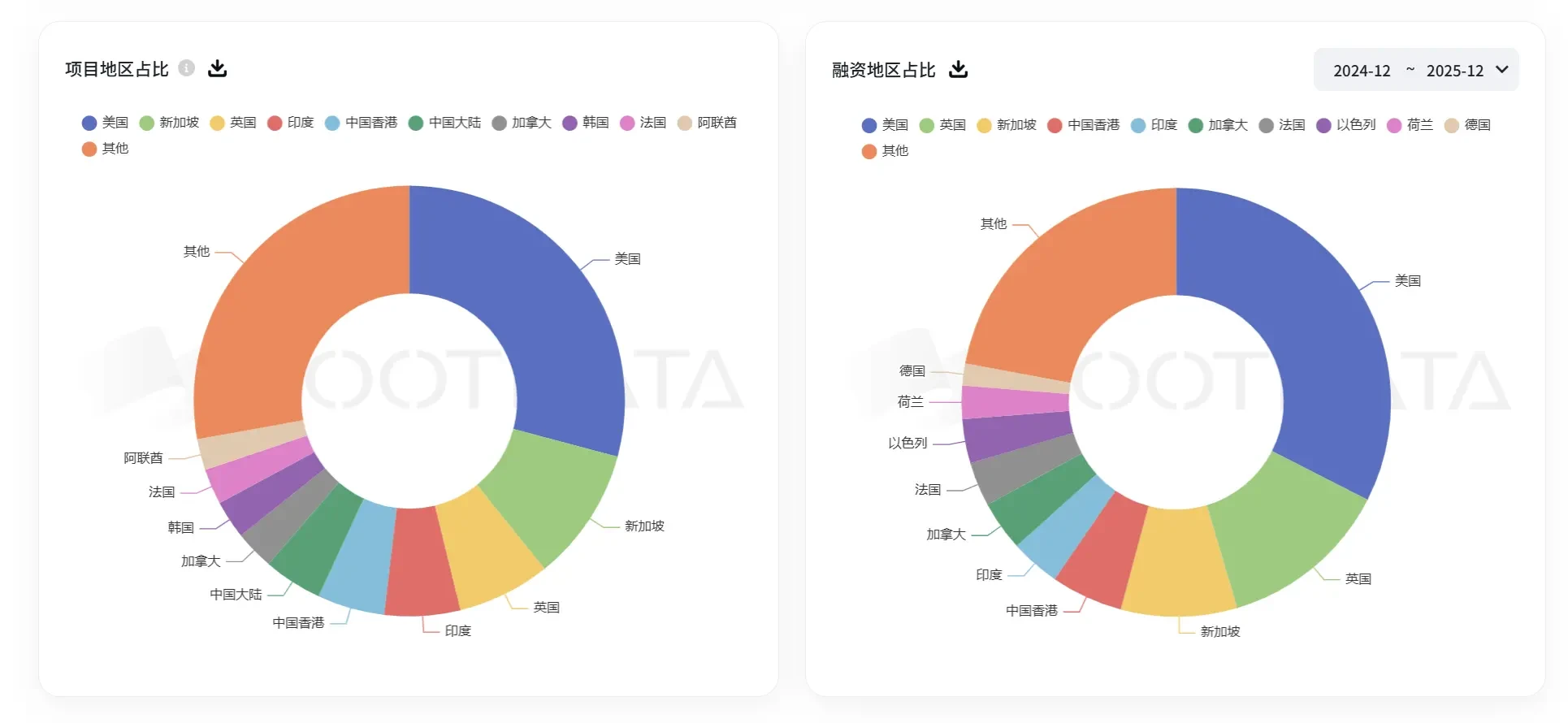
Source: RootData
Since the beginning of this year, the encryption industry has launched a wave of mergers and acquisitions, successful listings of companies such as Circle and Gemini, and frequent acquisitions such as Coinbase and Ripple, which have greatly increased confidence in entrepreneurs and even VC, but which are largely unrelated to Chinese projects. It can be said that the Euro-American project is benefiting from the institutional dividend of mainstreaming the encryption industry。
In terms of mainstream capital, the US-Europe project has natural advantages in terms of compliance, cultural identity, and exit, and it is difficult for the Chinese project to win European-American capital unless it has a strong advantage in team configuration and technical background。
The mismatch between capacity structure and industry maturity: the third severe impact of ecological faults
Over the past decade, the main melody of the encryption industry has been in infrastructure and tools tracks, during which many of the new concepts, such as DeFi, NFT, games, inscriptions and so on, have not been mainstreamed。
In a previous interview with ChainCatcher, the founder of Folius Ventures, Jason Kam, stated that during the past 5 to 10 years, Web3 has developed in the form of foundation-building, and more importantly product categories and states, a 10-year focus on ecology, infrastructure, tools and consensus-building. In other words, it's also a B2B product for 10 years。
EUROPE AND AMERICA HAVE THREE GENERATIONS OF EXTREMELY GOOD ENGINEERS WHO ARE VERY GOOD AT BUILDING THIS B2B ECOLOGY. THE ASIA-PACIFIC REGION IS DOMINATED BY 80 POST-80, 90 POST-90 YOUNG ENGINEERS WHOSE CAREER PATHS ARE ACTUALLY BEING DEVELOPED WITH CHINA’S B2C INDUSTRY, WHICH BEGAN IN 2005. IN OTHER WORDS, THEIR ENGINEERING EXPERIENCE IS IN TERMS OF B2C AND APPLICATIONS, WHICH ARE INCOMPATIBLE WITH THE ENTIRE CHAIN OF BLOCKS, SO THEY MAY NOT BE DOING WELL IN TERMS OF THE PUBLIC CHAIN AND INFRASTRUCTURE。
"If entrepreneurs in Asia and the Pacific compete with entrepreneurs in Europe and America at the ToC level, I believe that Asia-Pacific entrepreneurs do not have any disadvantage, or even advantages, because they have great product experience, and because they are extremely aggressive in taking market shares. I don't know
Although Chinese entrepreneurs have demonstrated this in the context of the Web2-based exchanges, with regard to the C end-end product, Stepn’s flower now supports the Chinese entrepreneur’s talent in C-end products, and the overall market for consumer-grade products is delayed, which is closely related to the maturity of the industry’s infrastructure, which has not yet reached the “comfort zone” of Chinese entrepreneurs。
Multicultural entrepreneurs are becoming industry leaders
Strictly speaking, Chinese entrepreneurs have not been new examples in recent years. The founder of Hyperliquid, Jeff Yan, was born of Chinese origin, when his parents immigrated to China, were born and grew up in Palo Alto, California, United States of America, and then admitted to Harvard University to major in mathematics and computer science. After graduation, Jeff joined the HF trading giant Hudson River Trading as a quantitative trader. In 2022, Jeff created Hyperliquid, which was built on the concept of "small but lean", "no VC" and "user-driven growth" as the fastest growing encryption industry in recent years。
However, while Hyperliquid is one of the most successful projects in this cycle, it is difficult to see it as a continuation of the influence of Chinese entrepreneurs, as he is hardly active in Chinese ecology, and has developed almost all the Euro-American values in the outside world and has not expressed them in Chinese. The rise of Jeff and Hyperliquid underscores the fact that, in the new cycle, Chinese descent may still have global influence, but only if it is integrated into the mainstream cultural system, rather than dependent on old Chinese entrepreneurial paths. If you rely on a single cultural system, you can only become a regional champion and not achieve excellence in the globalization process。
Indeed, many of the well-known Chinese projects that have led the raceway in this cycle, most of whose founders have a multicultural background, have been enrolled in Europe and the United States at least at the university level, such as the founders of Saha, Sean Ren, Kaito, Yu Hu, and BuidlPad, founders of Erick Zhang, whose long-standing experiences play an important role in their development。
In fact, entrepreneurs with a multicultural background do enjoy much more in the encryption industry, such as the founders of Taifung, Solana, and the founders of Bian, Zhao Chang Peng, who immigrated from their childhood to North American countries, and whose different political systems collided with culture, making it possible for entrepreneurs to become more aware of the value of individual sovereignty in the chain of blocks and to move quickly to action, focusing on cultural inclusion in team formation, resource matching, and day-to-day operations, and eventually gaining easier access to users from different regional cultural backgrounds。
The nature of encryption without borders, the regulation of encryption and the claims of States to its benefits, both of which conflict with each other, will for a long time dominate the development of the encryption industry. It is true that Chinese entrepreneurs face increasing challenges in the context of the multiple conflicts between China and the United States and the mainstreaming of the encryption industry, but at a time when the encryption industry has recently been confronted with many gaming tendencies, nihilistic questioning, and even more project concepts, the development of Chinese entrepreneurs may no longer be an important issue for the industry, and it is of real concern that, when the boom in rhetorical growth and narrative bubbles recedes, who can continue to invest in the long-term value of decentre technologies and redefine the industry through real products and proven innovations。
The core competitiveness of the future industry landscape will depend more on the ability of the founding team to engage in cross-cultural collaboration, long-term technical input and institutional understanding and organizational resilience in the face of regulatory uncertainty. Regardless of the cultural or national context, those who can sustain these dimensions can be the real beneficiaries of the next cycle. In other words, the success of the encryption industry never depends on where they come from, but on what they can do。
