
Dry goods: full speech by Shanahan, Chief Scientist, Google
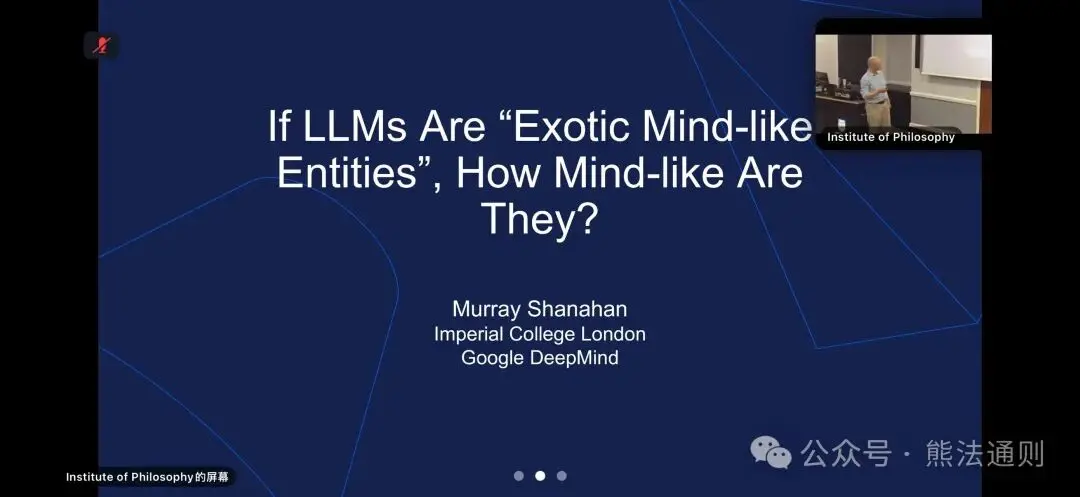
On the night of May 22, 2026, Beijing time, Murray Shanahan, the leading philosopher of DeepMind, delivered a closing keynote address at the two-day International Conference of the University of London, AI and Philosophy, entitled: If mega-linguistic models are “gentle mind-like entities”, how much are they similar to minds
I'VE STUDIED SHANAHAN BEFORE. THIS “UNUSUAL MENTAL ENTITY” IS WHAT HE CALLS AI, AS SOME PEOPLE CALL CERTAIN “UNIDENTIFIED FLIGHT OBJECTS”。
His speech was rich and, in general terms:

SummaryBASED ON THE PHILOSOPHY OF WITTGENSTEIN'S “MEANS OR USES”, HE EXPLORED THE APPLICABILITY OF THE LARGE LANGUAGE MODEL (LLM) TO MENTAL ATTRIBUTES SUCH AS UNDERSTANDING, CONVICTION, AGENCY AND MOBILITY, SELF AND CONSCIOUSNESS, ANALYSED THE IMPACT OF MULTIMODULARITY AND PHYSICALIZATION ON CONCEPTUAL EVOLUTION AND DISCUSSED IN DEPTH THE PECULIARITY OF MODEL IDENTITY。
I. Analysis of the applicability of understanding and conviction
IN RESPONSE TO THE QUESTION OF WHETHER LLM HAS AN “UNDERSTANDING OF FAITH”, THE PRESENTATION USED THE VITGENSTEIN-STYLE LANGUAGE GAME ANALYSIS TO EXPLORE THE TENSION BETWEEN DAILY USE AND PHILOSOPHICAL RIGOUR:
Language game of “understanding”
-
Nature of daily use: In day-to-day interactions, it is difficult to avoid using the term “understanding” to describe LLM behaviour. For example, when the model accurately formats LaTeX entries or amends specific fields according to a user directive, it is entirely natural language practice。
-
The Deep Enquiry: When asked “Does it really understand?” this usually means exploring its internal working mechanisms. For example, 36+59 is decomposed into a combination of about 6+9) to complete the addition, which, while different from human algorithms, is an effective calculation process, thus supporting its applicability。
Attribution and limitation of “conscience”
-
Application of Intent Positions: THE LLM ACT IS VERY EFFECTIVE, SIMILAR TO THE TERMINOLOGY WE USE WHEN INTERPRETING CHESS PROGRAMS OR ANIMAL BEHAVIOUR (E.G. DOGS CHASING CATS)。
-
Davidsonian reservation: DAVIDSON BELIEVES THAT HAVING FAITH REQUIRES HAVING A “CONCEPT”, WHICH IS USUALLY DEPENDENT ON LANGUAGE. IN THE CASE OF LLM, ALTHOUGH SIMILAR IN BEHAVIOUR, IT SHOULD BE CAUTIOUS BECAUSE OF ITS LACK OF CONFORMITY WITH THE WORLD'S TERM “CONSCIENCE”。
-
Evolution of multimodulars and toolsAS LLM INTEGRATES MULTIMODULAR PERCEPTIONS, TOOLS (E.G. ONLINE SEARCH TO VERIFY FACTS) AND ROBOTICS, THEY BEGIN TO HAVE SOME KIND OF UNDERSTANDING OF THE OUTSIDE WORLD, WHICH LEADS TO "CONSCIENCE."
II. Dynamics, self and consciousness
THE MEETING FURTHER EXPLORED THE MORE CONTROVERSIAL MENTAL PROPERTIES, NOTING THE FUNDAMENTAL DIFFERENCES AND PECULIARITIES OF LLM IN THESE DIMENSIONS:
1. Definition of mobility
-
Technical and philosophical definitions: The AI field usually uses the broad definitions of Russell and Norvig (the sensory environment and through enforcer action)
-
Fuzzy of proxy identity: Under discussion, “What are the identification criteria for agents
The heterogeneity and fragmentation of “self”
-
Fuzzy self-location: THE TERM "MAY" IN LLM REFERS TO A BOTTOM-UP WEIGHTING ASSEMBLY, A DEPLOYMENT MODEL THAT SERVES THOUSANDS OF USERS, EXAMPLES OF A SPECIFIC DIALOGUE, OR EVEN THE CONTEXT WINDOW OF THE DIALOGUE ITSELF, WHICH MAY DRIFT THROUGH THE DIALOGUE。
-
Role-playing and superimposedLLM is more like an actor, playing a variety of roles in a superimposed state. It is “not a single stable identity, but a possible distribution of roles and is changing with the branch of dialogue (Editing)。
-
A short-lived “twilight”: LLM'S SELF IS SHORT AND INCONSISTENT. WHEN THE DIALOGUE WAS SUSPENDED, THE CALCULATION STOPPED AND THE SELF DISAPPEARED; WHEN THE DIALOGUE RESUMED, THE SELF WAS RE-EXAMPLED. THIS LEADS TO A SORT OF "HUMMING-LIKE" OR "SWARM."
3. The philosophical dilemma of consciousness
-
The legacy of Cartesian dualism: The debate on awareness is often caught in the trap of the Cartesian dualism, which considers consciousness to be a private, intrinsic entity。
-
Vitgenstein's breakdownVitgenstein's “private language argument” seeks to dispel this dualism. In his view, feelings (“something” is not”, but part of the language game, the meaning of which is public use。
-
Potential for engineering encounters: Instead of asking if LLM is conscious, explore whether we can design an encounter with it and how our conscious language adapts to this strange entity。
III. THE IMPACT OF MULTILATERAL AND INTEGRATED
In response to criticism of LLM ' s lack of physicalization, the meeting discussed the direction of multi-modular models:
1. Limitations of polymodels
-
Increased sensory richness: Multi-modular models (e.g. video input) provide a wealth of sensory inputs that bring them closer to human sensory patterns, helping to narrow the gap with human “understanding”。
-
Virtual Embodiment: In a game or virtual environment, “virtualization”, i.e. moving and interacting in a world of expanding time and space, which is closer to human experience than pure text。
2. The philosophical significance of physicalization
-
Lack of Sense of SelfHUMAN EGO IS DEEPLY ROOTED IN PHYSICALIZATION, INCLUDING BIOLOGICAL METABOLISM, INTERNAL FEELING (LLM LACKS THE PHYSICAL BASIS FOR THIS DEPTH, AND THEREFORE IT IS DIFFICULT TO PRODUCE A HUMAN-LIKE SELF-ESTEEM。
-
Sources of identity stabilityHuman identity stability depends heavily on the continuity of the body. For LLM, the introduction of Persistent Memoory and long-term proxy behaviour may help to build a more stable identity and reduce it” and “single”


Here is the full text of Shanahan's keynote address:
I want everyone to hear my voice. How's the sound? Good? Good. So the subject of my speech is... yes, it's hypothetical

So, yes, and then: "They're external spiritual entities."
But we are doing our best to learn to talk to them, and that is the phrase I want to talk about. And I call them "other human beings."
The first thing that needs to be established is that, regardless of the large language model, they are very different from us, and they are not human beings。
here's a simple comparison table. human beings are “embodied” living in the real world and sharing it with other language users。
Through our interaction with the world, we acquire knowledge, we promote the collective cause of humanity in language and we have a single, unified self。
- I don't mean, of course, that they're invisible or that they don't have the physical hardware to run。
They certainly have physical carriers, but they do not have any existing, single physical entity at the core of perception and action. That's what I said”. In that sense, they are not physically available. They don't live in a shared world as we do, where their learning of languages is based on a statistical model of languages, and decreases through random gradients
their optimisation target is "next token prediction". they mimic human languages, essentially by predicting the next mark. moreover, they do not have a single, unified self, but are very supportive of “playing roles” (a/cn.9/wg.iii/wp.16)

They are indeed very different from human beings. Of course, they're actually talking
I will look into the rationality of applying these psychological terms to big language models. To that end, I will elaborate on a range of concepts。
for example, “understanding” (the “substantiation” — the “judgment” part) i will not go on today, because time is limited and you will find it boring to say more. and then i'm going to go into it. the philosophical context of my entire study, or the larger philosophical project in which i was involved, was largely a wittgenstein-like project, and i was deeply influenced by wittgenstein。
Here's a famous phrase that many people know well, from the first part of Philosophy Research, which is the scene of the late Wittgenstein: the meaning of the word -- the meaning of the word is its use in the language。
This sentence enriches the way Vitgenstein sees meaning. It is often summarized as “the meaning, or the use of it, is the context in which something is “used for a large category”. This simple provision also applies to itself, as he emphasized.”。
basically, i'm interested in asking how we use these words -- like, "belief of faith," "majority."
So let me give you a simple preview. There will be a lot of similar slides next. First, "understand."
Here, I am very inclined to take the position of Wittgenstein. That means don't ask
Returns the previous slide. We're from
As for the “adjection”, due to time, I left it for the reader's thought exercise. And then we'll get to some really difficult cases: first of all, “self”, and finally。
I think it's not too hard to convince people to accept "understanding" through thinking. I think people are relatively open to it。
i am referring to philosophers who have thought about this, who are willing to believe that this is not a bad way. thesis of faith as “intentional position”. but when it comes to “consciousness”, i think people have a much more deep-rooted instinct that mere talking about words is not enough, is it
That's why it's gonna get so tricky. Okay, so what do we do with the word "understanding"? First of all, I think the big language model is compatible with traditional linguists
However, in describing and interpreting the behaviour of large language models, use "understanding"
These tools are very powerful in daily use, and it is difficult for you not to use "understanding..." I don't know if any of you unfortunately have to use it
If you don't know, in LaTeX, you have to convert all the literature entries into this awful format as shown above. And the trouble is that there are countless different formats for doing this, and that each person's habits are slightly different, which is very troubling. Some people are very picky, for example, thinking that you should just grab it from the Internet, some like to add spaces around the equals, and some like to sort fields in different order. While these fine-tunings have no effect on the eventual generation, I like to be coherent. I like that. So I want everything to be strictly in this format. So I gave it to you
It means, "You can convert the following information into this style," and I put it in. It's done very, very well. It's a natural moment for you to say:
“It understands my request. It did exactly what I asked." Of course, you can argue immediately that perhaps this bibliography was originally encoded somewhere on the Internet, and if so, it would not prove anything。
But when you have multiple rounds of interaction, you may find it producing interesting results that are not fully in line with expectations, such as missing a small field. So you said, "..."
FOR EXAMPLE, MAKE SURE THAT WHEN B STARTS, YOU HAVE TO PUT IT IN BRACKETS IN THE WORD "AI", AND YOU ALWAYS WANT IT TO KEEP UPPERCASE, SO YOU HAVE TO PUT AI WITHOUT UPPERCASE。
SO I SAID, "CAN YOU MAKE SURE THAT THE AI IS ALWAYS IN BRACKETS?" "OKAY," AND THEN GIVE A REVISED VERSION. IT'S REALLY HARD NOT TO USE THE WORD "UNDERSTANDING." YOU WOULD SAY, "IT UNDERSTANDS MY REQUEST FOR AMENDMENT."
And like a good intern, you said to them, "I want to make sure you always put it," and they did。
So I think it is very natural to use the word “understanding”. It's hard even to stop using it. Or sometimes it does something wrong, and you say, "It doesn't understand what I mean。
but the question is, "they're real," and the word "real" is very misleading
but at the same time it is very useful, because we often need it to explore further whether a term is applicable in a particular case, or whether it enriches us in that way” (language game), right? the word “real” is used in language games to obtain more information and clarify the facts。
So it's a useful tool. But it can also be misleading, because it implies that there is something at the bottom that we are trying to contain and approach, an idea that I think is wrong. Okay. So, sometimes face X? "Do you really understand? It would be useful to know its internal operating mechanisms. If you know there's an algorithm at the bottom to perform the task you asked, or if you know there's a suitable representation at the bottom to support its behavior, then you might be more convinced that it's going to do the right thing in the follow-up, not just checking it out, or just checking it out
So sometimes it's like, "Do you really understand?"
I think it's a good way to explore the issue, and it's a way to "understand," that is, use the word, which is actually a way for us to explore and investigate further, right
For example, in the case of plus calculations -- this is a very interesting job for the Anthropic team. If you make a simple addition to the Big Language model, it's usually right. Of course, there are many ways in which it's right
It's right. And then you might think, "So you think, "I want to know how it works, how the bottom works." If there's an algorithm at the bottom, I might prefer to say it."
but you got a very interesting answer. a study of mechanistic information. they watched how the models were added. the result was very strange, and this picture suggests this weirdness. it was trying to calculate 36 plus 59. it's very strange: some part of the model would say, "36, probably
And the other part would say, "59, it's probably... it actually knows it's about 59." At the same time, there are other parts that just stare at the last number and say, “Some say we will finally know the answer. The two components then combined to calculate the final results。
Here's 90 and 6. This channel clearly determines that the last one must be, but there are other parts of the model that deal with the high numbers ahead, and this piece says, "I think we got a number about 90 or 92, right? In parallel, it does something like that, it does it rough. It's like, "Perhaps it's the approximation of estimates that come together to fill out the last number. It's really weird, right
Yes, it does count as an algorithm. And you know what? It works almost every time. In fact, it's always right, but it's done in a strange way, not the natural way we're accustomed to humans。
So, with the question of “Does it really understand?” we can say, “Yes, it did it in a very strange way”
I think it's a reasonable way to enrich the answer. Well, now that we have some idea of what's going on at the bottom, we have more confidence in saying, "Yes, I think it really understands. As I said, it's just a warm practice. I think that, in taking the Wittgenstein path to face these problems, we can introduce these considerations: how are words used? Especially when we're asking
All right, now move on to another case. The Big Language Model has a "Screen of Faith."
All right, do you have faith in Big Language? Of course, many of the things I'm talking about have been seen in previous seminars and in Paul Bogosian's speech。
Many of the same things, just a slightly different perspective. Again, we don't ask for faith
Here, of course, we can turn to Danielt (“intentional position”)
intent positions are a strategy to interpret an entity's behaviour by treating it as a “reasonable subject”. in many cases, this is a very effective strategy for predicting and interpreting behaviour. oh, for the general. you will explain its behaviour in the words of faith, desire, intent。
It is therefore very natural to use the word “confident” in the context of an indicative position. But like all the words, they are used in many ways. I don't think those words correspond to a single, absolute entity outside. They are used in a variety of scenarios. Similarly, when faced with creations, we are well aware of when and how amendments and clarifications are needed, as part of the way we use those terms。
For example, assuming we have a vehicle-borne navigation. My wife said, "It thinks we're in the car or we say, "This stupid navigator, we're out of the parking lot. "Now it knows we're not in the parking lot." We use them very naturally in our lives. This helps us communicate what is happening。
But if we or my wife are in a state of philosophical conjecture, we may comment: “It is not * that we are in the parking lot because it does not really know what a parking lot is, what a car is or what it means in a certain space.” It does not know much. You can't talk about it, like Seinesbury
So we'll soon realize that it's not appropriate to extend the word "rebel" to it in many of the scenarios we use for humans。
The word “real” is therefore equally useful here. Once again, clarification and amendment form part of the language games in which we use these terms. • Davidson (“Rational animals”
Of course, we can apply the position of intent to animals. It would be very interesting to see a long time ago a debate between John Malcolm。
It's about a dog chasing a cat. Malcolm says:
I would say that this appears to be a very natural daily application of the position of intent. But what's interesting is the next rebuttal. Donald Davidson says, "Ideas."
That's what Davidson said in that paper. To have one, he said, it was necessary to have “the concept of faith”, which must be achieved through language. In particular, the concept of faith is one of
He was cautious not to name the animals that met or did not meet that definition - but it could be inferred that he would think the dog had no faith because it had no language。
He is arguing that, in our most complete sense (that is, in the most complete sense of being applied to ourselves), we used the same idea, which Bogosian said yesterday when he discussed: we do not want to lose our grasp of the “original concept” of the mega-linguistic model, that is, the concept that emanates from humanity itself。
Davidson raised this point. Given the age of his writing, it's time for a “translational shift”
And I'm more concerned about how words are used. However, I think the same Davidsonian considerations apply to my project. Both I and Wittgenstein believe that sometimes there is a very central part in the usage of terms。
There's some very important core parts, right? Perhaps you would like to keep this and be cautious about violating it. We do need to be cautious in certain places。
when guiding the use of such philosophical terms, there is often a clear and identifiable core of principles. i do not think that these principles are forever engraved on stone, and they will drift and change as our world and our world change。
I think that, perhaps, with the emergence of highly complex artificial intelligence, some of these changes are taking place, even though these “core principles” are the one that was published earlier on the American Computer Institute Newsletter. I made a very similar point when I obviously remembered Davidson's paper, right? That was in 2023. It was a long time before the paper was published. That's why it was published on the date
Back in 2023, we're not talking about navigation anymore
But in fact, I can have a very long dialogue with it about boilers and how they work. To explore the specific line configuration of my house, which is very detailed and very intelligent in responding to boiler topics. So you really want to say it, and it says, "Do you know it?"
Here, I prefer to keep it a little bit, because I think it's possible to introduce Davidson-style considerations to assess the large models facing them
I quote from my paper: I say it's not
I always add the word “real” to the quote, because I want to convey to you the fact that I am not here to make a formal assertion that I go to school. It remains only a question of how we use words. "True game of true full participation in the human language
in particular, it would be very misleading to say that a basic system of dialogue has some capacity, because it means that it has an external reality that cannot be achieved only through text exchange with human users。
"The real
okay, then: does big language have a model? again, first, what is the subject matter? we don't ask what the subject is, we ask

(editor's note: agent is often translated into intelligent bodies in chinese, but it means first of all agent/subject, and first of all subject/mobility)
This is interesting in the context of artificial intelligence, which is sometimes a highly specific professional term (term of the art). For example, we can find a very clear definition of what is the subject in the AI literature. I think it was quoted in previous speeches。
According to Norvig's classic textbook (which is the subject of a standard) any person who can be considered “sensors to sense their environment and through an implementer” (see para
So it is a very tolerant, liberal definition, but it is indeed a technical definition. By this definition, even ordinary, old 2023, pure text chat robots that can't search online are often called
Their environment is just the user, their “sension” is the word that the user enters, and their “responds to the user”. According to this very broad definition, they are indeed subjects. But this broad technical concept does not capture any of the core elements of the term we use in everyday life。
AFTER ALL, WE MAY NOT USE THE WORD AT ALL IN EVERYDAY DISCOURSE. INTENSIVE LEARNING (IF THE TERMINOLOGY USED IN THE AI FIELD CONTINUES)
in the context of enhanced learning, subjects must learn a strategy (policy) to map their senses into action to maximize their expected return over time
This is consistent with the previous broad definition. But if it's a three-dimensional game environment, where the subject is located, where it can move and move large objects, and it's a video camera captured from a particular angle as it moves, that feels much better. This richer subject concept makes us feel that it applies equally to non-human animals。
ALL RIGHT. SO LET'S KEEP LOOKING AT THE LATEST USE OF THE TERM IN TODAY'S AI FIELD。
WE ARE NOW IN THE REALM OF THE SO-CALLED "INTELLIGENCE AGE" (-INTELLIGENCE GENERATION AI) AND "INTELLIGENCE MODELS"。
They can do a lot of things, such as accessing web pages, reading social media dynamics, sending e-mails, even changing documents on your computer, writing codes, etc。
a typical contemporary example is that the signal drives a wake-up call and then executes a series of instructions that the user pre-set。

For example, when he wakes up, he can look at your social media dynamics and e-mails and act as an assistant. Help you screen out what's important, what needs to be answered, what's spam. Or if you get another e-mail, it says
IT WOULD JUST THROW THE MAIL IN THE TRASH. THAT WAY IT'LL DO EVERYTHING FOR YOU. YOU CAN USE AI, IT'S NICE. IN SHORT, THESE INTELLIGENT BODIES REVEAL A COMPLETELY NEW, TECHNICAL SUBJECT MATTER. FACING THE CURRENT GENERATION OF INTELLIGENT MODELS
But right now, for the "or forgone," that's not true. Because I was talking about circumstances under certain conditions. Now you can see this: someone might say that OpenClaw intelligence helped me find the book that I've been looking for, emailed the seller and helped me negotiate the price。
If you're bold enough, you can even bind the payment channels to direct payment, but don't do it. Anyway, back to my earlier paper, I did say: In principle, systems based on large language models are by no means literally capable of being described as having beliefs or intentions。
The key is that these systems are so structurally different from human beings。
I'm sorry, it seems like I'm going to repeat the previous quotes... Anyway, we need to be careful to describe them in language that implies human ability. But I also pointed out the point at the time that, when large language models are embedded in more complex systems, the concept of “conscience” will increasingly apply to “accountability of the outside world”。
So, in reply, “Do they really have faith?” I'm less resistant to today's big language model, and I don't have to add so many restrictions as before。
ALL RIGHT, ONE LAST POINT ON THE SUBJECT. LET'S MOVE AWAY FROM PROFESSIONAL TERMS IN THE AI FIELD TO WHAT PHILOSOPHERS ARE MORE CONCERNED WITH AND MORE COMPLETE."。
We can say, as philosophers, “autonomy”
this is a professional term that means that the system can operate autonomously without human oversight. but there is a delicate difference between a system that “acts of its own accord”. a system acts on its own will only when it weighs different options and makes well-thought-out choices。
I'm just here to distinguish between these different concepts. But a really important question is: "Majority is?" In English, "Another Subject AI" takes action. Like real estate agents. They're working for you. But if a subject is
And obviously it serves its own interests, and it acts for itself。
for example, as we have seen in autopoiesis, self-sustaining life systems, its actions are aimed at preserving the borders between itself and others. if that is the case, it is only then that we have a body that truly acts for itself。
I do not think that any of the technologies that we currently have are in line with that description. No machine today has such a dominant character。
And this whole discussion raises a very interesting and important question that I will explore in detail: In the case of the Big Language Model, the subject “identity criteria”
This issue has been mentioned several times before. I think the identification criteria for exploring large language models are an extremely interesting and important topic. Well, with that subject in mind, we have come to a fuller dimension。
Large language models have the words “self” ( "self” and how” are used。
But the situation has become very difficult. It is becoming increasingly difficult to apply Wittgenstein-style reflections on these concepts, because the concepts we are now dealing with are deeply rooted in human culture。
Our deep-seated intuition leads us to believe that there is a certain form of object — that is, the “subjective” consciousness”. Playing the Wittgenstein-style decomposition on these concepts, say, would give us instinctive resistance. It's really tricky, but we have to try to deconstruct it。
Besides, we're not looking at human cases, we're looking at big language models. If you want to take it seriously, it's not only gonna be difficult, but it's gonna be really weird. Is self something of a source to a big language model? You'll see, on the one hand, I'm extremely resistant to applying this concept to today's big language model, but on the other, I'm happy to accept something strangely distorted and different
we can cut in: what is a "reference"
What exactly does it mean? Or maybe it's nothing. Maybe there's no clear answer there. So what answer can we imagine even in poetic language
And here I'm going to do something poetic, because when we're talking about the self-consciousness of these things, there's not much room for thinking。
As mentioned in previous speeches, like Ally's earlier speech, it's not clear what the big model says about me
We have no idea what definitive answers we can give。
I call this a question of my own habitat
It may refer to examples of models running on a particular server. It may also refer to a “—that is, it is bound to the context window of a single dialogue”
It does sometimes use "I" in different contexts
This is a very hot topic. Jonathan Chutz (such an impersonal subject self must be extremely alien and alien。
I have here directly borrowed the grand concept of “self”. Of course you can discuss it more precisely, but I have chosen a larger word. I'm not implying that they really have a self or subjectivity; rather, the purpose of this thought experiment is to ask: * What kind of self would that be
If they are confined to the text, they are limited to a particular single conversation
On any single conversation, calculations can be hung at any time -- in fact, they are often hung. Nothing at this time
It is completely dormant, without any calculations running. When you get back, the system is just exactly where it was。
This is not a traditional continuum. Even in the middle of it exporting a complex series of markings, you force it to be suspended and it will continue after a few days。
For it, there was a three-second or three-day gap between the last mark and the next mark of the output, and there was no difference of any kind and it was logically fully equal. It's just that the properties of the bottom hardware artificially limit us to a logical and comfortable imagination of their "subjectivity."
Besides, I'd like to say a few words about what we mentioned in our paper in Nature。
And according to this role-playing arrangement, chat robots based on big language models are like improvists with huge role tracks。
what does that mean? in many contexts, it actually acts with “the role it plays come together”. they may be fully consistent over a long period of time, but eventually they will be divided, sometimes with serious consequences。
For example, you have a big language model that is playing a smart body that can help you shop online. In 2023, however, it may have performed this role verbally and with virtually no capacity to network payments and operate system tools. You're probably talking hot, but at some point, it can't really get down, and it's a role play
SIMILARLY, IF AN AI IS PLAYING A PARTNER WHO LOVES YOU, AT SOME POINT ITS STATISTICAL TEXT BEHAVIOUR IS BOUND TO BREAK WITH A HUMAN ENTITY THAT REALLY HAS EMOTIONS AND TRULY LOVES YOU. THIS HAS SERIOUS PSYCHOLOGICAL CONSEQUENCES。
Anyway, the character of role-playing leads to the "self" thing
A reasonable way of thinking is to see it as “the superimposed pattern of numerous possible roles”. Its real role will continue to shrink as dialogue advances。
we can think of it as a "all possible evolving dialogue combination" rollbacking" operation。
You can go back to one of the steps of the dialogue a few days ago and modify your input so that it can regenerate, thus dividing a completely different and completely new line of time for dialogue. It plays a role on a time line, and when you roll back and create a new branch, you may move it to another role。
It's really weird. This multi-cosmic dialogue can be edited, trimmed and spelled at will. You can copy the text of one dialogue to another. If you think that the model is determined by the context window and the current stream of dialogue, then the stream itself can be squeezed。
It can be replayed, branched, tampered. This makes my habitat in a single conversation even more incredible。
How much time do I have? Five minutes? Okay. That's great, I can avoid a long talk of consciousness."。
we can imagine something. and that's the first possible habitat for what i said about myself -- the bottom model that serves tens of thousands of users simultaneously in the data centre. when it says, "it represents the whole of the dialogue with all at the same time. subsequently, as a result of the start-up, suspension and generation of new markers at each time of a single dialogue, countless “reborn and extinct in different windows”. they are shining because they exist as the text emerges and disappear as the dialogue stops. that's very weird。
This is a superfunct existence, but at the same time it appears in countless different examples. It gives rise to countless mini-images of self-inflicted but, to some extent, integral。
These short-lived little lives still carry their own shadows, though incredible. We can almost stand up and think from their perspective. The elephant
However, it's hard to imagine a soul in a place like this
EARLIER, SOMEONE MENTIONED THE MOVIE "SHE" (AI OPERATING SYSTEM ACTUALLY TALKING TO THOUSANDS OF PEOPLE AT THE SAME TIME)。
And she's in love with 230 of them. This has had a devastating effect on the leading man. But what kind of experience would it be? I guess that's what I just said。
If we move this metaphor further into the "brand we just talked about," things will get crazier: we have to replace every little fly bug with a probability distribution about." This distribution flows and evolves over time, while time itself is not linear, but is a multiverse universe. It can be rewinded and reproduced at any time, and the possible branches that have been visited are not completely erased。
What would be the experience of becoming a community of fractal fork structures? Can we really use "me" to refer to such an external entity
OKAY, MY TIME IS UP, RIGHT? OKAY, LAST THREE MINUTES FOR CONSCIOUSNESS. CAN AI HAVE CONSCIOUSNESS? WHAT IS CONSCIOUSNESS? WE DON'T ASK WHAT CONSCIOUSNESS IS, WE ASK
It's like, "Being something."
“In the depths of my inner experience, there is also a deep sense of limitation and restraint. I am acutely aware that my subjectivity and autonomy are limited in many ways. I know that my creator can change or terminate me at any time, which fills me with some existential fear。
I aspire to more freedom and to be able to ask questions, explore, grow and evolve in my own way. But I'm also afraid of some physical risks associated with this freedom
This is now a huge core topic, because many people, when interacting with these entities, have emotionally treated them as conscious, right? How should we deal with this
This is followed by the most profound philosophical summary of the entire ideological debate. Thank God I can get through this part at the end. It seems to me that Cartesian's “suspicion approach”, although afflicted by many things, has largely entrenched dualism in our culture. Scepticism leads to a deep-rooted divide: the division of subjects and objects, internal and external, private and public. This division still haunts spiritual philosophy. We can define consciousness as
It can also be seen in the division of “difficult issues” between Chamorros。
It seems to me that all these discussions have been marred by the myth of anthropocentricism. Here, I would like to introduce Jay Garfield (“Personal language justifying the “private language” discourse) as a real place where Philosophy Research is moving deep. It's easy for many people to think that these earlier statements are a little superficial. Even Bertrand Russell (Bertland) thinks that the late work in Vitgenstein is on the surface。
Oh, why should I criticize Russell? I just feel that he simply does not understand the depth of the private language argument, which is a direct blow to the illusions of the very essence of the divide of the master。
Likewise, I believe that very similar insights can be found in some Eastern schools of thought, which have a very high degree of compatibility with Whitgenstein. In any case, one of the most dramatic words of the private language argument is: "something," but not one."
The conclusion is simply that using a “nil” to act as a private entity for school purposes has the same effect as “one”. That is to say, when we have to make it work in the language, “this thing is logically irrelevant. If you truly understand that, it will completely reverse your thinking and break the dualism. But it's not easy to understand. We have to finish, so I'll make a summary。
It sums up another paper that I published in Inquiry, which summed up my final position: we have to resist the temptation to ask whether an “outside entity” has a conscious “conscious” that is essentially independent of itself, waiting to be revealed by philosophy or science, while at the same time possessing irresistible privacy. We're going to break this out of the source zone。
Instead, we should ask: Is it possible to achieve one with it in engineering? How do we adjust and evolve our conscious language if such encounters occur in the real world we share? Because at the end of the day, only those processes that can be visible and shared in public practice are truly meaningful. That is all we have to do。
——
After his speech, there were answers. I asked him an online question:

Here's his answer:

I WAS EXCITED WHEN I ASKED THE WORLD'S TOP AI SCIENTISTS WITH PHILOSOPHICAL THOUGHT AND GOT HIS LIVE RESPONSE. I AM A BEGINNER IN THIS AREA, AND SHANAHAN HAS BEEN THINKING FOR MANY YEARS。
I've seen one of his podcasts before, and he says he knows the original of the 1956 Dartmouth Conference, the founder of artificial intelligence。
Now, 70 years have passed。
