
An undisclosed loan to rip off the interests of the Minister of Commerce and Tether. Links
Original title:As Lutnick Sold Cantor to His Children
Original by David Kocieniewski, Anthony Cormier, Todd Gillespie, Bloomberg
Photo by Chopper, Foresight News
Last October, United States Secretary of Commerce Howard Lutnick sold his billions of dollars of shares in Cantor Fitzgerald to a trust fund that benefited four of its children. This financial service company, which he has been in charge for more than 30 years, is designed to comply with federal ethics-related requirements。
At almost the same time, one of the trust funds made an unusual move. “Dynasty Trust A”, which benefits all four children, borrowed an undisclosed amount from the stabilizer, Tether. With an investment in 2024, Tether has helped Cantor Fitzgerald to rise to a new high in size, while its overseas holding shareholders have been seeking more favourable regulatory policies for US encrypted currency。
The spokespersons of the children of Cantor Fitzgerald and Lutnick refused to discuss the size of the loan or to disclose whether the money was used to finance any part of the sale. However, according to the spokesman, Stan Neve, the acquisition was “financed at market rates and prices through multiple sources of funding, companies and trust funds”, in line with the federal ethical agreement signed by Howard Lutnick. This loan has never been reported in the media before。

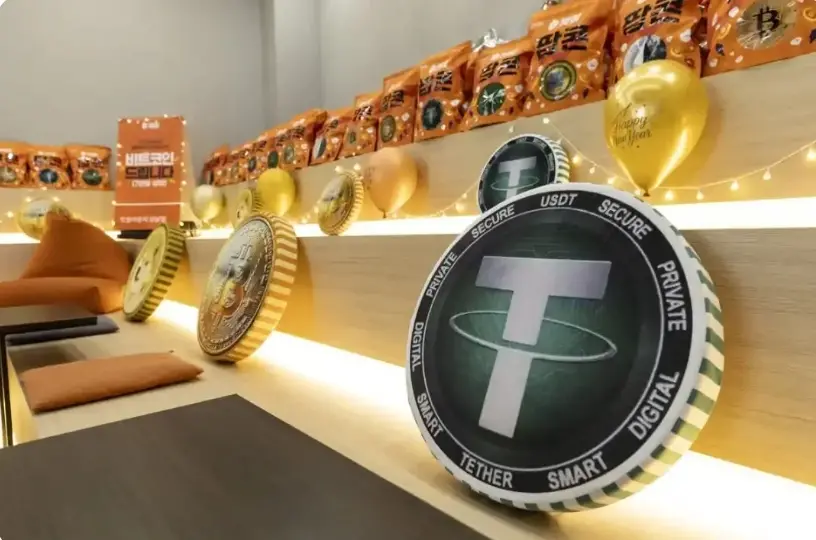
In February 2026, on the cushion of the Bithumb trading platform in Seoul marked Tether
On October 7, a credit document submitted in the state of New York showed that the loan was secured by "all assets" held in trust, including any assets that it might subsequently acquire. An executive of Cantor, who was aware of the transaction, stated that the loan was specifically secured by a convertible bond that gave Cantor the right to a 5 per cent interest in Tether。
According to a recent declaration by this financial service company, the assets of Dynasty Trust A include more than half of Cantor Fitzgerald ' s equity. However, Neve states that, through another independent administrative entity, the control of the company was “fully held by the next generation of the Lutnick family and never pledged”。
By selling assets, Lutnick met the requirements of federal legislation, which was designed to remove potential conflicts of interest from officials nominated by the President. However, the expert who reviewed the relevant transaction documents indicated that if the loan had helped Lutnick sell shares to the children ' s trust, it would have been contrary to the original purpose of the federal asset divestment requirement。
“This deal, which should in theory have eliminated conflicts of interest, has in fact created a new conflict,” says Kathleen Clark, Professor of Law at the University of Washington, St. Louis, and former ethics legal adviser in the District of Columbia. She states that if the loan from Tether helped Lutnick to complete the deal, which "would ultimately benefit both himself and his children", it would be that his family owes Tether another favor. This also increases the fear that Howard Lutnick may use the power of government to profit Tether and his children rather than serve the public interest。
One executive, Cantor Fitzgerald, who was aware of the matter, objected to Clark's argument that the loan would not change the "well-established alliance of economic and strategic interests" between Tether and the company. Tether's spokesperson did not respond to the request for comment。
The spokesman for the United States Department of Commerce did not respond to a series of questions, but sent a statement that “Minister Lutnick has fully complied with the terms of his ethical agreement, including all requirements for divestiture and recusal of assets, and will continue to do so”
The amount of the loan provided to the trust by Tether is not clear, nor is the price of Lutnick ' s children ' s acquisition of the father ' s equity disclosed. But as CEO and Chairman, Lutnick holds the vast majority of shares in the company. After investing in Tether in 2024, the company ' s valuation bookbooks surged by billions of dollars。
Tether's core business is the issuance of a stable currency called USDT, a digital currency linked to the United States dollar; holders can carry out instant and low-rate transactions outside the traditional banking system. Each USDT issue, Tether should be supported by high-quality, highly liquid reserve assets. Last year, Tether disclosed that its reserves amounted to $192 billion; from 2021 onwards, Cantor has been earning costs by managing these funds。Tether ' s business profits were extremely high, with a profit of $10 billion, with a profit margin of 99 per cent, allegedly achieved last year。
The success of this stable currency company was accompanied by controversy。In 2021, the United States regulator charged Tether and his affiliates with making misleading statements about losses and reserves, which were subsequently fined approximately $6 million, but did not acknowledge any misconduct. According to two sources, Tether was also investigated by the United States Department of Justice in 2024, although the status of the investigation is not yet clear。
At the same time, Donald Trump's government eased its enforcement of encrypted money by disbanding the Department of Justice and the United States Securities and Exchange Commission's team responsible for investigating money-related offences. In 2024, a United Nations report reported that Tether was a "preferred tool" for gangs and money launderers in South-East Asia. Tether responded at that time that the company was working with law enforcement agencies around the world to monitor the full range and high standards of its issuance。
Prior to the 2021 cooperation with Cantor, most United States banks avoided doing business with Tether. Lutnick had indicated that it had personally negotiated a cooperative relationship with the company and audited its accounts to ensure that it held all the assets claimed. At the Senate nomination hearing, he stated that the senior director of Tether assured him that he would cooperate with law enforcement and take a series of measures to curb money-laundering。
In April 2024, Lutnick participated in the Cantor Fitzgerald investment negotiations with Tether. Bloomberg reported that the investment was in the form of $600 million in convertible bonds, giving the financial services company 5 per cent of the equity. The book value of that portion of the equity has risen significantly, and the value of the equity would have reached $25 billion — more than the sum of all other assets of the company — if Tether had met the $500 billion valuation target in recent negotiations with potential investors。
In November 2024, following the re-election of Trump, Lutnick assisted in leading his transition team, while Cantor continued to work with Tether to advance transactions. In December 2024, Cantor arranged a deal for Tether to invest $775 million in the lost video-sharing platform Rumble Inc. In April 2025, Twenty One Capital Inc., a Bitcoin Treasury Management Company, was announced by Tether and Cantor。

Twenty One Capital listed on the New York Stock Exchange Platform in December 2025
In July 2025, Trump signed the GENIUS Act, a landmark legislation for stabilizing the currency industry。The Act contains a number of provisions in favour of Tether, such as a three-year grace period for the company based in El Salvador before United States regulations are complied with。
In response to questions about Lutnick’s divestment of assets and Tether’s loan, White House spokesman Kush Desai said: “The only special interest that guides Trump’s government decisions is the best interest of the American people. By entering into historic trade and investment agreements, creating a level playing field and creating jobs for American workers, Secretary Lutnick has always placed the American people and the United States first.”
In February 2025 Lutnick handed over the Chairman and Chief Executive Officer of Cantor Fitzgerald to his 28-year-old son, Brandon. Brandon, who worked with Tether in Lugano, Switzerland, recently claimed to have established "an ever-increasing friendship" with Tether's CEO, Paolo Ardoino。
As a billionaire on Wall Street, Lutnick faced complex tasks in asset stripping. His financial declaration documents listed over 800 assets, ranging from shares, apartment complexes to a satellite company. One of the officials involved in the filing process, who requested anonymity, stated that Lutnick had so many subsidiaries and joint venture interests that lawyers reviewing the divestiture of his assets were concerned that it would not be possible to clarify the fate of his entire financial interests。
In January 2025, Lutnick tried to calm those concerns by submitting an ethical agreement stating that he would seek to divest himself of his shareholding and resign from management positions in the company. As some transactions require regulatory approval, which may take longer, Lutnick states that he will not " personally and substantively participate in any particular matter that may benefit the enterprise from which he is dispossessed" unless he receives moral immunity。

IN JULY 2025, PRESIDENT DONALD TRUMP PRESENTED A COPY OF THE GENIUS ACT IN WASHINGTON
In the early days of the Government, Lutnick joined the Encoded Monetary Policy Steering Group, which later agreed in May to lock down its asset prices and forgo future value-added gains. On 8 July, he was granted a limited moral exemption to participate in a "high-level strategy and implementation" discussion of the subject that could have a "very small impact" on the businesses he sells, but was barred from participating in matters that would directly affect them. He completed the sale of Cantor assets in October。
Lutnick was one of a dozen members of the Presidential Working Group on Digital Asset Markets, which held over 1,000 meetings with industry officials in late winter. On 30 July, the group issued a 160-page report on the Government ' s plans. Lutnick's three colleagues in the Department of Commerce participated in the preparation of the document。
The group's recommendations include "promoting the development and growth of a stable currency"Tether owns about two thirds of this financial instrument marketI don't know. The report states that "policy makers should encourage the use of stable currencies to enhance the dominance of the United States dollar in the digital age." The Group appreciates the GENIUS Act, both of which Cantor Fitzgerald and Tether lobbied strongly。
Before the nomination hearing, Lutnick was asked about his relationship with Tether and responded that he would “be faithful to his duties in accordance with applicable government ethics laws and regulations”。
On 19 May, Cantor Fitzgerald and his associates announced that an agreement had been reached to sell most of their business to Lutnick's children, claiming that it marked the company's move towards “the next generation”。
The sale of the assets was completed on 6 October. Lutnick ' s interest in the company Cantor Fitzgerald listed (the commercial real estate company Newmark Group Inc. and the brokerage company BCG Group Inc.) was repurchased by Cantor and the two companies, totalling more than $350 million。
