
IOSG: When Fintech merges encryption bottom: the next decade of digital finance
Head-on financial technology is embedding stable currency and block chain infrastructure in core products to reshape global payment patterns。

Original title: IOSG Weekly Brief |Findech Integration Encryption Bottom: The Next Decade of Digital Finance #320
Original by Benji Siem, IOSG Ventures
Introduction
Stripe bought Bridge with $1.1 billion. Mastercard bought Zerohash at about $2 billion. Robinhood launched his own L2。
These are not isolated betsIt's a sign of a structural transformation -- the biggest financial technology giant is embedding block chain infrastructure, currency stabilization and decentrization of the financial track directly into their core productsI don't know. Over the past decade, FTS has transformed payments, banks and investments through software primary platforms and large-scale digital distribution. The next phase has begun: encryption is becoming the back end。
The report analyses the approach of the top 10 financial technology firms in the digital finance sector, focusing on their business models, revenue drivers and strategies to integrate encrypted payments and DeFi infrastructure。
A consistent pattern emerged:The most successful companies do not treat encryption as speculative assets, but rather as a back-end infrastructure that can increase the speed of settlement, reduce costs and expand global financial connectivity. In particular, the stabilization currency is becoming a bridge between the traditional financial system and the chain market。
Insight in the financial technology industry
Digital finance consensus: how different players see this opportunity
The digital financial base of the ten companies can be summarized as follows:
"Financial services should be borderless, real-time, software-defined, combustible — compliance is unsure of end users."
Different types of players understand opportunities:
Infrastructure players (Visa, Mastercard, Stripe, Adyen)
• Basis: transforming bottom lines of financial flows without customer relations
:: OPPORTUNITIES: EVERY NEW PAYMENT TRACK (STABILIZED CURRENCY, A2A, INSTANT PAYMENTS) IS EXPANDING THE SERVICEABLE MARKET
• Close entry point: stabilization currency reduced settlement friction and 7x24-hour fund management
Consumer platform type (Nu, Revolut, PayPal, Cash App)
• Basis perspective: major financial entry points for users, cross-marketing of service packages
• Opportunity: add bank + payment + investment + encrypt into an App to enhance LTV
• Add a close entry point: use encryption as a layer to increase activity and liquidity (transaction fees, interest-producing products, cross-border)
Mixed Players (Robinwood, Block, SoFi)
The polymers bid for polymer capacity to various markets:
• BASIS: VERTICAL INTEGRATION AT THE END OF C END PRODUCT + INFRASTRUCTURE
• OPPORTUNITIES: PROFIT FROM MULTIPLE LAYERS OF CAPTURE (C END-ACTIVITY, B2B INFRASTRUCTURE, ASSET HOSTING)
• CLOSE ENTRY POINT: BILATERAL ENCRYPTION STRATEGY (C END DISTRIBUTION + INFRASTRUCTURE OWNERSHIP)
Main trends in financial science and technology
based on an analysis of the 10 front companies, several clear models emerged. they are at the heart of this report, and their subsequent company cases and integration playbook are evidence of them。
Infrastructure preference, not speculation
Almost all companies treat encryption as a back-end infrastructure rather than a front-end speculative product. Visa, Mastercard, Stripe and Adyen are upgrading the settlement layer in stable currency while maintaining the C-end experience. Encryption only works when it's invisible. It's the most consistent model in ten companies, and it runs through all the integration strategies that follow。
That's the bridge asset
Every company that touches encryption is held in a stabilizer as a bridge between TradFi and encryption:
• Visa: USDC settlement, 130+ stabilization card scheme on Solana
• Mastercard: USDC, PYUSD, USDG, FIUSD four stable coins, covering multiple chains
• Robinwood: working with UDDG and sharing benefits
• PayPal: spontaneous PYUSD, internalizing the settlement chain
• Stripe: USDC for cross-border business payments
STABILIZED CURRENCIES REDUCE SETTLEMENT TIMES, REDUCE FX FRICTIONS AND ACHIEVE PROGRAMMABLE FUND MANAGEMENT WITHOUT VOLATILITY。
"Regulated distribution" of the moat
Companies with a large user base (PayPal 400 million, Revolut 50 million+, Nu 122 million, Cash App 58 million) have positioned themselves as compliant access points rather than as protocol builders。Their competitive advantage is not technology, but trust, compliance and scale distribution。
DeFi is wholesale, not retial
None of the companies exposed the original DeFi protocol directly to the C-end user. On the contraryDeFi exists as the everyone backend:Sources of proceeds (currencyization of national debt, currency markets), optimization of liquidity (faster settlement, cheaper cross-border) and product packaging (compliance savings account supported by DeFi proceeds). DeFi has become an infrastructure that supports regulated products rather than a user-oriented experience. This basis also determines the opportunities for integration and investment themes for follow-up to this report。
Multi-orbit policy (Multi-Rail)
Companies are building infrastructure that is not related to payment modalities:
• Stripe: "I need to have the programmable currency on either track."
• Mastercard, Multi-Track Company, covering cards, A2A, real-time payments, block chains
• Adyen, “Global operating system for corporate payments”
AS PAYMENT PATTERNS BECOME MORE FRAGMENTED (CARDS, A2A, STABILIZATION CURRENCY, BNPL), THE WINNERS WILL BE COMPANIES THAT CAN USE SMART PATHS BETWEEN ALL ORBITS。
Keep it together
The winning strategy can be derived from:Compensable shell for programmable currency to capture value through distribution, trust and compliance rather than by holding agreements or exposing speculative exposure。
The most advantageous companies have at least one of the following: Mass distribution (Nu, PayPal, Revolut, Cash App), infrastructure control (Visa, Stripe, Mastercard), or vertical integration (Robinwood, Block, Sofi)。
good mode
Extended and powerful business models
The payment network's "call-backer" model (Visa, Mastercard)
& nbsp; marginal cost per transaction is nearly zero; huge fixed cost leverage; network effects are almost unbreakable。
• Broadly unlimited expansion: every new transaction is increasing revenue, but incremental costs are almost zero。
• Encrypted integration risk: while the theoretical stabilization currency and A2A payments may bypass the card organization, Visa and Mastercard respond by positioning themselves as a “network network” that sits on all tracks, including encryption。
Infrastructure-as-a-Service (Stripe, Adyen)
• THE COST OF SWITCHING IS EXTREMELY HIGH ONCE EMBEDDED IN A COMMERCIAL TECHNOLOGY WAREHOUSE; INCOME IS RECOVERED AS A BUSINESS GROWS; AND VALUE-ADDED SERVICES (ANTI-FRAUD, TAXATION, BILLING) CONTINUE TO RISE。
:: Stripe disposed of $1.4 trillion (about 1.3 per cent of global GDP) in 2024。
• Bridge/Tempo of Stripe is the most radical infrastructure approach at present. If you stabilize the scale of the currency payments, Stripe may take down the developing layers of encrypted business。
Recurrent income + floating (Coinbase Subscription and Services, Revolut Premium)
The interest on stable currency reserves (Coinbase Q4 in 2025 alone) earned $332.5 million from USDC, pledge incentives and subscriptions, which are much more stable than transaction commissions。
REVENUE EXPANDS AS AUM/AUC EXPANDS, NOT AS TRADE VOLUMES EXPAND, WITH GREATER PREDICTABILITY。
Low-cost digital banks for under-served markets (Nubank)
The cost of services per month was only $0.80, compared to $5-10+ dollars in traditional banks; monthly activity rate of 83%+; net interest differential of 17.7%。
In markets where banking services are inadequate, the customers are almost viral; 122.7 million customers have huge cross-market space。
Higher risk / Less extended pattern
Dependence on purely transactional fees
• More than 90 per cent of the revenue is generated by companies with transaction fees, which are completely market-oriented. Encrypted Bear City, the volume of trade could drop by 70 to 90 percent。
• Diversity is important: Coinbase ' s share of transaction income fell from 96 per cent in 2020 to 59 per cent expected in 2025. Robinwood now has 11 lines of business。
PFOF DEPENDENCY
• PFOF HAS BEEN BANNED IN THE EUROPEAN UNION AND IS UNDER CONSTANT REVIEW IN THE UNITED STATES. COMPANIES THAT RELY ON PFOF ARE EXPOSED TO LIFE- AND DEATH-LEVEL REGULATORY RISKS IN THEIR CORE INCOME MODEL。
• Better paths: shift to subscriptions (Robinwood Gold), interest income and institutional clients (acquisition of Bitstamp)。
No regular/ sticky income encryption operations
• An encrypted trading platform based solely on spot transaction charges, no pledge, no interest on stable currency, no trust, no revenue from the DeFi agreement, no subscription — an extremely procyclical business。
• A good encryption business model superimposes multiple income lines (transaction + pledge + interest + protocol fee + subscription)。
The profit-free bitcoin income line
• Block reported income of $1.97 billion bitcoin in 2025 in Q3, but it cost $1.89 billion, with only about 4 per cent of BTC channel revenues. It raised the revenue, but did little to Māori。
• Its strategic value lies in ecological lock-ups (more sticky users buying BTC at Cash App), rather than making direct profits from BTC。
Framework: What's the "good" secure finance business model
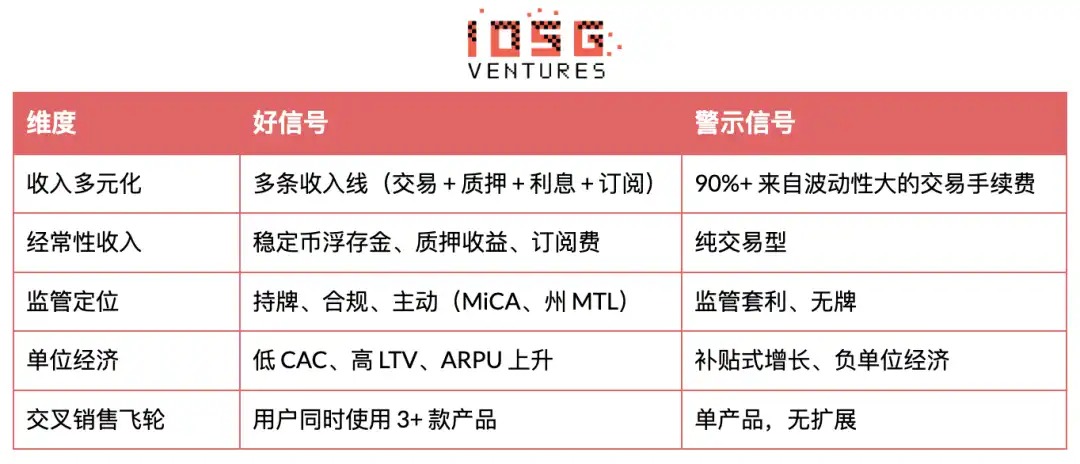
Financial Technology Encryption Playbook
the playbook below combs how ten companies implement the above. to understand why these techniques work, please go back to the "major trends" section。
Stabilization currency consolidation (most common, most dynamic)
• Visa: Networked USDC settlements
• Mastercard: cooperation with OKX card; acquisition of Zerohash
• PayPal: spontaneous PYUSD ($3.6 billion in circulation); support for DeFi
• Stripe: $1.1 billion acquisition Bridge for stabilization currency; build Tempo L1
:: Coinbase: USDC co- issuer/collaborator; stable currency revenue projection for 2025 $1.4 billion
Make encrypted transactions a feature
• Robinwood: encryption transactions and stock/sovereign integration
• Revolut: 200+ tokens within App
• Nubank: NuCripto
• Block/Cash App: Bitcoin buys, sells, transfers
Added costs are low; retail demand is available in cattle markets; and user viscosity is enhanced。
Self-built block chain infrastructure
• Coinbase → Base Chain (L2 based on OP Stack)
• Stripe → Tempo (L1, in cooperation with Paradigm)
• Robinhod → Robinhod Chain
Ownership chain = economic ownership (Sequencer cost, MEV, ecological network effect)I don't know. The analogy is that Visa built VisaNet instead of relying on third-party networks。
Bitcoin's whole inn
(a) Consumer Wallet (Cash App) (Square Bitcoin/Lightning) (Bitkey) (Proto) (Spiral)。
This is a vertical bet of high conviction:If bitcoin really became a daily payment track, Block would have every layer; if not, it would be a huge resource investment with uncertain results。
Host and institutional services
• Coinbase Prime: custodian of ETF for most Bitcoin/Etherdorf
• Mastercard and Visa: provide compliance/ KYC/ AML level for encryption of institutions
Institutional funds require credible, regulated hosting — a high-threshold, profitable business。
DeFi, access money and protocol participation
• PayPal: PYUSD supports DeFi borrowing/transactions at the Ether House
Coinbase: Base Chain carries the DeFi protocol; USDC is the leading stable currency in DeFi
• Revolut & Robinhood: Mortgage services (ETH, SOL)
Encrypted payment and DeFi integration opportunities
Upstream (wholesale / infrastructure level)
Stabilization of currency clearing network
STABILIZED COINS ARE USED FOR INTER-BANK SETTLEMENTS, FUND MANAGEMENT AND COMMERCIAL PAYMENTS. THE SETTLEMENT TIME IS COMPRESSED FROM T+2 TO NEAR REAL TIME, REDUCING AGENCY BANK COSTS。
:: Beneficiaries: Visa, Mastercard, Stripe, Adyen
:: Example: Visa 's obligation to settle VisaNet with USDC on Solana
Currencyized currency markets as liquidity
The use of monetized national debt (e.g. Ondo OUSG, Franklin Onchain) as an interest-bearing reserve does not result in loss of liquidity or credit risk。
• Beneficiaries: PayPal, Nu, Revolut, SoFi
• Example: MasterCard MTN-supported national debt assets
Cross-border remittance tracks
REPLACE SWIFT / PROXY BANK WITH A STABLE CURRENCY TRACK FOR B2B AND C-END REMITTANCES. IMMEDIATE SETTLEMENT, LOWER RATE, BETTER FX RATE。
• Beneficiaries: Stripe, PayPal (Xoom), Revolut, Nu
• Example: Stripe is using USDC for global business
Programming compliance layer
AML/KYC BASED ON SMART CONTRACTS, TRANSACTION MONITORING AND SANCTIONS SCREENING. AUTOMATE COMPLIANCE, REDUCE LABOUR AND ACHIEVE REAL-TIME RISK RATINGS。
:: Beneficiaries: all regulated players (especially Visa, Mastercard)
• Example: Visa Project for A2A Payments, MasterCrypto Security
DOWNSTREAM (C/ COMMERCIAL LEVEL)
Stabilization Card
DIRECTLY FROM THE CARD THAT STABILIZES THE CURRENCY BALANCE, CONVERTED TO FRENCH AT THE POS END。
• Beneficiaries: Visa, Mastercard (basic), Revolut, Cash App (distributed)
• Example: 130+Stand Card Scheme for Visa, Mastercard OKX Card
Encrypted mortgage lending
Encrypted assets are used as collateral for French loans without triggering taxable events。
:: Beneficiaries: Robinwood, Sofi, Block, Revolut
:: Example: Bitcoin mortgages provided through Cash App or SoFi Paragraph
Interest-bearing savings account
High-yield savings products supported by a monetized national debt or a DeFi borrowing agreement to be delivered in compliance with the shell。
• Beneficiaries: Nu, Revolut, PayPal, SoFi
• Example: Revolut provides a "crypto early" product, with returns close to pledge proceeds
Business stabilization currency settlement
TO ALLOW BUSINESSES TO SETTLE IN FOREIGN CURRENCY WITH A STABLE CURRENCY, TO REDUCE THE RISK OF FX AND TO SPEED UP THE PAYMENT。
• Beneficiaries: Stripe, Adyen, Square, PayPal
• Example: Mastercard allows businesses to settle through Nuvei/Circe on USDC, PYUSD or USDG
IMMEDIATE CROSS-BORDER P2P
Fixed currency-driven remittances, second-rate billing, at a rate of less than 1 per cent. In Lat Am and Asia, we squeezed Western Union/Moneygram。
• Beneficiaries: PayPal (Xoom), Revolut, Cash App, Nu
:: Example: Nu achieves BRL → USDC local currency transfers in Latin America
Discrepancies / high-profit opportunities
Self-Custody Wallet-as-a-Service
Whitemarks for institutional and high net value users are taken from the hosting programme. It will be able to charge both hosting fees and self-custodial compliance requirements。
:: Beneficiaries: Robinwood, Block, Stripe (through Bridge)
• Example: Bitkey Hardware Wallet for Block
A loyalty plan based on a block chain
The credits are issued in token form and trans-ecologicalized. Increase viscosity and create new revenue from tokenization incentives。
• Beneficiaries: Mastercard, Visa, PayPal
Institutionally oriented DeFi protocol integration (high potential)
Through compliance intermediates, institutions are provided with regulated DeFi lending, pledge, mobile mining entrances。
• Beneficiaries: Sofi (Galileo), Stripe (Bridge), Mastercard (MTN)
• Example: SoFi Galileo provides a white-marked encrypted pledge to banks
Privacy protection payments
ZERO-KNOWLEDGE EVIDENCE OF "SECRET AND COMPLIANT" CURRENCY TRANSFERS. SUPPORT CONFIDENTIAL ENTERPRISE PAYMENTS WHILE MEETING AML COMPLIANCE REQUIREMENTS。
• Beneficiaries: all companies (especially Visa/Mastercard, B2B)
Unbundling-Rebundling: Structural Perspectives
Insight to another report: The Architecure of Value: Regular Assistance of Financial Participation and Deep Dive Report on Vital Capital Strutegies
(https://claude.ai/30284df5d6ec6803a52f792bb549832?pvs=25)
Rebundling's winner is an infrastructure provider, not a consumer platform
the longest and most extensive financial technology business is for someone else to do the booking, not for themselves
Infrastructure players (Visa, Mastercard, Stripe, Adyen)
90-98% Māori rate, 50-62% Operating profit margin
• Nearly zero client cost (developer/bank bringing users)
Network effects or developers locking in moats
:: Income increases with ecological expansion rather than direct access
Consumer platforms (Robinwood, Nu, Revolut, PayPal):
30-50% Māori rate, 10-25% Operating profit margin
200–450 United States dollars
• 3+ product adoption is required to be profitable
:: Vulnerable to regulatory changes and market cycles
Visa received 97.8 per cent of the proceeds of the $17 trillion in payments, while Robinhod's income from encrypted transactions was pro-cyclical - a comparison that illustrates the fundamental gap between the two。
It's decided that Rebundling's three key dependencies for success or failure
Dependency 1:Source of funds (bank plates = compound moat)
Winners: Nu (19 billion dollars in deposits, 3-4 per cent in capital costs, 17.7 per cent in net interest on loans), SoFi (bank plates absorb deposits)
:: Losers: PayPal (unlicensed, unable to absorb deposits), Revolut (United Kingdom plates delayed, unable to compete at the lending end)
Consumer finance technology without bank licences is either kidnapped by BaaS partners (such as the 2024 Sympse crash) or unable to internalize the “deposit-loan” spreads – which is the key to making money。
Dependency 2:Cross-sale economy (3+ product threshold)
• SINGLE-PRODUCT USERS ($50 PER YEAR OF INCOME, LTV 150) ARE IN DEFICIT AT $200–450 CAC. THE USERS OF THE THREE PRODUCTS (INCOME OF $180 PER YEAR, LTV 540) ONLY STARTED MAKING A PROFIT。
:: Success cases: Robinhod (11 products, ARPU 191, vs. + 82 per cent), Revolut (value business income + 298 per cent), Nu (83 per cent)
• Failure cases: PayPal (400 million users, but mostly only closed, Venmo/encrypted/savings sold intact)
Dependency 3:Developer / Enterprise Lock (Integration Depth)
• Stripe's moat: Once Billing + Tax + Connect + Radar is integrated, six + months of engineering input is required for dismantling. For each additional product, the switch cost is repeated。
• The “mixed sequence” genius of Visa: 20,000 banks compete with each other (decentrization), but all use the Visa agreement (centralization). Banks cannot leave because the network itself is a product. Zero CAC, 97.8 per cent Māori, receives $17 trillion in transhipment fees。
For C-end encryption, the structural challenges include: fiduciary liability; profit compression (Uniswap 0.3 per cent vs. Coinbase 1-2 per cent); lack of lock (user can remove from trust); and procyclicality (Coinbase earned - 75 per cent in 2022-2023)。
Base for encryption: "Strip / Visa"
The common model of financial science and technology success stories is clear: building compliance intermediates that abstract the complexity of block chains for business and financial technology clients。
Investment theme 1:Stabilised Currency Layer
• Stripe's $1.1 billion buy-out Bridge proved one thing: companies want to stabilize their currency, but they don't want to run their own nodes, their wallets, or get 50 state plates。
• Winning products: an API that simultaneously handles multi-link routes, liquidity optimization, compliance screening and tax reporting. The enterprise simply calls POST/transfer, and the infrastructure is responsible for the rest。
• economic model: 0.5-1 per cent takerate for large transactions, with zero marginal cost per transaction and very high cost for access switching. it's also 90% + maori, but applied in $2 trillion + stable currency settlement market。
Investment theme 2:Vault-as-a-Service ( "Fireblocks" style)
PayPal, Robinhod, and Nu are all hosting billions of dollars of encrypted assets. Hostage requires OCC compliance, MPC/HSM security, $100 million plus insurance, disaster recovery。
• THE OPPORTUNITY LIES IN THE PROVISION OF “ENCRYPTED HOSTING AWS” — ACCESS BY BUSINESSES THROUGH API, WHICH IS RESPONSIBLE FOR KEY MANAGEMENT, STRATEGIC ENGINES (E.G. “THREE APPROVALS FOR CASH WITHDRAWALS ABOVE $100,000”), COMPLIANCE REPORTS, AND OFAC SCREENING。
• Every family needs it with encrypted financial technology
ZERO CAC (B2B SALES CYCLE)
• High retention (replacement = 12+ months security audit)
:: Winners: Fireblocks (8 billion United States dollars valuation), Angelage Digital (OCC licence), Cooper.co
Investment theme 3:DeFi Middle / "Vault Schemer" Layer
What's missing is a "DeFi Gains Stripe". It can aggregate gains between Aave, Compund, Morpho and Ondo OUSG, while abstracting Gas fees, generating tax reports (IRS compliance 1099), providing insurance casings and compliance layers。
Vault offers:
:: Ondo Finance: National Monetary Debt, 5 per cent
• Backed Finance: monetized corporate debt
• Maple/Goldfinch: Institutional-level DeFi lending with underwriters
Specific example: SoFi has multi-billion dollar deposits on its books, and traditional accounts are given only 0.1 per cent. If its B2B platform Galileo could provide a "DeFi Yield API" to match 5 per cent of the national debt, SoFi could give the client 4 per cent of ASY, leave one per cent of the difference and not press assets on the balance sheet. This intermediate approach, between agreements and regulated financial technology, and the responsibility for compliance shell and tax reporting, is the current lacuna。
Framework: Assessment of business models for financial science and technology
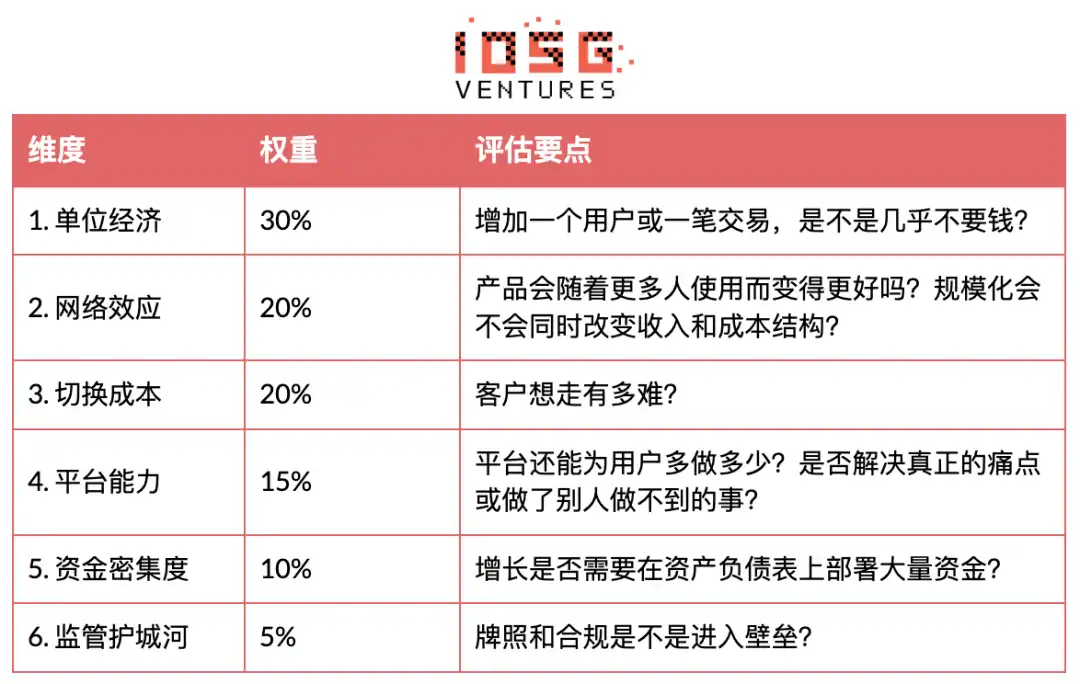
Overview
Encryption and basic alignment of companies
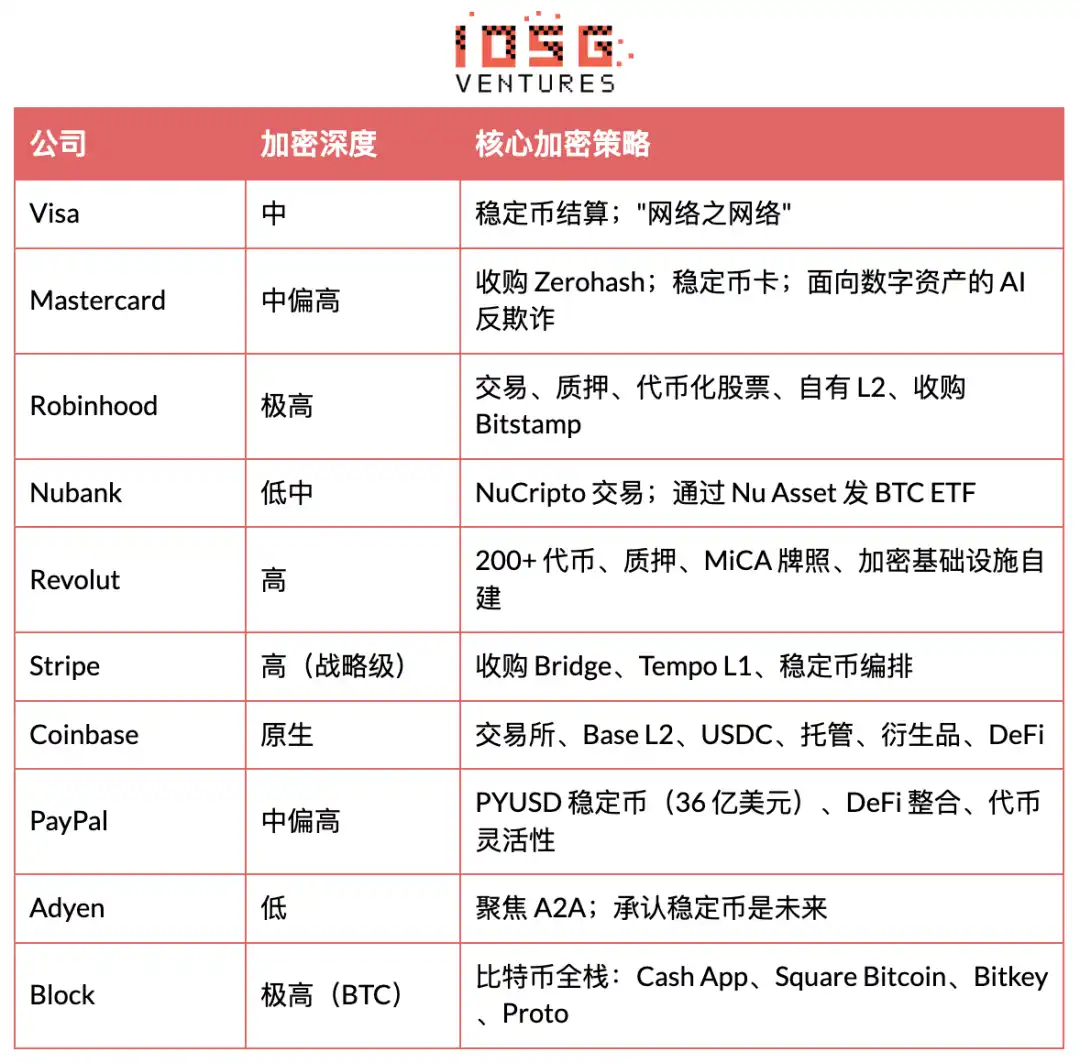
Concluding remarks
The future of financial science and technology lies in the integration of traditional financial platforms with programmable financial infrastructure. The block chain technology is not replacing the existing system, but is increasingly integrated as a layer of settlement and liquidity operating behind the scenes. Stable currencies, monetized assets and chain markets bring faster settlements, cheaper cross-border payments and new financial products, which are largely invisible to end-users。
Ultimately, the companies that are best able to capture value in digital finance are those that simultaneously have large-scale distribution, regulatory confidence and infrastructure controls. Whether through payment networks, development platforms or consumer financial ecology, winners will be platforms where financial complexity is abstracted and multiple payment tracks are organized. As programmable currencies become more widely adopted, financial technology companies that can successfully integrate traditional finance with block chain infrastructure will shape the next generation of global financial services。
