
From Gas Limited to Keyed Nonces, how can we understand the next stop of expansion
It is not just "making the blocks bigger and the Gas lower" but redefinition of how users use the Ether factory through their wallets。

Objectively, for some time now, the visual perception of the Ethera has been felt by many users, often not from road maps or developers ' meetings, but from a specific chain operation。
For example, in the last two years, when people have been feeling the same transfer, Gas is getting lower, experience of cross-chain interoperability has improved, and that's why the expansion of the ETA has not been a simple "performance contest" problemFOR ORDINARY USERS, HIGHER TPS, LARGER BLOCKS, MORE COMPLEX BOTTOM STRUCTURES CAN ONLY BE MEANINGFUL IF THEY REALLY TRANSLATE INTO LOWER-COST, SMOOTHER AND SAFER WALLET EXPERIENCES。
A series of recent developments in the Taifeng have coincided with attempts to move systematically to the protocol level the complexities previously borne by wallets, DApps, third-party repeaters and users themselves。
Among these are Keyed Nonces, the directed consensus built around 200 million Gas Limited floor during the Vitalik upgrade, and the series of grass-and-brand lines that continue to be highlighted in the 2026 road map, such as abstract, cross-L2 interoperability and L1 security enhancements。
One, Gas Limited up to 200 million
First of all, it's the easyest thing to feel, Gas Limited。
It is well known that every transaction (whether transfer or contract interaction) in the ETA network requires a certain amount of gas consumption, while the capacity of Gas Limited in each ETA block is fixed, i.e. the pit space is limited:The more pits, the more passengers can be transported at the same time; the more stressful the pits, the more you bid for the same seat, the higher the cost of the gas。
Theoretically, the expansion of the size of the block Gas ceiling would indeed directly and significantly enhance the performance of the ETA host network, although in the past, in the context of the expansion of the L2 route, much of the expansion pressure was deliberately pushed to the L2 track。
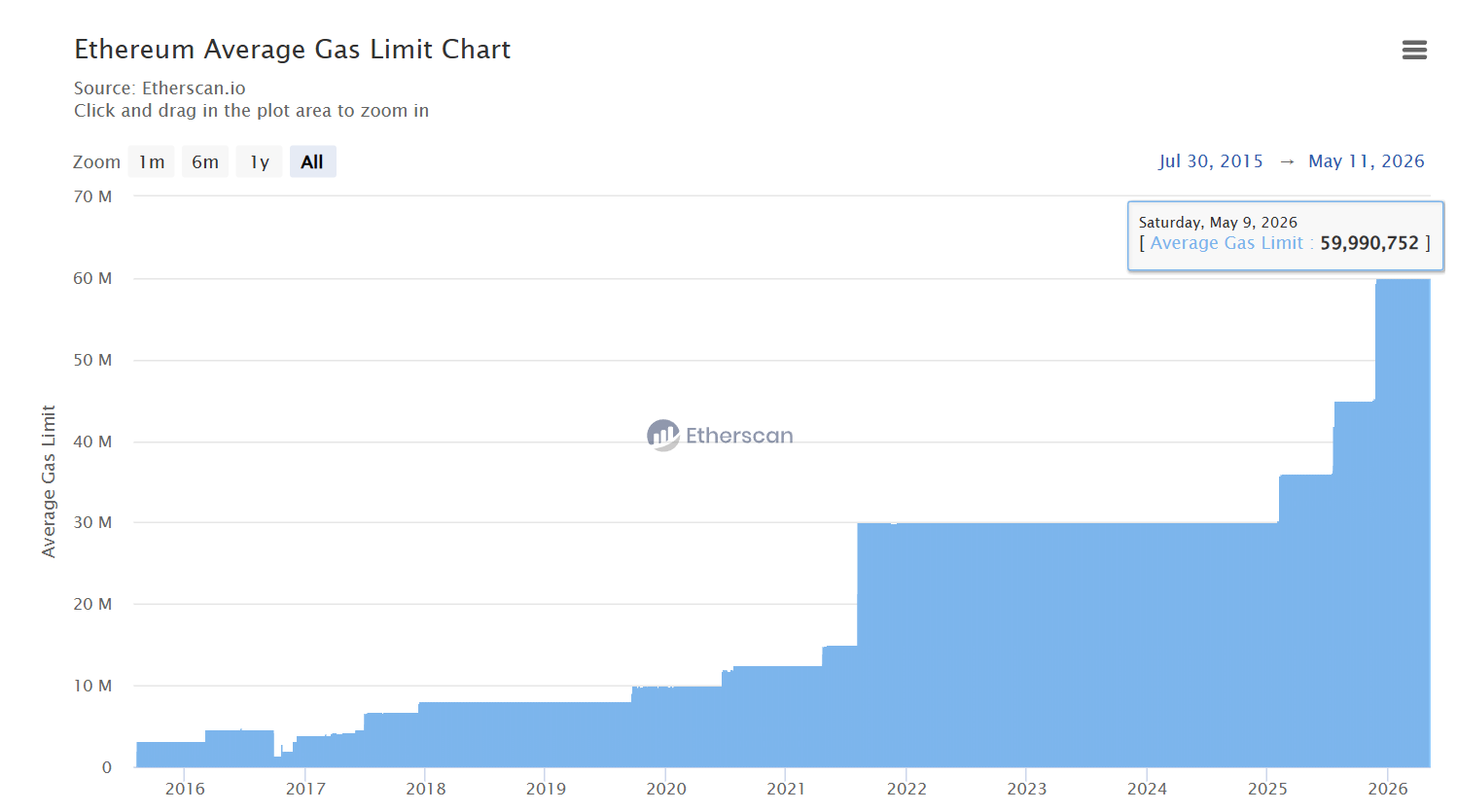
If you look at the expansion curve of the Ether Factory Gas Limited, in September 2019, Gas Limited made its first breakthrough from 8 million to 10 million, until this year, seven years later, from 8 million to 6 millionIn particular, it was only in 2025 that it actually entered the acceleration route - in February, 30 to 36 million, in July, to 45 million, and in December, when Fusaka was upgraded, to 60 million。
It can be said that most of the expansion was done in 2025, which, as we have mentioned before, was also a crucial year in the history of the development of the Taifeng, and only seven months after the upgrading of Pectra in May, the Fusaka upgrade proved that the EF, which had undergone major leadership changes, still had the capacity to drive major updates and also marked the official entry of the Taifeng into the accelerated development rhythm of the "twipe fork" twice a yearETHERPORT 2026: READING THE EF'S LATEST PROTOCOL ROAD MAP, OFFICIALLY ENTERING THE ERA OF ENGINEERING ESCALATION)。
Source: Ederscan
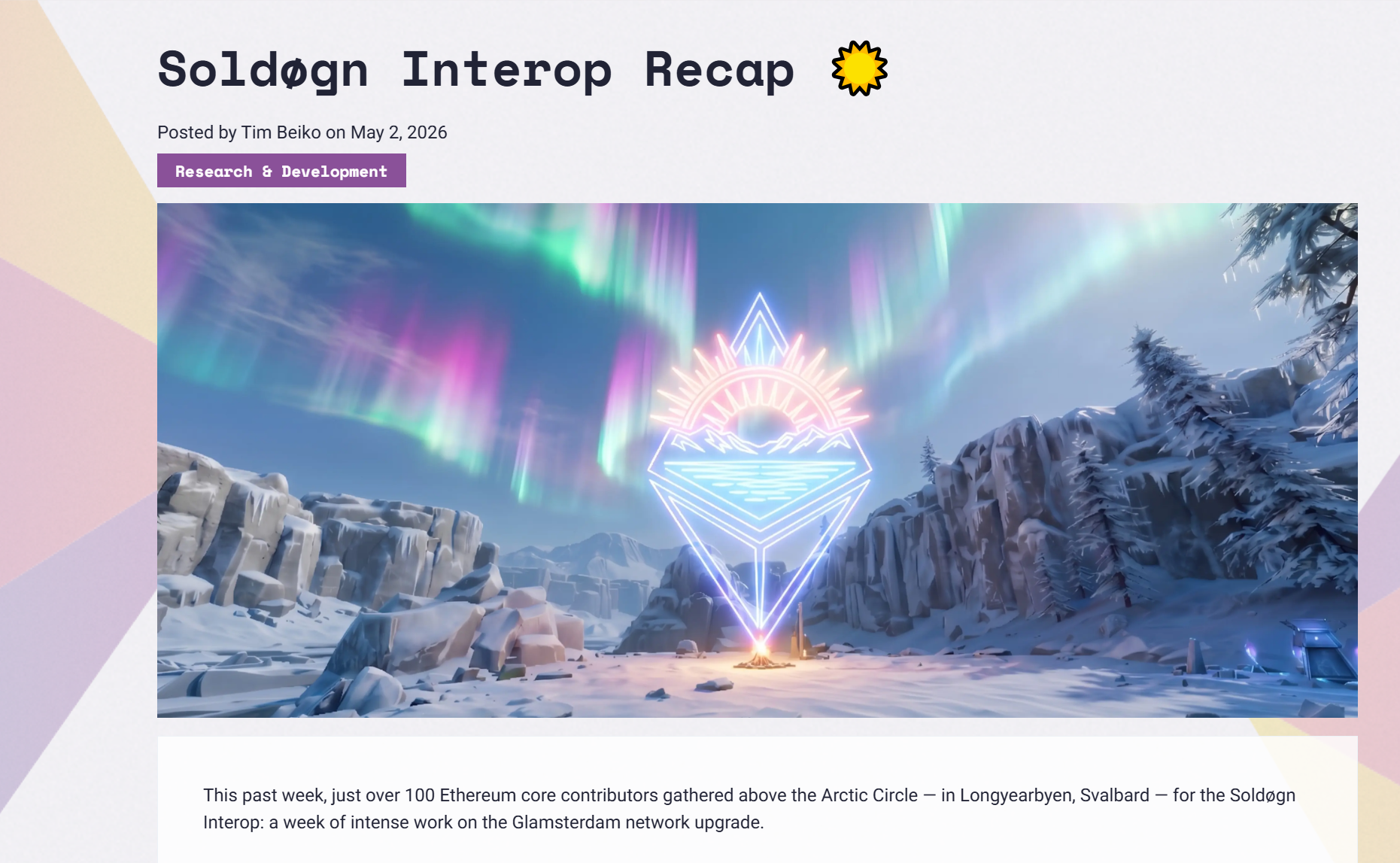
According to the release of the Egypt Foundation on 2 May, Soldøgn Interop Recap, more than 100 IE core contributors participated in an interoperability meeting around the upgrading of Glamsterdam in Svalbard, Norway, with a focus on advancing the multi-client alignment of Glamsterdam, which ended with the development of a directional consensus around 200 million Gas Limited after Glamsterdam。
This means that if the follow-up process goes smoothly, the implementation capacity of the ETA L1 is expected to rise further from the current level of about 60 million Gas Limited to a level of 200 million, with a longer time dimension. The open and discussionable attitude towards Gas Limited is clearly “radical” with the ecology of the OTA, and the EIP-9698 proposal even recommends “a tenfold increase every two years” by 2029, raising Gas Limited to 3.6 billion, or 50 times the current level。
But here's what needs to be stressed is that raising Gas Limited isn't simply making blocks big。
If it's just a rough increase in the amount of calculated capacity per blockWhile costs may be reduced in the short term, the long-term effect of heavy nodes burdening and inflating state data also means that ordinary users are more difficult to run, ultimately weakening the decentrized base of the core of the Taifung。
So Glamsterdam's idea of expansion is a combination of punches:
- ePBS (enshrined Proposer-Builder Security) integrates block construction and validation processes more clearly into the protocol rules, allowing certifiers to handle larger blocks more safely
- Block-Level Access Lists (BAL) records in advance accounts and storage locations that are accessible during block execution, thus supporting simultaneous disk reading, parallel transaction validation and parallel state root calculations
- EIP-8037, on the other hand, creates the cost of the operation by raising the status, avoiding excessive state growth following the Gas Limited increase
At the end of the day, the Ether Workshop does not just want to "load more trades" but rather to think about how to keep the node running at a higher and higher threshold。
This is also the fundamental difference between the Taifaf expansion route and many high performance chain narratives, which have been seeking not at the expense of certification costs in exchange for surface throughput, but rather to increase the carrying capacity of the main network itself, while preserving as much as possible the participation of ordinary nodes and system validation。
ii. Keyed Nonces: turning "one team" into "multi-channel"
If Gas Limited solves "how much one block can fit," Keyed Nonces is concerned with another more detailed but crucial question: how to line up
it is well known that in the taifeng, nonce can be simply understood as the "serial number" of an account transaction, which serves to prevent the same transaction from being duplicated and to ensure that transactions originating from the same account are processed sequentially。
The mechanism is well understood in the context of ordinary transfers, namely, the first transaction in order, the second transaction, the third transaction in order, and the second in order。
But the problem is that when account capabilities become more complex, such as privacy transactions, smart wallets, talking keys, bulk operations, third-party payments, single-line nonce can become bottlenecks, so the core idea of EIP-8250, Keyed Nonces, is to change the original account from a nonce queue to having multiple nonce domains。
Specifically, it replaces the single senser nonce in EIP-8141Frame Transport with (nonce key, nonce seq) structure in which nonce key = 0 against traditional accounts nonce, instead of zerokey, an independent protocol to manage the nonce series, with separate transactions under key not affecting each other。
It sounds technical, but it can be understood by a living metaphor:One account in the past seemed to have only one window in the bank, and all operations had to be in the same line; Keyed Nonces was like dividing different operations into different windows, where transfers, private withdrawals, conversational authorization, bulk execution could take place separately。
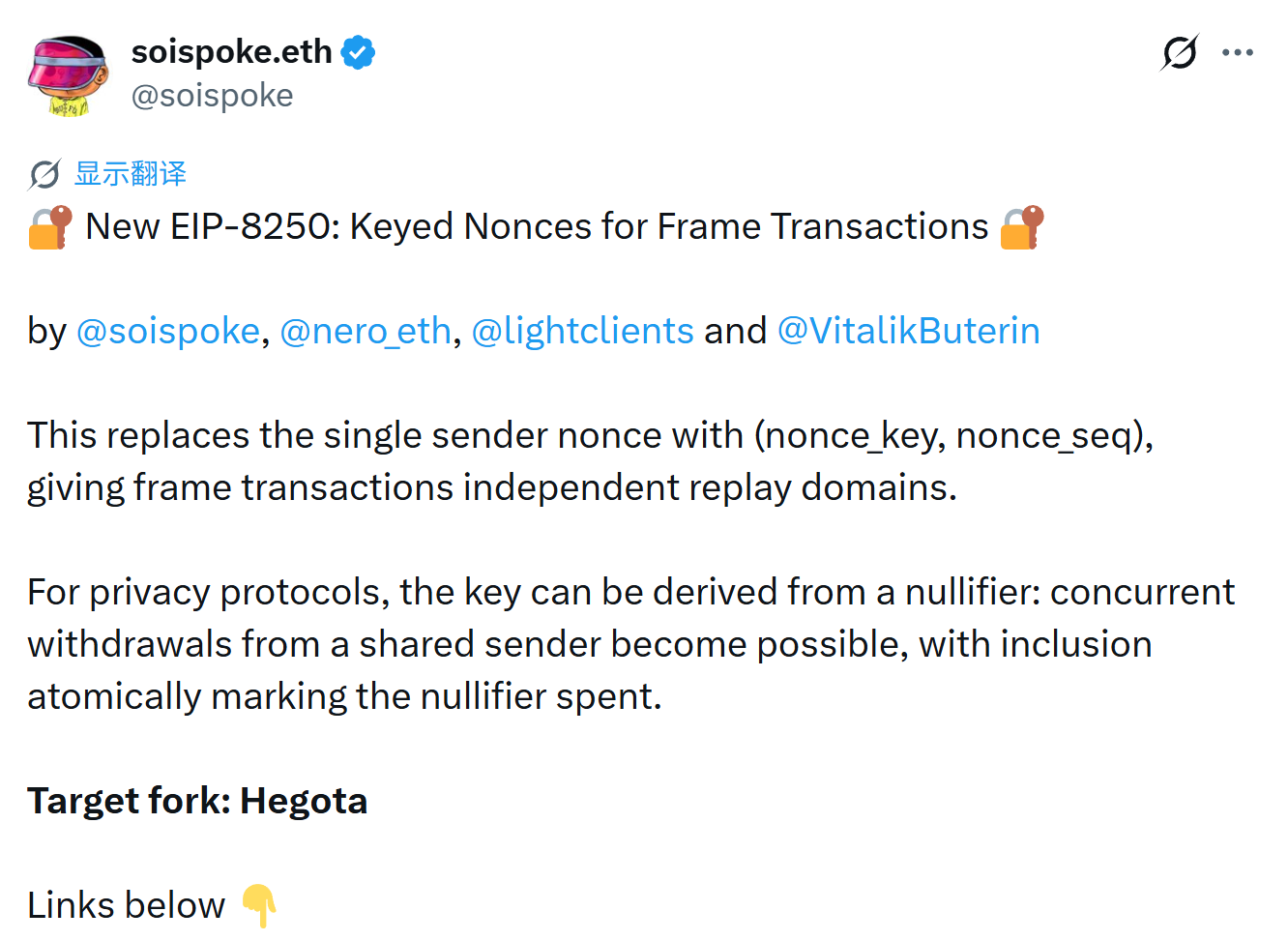
this is particularly important for privacy protocols, which may allow multiple users to initiate transactions through the same shared sender address in order to avoid the direct binding of user chain activities to a single public address, but under a single nonce mechanism, a transaction by a user is packaged, which may invalidate or block a transaction that other users are still waiting for。
And..Keyed Nonces allows each expenditure to choose its nonce domain, e.g. from privacy nullifeer, to reduce this queue from the protocol level。
Vitalik, who himself is more ambitious about its location, made it clear in his introduction to EIP-8250 that Keyed Nonces "is not only more supportive of protocol-level privacy programs, but may also be the first step of a new Taifeng state expansion strategy" • Be extremely scalable while maintaining the decentrization of agreements by creating specially optimized types of storage for different uses.”
In other words, it's simple to say that Gas Limited solves the size of the blocks, and Keyed Nonces is talking about the shape of the state. The future of the Etherport is not just more transactions, but more types of transactions。
How will this affect ordinary users
For the ETA ecology, many protocols appear to be upgraded far from ordinary users, but eventually end up in wallet experience。
Because the user's real access to the Ether Workshop is not an EIP, client or developer meeting, but every transfer, authorization, signature, cross-chain and DApp in the wallet. In other wordsThe transformation of the protocol layer, from a technology upgrade to a user experience upgrade, can only be achieved when the wallet layer is translated into a clearer, smoother and safer operational experience。
For example, the abstract nature of accounts, which are now well known, is not to allow users to understand more technical terms, but to allow users to use chain accounts more naturally in the future. As a result, bulk transactions, Gas surrogates, restoration mechanisms, different signature methods, conversational authorizations, and more flexible security strategies have become the basic capabilities in wallets in recent years。
Again, for example, Keyed Nonces, it sounds like a very bottom-up account queue mechanism that optimizes, but its potential impact is not abstract. Because today many users may have experienced a similar scenario when they operate on the chain: a failure to confirm a transaction, a subsequent transaction is stuck, a desire to cancel or accelerate the transaction is not understood, and the relationship between nonce, Gas, and replacement transactions is not understood, especially when multiple operations go hand in hand, a failure that affects the entire process。
For ordinary users, these questions look like "a bad wallet" or "a bad chain" but they are related to the design of a single linear nonce in the Taifung account model. Keyed Nonces, on the other hand, represents the direction in which the account can no longer perform all operations in one sequence, but can separate multiple parallel channels depending on the context。
In the future, ordinary transfers, DApp authorizations, privacy transactions, bulk transactions, Gas surcharges, etc. could theoretically have more independent enforcement space, reducing the probability of each other blocking and conflict。
This will undoubtedly further open the design space for smart wallets。
More importantly, in the past, these capabilities often involved the sharing of complexities between wallets, DApps, relay services and users. Users needed to understand the scope of the authorization, to judge whether Gas was reasonable, to know exactly what they were signing, and to repeatedly confirm in multi-step operations such as cross-chain, convert, pledge, receive incentives, etc., that any deviation in understanding could entail operational failure and asset loss risks。
What is now being tried by the Taifeng is to move part of the complexity to the protocol level so that the wallet can provide a better interactive abstraction for users based on a more standardized and primitive bottom-up capability。
That is why Gas Limited, BAL, ePBS, Keyed Nonces, Frame Transports, Native Account Abstracts and Cross-L2 Interoperability, which appear to be separate technical modules, are all serving the same thing: allowing the ETA to use a more complex chain without losing its centrality and safety。
In particular, by combining these dynamics, the focus of the Ether Workshop in the near future is not fragmented:
- Gas Limited upgrade to address the implementation capacity and cost pressures of the main network
- BAL, ePBS, EIP-8037, addressing how to maintain validation and state growth control during the build-up
- Keyed Nonces and Frame Transports, addressing bottlenecks in account models, privacy protocols and smart wallets at the protocol level
- THE ABSTRACT AND CROSS-L2 INTEROPERABILITY OF PRIMARY ACCOUNTS POINTS FURTHER TO THE REAL EXPERIENCE IMPROVEMENTS THAT ORDINARY USERS CAN FEEL。
It also means that the Ether Mill is entering a new phase。
After all, over the past few years, the market has become more concerned with L2 expansion, Blob fee reductions and modular narratives, and users have become accustomed to moving assets between different L2s and finding lower-cost interactive environments. However, as the main network, Gas Limited, continues to grow, the upgrading of Glamsterdam and so forth, and the development of abstract and interoperability programs, has continued to growThe answer to the question that is being answered is not just "how to make the deal cheaper" but "how to make the chain more a whole."。
In this process, the importance of the wallet will undoubtedly be further amplified。
Because the wallet is not just a user's entry point to the Ether Workshop, it's also an interface where protocol capabilities are really understood and used by users. In the future, the more complex the bottom upgrade, the more necessary it will be to transform the wallet into a clearer signer, a more comprehensible path to the transaction, a more advanced risk identification, and a smoother interaction on the chain。
We're all here。
