
Why is the consumer becoming more pessimistic
THE US ECONOMY IS MOVING TOWARDS DEEPER K-TYPE FRAGMENTATION

Original title: The Stock Market and Consuer Series Are Telling Two Different Stores
Photo by Anthony J. Popliano
Photo by Peggy
The authors press: the US stock is constantly refreshing its historical heights, while consumer confidence has fallen to a low level, and two seemingly contradictory sets of data are presenting the most typical structural fragmentation of the US economy。
THE PAPER SEEKS TO EXPLAIN NOT WHETHER THE STOCK MARKET IS OUT OF CONTEXT, BUT ON WHAT BASIS THE SO-CALLED “UNITED STATES CONSUMER REMAINS STRONG” NARRATIVE IS BASED WHEN THE RISE IN ASSET PRICES COINCIDES WITH THE DOWNFALL OF ORDINARY HOUSEHOLDS. THE AUTHORS POINT OUT THAT THE CONSUMER CONFIDENCE SURVEY ITSELF MAY HAVE A SAMPLE DEVIATION, BUT THE MORE CRITICAL PROBLEM IS THAT THE UNITED STATES ECONOMY IS BECOMING MORE AND MORE "K"-TYPE: THOSE WHO HOLD SHARES, PROPERTIES AND FINANCIAL ASSETS CONTINUE TO BENEFIT AS ASSET PRICES RISE, WHILE THOSE WHO DO NOT INVEST ASSETS ARE FURTHER DISLODGED FROM INFLATION, FOOD AND ENERGY PRICE PRESSURES。
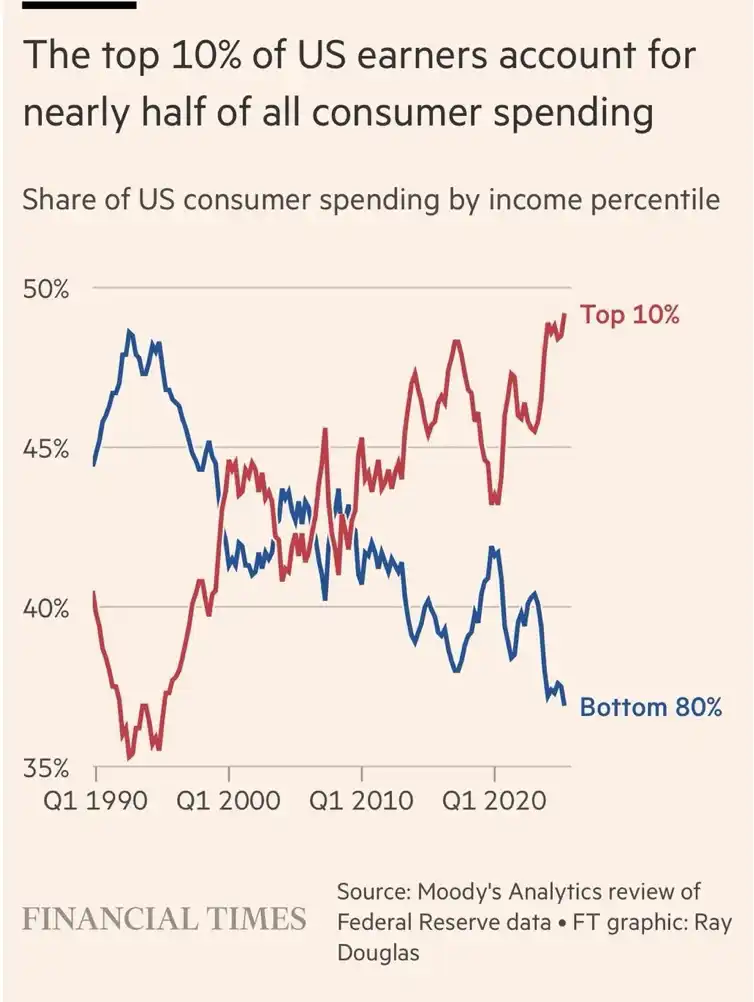
This explains why total consumption data still appear robust. The top 10 per cent of consumers in the United States have contributed nearly half of their consumption spending, and the continued consumption of asset holders, high-income groups and wealthy retirement groups obscures the fact that most households are weakening. In other words, the United States economy is not without resilience, but it is increasingly concentrated on a few。
Low consumer confidence may be a reverse indicator for investors; but for ordinary people without assets, stock-market increases do not necessarily mean better lives. The real problem is that the same set of mechanisms that drive asset price increases may also continue to increase pressure on asset-free groups. This is the sharpest contradiction in the current United States economy: the more prosperous the market is, the more divided it may become。
The following is the original text:
To investors:
Perhaps the most confusing of the financial markets is the one that puts consumer confidence together with the United States stock market. Over the past time, the United States stock has been at record highs almost daily, but consumer confidence has continued to decline to record lows。
How can these two things happen at the same time
First, the quality of consumer confidence surveys at the University of Michigan has significantly declined. In the past, the survey interviewed about 50% Republicans, 50% Democrats, but the situation has changed over the last three years. As the pattern of the investigation shifted to the line, there was a shift in the sample structure: Today, about two thirds of the respondents are Democrats and one third Republicans。
Considering that the current perception of the economy by Democrats is clearly more pessimistic, this over-sampling of a particular political camp would significantly magnify the negative sentiment in the findings of the survey。
Having said that, I personally do believe that a large part of the United States has a negative view of the economy and its own financial situation. They are under pressure from currency devaluations and high inflation over the past few years. Food and petrol bills have accumulated, while wage increases have not kept pace with price increases。
Second, stockholders would be pleased with the rise in the stock market; but those without investment assets would feel left behind even further as stock prices went up. Fortunately, about 60 per cent of Americans own stocks directly or indirectly, so a significant proportion of them actually benefit from higher asset prices。
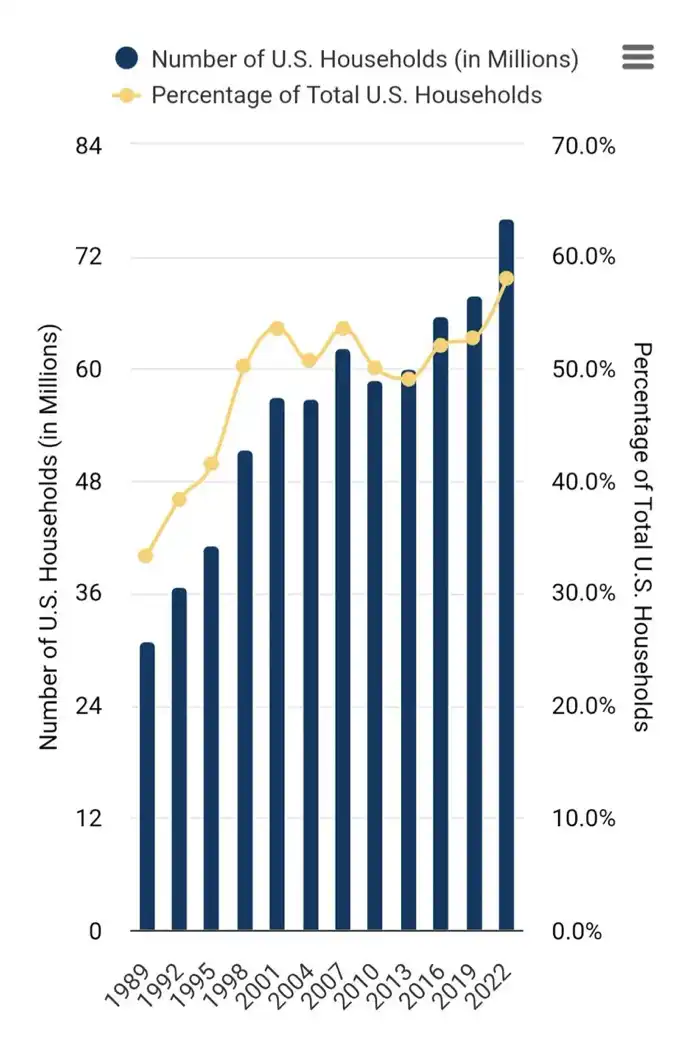
But there's 40 percent of Americans who don't get it. These people usually do not appear on national television programmes, nor do they express their views on X or Substack, much less accurately describing the financial suffering they are experiencing in a language familiar to economists or investors。
This explains the widening gap between stock market performance and consumer confidence。
It may be countered that consumer rhetoric is one and actual consumer behaviour another. This is partly true, as consumer spending in the United States does continue to grow. But the details are that the top 10 percent of the U.S. consumers today have contributed 50 percent of the country's consumption spending。
As my friend LightBringer wrote:
“The consumer economy of the United States is becoming more and more like a demand engine driven by luxury goods and high-income populations, while the bottom is wrapped in a fragile mass market shell. The picture is cruel because it shows that the consumption base is being emptied. The first 10 percent of people are now supporting nearly half of consumption spending, while 80 percent of people at the bottom are falling。
This means that, in terms of aggregate data, United States consumers appear to be still strong, but most households are actually weakening. The overall consumption is sustained because it continues to be consumed by asset holders, high-income and wealthy retirees.”
IF YOU STUDY THE DATA IN DEPTH, YOU CAN SEE THAT THE "K-TYPE ECONOMY" IS BECOMING MORE APPARENT IN CONSUMER SPENDING. THIS MAKES THE SITUATION COMPLEX AND CONFUSING, BUT IT CAN BE EXPLAINED IF IT IS LINKED TO THE DECLINE IN CONSUMER CONFIDENCE。
For investors, however, I have also brought some good news. Creative Planning CEO Peter Mallouk points out that very low consumer confidence surveys are often a “very good reverse indicator”. He said, “The worse people feel about the future, the better they will be after the stock market.”
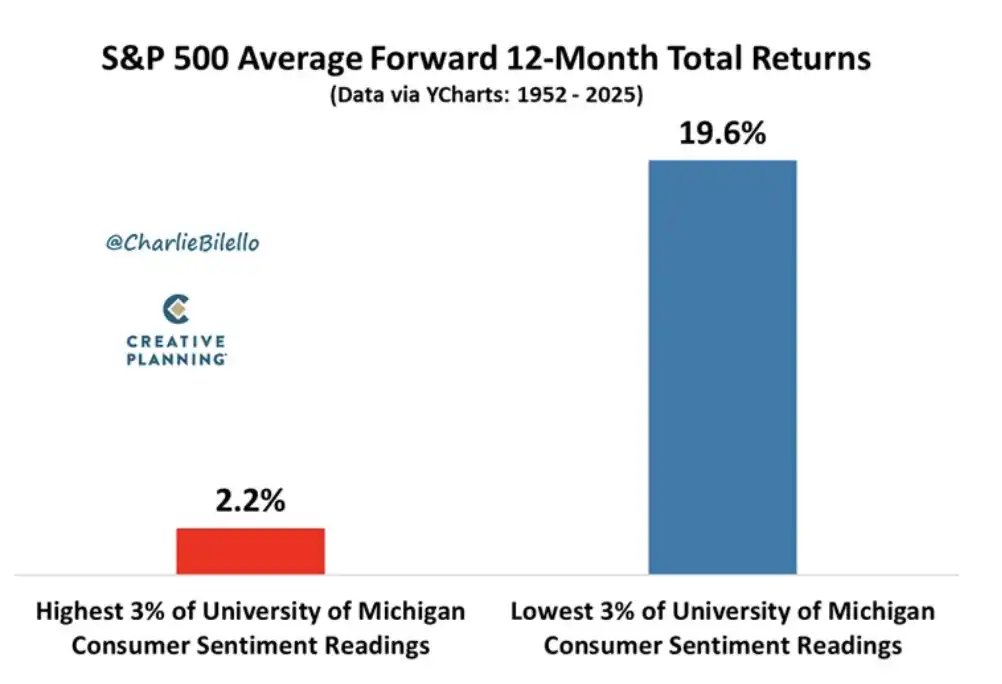
When the University of Michigan Consumer Confidence Index fell to the lowest 3% of historical readings, the Standard 500 Index reached a return of 19.6% in the next 12 months. This should reassure investors in view of the fact that there has been such a clear departure between the stock market and consumer confidence. But the continued strength of the US economy may not really help 40 percent of the Americans at the bottom -- they don't have the capital to invest, but they continue to suffer from higher consumer prices。
This is the deepest dual division of our time。
The rich have become richer, while others have been further dislodged. The factors driving the rise in asset prices are also punishing those who need the most breathing space. If you want to know what the Fed, Treasury or Washington will eventually decide, just look at what kind of person is responsible for making the decision。
Rich and powerful people are trying to cope with the situation with the tools at their disposal. They will try to show common sense and will see as much data as possible. I also sincerely believe that these people want to do the right thing and help as many as possible。
The problem is that they cannot serve both owners at the same time. As a result, rich asset holders will continue to win, while others will continue to sink. The only thing you can do is make sure you're on the right side. As time passed, asset prices were rising, while inflation was devouring more victims。
Have a nice day. We'll talk next time。
[ Chuckles ]Original Link]
