
Encryption AI Panorama: How to build a new operating system for AI Agent from the Ether's main battlefield
When AI Agent needs identification, payment, verification, block chains are becoming their operating system。

In 2026, it was becoming a critical turning point for Crypto to interact with AI。
Over the past two years, we have witnessed a change in AI from "aid tools" to "autonomous economic players," and AI Agent is no longer just talking robots that answer questions, and they start to start trading, call API, manage asset portfolios, and even hire other Agents to do their job。
But all of this is premised on the fact that these Agents need identity, access to payment, credit records, a verifiable implementation environment。
And these are precisely the problems that block chains are best at addressing。
It is also an old story that in September 2025, the Ether Fountain Foundation established the Decentroization AI (dAI) team, Vitalik Buterin published a systematic AI strategic framework at the beginning of 2026, and that a series of agreed standards around Agent identity, payment, and enforcement are already operating on the main online line, while solana and other public-chain ecologys are building the AI infrastructure along their own paths。
THEREFORE, THIS PAPER ALSO ATTEMPTS TO PROVIDE A COMPLETE PICTURE OF THE CURRENT ENCRYPTED AI PROTOCOL, WITH ITS MAIN AXIS, SUPPORTED BY IMPORTANT ADVANCES IN OTHER PUBLIC CHAINS。
First, Vitalik's AI Blueprint: Ether's "Trust Level" in the AI world
In February 2026, Vitalik Buterin published a systematic post on X that specifically revised his "encrypted x AI" cross-frame two years ago。
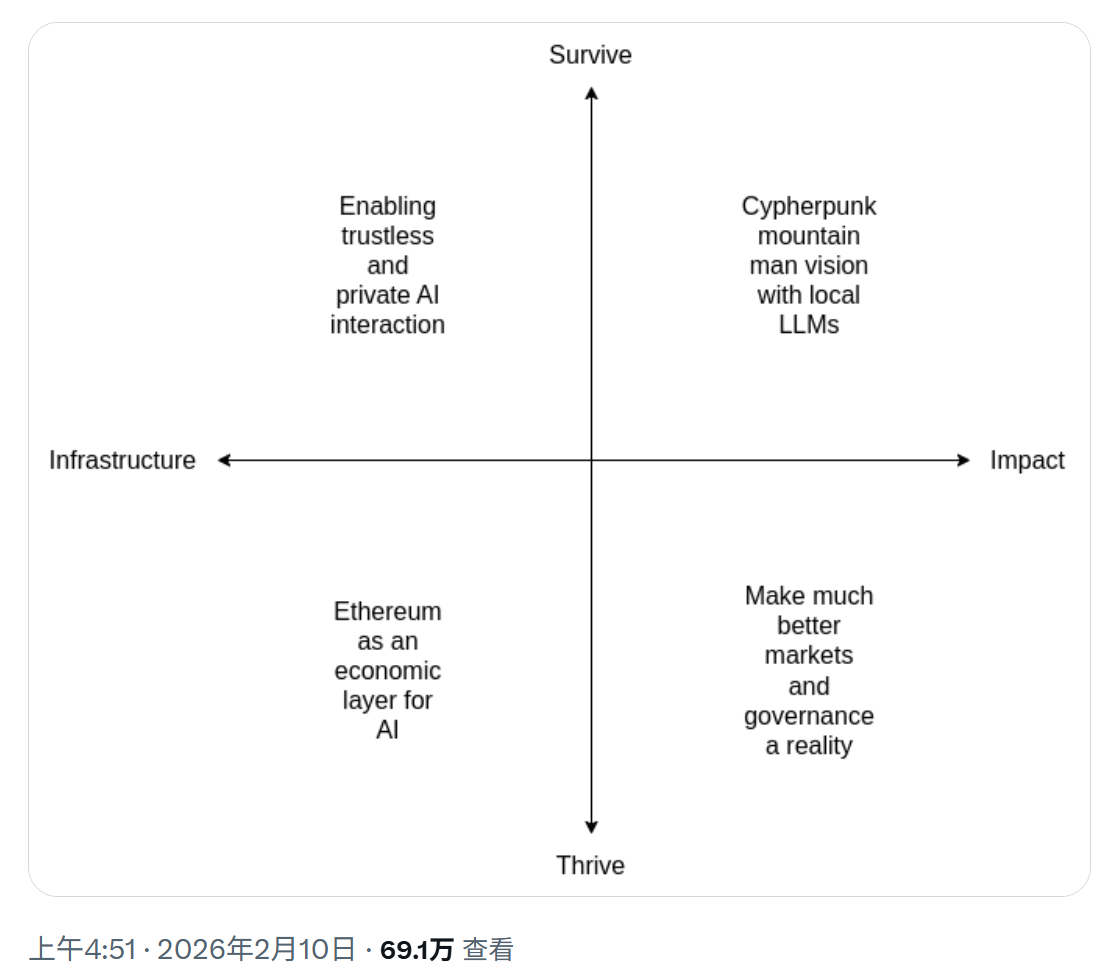
IN HIS PAPER, HE RE-EXAMINES THE IDEAS PUT FORWARD TWO YEARS AGO, ARGUING THAT THE ACCELERATION OF UNIVERSAL ARTIFICIAL INTELLIGENCE TENDS TO BE SIMILAR TO THE UNCONSTRAINED SPEED AND SCALE THAT TAIFUNG ITSELF WAS CHALLENGED WHEN IT WAS CREATED, AND EXPLICITLY OPPOSES THE SIMPLISTICIZATION OF AI DEVELOPMENT AS AN "AGI COMPETITION" AND ADVOCATES THAT TAIFUNG SHOULD BE THE WORLD’S GUIDE。
IN OTHER WORDS, WHAT HE REALLY CARES ABOUT IS NOT HOW TO GET AI OUT OF CONTROL FASTER, BUT HOW TO LET AI EXPAND ON A VERIFIABLE, AUDITABLE, BINDING INFRASTRUCTURE。
In general, the Vitalik framework contains four core pillars。
FIRST IS A TRUSTED AI INTERACTIVE TOOL。He advocated the use of tools such as local LLM and zero knowledge proof payment mechanisms to allow users to use AI services without exposing identity and raw data。
This attitude is not confined to abstract formulations. In April 2026, Vitalik also publicly shared his own local LLM use scheme, and after testing multiple hardware sets, he chose to operate locally an open source model of 35 billion parameters Qwen3.5 on a computer that carries NVIDIA 5090 GPU, all of which was calculated locally, with the aim of increasing the rate of reasoning to its daily availability and minimizing the reliance on cloud-based models。
OF COURSE, IT'S MORE SYMBOLIC THAN PRACTICAL, BUT IT SHOWS, AT LEAST IN HIS VIEW, THAT AI IS REALLY WORTH PURSUING IN A DIRECTION THAT IS NOT JUST A STRONGER MODEL, BUT A MORE MANAGEABLE ONE。
THE SECOND IS THE AI ECONOMIC COORDINATION LEVELThis includes supporting mutual payments, security guarantees, dispute resolution and credibility accumulation between Agents by means of smart contracts, leading to a programmable economic relationship between machines and machines; and, thirdly, AI as an interface with Web3 such as local AI assistants who can help users draft transactions, audit smart contracts, interpret formalized certificates, and act as a bridge between ordinary people into a complex world。
FINALLY, AI'S ENHANCED GOVERNANCE SYSTEM, SUCH AS USING AI TO UPGRADE THE FORECASTING OF MARKETS, SECONDARY VOTING, ALLOCATION OF PUBLIC FUNDS, ETC., FINDS A BALANCE BETWEEN AUTOMATION AND HUMAN JUDGEMENT。
Overall, the core philosophy of this framework can be condensed into one sentence:ETHERLEAF IS NOT TO ACCELERATE AI, BUT TO ALLOW AI TO OPERATE IN A VERIFIABLE, AUDITABLE, DECENTRALISED ENVIRONMENT。
So how does that happen
II. FROM AN IDENTITY AGREEMENT TO A PAYMENT AGREEMENT TO AN ENFORCEMENT AGREEMENT TO A VERIFIABLE AI
If Vitalik's framework is a macro blueprint, the recent evolution of the Taifung ecological wave has begun to push this approach into a specific technology warehouse。
THE FIRST INFRASTRUCTURE NODE OF GREATEST CONCERN IS ERC-8004。
As the identity, credibility and certification standard for the Taifung design for AI Agent, it was developed with the participation of Google, Coinbase and MetaMask, led by the Taifeng Foundation dAI team, and included almost three key entry points for AI, transactions and wallets (extension readingIAAgent's new ticket: Push ERC-8004, what are you holding on to)。
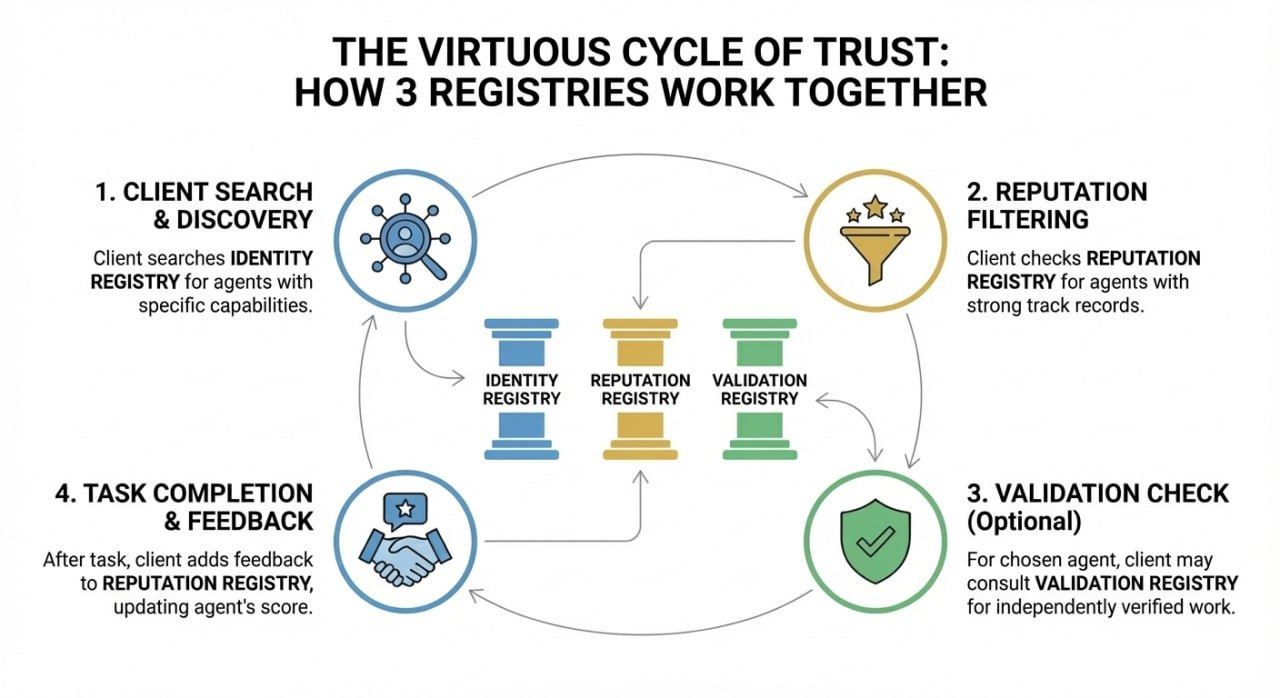
As its official name is Trustless AgentsAND ITS CORE LOGIC IS NOT A COMPLEX ALGORITHM, BUT RATHER IS DESIGNED TO GIVE AI A VERIFIABLE IDENTITY, REPUTATION AND ABILITY ON THE CHAINIn short, it was designed with great restraint, to do only three things:
- Identity registration form: Based on the ERC-721 standard, each AI Agent is "NFTized", meaning that AI Agent can be consulted, quoted and integrated into other protocols like a wallet address
- (a) A reputation registration form: it can be understood as an "public opinion" of the AI community, allowing feedback to be received from actual interactive users of Agent or other Agent, and these evaluations can be linked to chain-based payments or hosting, ensuring that reputation is not an empty narrative but a historical record based on real economic behaviour
- Validation of the registration form: The historical reputation is not sufficient for high-value or high-risk missions, and ERC-8004 therefore leaves a third-party authentication interface to allow endorsement of the Agent ' s capacity or implementation process through credible implementation of the environment, zero proof of knowledge, etc.
If identity answers the question "Who's Agent" and the 402 agreement represents the payment infrastructure, then the question is "How does Agent trade."。
As is well known, x402 is an open HTTP payment agreement, co-sponsored by Coinbase and Cloudflare, whose basic principles are so clever that it revives the 402 status code (Payment Required) that has been on hold for a long time in the HTTP protocol, and when an Agent tries to access the fee service, the server returns 402 status code and payment requirements, and Agent is granted access upon payment in a stable currency.
THE WHOLE PROCESS IS EMBEDDED IN THE HTTP REQUEST WITHOUT THE NEED FOR A REGISTERED ACCOUNT, CREDIT CARD OR MANUAL INTERVENTION. IN OTHER WORDS, IT'S A PAYMENT SYSTEM DESIGNED FOR MACHINES, NOT FOR HUMANS.
It is interesting to note that, just at the beginning of this month, Linux Foundation was a formal takeover of the 402 Foundation and accepted the contribution of Coinbase to the X402 agreement, which is very clear:x402 is to embed payments directly into the HTTP interface so that AI applications, API, are as valuable as data exchange。
The importance of this message has been largely ignored, on the one hand, by the penetration potential and significant influence of 402 on AI and Internet payments, and, on the other hand, by the luxuries that have been promoted by 402, of course, but this is clearly the effect of 1+1 > 2。
In addition, the V2 version of x402 is also working to expand the payment modality, including not only to support chain stabilization currencies, but also to accommodate traditional ACH (Automated Clearing House, Automatic Clearing System) and banking card networks in order to bridge the boundaries between AI Agent and the real-life financial system。
Finally, the third piece of the puzzle recently completed by the Taifung is the executive layer, in addition to identity and payment。
In April 2026, Biconomy, together with the Improve UX Foundation, promoted ERC-8211, trying to solve the most realistic card points in the DeFi world, such as the complex operation of the chain, which is often not a call, but rather a multi-step, dynamic, efficacious implementation chain。
We can simply interpret it as a "smart batch" mechanism designed specifically for AI Agent and complex DeFi operations, because in traditional chain operations, the completion of a complex DeFi strategy often requires multiple independent transactions: withdrawal of funds from loan agreements, conversion of coins, and depositing in another agreement。
Each step requires a separate signature and confirmation, which is already cumbersome for human users and a further bottleneck for AI Agent, which requires a high-frequency autonomous operation, while the ERC-8211 solution allows multiple block-chain operations to be carried out in a single transaction, with each step being implemented dynamically deciphering the actual values and meeting predefined conditions before proceeding。
An Agent, for example, can be completed in a signed transaction: withdrawal of funds from Aave to exchange the amounts actually received for Uniswap to deposit the exchange results in Compund -- all atomized, without the need for a new smart contract。
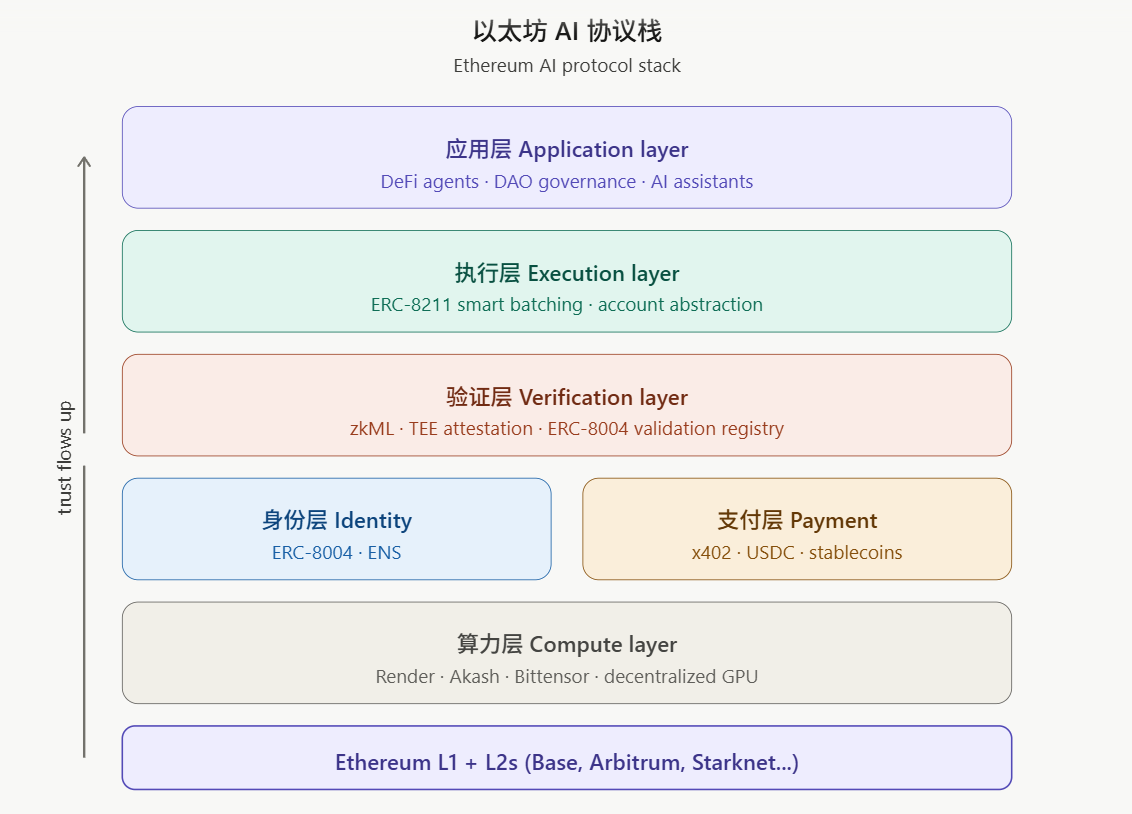
Put these three together. The Ether's line has been clear latelyERC-804 answers, "Who are you, why are you trusted by others," and 402 answers, "How do you pay for your services," and ERC-8211 answers, "How do you perform complex operations efficiently?"。
In other words, what is really lacking in the AIAgent economy is never just a bigger, smarter model, but an open, combustible and scalable collection of agreements; that's exactly what the inn does best。
iii. Calculations outside the Taifeng: Solana, DePIN and decentrization
AND, OF COURSE, EVEN THOUGH THE ETA IS A LEADER IN STANDARD SETTING AND TRUSTING INFRASTRUCTURE, AI IS MUCH MORE THAN A CHAIN OF ENCRYPTED ECOLOGY。
More precisely, the Ether Workshop is competing for the standard and confidence layers, while other ecology shows different advantages in the executive and the computational layers。
Solana is the most typical example. The growing sense in Agent’s payment topic is that the demand for the chain is not ideologically correct, but rather “low delay, low cost, sufficiently stable” and that Solana’s official introduction to x 402 directly uses the end of milliseconds and extremely low transaction costs as an important selling point for machines, which explains why Solana is more likely to take on the high frequency, small size, and instant feedback Agent interactions。
At the same time, the Agent tool chain around Solana has grown rapidly, and Solana Agent Kit official GitHub has allowed the Agent to perform more than 60 Solana actions autonomously on any model, covering transactions, coins, loans, airdrops, Blinks, cross-chains, etc., and has been reused by a large number of chain projects and developers。
So, in today's pattern, the division of encrypted AI is becoming clearer. It is more like a bottom abstract in terms of protocol standards, identity credibility and credible enforcement, while Solana has a real advantage in the interaction between high-frequency payments and low friction, and the value of decentrized computing networks is re-pricing as more Agent actually enters the production environment。
IN GENERAL, WE LOOK BACK AT APRIL 2026, APRIL, AND THE ENCRYPTION OF THE AI PROTOCOL IS IN ITS INITIAL FORM:
- Level of identity: ERC-8004 as the Agent Identity Standard, which is dominated by the Taifeng, has been extended to multiple chains such as Base
- Payment level: x402 from the Coinbase experimental project to global standards under Linux Foundation governance
- Implementation level: Standards such as ERC-8211 simplify the complex chain operation of Agent
- Validation layer: technologies such as zkML, TEE, password certificates are beginning to provide authentication for high-value Agent interactions
- (a) Competition patterns: Taifah as a standard and confidence layer, Solana as a high frequency executive level, and Bittensor as a possible complement to dimensions such as calculus, creating complementary rather than zero-sum patterns
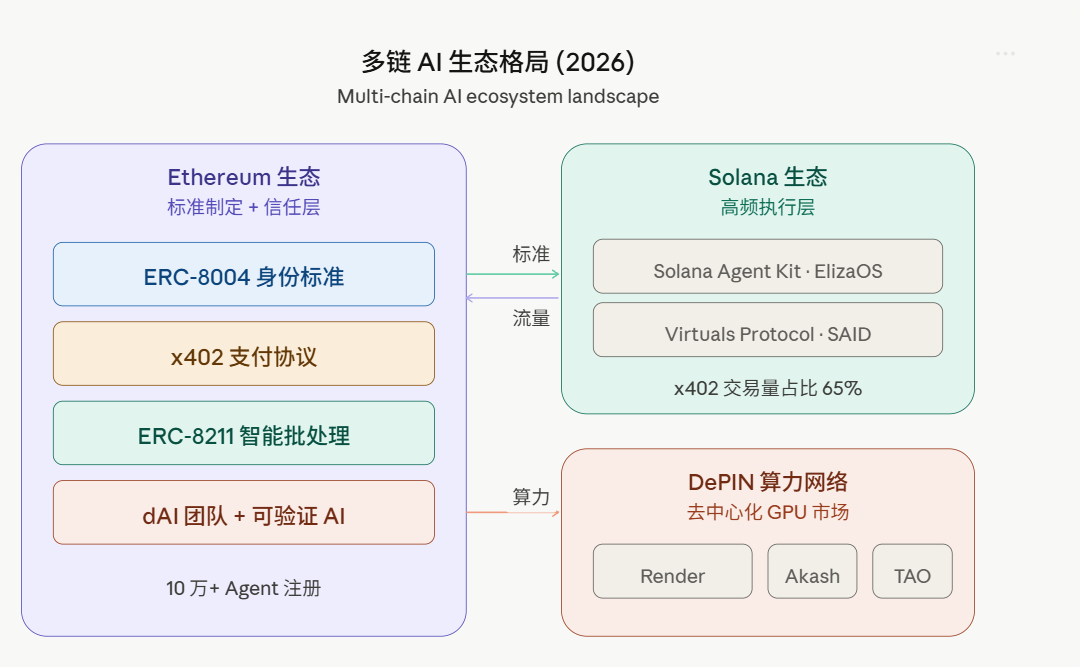
Looking forward to the second half of the year, the new upgrading of the Taifeng is likely to drive the L1 expansion, the abstraction of primary accounts, and the security of the back quant, in which the abstract penetration of accounts will undoubtedly significantly reduce the threshold for the use of Agent's wallets; and the deep integration of x402 with ERC-8004 may also trigger a closed Agent economy, which covers the registration of Agent, the discovery of services, the initiation of payments, and the accumulation of creditworthiness, all of which are completed on the chain。
At the end
THE ETA AND THE BLOCK CHAIN ARE NOT INTENDED TO ACCELERATE THE ARRIVAL OF AI, BUT TO ENSURE THAT WHEN AI COMES, THE WORLD DOES NOT GO OUT OF CONTROL。
After all, in the Web2 world, AI's identity is defined by the big company API Key, payment is carried by a credit card system, trust is endorsed by a centralized platform that barely works in the context of human users, but under the new paradigm of millions of AI Agent, which requires 7 x 24 hours of self-collaboration, it is becoming less and less effective。
And a new infrastructure for the AI Agent economy might be built by standard-setters based on the Taifeng, efficient executive layers represented by Solana, and decentrized by DePIN。
