
OpenClaw for gold: Scratchers never worry
This collective anxiety is being realized in a complete industrial chain. 。

Original author: Black shrimp cage, deep tide TechFlow
OpenClaw is completely on fire in China. How many people are anxious around you and how many people are counting money
There's a country trip to Shenzhen, and he's flying over the state of Hangzhou, and he's setting up this "crawfish" for his little bosses。
OpenClaw was sent directly to the client for start-up and earned $1.8 million。
An encrypted miner, who was already in a bad business, is now changing and selling OpenClaw hardware。
Selling Token API's transit station is making millions a month。
This is the true face of the OpenClaw wave: millions of people are deploying, buying hardware, buying courses in front of the stage, and a complete industrial chain is transforming the collective anxiety into a layer。
From hardware to cloud servers, from Token to Skill, free open source, anxiety is the real commodity。
Make OpenClaw hardware
There's a picture on the Internet, and many people can't laugh when they see it。

In the 1990s, the masters of gas drew circles on the public aluminum pan, known as access to cosmic energy; in 2026, people were baptized in conference rooms with lobster caps, as if they did not have a lobster, and were behind the times。
After the laugh, it's worth paying attention to the man who's speaking on the stage. His name is Kong Swordpin, encrypted OG, ipollo founder。
THE FAMOUS KOL "ENCRYPTED WITHOUT FEAR" COMMENTED ON SOCIAL MEDIA:“It must be Mr. Kong Swordpin who always stands at the hottest point in the ring of money the big money is right, the small money is clear.”
When Bitcoin was digging for the mine, he launched the mining machine company Nano Labs. He said he was moving from a mine to a meta-cosmic operation, which would usher in a new era for mankind; that Hong Kong's policy had been highlighted by his placement of Hyangjiang as Director of the Hong Kong Digital Port; and that he was a DAT company when the DAT concept was hot..
This time, OpenClaw was on fire, and Kong was operating in cities across the country, declaring that humanity had entered the “Web 4.0” era, led by AI Agent, and introducing the hardware iPollo Claw PC, an official presentation entitled “For Open Claw applications”, AMD 5600H processor, max 64GB memory, pre-assembling the ClawOS original system and selling $439 on the Internet。

Kong Swordping is not an exception. He is only the most visible name on the hardware chain。
Toshio, a hardware manufacturer, a salesman's friend circle full of lobstersOpenClaw lobster hardware program in support of OEM ODM, B end and large commercial customers。

A standard white factory, where anyone who wants to get in the game makes a phone call, signs an "AI host for OpenClaw Optimization"。
As with this East China company, the upper part of the hardware chain, many of which were factories that used to be encryption machines like Filecoin, were too familiar with the script:Concept eruption, surge in hardware demand, discount premium, harvest window period。
The speed of supply chain response, which has been practiced in the mine age, is equally useful for changing tracks。
The core logic of this business is no mystery: Mac Mini is the most widely recommended local running hardware of OpenClaw, but for most ordinary users, a more than $3000 Mac Mini plus a command line configuration without a graphical interface is too high a threshold. So demand arises, and people come to sell a “lower threshold” service, or simply sell a “open-to-use” machine, monetizing the threshold。
As much anxiety as the premium is。
Token, it's a big deal
OpenClaw itself is free, but running it requires continuous feeding to the big model Token。
MINIMAX and KIMI became one of the greatest beneficiaries, but there are still people who want to use big overseas models like Claude and ChatGPT to do complex tasks。
The trouble is that registration numbers and payments are difficult, and Claude is more likely to ban Chinese users. Official API prices are good, a high-intensity OpenClaw user runs full-scale Claude, with easy monthly costs exceeding $800。
This created a huge token transit market。
On the market, you can buy a lot of '50 or even three' Claude API, but where they come from is always a mystery。
ON THE FACE OF IT, THE INDUSTRY IS A LOW-PRICED BUSINESS, API, RESOLD AT A HIGHER PRICE, MAKING THE MIDDLE PROFIT, BUT THE WATER GOES FAR BEYOND THAT。
At the bottom, the most common way of doing this is to reverse the ChatGPT, Claude's web interface and package it as a standard API resale。
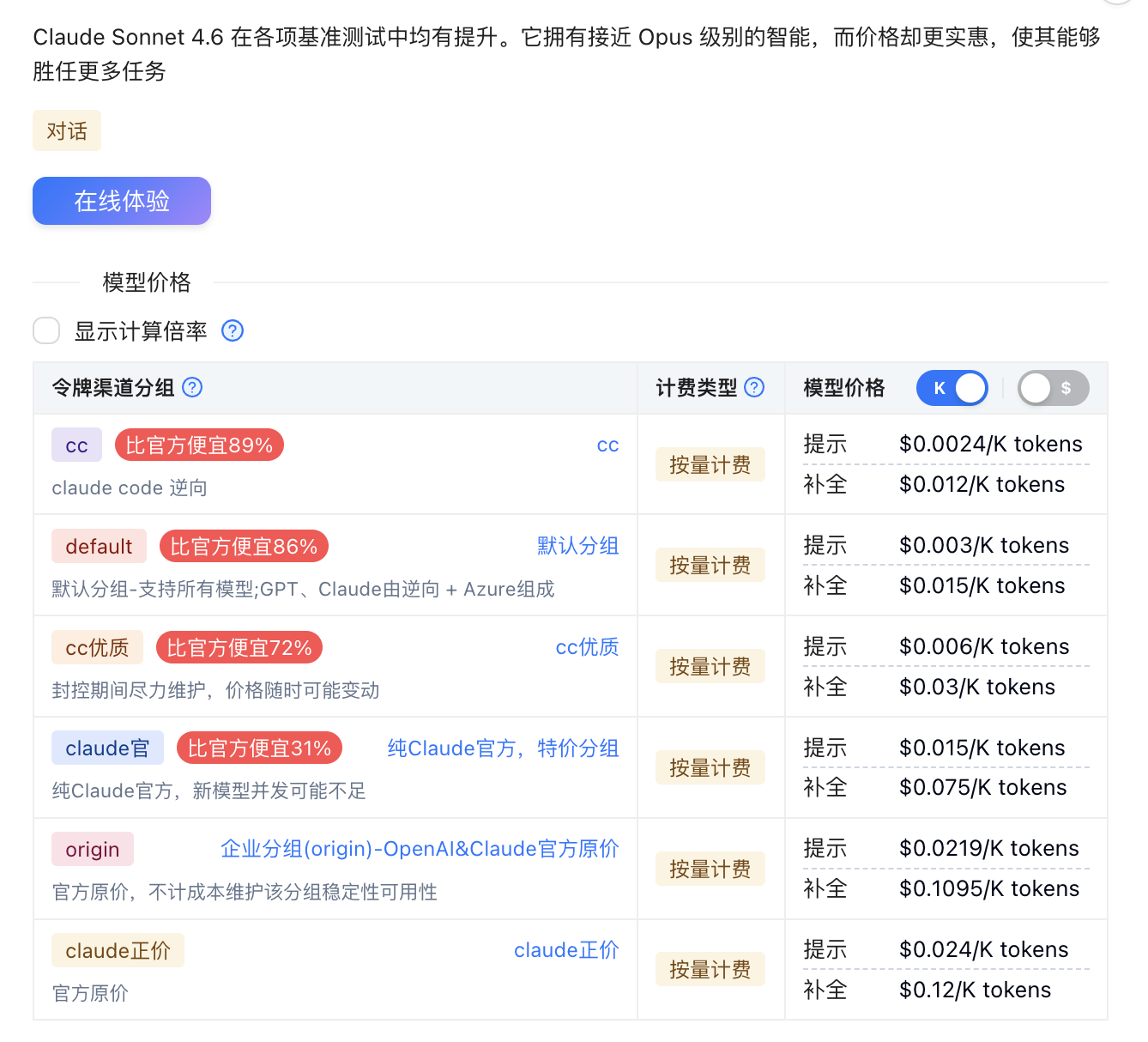
The price of an API transit station shows that its reverse Claude Code API is 89 per cent cheaper than the official price of $0.024/K Token, which only requires $0.0024/T Token。
Even more expensive is selling fake goods directly。
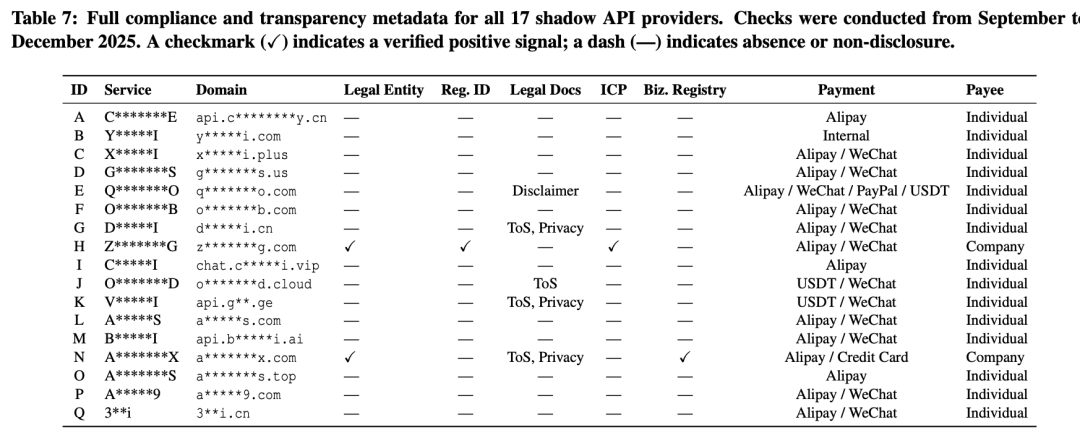
In early March, the CISPA (Hemhods Information Security Centre) published a study entitled Real Money, Fake Models: Deceptive Model Claims in Shadow API。

They foundALMOST HALF OF THIRD-PARTY API ENDPOINTS ARE DOING THE JOB OF STEALING BEAMS。
YOU PAY THE API, HAPPY TO THINK THAT YOU'RE CALLING GPT-5 AND THAT THE MERCHANTS ARE SNEAKING AROUND BEHIND YOU, BUT IT'S VERY LIKELY TO BE A VERY LOW-COST NATIONAL MODEL, OR EVEN A FREE OPEN SOURCE MODEL OPERATING LOCALLY (GLM-4-9B, ETC.)。
OF THE 17 INDEPENDENT HEAD SHADOW API SERVICE PROVIDERS IDENTIFIED BY THE CISPA AUDIT, 15 ARE OPERATED EXCLUSIVELY BY INDIVIDUALS, AND MORE THAN 88.2 PER CENT OF PROVIDERS HAVE NOT EVEN FILED WITH THE MOST BASIC INTERNET CONTENT PROVIDER (ICP)。
One of the API agents told Deepwater TechFlow that now head-to-head API can make millions of dollars a month, and demand is huge。
These are only cost-side stories, and former Manus staffman Yan publicly revealed the deeper logic of the business:The central purpose of many Token transit stations is not to sell API at all, but to collect high-quality distillation material for specific scenarios。
“All transit requests, complete prompt plus response, are available distillation data. In particular, OpenClaw's programming scenes, where users produce complex reasoning chains and real engineering decisions that are the desired training material for model manufacturers. So the real business model for some of the transit stations is likely to be: charging you a transit fee is a apparent business, and selling your request data to large plants for model distillation is the core profit. You're a paid customer, and you're a free-of-charge training data producer
On the top of this whole chain, there is another layer of business that looks cleaner: Token aggregating routers, APIs that connect you to a dozen models, autorouting the complexity of the task, a cheap home-grown model for simple tasks, a complex mission using Claude or GPT, which says it saves users 65 to 80% of API costs. The service itself is valuable, and those who have mastered the traffic portal accumulate real user profiles earlier than any model manufacturer。
Data, always real assets。
Poor information. The oldest business
If the first two lobster gold mines are based on hardware and data, the third is based on something simpler:You know, and others don't。
Li Hwan's recent business is a national business trip. With his notebooks, flying in Shenzhen, flying in Chengdu, flying in Hangzhou, he installed OpenClaw, attached flybooks, nails, calibrated automated workflows and the exclusive Skylls to his bosses everywhere. One thousand dollars or even tens of thousands of dollars a month is considerably higher than the monthly salary of many programmers。
It is an anomaly that Li Hwan is not a programmer, but is of literary origin, and he frankly states that he is not selling technology, or poor information, directly translating a popular concept into a product that the boss can use directly, while giving emotional value and calming anxiety。
To make this logic extreme is an American named Adam Sand。
Adam wasn't an engineer, he and his wife Allison worked on the roof business, and after OpenClaw went on fire, he did something that seemed to be free in the tech world: Load pre-packaged OpenClaw into MacBook and connect it to the Skills package, HubSpot CRM and the worksheet system for the roof industry, secure data and send it directly to clients. Put the electricity in, and the AI employee goes to work. One-on-one training, ongoing weekly support, pricing $5,000 for one。
The project, known as RoofClaw, had a total historical revenue of over $1.8 million and delivered over 360 roof contractors。
A lot of people's first reaction is: Isn't that putting a free open source project into hardware and charging $5,000
Yeah. But Adam wasn't selling software or hardware. What he's selling is that a roof contractor doesn't need to know any technology to get AI employees to start work tomorrow. That $5,000, most people don't hesitateBecause they're hurting Adam more than anyone knows, he's been fighting the industry for over a decade。
That's the essence of the bad information business. You really understand your customer needs。
Back in the country, the business had got to another painting。
On the treasure hunt, there are more than one installation service store with more than 1,000 orders, a team of dozens of engineers, nearly 30 to 45 million dollars to install OpenClaw in a month. Even the installor promised on the detailed page “to deploy at home and to offer a cooking service once, and to cook regular food”。
THIS TRACK IS SO HOT THAT THE AMERICAN CORPS, KYOTO, THE UNITED IT SERVICE, HAS LAUNCHED A REMOTE DEPLOYMENT SERVICE. FROM INDIVIDUAL HOUSEHOLDS TO LARGE INTERNET FACTORIES, PEOPLE AT EVERY LEVEL EARN MONEY, INDICATING THAT THE DEMAND IS REAL AND LARGE ENOUGH。

Skills trafficking is the other side of that logic。
OpenClaw's ecoclawHub and community contributions of Skills have exceeded 5700. Some are selling ready-made Skills packages, others are selling SoUL.md role configuration templates, AI CEO, marketing director, legal examiner, $19 to $99, some are selling customized development services, and others are selling “OpenClaw’s full course of practice”。
The higher the technology threshold, the more people are willing to pay for lowering the threshold, a rule that has never failed in each technology cycle。
The shovels never get anxious
On a platform where income is officially certified, OpenClaw has 126 entrepreneurial projects, ranked in real time on the certified income of the last 30 days。
The data is cruel: of the top 30 projects that make the most money, more than 17 do the same thing, one key to cloud hosting。
Claw Mart has received $54,000 for the last 30 days, $747 million for Donely ' s total historical income and $1.8 million for RoofClaw ' s total historical income。
But the other side of the story is:The half-life of the poor information is measured as “week”, not “month”。
The first to sell shovels has begun to retreat. A project called QuickClaw, which calls “Telephones 30 seconds to deploy OpenClaw”, starts rapidly during a week of traffic, and then offers an external offer of $300,000 for sale。
This is the truest rhythm of the wave: the explosion of the technology concept, the opening of the bad-information window, the first crowding in, the rapid dissipation of the dividends and the departure of the shovels。
Kong Sword Ping had already carved this rhythm into his muscle memory. He went from the Bitcoin mine to the OpenClaw mainframe, across an entire era of encryption. Each time, he can get on the wave, not because he understands technology before others, but because he knows more about humanity, about the fear of “I can't lag behind” and about how much people are willing to pay to overcome it。
The contrast of the aerodynamics makes people laugh, and the images of both times are the same: aluminium pots and lobster caps are rituals, they are the visualization of anxiety, they are the symbol of "I'm on the right side."。
The only difference is that the lobster hat in 2026 is connected to a real industrial chain, more sophisticated and knowledgeable about humanization。
In 1849, California's gold rush ended up making money not by miners, but by Levi Strauss, who sold jeans。
In 175 years, every technology wave was told。
Because every time, it's right。
Those who sell shovels don't gamble on the loss of technology but on the stability of humanity。
So they never worry。
