
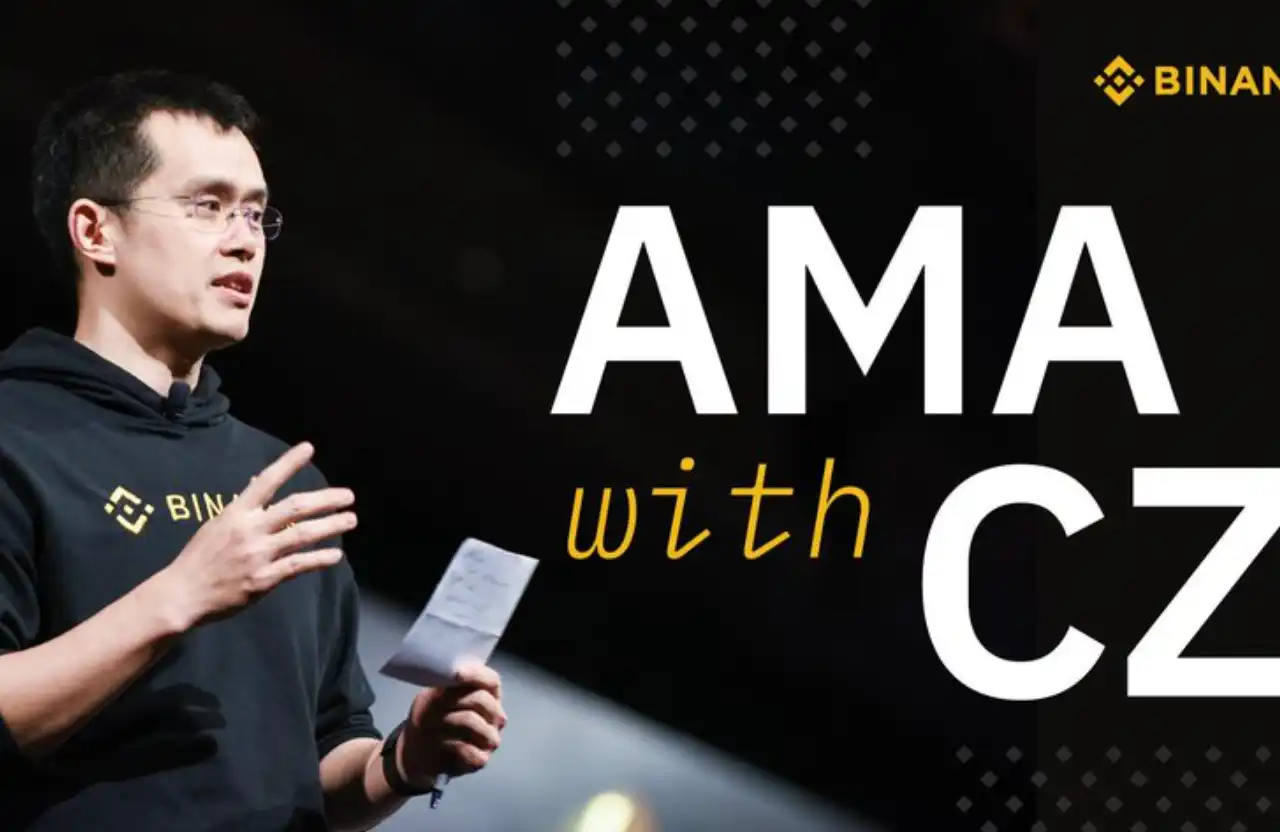
FIRST AMA AFTER THE CZ BOOK: BUSINESS, INVESTMENT AND LIFE ADVICE FOR ORDINARY PEOPLE
CZ RECOMMENDATIONS FOR YOUNG PEOPLE: MORE OPPORTUNITIES THAN IN THE PAST, CONTINUOUS LEARNING, ACQUISITION OF CORE SKILLS, CONTROL OF RECREATIONAL TIME TO ENHANCE SELF。
This post is part of our special coverage Syria Protests 2011
On April 15th, one week after the sale of the new book "The Life of Bianan" by the founder of Binance, many participants in different circles have read it, what questions will they ask? How will CZ answer these questions
HERE IS THE FULL TEXT OF AMA ON APRIL 15TH:
I. How to build confidence and sustain entrepreneurship from 0
You started from scratch, without resources and without complete planning. How did you build confidence, persevere and believe that you were on the right path
I was exposed to entrepreneurship at an early stage, when I was involved in small-scale entrepreneurship projects as a developer, which gave me a preliminary idea of the entrepreneurial environment. Later, I worked in companies of different sizes, including small and large, which led me to realize that my personality was not suitable for long periods of time in a highly structured corporate environment。
In contrast, I prefer a more liberal and rapidly changing team and entrepreneurial environment. That's why I've been developing in this environment, and I've tried to start businesses many times。
In the process, I have experienced many failures. So my advice to entrepreneurs is to manage risks. Failure must not overburden itself and financing should be as investment-oriented as possible, rather than borrowing, without creating pressure to repay。
My growth is a long-standing process: first, the upgrading of technical capabilities, then the gradual involvement in commerce, marketing, and then the formation of teams。
THE REAL TURNING POINT IS THE EMERGENCE OF ICOI don't know. I realized that this was an opportunity, that it could be financed in this way, and I started to form teams and seized it in 2017。
The whole process is not clearly planned from the outset, but it is constantly attempted, adjusted and gradually developed a path in the process。
Ultimately, without the so-called formula of success, everyone's path is different。
The key is to find the right direction and create value for others。
II. How is the direction right? What if it's the wrong direction
Many have worked very hard, but have been unable to break through, possibly in the wrong direction. How do you judge the right direction? What if it's the wrong direction
My experience at the bottom of life is to move on. Many times, the situation improves over time, either the environment changes or you adapt yourself。
But the more crucial issue is direction. If you continue to do something that is not effective, then you have to reorient, not repeat it。
Many suffer because their behaviour patterns are per se wrong, such as long-term spending that exceeds income or maintaining habits that are not conducive to improving the status quo。
In such cases, a proactive change is required:
• Control of expenditure, first and foremost, to ensure that a portion of income can be saved。
• The second is the continuous upgrading of oneself and the daily learning of a little new knowledge or skills。
Even those engaged in manual labour can devote time to self-improvement on a daily basis. Long-term persistence will change。
Many choose to consume time after working hours, such as entertainment or socialization, which provide short-term satisfaction without long-term improvements。
If a person does not make progress for a long time, it is easy to stay put。
Continued modest progress would not only improve the situation, but would also provide positive psychological feedback. It was therefore important to maintain progress and optimism。
iii. do ordinary people have any opportunities in the current crypto environment
are there opportunities to make a leap forward in the area of crypto for ordinary people now that institutional entry, industry maturity? what do they have left
I think the industry is still in placeVery early。
IN MY VIEW, THERE HAVE BEEN THREE MAJOR TECHNOLOGICAL WAVES IN THE PAST FEW DECADES: THE INTERNET, BLOCK CHAINS AND AI, ALL OF WHICH HAVE A PROFOUND IMPACT ON SOCIETY。
although the crypto industry is much more mature than it was 10 years ago, it is still in its early stages as a whole. the current block chain is still very limited in its application in the financial system, and core areas such as loans, payments, foreign exchange and commodity transactions are still not fully linked。
according to data, the percentage of people who have been exposed to crypto is about 7 to 10 per cent, but the share of crypto held by these people is still very low, with total assets less than 1 per cent。
This means that there is still considerable room for growth in the whole market。
The future block chains have the potential to become part of the global financial infrastructure, even without distinguishing between “traditional finance” and “encrypted finance”。
At present AI has attracted considerable funding and attention, but this has left more long-term builders in the crypto industry. This environment is conducive to long-term development。
AT THE SAME TIME, AI WILL ALSO BE INTEGRATED WITH BLOCK CHAINS IN THE FUTURE, SUCH AS TRANSACTIONS BETWEEN AI AGENTS, WHICH ARE MORE SUITABLE FOR COMPLETION THROUGH BLOCK CHAINS。
SoThe industry is far from mature, and there are still many undeveloped opportunities。
Although it is not possible to predict price trends for specific assets, I remain very optimistic about the block chains from the perspective of industry development。
IV. How is the direction right
How do you judge the right direction in life or in entrepreneurship
I mentioned a point in my book:When you're at a low point in life, it's important to keep moving。
It's a long time ago. It was before I went into encryption. In my experience, things tend to get better whenever there are stressful situations or when things go wrong, if you can hold out for a few days. Either the environment really changes or you're getting used to it。
In many cases, the situation is not as bad as it looks。
I remember a while between two jobs when I first graduated. I took up a short-term consultancy project, which was renewed on a monthly basis. At the end of each month, I was not sure if the client would renew, and that uncertainty was putting a lot of pressure。
If my contract is not renewed then my financial situation will be directly affected. The pressure was very real when I graduated。
A few days later, the client did renew the contract, which made me realize that many of the pressures were in fact short-term and not necessarily sustained。
Similar situations have occurred many times in my life, including later when faced with greater pressure, such as regulatory or legal issues, the same logic: in the short term, it is difficult to look at them, but as time goes by, things gradually ease。
But back to the core question: if we keep going, how do we know the right direction
In my view, in most cases you can judge by results。If what you are doing does not generate any positive feedback, or if there is no long-term improvement, then it may be problematic to indicate the direction。
In such cases, it is not possible to simply continue, but rather to adjust。
V. What if the direction is wrong
If the direction is wrong, what matters is not to continue, but to change。
Some are unable to leave because they have been repeating the same acts, but they are not valid in themselves. In these circumstances, it is impossible to achieve different results without change。
I have observed that a very common problem is that many people have long been in a situation where they spend more than their income. They have developed a fixed consumption habit that must maintain a certain standard of living but cannot be supported by income。
In this way, they will remain under constant pressure and will remain in a state of difficulty。
In such cases, the first step must be expenditure control。
For example, you can reduce some non-essential consumption:
• Fewer bars, less meals, less entertainment
These adjustments do not really affect basic life, but they can give you some financial space。
The second key point is: continuous learning and promotion。
No matter what work you do now, even manual labour, such as construction workers, restaurant attendants, dishwashers, which I have done, you can still take a little time to study every day。
It can be either reading or learning a new skill。
If you make a little progress every day and control spending at the same time, you can gradually regain control over your own lives。
This process may not be fast, may take years, or even longer, but it is an effective path。
Many people are unable to improve because they are just resting or entertaining after work, such as watching television and painting social media. These actions will bring about short-term easing, but not long-term improvements。
If we don't make progress for a long time, people will be stuckI don't know。
Once continuous progress has begun, positive feedback will emerge and momentum will be easier to sustain。
How does it feel to finish this book
When I finished the book, my greatest feeling was "I'm relieved."。
THIS IS A VERY LONG PROJECT, NOT JUST THE WRITING ITSELF, BUT ALSO A LOT OF OTHER WORK, SUCH AS RECTIFICATION, COMMUNICATION WITH EDITORS, DECISION ON PUBLICATION, DESIGN OF COVER, APPLICATION FOR ISBN, ETC。
The whole process involves a great deal of detail, and every link requires time and effort。
I have also learned some lessons in writing. I read some other authors' books about how to write autobiography, and one of the important points is that the first draft must be bad。
You need to write all ideas first, and then you need to keep changing them. I've changed about a dozen or 20 times, and it takes two or three weeks for each round。
Writing a book is actually a trifling process, not a single one。
Another reality is that writing autobiography is almost certain to offend people。
Because if you want to tell your story honestly, you have to talk about issues that often involve specific people. As long as you express your true feelings, you will inevitably make some people uncomfortable。
So writing autobiography is not just a writing problem, but a psychological challenge。
At the same time, after the publication, you will be looked at and even criticized. It's also part of the book that has to be written。
But from another point of view, it is also valuable。A book can present your experience and perspective more fully than social media expression, allowing others to understand you more systematically。
VII. What do readers want from the book
I don't write this book for a teaching book, or for a successful methodology。
What I want to do is to tell my own story in its entirety and let others understand it from my perspective。
There have been many negative narratives and misunderstandings in the encryption industry, including Binance itself. Many people have a partial understanding of the industry, of the company and even of me personally。
These perceptions are often from external information rather than from the perspective of the parties。
So I want you to see through this book:
• What we were going through and how we were making decisions in the face of problems, what I was thinking
• I have written a lot of questions and difficulties in my book, not just the success stories. Because if you just say good things, it's not true。
Besides, I didn't mean to exaggerate. In fact, I deleted something more dramatic。
Some things are not written because:
It's too close
Or things that are still legal, regulatory, etc
If the second edition were to be written in the future, more might be added。
So overall, the core goal of this bookIt is to give readers a more realistic understanding of this experience, not to provide some standard answer。
VIII. How to avoid missing outstanding projects
A lot of investors missed Binance that year. Now that you're investing yourself, how can you avoid making the same mistakes and not miss a really good project
Frankly, this is inevitable。
In the early stages of the project, you have very limited access to information. There is usually only one idea, plus a founder, and the project itself has not really landed。
In these circumstances, you can almost judge the founders, not the project。
So even me, if I looked at Binance as an investor at the time, I might not have invested。
Similarly, now that I am investing, I will miss some projects that may be successful in the future. This is the attribute of the investment itself and cannot be entirely avoided。
Investment is not about seizing all opportunities, but about achieving positive returns overall。
That means:
You'll miss a lot of good projects
You'll miss a lot of projects
The key is that a small number of successful projects can cover the losses of failure。
So I don't try to be "not miss any chance" but accept it。
IX. What is the highest value for investment
In early investmentAt the very heart is the founder。
I prefer to invest in those who have a long-term sense of purpose, rather than focusing only on short-term gains。
A more obvious way of judging is for those who still insist on the project in Bear City。
If the market environment is poor and the encryption industry is at a low stage, but the man is still working on the project, he is more likely to be a long-termist。
In contrast, in cattle markets, there will be a large number of high-value projects, which will appear attractive in the short term, but it is difficult to judge who can be truly long-term。
So..I personally prefer to invest more actively in Bear City。
In addition to this, I will look at basic factors such as:
• Is a product or prototype available
:: Whether there is some enforcement capacity
• The ability to move quickly
NOW THERE'S AI, AND IT'S VERY FAST TO MAKE A PROTOTYPE, SO I'D LIKE TO SEE ACTUAL IMPLEMENTATION, NOT STAY AT THE THOUGHT STAGE。
Another important factor is valuation。
I would not normally accept a project with no products, no users, but very high valuation requirements。
Of course, investment judgement is a team act, and our team will do more thorough due diligence, and I personally judge the founders more from instincts and experience。
how can a crypto project be judged to have long-term value
in the current market, there are many narratives and hot spots. how do you judge which crypto projects or narratives have long-term value and which are short-term engagements
There is no absolute approach to this problem, but it can be judged by multiple signals。
First, a very important indicator is the level of development activity of the project, for example, on GitHub. If a project has continuous code upgrades and ongoing participation of developers, this means that the project is truly continuing。
This can be understood as whether a project is "live." As long as development activities continued, the project was still developing。
Many projects will be heavily marketed at an early stage, with a single version being launched and followed by short-term attention. However, the long-term value of the project is questionable if subsequent development activities decline rapidly。
Sometimes you find that development activity falls before prices fall。
The second important factor is whether the project has experienced multiple market cycles。
A project is more likely to be a long-term project if it lasts for multiple cycles and remains developed in Bear City。
On the contrary, some projects are very popular in one round of markets, but almost disappear in the next round. Such projects often lack continuity。
For example, some of the projects that were once very popular were almost no longer mentioned after the cycle, and even though they were still under development, their level of activity and impact declined significantly。
The third factor is the history of the founders。
If a founder replaces the project every one or two years, it is assumed that the life cycle of his current project will not be long。
While exceptions exist, the long-term willingness of the founders as a whole is an important signal。
Taken together, I value more:
:: Development activity
:: Cross-cycle
:: The history of the founders
In contrast, I will not rely too much on price or market heat。
What's the real story behind the success of 11, Binance
The outside world sees more of the growth and success of Binance. Are there some unknown factors that are actually essential to the development of Binance
I think the most underestimating is the intensity of the team's workEspecially at an early stage。
The encryption trading platform is a 24-hour business without real "closure time". The system must be readily available and team members on standby。
At an early stage, teams often stayed in the office for long periods of time, almost continuously working。
Even if I'm not in front of the computer, I need to be on the phone at any time。
This method of work is very demanding in terms of body and energy, but it is difficult for the outside world to really understand this intensity。
Many say "working hard," but it is hard to appreciate this long-term, sustained and intense input。
As the team size expands, the situation will gradually improve, the organizational structure will become more stable and the intensity of work will decrease. But in the early stages, this high intensity is inevitable。
XII. What are the recommendations for lost young people
Many young people now have a common starting point, weak self-control and, at the same time, more intense competition and a confused future. What would you advise them
I believe that the present opportunities are actually more, not less, than in the past。
The greatest advantage for young people is that they are better able to learn and that the brain is more adaptable to new knowledge. If there is continuous learning and progress every day, growth will be very rapid。
On the contrary, they do not bring about long-term upgrading if they spend considerable time on entertainment, such as games, social media or short-term enjoyment。
This does not mean that there is no recreation at all, but rather that there is a need to control the ratio, for example, by spending only a small amount of time on entertainment and spending more time on learning and self-promotion。
Besides, I think everyone should have at least one core skillFor example:
• Technology market finance
On this basis, other capacities are gradually being developed。
From a more macro perspective, technological development is accelerating。
In the past, it took a long time for a company to grow from zero to tens of billions of dollars, and the process is now shrinking。
TECHNOLOGIES SUCH AS THE INTERNET, CLOUD COMPUTING, AI, BLOCK CHAINS AND SO ON HAVE SIGNIFICANTLY REDUCED THE THRESHOLD FOR ENTREPRENEURSHIP, AND GLOBALIZATION HAS ENABLED PRODUCTS TO REACH USERS QUICKLY。
While competition is indeed more intense, competition itself is part of learning and can help you understand what works。
Many will find the environment more difficult, but similar views will emerge at every time. Indeed, the living conditions of humankind as a whole are improving。
Therefore, I do not agree with the "reduced opportunity" view. There are now more opportunities, just for continuous learning and adaptation。
