
The energy crisis is approaching. America is losing the Iran war.
In the coming weeks, the world may begin to pay for this war。
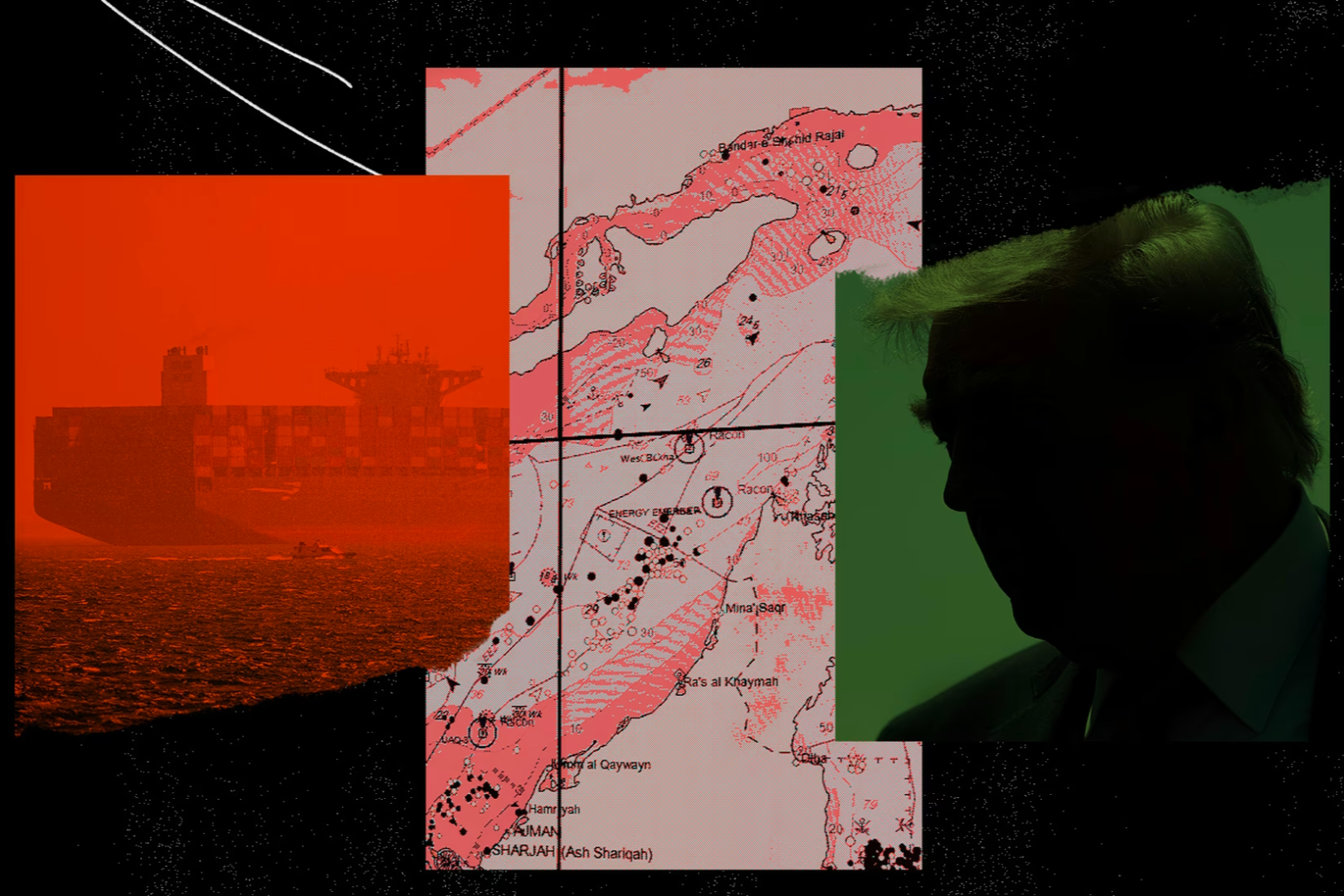
Original title: Trump Has Officely Lost The War In Iran and The Great Energy Collapse Of 2026 Is Coming.
Photo by Dean Blundell
Original language: Peggy
The editor presses that when a military operation that was originally packaged as a "quick victory" evolved into a long-term blockage in the Straits of Hormuz, rising global energy prices, and countries activated fuel rations and the release of strategic reserves, the consequences of the war were no longer confined to the battlefield itself, but instead entered the bottom of the global economy。
Using Robert Kagan’s article in the Atlantic Monthly, the paper points to a symbolic turning point: those who have long been providing strategic justification for United States military intervention now have to admit that what the United States has experienced with regard to Iran is not a partial setback, but a deeper strategic failure. What the author really wants to discuss is not just whether the United States won a war, but whether the United States has the capacity to work for global energy security, Gulf order, and ally systems。
It is even more noteworthy whether the Strait of Hormuz will be reopened in the short term, but that the global confidence structure surrounding it has been rewritten. In the past, the United States has maintained “freedom of navigation” with naval force and security commitments; now, according to the author, this mechanism is being replaced by a new “licensing system”, with licences being transferred to Tehran. The Gulf countries had begun to recalculate their relations with Iran, their allies had begun to question the validity of the United States commitment, and energy-importing countries had responded to new realities through rations, reserves, alternative imports and price controls。
The article is sharp in that it leaves military failure, the energy crisis and domestic political deception in the same chain: war is not an isolated event, but the result of years of strategic arrogance, policy miscalculation and political performance. When policymakers see war as a triumph in television images, it is those in front of the gas station who really bear the costs, small enterprises dependent on diesel transport, food systems pushed up by fertilizer prices, and all ordinary people who depend on global supply chains。
When the United States was unable to reopen an energy lifeline that it had long been committed to protecting, the global order had begun to re-pricing around that fact. The cost of war will also gradually be translated from the sentence in the strategic report to the figure on the individual bill。
The following is the original text:
On Saturday, Robert Kagan published an article in the Atlantic Monthly, entitled " Death in the Iranian chess game " 。
That's right, the co-founder of the New American Century, Victoria Newland's husband, the brother of Frederick Kagan, and the "Royal Philosophy" of every war in America for the past 30 years
In his paper, he wrote that the United States had suffered “a total failure in a conflict, a failure so decisive that this strategic loss could neither be remedied nor ignored”
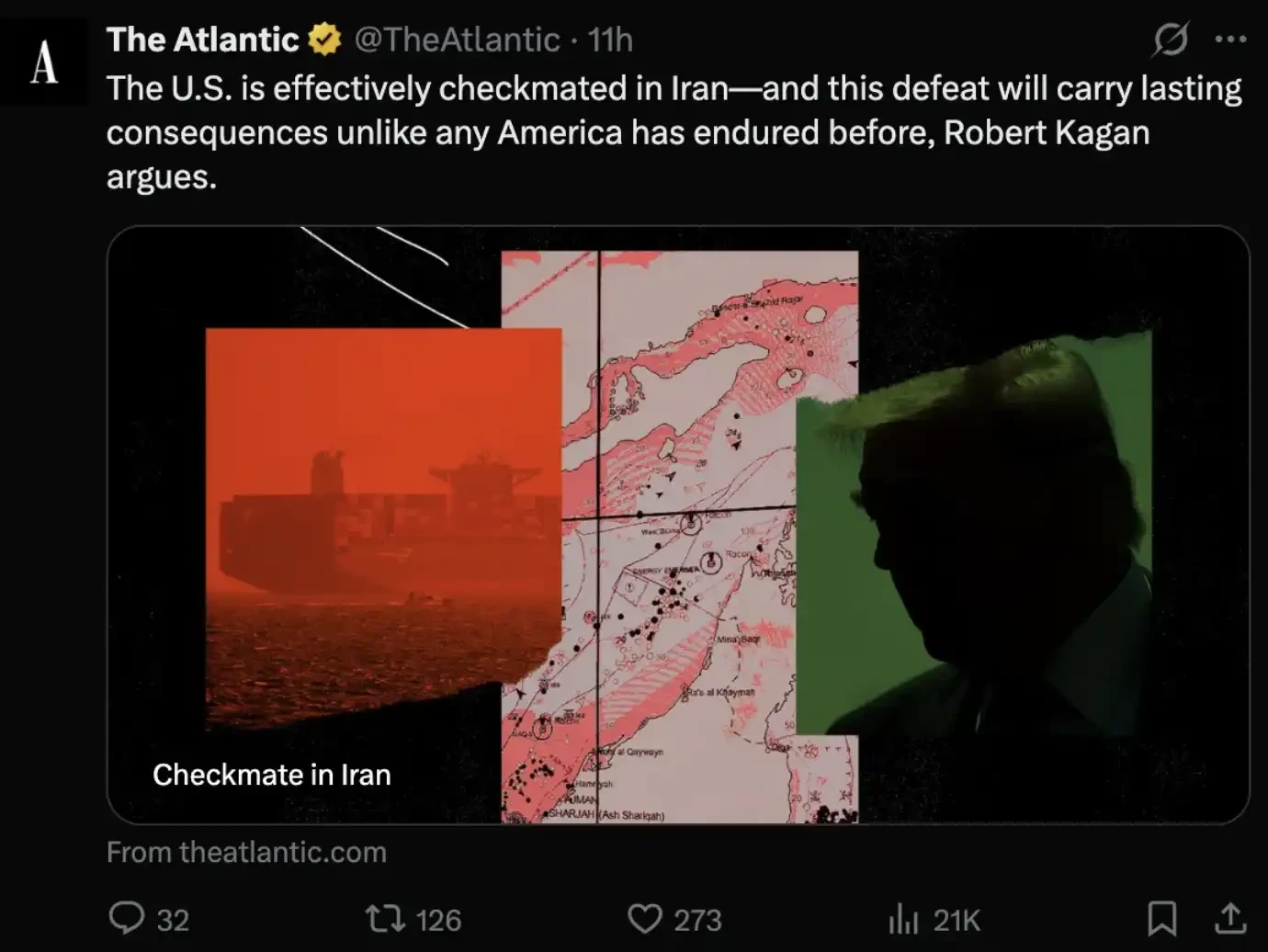
This is not an ordinary critic, but a man who has long provided strategic arguments to hardliners like Dick Cheney; it is not an ordinary medium, but a magazine that can almost package every American military intervention as "strategic necessity."。
But right now, it's in a language that is likely to be condemned as “failism” or even “unpatriotic”: America just lost. It is not a battle, not a military operation, but its place in the global order。
If even Uncle McDonald starts to say burgers are bad, it's really serious。
It is even more worthwhile to ask every American to stop and think seriously: when Cargan also wrote an ex post review of this strategic failure in the Atlantic Monthly, the real world — a world of gas stations, supermarkets, refineries and freight charges — is beginning to bear the consequences。
Sri Lanka has begun to pass the 2D ration; Pakistan operates four days a week; India has only 6 to 10 days of strategic oil reserves; South Korea has a single double-numbered line; and Japan is in the process of releasing its second emergency reserve this year. In the United States, where the Secretary of Defense publicly stated in February that Iran would “surrender or be destroyed,” gasoline prices are rising, and strategic oil reserves are being included in the largest coordinated release operation in the history of the International Energy Agency。
This is the reality of an "optional war": the so-called choice is made by a group of people willing to burn their country in order to manipulate the market and satisfy their fragile self-esteem。
Let's take a look。
One, Trump tells you this war can end in a weekend
Retrieve the time (not too long, because the distance is just 70 days) on February 28, 2026。
That night, the Trump government joined Israel in launching Operation Epic Fury. It was a coordinated air-to-sea strike. In just 72 hours, the Iranian Supreme Leader was killed, the Iranian navy was destroyed, the Iranian defence industry system was largely paralysed, and a whole generation of Iranian military leadership was struck by cleansing。
The smoke is still running out, and Trump announced on the Truth Social that he is seeking peace. Peter Högseth – a man who now insists on calling himself the “Minister of War” – seems to have been able to perform some sort of role-play at a press conference – then went to the Pentagon's podium with his consistent bluff and little analytical depth to declare that Iran has “no defense industry, no capacity to supplement.”。
But he missed a key detail. What Iran is going to do next does not require a defense industry. It just needs a map。
On 4 March, the sixth day after Hegseth claimed that the war had been won, the Islamic Revolutionary Guard Corps declared the Strait of Hormuz closed. It's not "blocked," it's "restricted" and it's closed. According to the Iranian side, "one litre of oil" cannot pass without permission from Tehran. Any vessel that attempts to pass "associated with the United States, Israel or its allies" will be considered a "legal target"。
WAR RISK INSURANCE HAS INCREASED FIVEFOLD WITHIN HOURS. WITHIN 72 HOURS, THE AIS AIS RESPONDER FOR SEVERAL LARGE TANKERS WORLDWIDE WAS SHUT DOWN. THIS STRAIT, WHICH CARRIES ABOUT 20 PERCENT OF THE WORLD'S MARINE OIL TRAFFIC AND A SIGNIFICANT PROPORTION OF ITS LIQUEFIED NATURAL GAS TRANSPORT, IS ACTUALLY SUNK。
To be fair, the Joint Chiefs of Staff did not fail to warn Trump. According to numerous reports, in a briefing prior to Operation Script, the military has clearly warned that Iran's most likely countermeasure is the closure of the Strait of Hormuz。
Trump's reaction was to the effect that Iran would “submit” and that if they did not, “we can open the Strait again”。
But the reality is that the United States has not reopened it. Nor can the United States reopen it。
That is the heart of the whole story。
Two, what did Kagan really admit and what he still couldn't say
The most noteworthy aspect of this article is not what it predicts, but what it admits。
If the traditional tone of the strategic circle is removed, and the Atlantic Monthly is packaged, the rest is in fact a confession. More frankly, he acknowledged the following:
First, it is not Viet Nam or Afghanistan. According to Kagan, those wars “have not caused lasting damage to the overall position of the United States in the world”. But this time, he admitted categorically that its nature was "unlikely different" and that its consequences were "irreparable or negligible"。
Secondly, Iran will not return the Strait of Hormuz. Not "not this year," not "not unless the negotiations fail". As Kagan put it, Iran today “can not only demand tolls, but also restrict the passage of countries with which it has good relations”。
In other words, the “freedom of navigation” regime that has underpinned the global oil order since Carterism – the core premise that the United States has provided legitimacy to its military presence in the Persian Gulf for the past 40 years – is over. What is emerging is a new licensing system, which is in Tehran ' s hands。
Thirdly, the Gulf monarchy must compromise with Iran. “The United States will prove itself to be a paper tiger, forcing the Gulf and other Arab countries to give in to Iran.”
The translation is more straightforward: every Saudi, United Arab Emirates member who has seen first hand that the United States is unable to protect oil refineries and shipping routes is now on the phone with Tehran to discuss new arrangements. In other words, the security architecture that the United States has built in the Gulf for half a century is breaking down in real time。
Fourthly, the United States Navy cannot reopen the Strait. This is worth taking seriously, as it is the most explosive admission in the article as a whole. “If the United States, with its powerful naval forces, is unable or unwilling to open the strait, no one has the capability to do so other than the United States coalition, which is a fraction of its size.”
The German Defense Minister Boris Pistoreus said the same thing almost in a more straightforward way: How many European frigates do Trump expect to do what the powerful United States Navy can't
This sentence can almost be read as an obituary. The United States asked its allies to clean up its mess, while its allies asked: "What to do?"
Fifthly, United States weapons stockpiles are at the bottom. Kagen wrote: "War with a second-rate power in only a few weeks" — Note that the term "second-rate power" comes from a man who has long supported the narrative of regime change — "has consumed United States weapons stocks to dangerously low levels, and no quick fixes can be seen in the short term."
If you are sitting in Taipei, Seoul or Warsaw right now and reading this phrase in Atlantic Monthly, you will not feel safer, but will feel clearly more insecure。
Sixthly, the trust of allies has been compromised, United States security commitments have been perjured and Chinese and Russian judgements validated. There is hardly any direct statement of this — he cannot, at least not in the Atlantic Monthly — but this conclusion lies behind every word he says, like a body under the floor。
Of course, what he can't really say is how the United States got to this point。
Because he was one of those who brought America here. He, his wife, his brother, co-signatory of every open letter to the New American Century since 1997, and every think tank researcher who has been shaping Iran into an indispensable enemy of the United States for the past 25 years, are part of this process。
In his article, he does not see any self-interest. Not even a momentary admission: perhaps the 30-year limit to pressurizing a rival who today can in turn push America to death。
The smoke is everywhere, and the arsonists are still wondering why there is a smell in the air。
So what is his solution
You want to laugh first, then you can't laugh。
The answer is: bigger wars. Specifically, he advocated “a full-scale land and sea war to overthrow the current Iranian regime and occupy Iran”。
A man who just wrote 4000 words explaining the inability of the United States Navy to reopen a 21-mile wide waterway in the face of an opponent he called the "second-rate power" came to the conclusion that the invasion and occupation of a country with a population of 9 million people, located on the most difficult mountain terrain in Western Asia, was a matter of concern。
The arsonist gave a plan for putting out a bigger fire。
III. At the same time, in the real world: the global oil crisis is unfolding country by country
Strategic analysis is one thing. Strategic analysts can finish writing, go to the coffee shop on the corner of Washington, order a glass of raspberry, without thinking about where the milk truck was burning diesel。
But the rest of the world, at this point, is calculating the account. And that's not good-looking。
As of this morning, the global situation has become as follows:
Sri Lanka has entered a national fuel ratio. Each vehicle is allocated through a 2-dimensional code, and energy-saving arrangements are being implemented in schools and universities. This is not a prediction, but a reality that has happened。
• Pakistan has introduced a four-day work week in both the public and private sectors. The market was closed early and teleworking was promoted on a large scale to reduce the need for commuting。
India ' s strategic oil reserves are about 6 to 10 days away. Although the total system-wide inventory was about 60 days old, panic purchases were rising rapidly and the Government was looking for emergency sources of imports. More and more crude oil comes from Russia, which is clearly willing to provide it。
The Republic of Korea has imposed a mandatory double-number restriction on the public sector, voluntary measures for other groups and incentives through price ceilings. At the same time, the Republic of Korea has imposed a five-month export ban on plaster。
Japan is in the process of releasing its second large-scale emergency strategic reserve this year. The first time happened in March. Today, Japan is using the 230-day buffer reserve previously declared to the International Energy Agency。
• The United Kingdom entered the price shock pattern. The Government had launched targeted assistance programmes for households using heating oil, legislation on windfall taxes had been put back on the agenda and anti-price enforcement had been initiated。
Germany extended the petrol and diesel tax relief and started introducing fuel subsidies to employers。
:: France introduced targeted fuel discounts and accelerated the issuance of energy coupons to high-mile drivers, transport workers, fishermen and the agricultural sector。
• South Africa has significantly reduced fuel taxes, but gas stations continue to line up。
• Turkey reduced its special consumption tax on fuel。
• Brazil abolished the diesel tax and provided subsidies directly to producers and importers。
Australia has halved its fuel consumption tax, launched a national "everything counts" energy-saving initiative and provided commercial support loans to industries affected by fuel shocks。
• The United States is participating in the largest coordinated strategic reserve release operation in the history of the International Energy Agency, totalling 400 million barrels. At the same time, several states have implemented petrol tax exemptions and the Federal Government has publicly considered extending this policy to the entire country。
• China, as the world's largest importer of crude oil, has responded in a consistent manner during times of crisis: first, to close the suspension bridge. Large-scale domestic reserves were retained, exports of finished oil were prohibited and domestic price controls tightened further. At the same time, the crude oil that each ship could find was bought at discount in Russia and Venezuela. Because of course it would。
This occurred in a context where the International Energy Agency (IEA) had launched a historic level coordinated release operation。
Read this part carefully, because from here on, it is no longer just a figure on the chart, but it goes into everyday life。
In a recent interview with Bloomberg, Energy Analyst Eric Nathal of Ninepoint Partners said that, according to the repertoire I saw, his core judgement was: "We are not talking about months or quarters later. In the next few weeks, you will have to reduce demand by a scale that goes beyond the new crown period.”
According to his description — not my general description — this could be “the largest energy crisis in modern history”. And ration, especially demand-side ration, which the United States has hardly seen since 1973, may be a few weeks away。
Weeks. Not a few months, not an abstract medium term, but weeks。
You should look at the car at the door now with a completely different look。
iv. Why can't this thing be solved by itself
I would like to stop here because it is easy for American readers to interpret this as a temporary disturbance。
In instinctively, they think that as long as there is some sort of combination, things will end in the next news cycle: Iran “blinks down”; Trump finds a decent step down; Saudis open the oil tap; or the US Navy finally “act.”。
This will not happen for the following reasons。
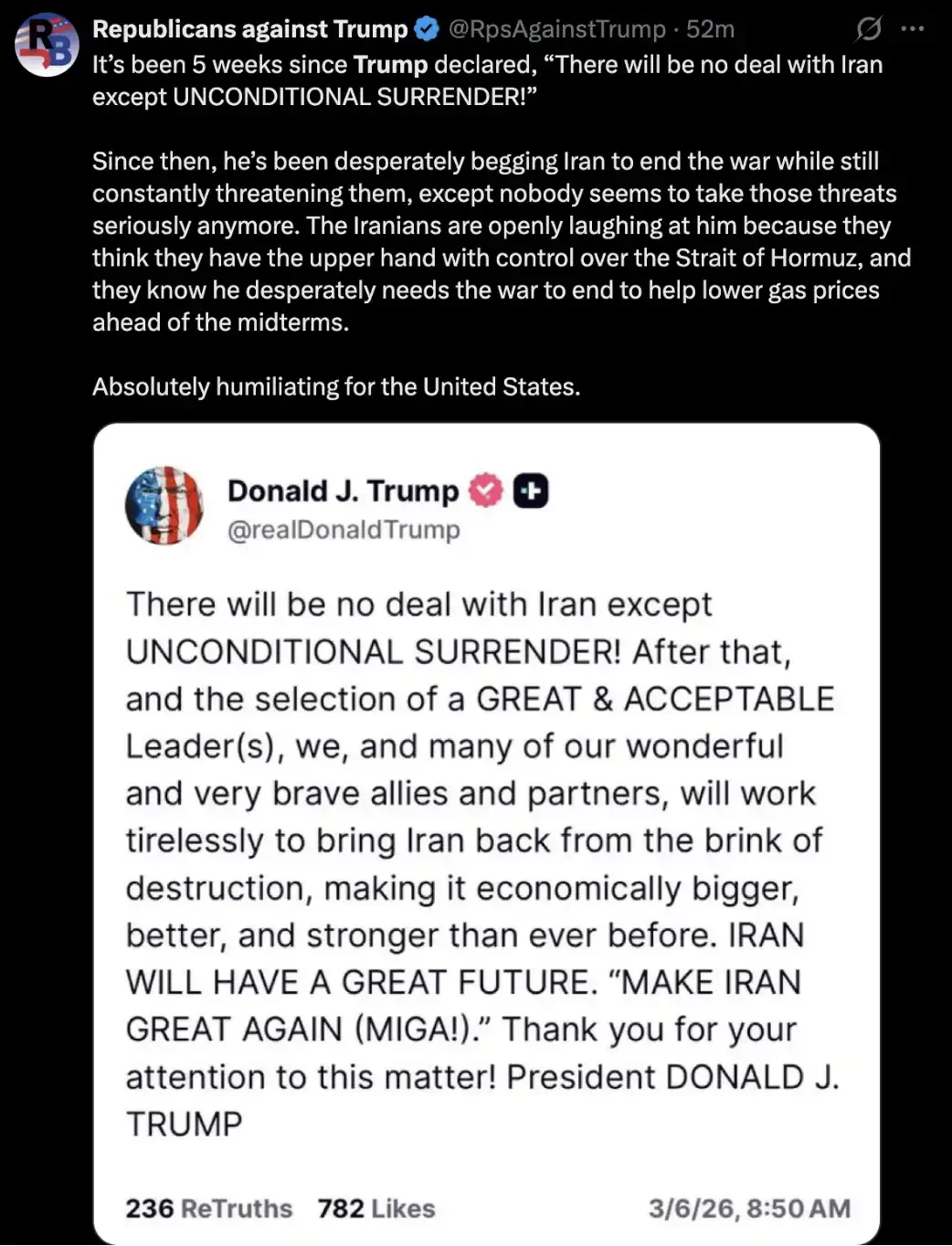
Iran has no motive to abandon the Strait of Hormuz。
No, not at all。
Today, the Strait has become Iran's most valuable strategic asset - It is more valuable than Iran ' s nominal nuclear programme, and more valuable than the various proxy networks that used to serve as bargaining chips. “The situation in the Straits of Hormuz will not return to its pre-war state.”。
This is not a bluff, but a policy statement。
For the past 40 years, Iran has been told that it has no leverage. And now it holds the most important card in the global economy. The next Iranian regime — and certainly the next — will also inherit and use this card, because the air strikes have killed enough of the old leadership and power changes are almost inevitable。
To think that Iran would hand it over easily is to lack a basic understanding of what has just happened。
THE GULF MONARCHY CAN NO LONGER OPENLY CONFRONT IRAN. SAUDI OIL REFINING NETWORKS, UNITED ARAB EMIRATES PORTS AND QATAR'S LNG TERMINALS, ALL OF WHICH ARE WITHIN THE REACH OF IRANIAN MISSILES, DRONES AND PROXY FORCES. THOSE COUNTRIES HAVE JUST WITNESSED THE FAILURE OF THE UNITED STATES TO DEFEND ISRAEL’S MOST STRATEGIC OBJECTIVES, TO PROTECT ITS BASES IN THE UNITED ARAB EMIRATES AND BAHRAIN, AND TO REOPEN THE STRAIT THAT SUSTAINS ITS ECONOMIC LIFELINE。
The so-called commitment to security has been veritable。
Riyadh and Abu Dhabi would not be betting the existence of the State on a guarantor who had just proved itself unable to provide guarantees. They'll seek a deal. In fact, they are already seeking a deal。
Nor can the United States military reopen the Strait at the practical level. This should have been done by everyone。
The United States Navy remains the most powerful maritime force in the history of mankind in terms of absolute strength. However, it has just been engaged in 38 days of "main combat operations" with a rival known by the Cardinals as "the second-rate power" and has already consumed its weapons stocks to a "dangerous low"。
Today, the United States Navy has launched an increasingly euphemistic operation, Project Freedom, to escort a merchant ship across the Strait of Hormuz. As a result, only two passes a week。
Two. And the pre-war average was 130 a day。
On Tuesday, Rubio described the project as a "first step" to create a "protecting bubble"。
A bubble. Channels that used to pass like highways can only now try to protect a bubble。
More importantly, there will be no coalition to pick up the wheel. Boris Pistorius has made his point. The British and French defence services are less straightforward, but the meaning is equally clear. Trump asked South Korea to "be part of the mission" and the polite response said "will study the proposal." In diplomatic language, the phrase means that we will not join。
Japan is busy consuming its own strategic reserves and has no time to send its navy to the Strait. India is buying Russian oil. As the country with the greatest dependence on Holmuze, China is absent – and apparently has no intention of cleaning up a legacy of the United States that is not made by China, and can even be said to be benefiting China。
The United States is asking the world for help. The world looked at the situation, counted and discovered a very uncomfortable fact: For the first time in 80 years, the United States is in fact no longer able to cover up global energy security。
This means that the world is reorganizing itself around this fact. This is not a news cycle, it is a change of order. It is not, however, the kind of "regime change" that Trump and Hegesses had originally envisaged。
Trump and Hegesseth: deceptiveness is in itself a policy
We must be precise about what is alleged here, because it is important。
This is not an unforeseen disaster. It's not a black swan. Almost everything that has happened has been predicted in advance: in the pre-war briefing, the Joint Chiefs of Staff warned; in each case, the leading think tank analyst, not dominated by the Kagans; in each case, every American war veterans with experience in the Gulf; and even in Iran itself, in public statements over the past 20 years。
The Strait of Hormuz is so well developed that it even has its own Wikipedia classification. But the Government did。
Why? Because Trump needs a victory. Because Hegessex needs to make himself look like a real defense minister. For the political logic of Trump's second term — domestic chaos, falling polls, basic agitation — requires an overseas adventure: It must be clear-cut, and it is best to be able to quickly finish the victory narrative on television。
The Bush era called it a "pretty little war". Hegesseth called the "Operation Middle Hammer" of 2025 the most complex and secretive military operation in history. That lack of historical common sense should have ended his term of office。
But it didn't。
He's still there. He still calls himself "Minister of War". He remained at the podium of the Pentagon, declaring that the ceasefire had not broken, even if the missiles were flying; that even if the ship was burning, the operation would not be offensive; and that even if the price of diesel fuel in Los Angeles had reached $7.40 per gallon, Iran had been "destructed"。
This man is essentially a cable TV mouth in a Pentagon suit. The position he occupied required the most rigorous strategic judgement and logistical capacity within the United States Government. He's neither。
The consequences of this mismatch are now being borne in real time by every ordinary person on the planet: those who drive to work, those who take public transport to school, those who operate small businesses that depend on logistics for distribution, those who eat food that depends on nitrogen fertilizer and those who live in countries that depend on imported diesel for their operation。
In other words, almost all of us。
This war is illegal. There is no parliamentary mandate or United Nations mandate for hostilities of this magnitude, much less a credible and imminent threat. It has only one president who wants to war, a defense minister who wants a press conference, and a national security machine — as Kagan and his companions have trained it over the past 30 years — finally answered yes。
And those who used to say "yes" are now writing 4000 words in the Atlantic Monthly, explaining how surprising it is。
What are you supposed to do this week
I don't usually write practical recommendations. This newsletter is not usually this type。
But Nathal said "weeks." Sri Lanka, Pakistan and Korea are no longer waiting. The release of International Energy Agency reserves is not unlimited. I think those who read here deserve to hear some direct words。
So:
• If you've been thinking about buying electric cars, the way it's calculated has changed. I'm not telling you how to use your savings. I am simply saying that the marginal cost of every extra week that continues to hold a fuel truck is significantly higher than last month, and that the marginal gain of electricization — your ability to travel when the gas station lines up, the tanks run dry, or when fuel levels begin to be rationed — has increased accordingly。
• If your charging conditions permit, now is the moment when the logic of calculation turns。
• Do it now if you are able to store some food infrastructure that depends on diesel-intensive distribution systems. It is not panic shopping, but a reasonable family reserve. Fertilizer supply shocks -- remember, the Persian Gulf accounts for 30 to 35 per cent of global urea exports, and ammonia exports account for a significant proportion -- will be transmitted to food prices in 6 to 9 months, but it will be transmitted. Beans, rice, oats, frozen protein. This is standard emergency preparedness, not end-of-life bunkers。
• If your work depends on the physical commodity supply chain, the contingency plan should be discussed with employers this week. In particular, the cost of air freight will continue to rise — North America has risen 95 per cent over pre-war prices, and no mitigation path is visible in the short term。
• If you are an American, call your congressman on the War Powers Resolution. What is currently happening in the Persian Gulf does not have any parliamentary mandate. There was, and is, no. The legal basis on which the Freedom Project relies is only a legacy of the mandate of Operation Scrabbling, which Rubio himself has said is over. The legal framework that underpins this has evaporated in technical terms。
• If you are a journalist or analyst, read the Kagen article. Read twice. Watch what it lacks: moral reflection, self-examination, human cost, the name of the dead. Attention is also drawn to what it presents: a strategic recognition — the neoconservative project is over. It is a historic document that should be read both as a confession and as a warning。
• If you're out of the United States, you're probably done. You're rationing, reserve, hedge. You don't need my advice. Maybe all you need to know is that there are still some Americans watching this. There are not enough, but there are。
VII. The smell of smoke
I'd like to end with a sentence that's been in my head since I finished reading the Kagen article, because I think it sums up the whole thing。
The arsonist smelled smoke。
For 30 years, Washington has had a particular group of people – Karen, Newland, Frederick Cagan, signatories to every open letter on the New America Century Plan, and think-tank researchers with "US" "Defence" or "Security" in each name – who have consistently argued that the United States must maintain a military predominance in the Middle East。
They said that the change of regime in Iraq would lead the entire region towards democracy。
They said that pressure on Iran ' s limits would either overthrow the regime or render it incapable of harm。
They said that the United States could provide security guarantees to the sovereign States of the Gulf indefinitely。
They said that United States weapons, United States intelligence, United States naval forces and the United States were determined enough to keep the global energy system on the same footing as Washington。
All these propositions have now been veritable and are in real-time reality。
It took only 70 days for a war that was originally conceived as the ultimate victory of this project to become its obituary. And in many ways, the core architects who shaped this disastrous view of the world are sitting on the page of Atlantic Monthly, writing in almost plain words: we lost。
But he still can't say that we caused all this。
He was still unable to mention the dead — 165 female students killed in an air strike, thousands of Iranian civilians under bombing, workers on fuel tankers, workers in the port of Bahrain, passengers on Tel Aviv bus, soldiers from a dozen countries。
They didn't appear in his article。
For him, it's a strategic chess issue, but it happens to be a human being。
But strategic issues themselves are ethical. The two are not separate。
A war waged by a fraud, sold by a liar, executed by a liar and eventually lost by a liar is a moral disaster before it becomes a strategic disaster. Strategic disasters, on the other hand, arise directly from a moral disaster: the same failure to create lies, the same inability to think clearly, and the resulting failure of action. The arrogance that ignores the warnings of the Strait of Hormuz and the cost of human life is the same arrogance。
For the next six months, Trump will continue to try to package the failure as a victory. Högseth will continue to hold press conferences at which the word "destruction" will appear much more frequently than "fact". Cable television networks will swing between anger and optimism. The strategic reserve will continue to be depleted. It's gonna be longer and longer before the gas station. Shipping rates will continue to rise. Fertilizer prices end up in bread prices。
And somewhere in Washington, Bob Cargan is probably carrying a glass of wine, and for the first time in life, he feels something like fear。
It was not for the female students, not for the truck drivers in Karachi, not for the families in Sri Lanka who received the 2D ration, but for the project. For 30 years he had been involved in building a building that was now before him and collapsed along his foundations。
The arsonist smelled smoke. And he finally, just started to realize that the house was his own。
Americans now have to bear these consequences. And these consequences will become extremely painful in the coming months, and may even last for years。
So, guys, get ready to go。
