
Why would Kraken buy a Reap instead of a U-card
Author:YokiiiyaStablehunter
Kraken parent company Payward is going to buy up to $600 millionReapThis is a suitable entry point for understanding stable currency payments. According to the official announcements of Payward and Reap, Reap is defined as a family♪ can't you see ♪Company. Upon completion of the deal, Reap's capabilities will be incorporated into Payward Services to supportcards aresuance, cross-border payments and stablecoin trusty servicesI don't know。

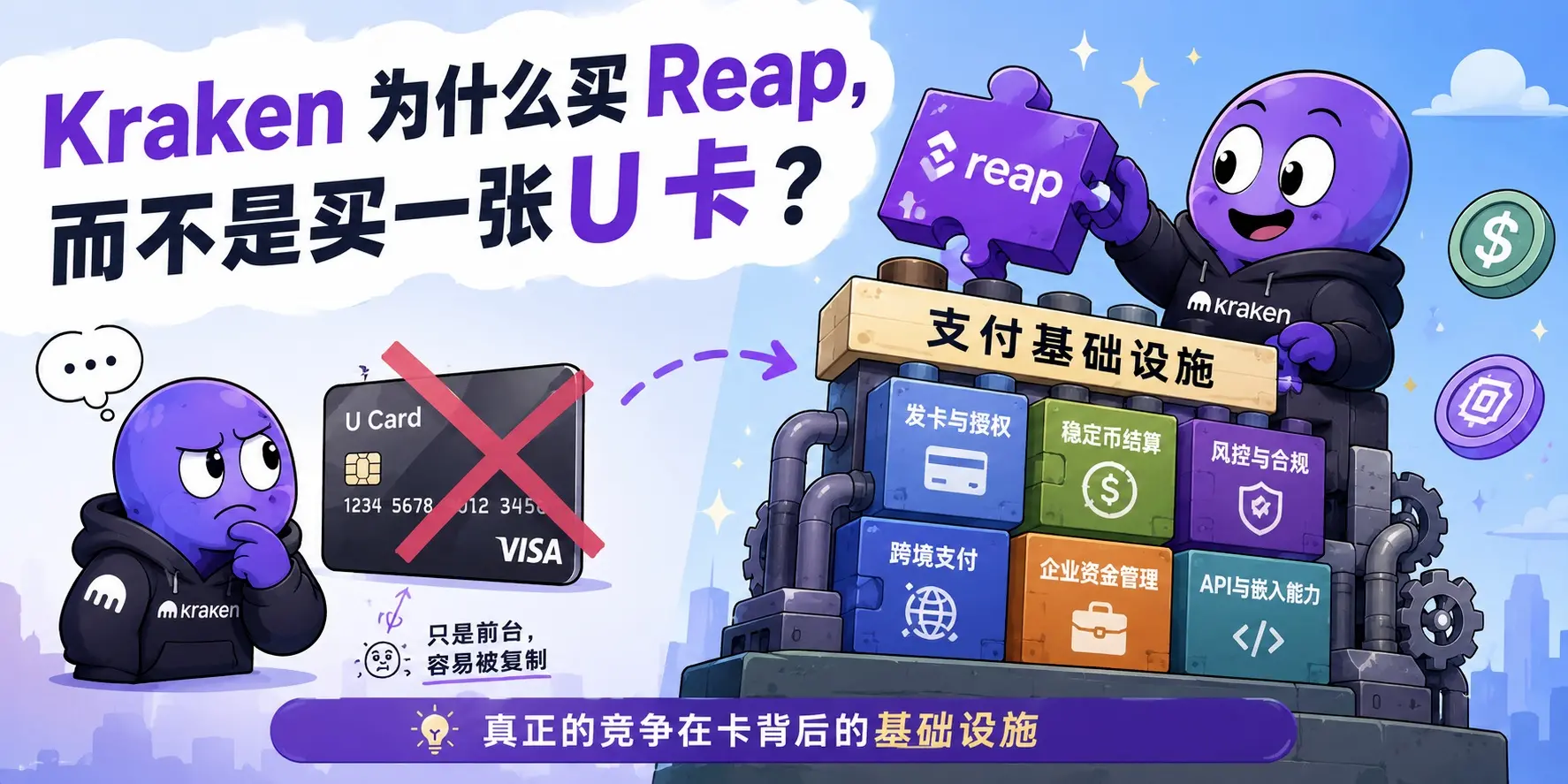
These words are really crucial. It shows that Payward bought not just a product that can issue U-cards, but a set of cards, cross-border payments, stable currency settlements, and infrastructure related to the management of business funds. So I think the most interesting thing about this is not "Kraken why do U-cards." They are:IF IT JUST WANTS TO MAKE A U CARD, WHY DON'T YOU JUST BUY A FRONT OFFICE U CARD BRAND
There are already a lot of U-card products in the market that are more sensitive to users. Open App, FillUSDTor USDC, binds a virtual card or a physical card and then goes for consumption online or offline. It's a good story: stability money can finally be spent like bank card balances. But Payward this time didn't buy a single U-card brand for C-end users. It bought Reap。
This means that what it really wants to do is not "send a card" as a front-office capability, but rather the more difficult, heavy and valuable infrastructure behind the card: the issuing card, authorization, stable currency settlement, cross-border payments, business treasury, compliance controls, and the connectivity of traditional finance rails. In other words, the U-card is just what the user sees。
The real value is for the card to be sent, brushed, accepted by businesses via the Visa/Mastercard network, and for stable currency exchange, clearing, reconciliation, wind control and compliance backstage。
SO WHAT THIS ARTICLE REALLY WANTS TO OPEN IS NOT THE U CARD THAT'S BEST USED, BUT THE OTHER THING:What kind of infrastructure are companies like Reap, Rain, StraitX? Why are they being targeted by exchanges, wallets, fintechs, even traditional payment giants
Because it's not as simple as "do an App + and a card number." It's got to be connected to both the network, the profile, and..It's not your fault, issuer processor, real-time authorization, stable currency entry and exchange, chain-to-chain transactions, enterprise fund management, cross-border settlements, KYC/KYB, AML, non-payment management, fraud controls, and local banks and payments rails. And that's why the front desk U-card brands can be a lot, but not a lot of companies that actually do infrastructure。
The front-office product deals with what the user sees. Infrastructure companies have solved the problem of “why is this card really being sent, brushed out, settled back, and someone can go through with it.”。
The meaning of Payward buying Reap should also be understood here. It's not just buying an U-card entrance, it's filling up a set of stable currency payments infrastructure. And then we're going to start off with the basic question of a U-card: How was it actually sent out
HOW DID YOU GET A U-CARD
A lot of people would think that an U-card was issued by an exchange, a wallet or a crypto app. In practice, however, the front-office brands that users see are often only the top layer of the industrial chain。
A really useful U-card, with at least a few layers of capacity coming together behind it: the network of card organizations, card qualifications, BIN sponsor, Sosser Processor, program manager, stable currency infrastructure, and ultimately user-oriented front-office products. And that's why I said earlier that the U-card is not a single-point product, but an industrial chain。

First floori'm sorryIt's a card organization like Visa, Mastercard。
They provide a global business acceptance network, transaction rules, liquidation rules, dispute management frameworks and network brands. Users do not usually know that this is a "U" card when they use it online or when they enter a card number online. It sees a card that can be handled by Visa or Mastercard network. So the U card is not bypassing Visa/Mastercard. On the contrary, many of the U-card products are used to bring stable currency balances into real consumption through the Visa/Mastercard business network。
Second floorassuer/issuing bank/issuing insituationAnd that's the kind of agency that really gets to issue the cards。
It can't be simply understood as "must be a bank". In the traditional card business, Susser is a bank for a lot of times. However, in crypto card or fintech card, the actual assuer may also be an electronic money agency, a payment agency, or a licensed fintech owned by Visa/Mastercard private membership. In common, they are eligible to participate in the issuance of cards and assume a range of responsibilities, such as transactions, funds, compliance, non-payment and fraud。
For example, some crypto card are backed by banks, some by electronic money agencies or licensed payment agencies. CoinbaseCard in the United States was released by Pathward, N.A.; NexoCard was launched in Europe in cooperation with Mastercard and DiPocket; Cripto.com VisaCard in Singapore was distributed and distributed by Foris Asia Pte. Ltd., in possession of MAS Major Payment Investment Limited. The structure of Assuer may vary from region to region, from product to product。So many of the front-office brands look like they're handing out cards, but there must be assuer, assuring insituation, or card-holders taking responsibility. And that's why the "fastcard" isn't an App that can do what he wants。
Third floorIt's not your faultI don't know。
BIN is the corresponding card identification number of the first card number, which determines which card agency, which card type, which network and which area it belongs to. Many Finland or crypto platforms do not have full card qualification themselves and need to access the card capability through BIN sponsor. BIN sponsor offers qualifications and access, but it is not unconditional. It would require projects to comply with compliance, controls, funds and operating rules。
This layer is particularly critical for crypto card. Because, in the event of high-risk transactions, fraud, non-payment or regulatory problems, responsibility does not rest solely with the front brand. BIN sponsor, Sussuer, Processor and project managers may be implicated。
The fourth floori'm not sure i'm going to be able to help youI don't know。
this layer handles delegation of authority, liquidation, route of transactions, balance verification, card control, limits, rules of the wind and transactional events. the moment the user swiped the card, the business initiated the authorization request. processor has to judge in a very short time: is this card working? is the balance sufficient? is the deal allowed? is there a problem with the business class? are there limitations in the area? are the risks acceptable? it then returns the results to the network and business. if this card is connected to stable currency balances, things will be more complicated. the system does not only look at a french currency account balance, but also deals with stable currency balances, exchange rates, freezing, exchange, chain-to-chain transactions and subsequent reconciliations。
Fifth floori'm sorryI don't know。
It's more like a card project operating brain. Who is it open to? Is it a C-end consumption card or a business card? Is it a virtual card or a physical card? Which areas are supported? Which business categories are not available? What's the user doing? KYC? What's the business client doing? How do we set the transaction limits? How do we handle the withholding? How do we respond to the client service? These are all part of the programme. Some companies themselves are program manager, while others hand over this capacity to infrastructure service providers。
The sixth floorcrypto or stablecoin infrestructure programI don't know。
this layer is responsible for the stabilization of the relevant parts of the currency: charge, chain-to-entry, wallet account, currency stabilization and exchange of french currency, management of trasury, chain-to-chain reconciliation, cross-border settlement, transaction monitoring and compliance review。
But one special note here: companies like Reap, Rain, StraitsX, are often not just on the sixth floor alone. Their value is not just to make one link, but to wrap up multiple layers of capability: card issuing, BIN sponsorship, program capacity, real-time integration, stablecoin settlement, treasury, cross-border plans and local financial connections。
So they don't just "send a card" for their clients. They are addressing a more complex question: how to bring the stable currency balances in the hands of users or enterprises into the traditional card system, the network of card organizations, the compliance system and the local financial system. That is why such companies are called infrastructure companies。
If it's just a front office U card product, the focus is on user experience, visitors and scene packaging. But if the infrastructure is to be built, the focus will be on whether it can help different wallets, exchanges, fintechs, or business customers to connect the previously dispersed links of issuing cards, authorization, stable currency settlement, cross-border financial flows, and compliance controls。
The last floori'm sorry, the exchange, wallet, crypto app or fintech product that the user actually sees。
The front brand is responsible for the acquisition of customers, product experience, card design, user operation and scenario packaging. Users think they use a card from a wallet, a card from an exchange, but it often combines card organizations, asser, BIN sponsor, processor, program manager, stable currency settlement parties and compliance service providers。
SO, A U-CARD ISN'T ACTUALLY "A COMPANY ISSUES A CARD." RATHER, IT IS THE RESULT OF A GROUP OF AGENCIES WORKING TOGETHER. THE USER SEES A CARD. BEHIND THIS IS A SET OF SYSTEMS THAT SHARE CARDS, AUTHORIZATIONS, CONVERTS, LIQUIDATIONS, SETTLEMENTS, COMPLIANCE, NON-PAYMENT AND RISK。
this is why stable currency payment infrastructure is difficult to do. it's not just a crypto technical problem, it's not just a card problem, it's a crossWeb3, traditional payments, banking, compliance, wind control and systems engineering of local financial networks。
The companies that can do this are often not because they can issue cards, but because they have taken a long time. Go onestablishment of banking relationships, card organization relationships, licence plates, wind control models, processor docking, stable currency accounting systems and local clearing networks。
None of these things can be made up by a round of financing, or by an API file. And that's why Payward bought Reap, not just a front office U-card brand. The front-office brand can be very good, and it can grow fast. But what is really hard to replicate is the kind of infrastructure behind it that allows cards to come out, brush them out, settle them back and, when problems arise, someone can afford them。
HOW THE HELL DID YOU RUN THE MONEY WHEN A U-CARD CAME OUT
WHAT I'M TALKING ABOUT IS, A U-CARD IS GOING TO BE SENT OUT, AND WHAT'S THE ROLE BEHIND IT. BUT TO REALLY UNDERSTAND THE U-CARD BUSINESS, THERE IS ANOTHER QUESTION:How the hell did the money run
Suppose a user has 100 USDC in his wallet, and then he uses this U-card to consume $20 abroad. From a user's point of view, it's simple: turn on App, see the card, brush it, and the balance is reduced. But what happened backstage was not "a direct receipt of 20 USDC." It's also the easiest place for many people to misinterpret U-cards。
In most cases, the business side still follows the traditional card payment process. Business passCollectionsStarts a card transaction that enters the Visa or Mastercard network and is then routed to the corresponding issuer/ processor system. In other words, it is not a chain transfer. Businesses want a standard card transaction result: can this card be deducted? Can this deal be authorized
and then, suer processor will be asked to start making a series of judgments. is this card working
IS IT FROZEN? DOES THE TRANSACTION AMOUNT EXCEED THE LIMIT? ARE BUSINESS CATEGORIES ALLOWED? IS THE TRADING AREA OPEN? IS THERE A RISK OF FRAUD? ARE THERE SUFFICIENT BALANCES IN THE USER ACCOUNTS? IF THE CARD IS CONNECTED TO A STABLE CURRENCY BALANCE, THE SYSTEM WILL HAVE TO MAKE AN ADDITIONAL ASSESSMENT AS TO WHETHER THE USER ' S USDT OR USDC BALANCE IS SUFFICIENT TO COVER THIS CONSUMPTION AND WHETHER IT IS SUFFICIENT TO CONVERT INTO A COMMERCIAL SETTLEMENT CURRENCY。

There will be two common ways of dealing with it。
One is real-time exchange. When users swipe cards, the system immediately converts stable currencies of corresponding values into French currency, completes authorization and subsequent settlement。
The other is to freeze first. The system first freezes the stable currency of the corresponding value in the user accounts and then consolidates the exchange, reconciliation and transfer of funds once the transaction is in the liquidation and settlement phases。
depending on the design of the card project, the issuing area, the cooperative banking requirements, the processor capacity, the type of assets to stabilize the currency, the liquidity arrangements and the accounts system of the infrastructure service provider。
However, in either way, businesses do not usually collect USDC directly from users' wallets. For businesses, it still receives a standard card transaction. It is faced with a collection agency, card organization and card system rather than a block chain. What really changed was back-office funding and settlement logic. User brushes Visa or Mastercard networks. However, funds to support this consumption may come from stable currency balances in user accounts. In the backstage, authorization, freezing, exchange, clearing, settlement, reconciliation and transfer of funds will be completed between the platform, issuer, procssor, card organization, single-side, stable-currency infrastructure service providers and local banks. This is the key to the U-card:The front desk is a card network and the back desk is a stable currency flow。To understand this, the U card will not be misinterpreted as "Visa/Mastercard is replaced with a stable currency"。
At the current stage, it is more accurate to say that the stabilization currency is not a direct substitute for the commercial side of the card processing network, but rather a source of funding, the treasury tool and the clearing assets behind the card project. This is why the stabilization card really improved, not necessarily the business front experience. The business would have received Visa, Mastercard. What has really been changed is the way in which funds are revolving behind the platform and the issue card project。
traditional cross-border card projects often face several problems: funds had to be placed ahead of schedule in different regions or cooperative banks, the settlement of weekends and holidays had to slow, cross-border transfers took time, multi-accounts had to be kept and funds were trapped in different corridors。
USERS OF THESE ISSUES ARE NOT NECESSARILY VISIBLE, BUT THEY HAVE A DIRECT IMPACT ON THE CAPITAL EFFICIENCY OF THE CARD PROJECT, THE AUTHORIZED SUCCESS RATE, THE SPEED OF REGIONAL EXPANSION AND THE PROFIT MARGIN. THE VALUE OF THE STABILITY COIN BEGAN TO APPEAR HERE. IT CAN MOVE AROUND 24/7 AND CAN CONTINUE WITH FUND TRANSFERS ON WEEKENDS AND HOLIDAYS, MOVING ACROSS WALLETS, PLATFORMS AND REGIONS, AND MAKING SOME OF THE FINANCIAL ARRANGEMENTS THAT WOULD HAVE TO BE COMPLETED OVER A NUMBER OF DAYS CLOSER TO REAL TIME. SO, U-CARDS DON'T SIMPLY MOVE THE "PAY ON THE CHAIN" TO A SUB-BUSINESSER. IT IS MORE LIKE ADDING A NEW LAYER OF FUNDING AND CLEARING TOOLS TO THE TRADITIONAL CARD NETWORK. USERS SEE "I'M SPENDING IT IN STABLE CURRENCY." WHAT THE MERCHANT SAW WAS "I GOT A REGULAR CARD DEAL."。
The infrastructure company saw "I want to connect the two systems with authorization, exchange, clearing, settlement, reconciliation and compliance. " That's why it's hard. The difficulty is not to make a front page, nor to let the user App show a balance. The difficulty is: can the system judge whether the transaction will pass within a few seconds when the user is really using the card, and can it match all of the stable currency, the French currency, the card network, local bank funds, business accounts and compliance records after the transaction is over。
As long as there is a problem with one link, the user sees the failure of the transaction, the freezing of the card, the abnormality of the balance, the lack of transparency of the exchange rate or the restriction of the cash position。
SO, CAN AN U-CARD REALLY BE SCALED UP, AND IT'S NOT JUST HOW MUCH MONEY AND AREAS IT SUPPORTS ON THE PAGE, IT'S WHETHER THE BACK-OFFICE SYSTEM IS ABLE TO STABILIZE THESE VERY SEXY, BUT VERY CRITICAL QUESTIONS: WHETHER THE MANDATE CAN BE CROSSED. CAN YOU GET THE MONEY? CAN'T THE CHECK EVEN. RISKS CAN'T BE CONTAINED. CAN COMPLIANCE BE EXPLAINED. THERE'S NO ONE OUT THERE. THIS IS THE REAL THRESHOLD FOR STABLE CURRENCY PAYMENTS INFRASTRUCTURE。
Why would overseas players put stabilization coins in the back of card operations
As mentioned earlier, when users brush U-cards, the business side still sees a standard card deal. Businesses do not need to understand USDC or USDT, nor do they need to connect their wallets. So the stabilization card is not a direct substitute for Visa / Mastercard on the side of the business。
More precisely, in some overseas compliance scenarios, the currency of stability has been placed in the back of the card project as part of account balances, exchange arrangements, funds transfers or clearing instruments. This is also where such infrastructure is truly complex。
It's not just about showing a stable currency balance in the user App, it's not just about creating a virtual card number. The back office also deals with a whole range of questions: how user balances are verified, how cards are written, how currencies are exchanged between stable and French, how transaction records and chained accounts are matched, how funds are channelled from different regions, and how KYC/KYB, AML, sanctions screening and transaction monitoring is completed。
in other words, the stabilization currency is not a "substitute card network" role here, but is embedded in the back of the card business, participating in the management of sources of funding, accounts, exchange, settlement and treasury. however, this cannot simply be interpreted as "stabilizing money to make payments cheaper"。
in real business, it continues to face regulatory licences, bank cooperation, on/off-ramp, rules for card organization, liquidity, exchange rate, accounting processing, taxation and compliance review. the boundaries of different regions are also completely different。
So some overseas payment companies, exchanges and fintechs are exploring stabilization currency as part of back-office finance and clearing instruments, but its size depends on licence plates, banking cooperation, wind control capacity, local regulation and compliance borders. This is why Reap, Rain, StraitsX, etc. are of concern。
Rather than issuing a "cooler card", they are linking digital asset balances, issuance card systems, card organization networks, corporate fund management and local financial systems within the framework of overseas compliance. From this perspective, the centrepiece of the stabilization card is not the front-office consumption experience, but the back-office infrastructure capacity。
WHO'S BUILDING THE INFRASTRUCTURE BEHIND THE U-CARD
What we're going to open up is what we're going to go through when an U-card is sent out and brushed out. That's from the operation chain. But if you look at it as "corporate ecology", you see another picture: It's not just a front office U-card brand, but it can be divided into categories of players. The top is the U-card product that the user can see. In the middle is the infrastructure for stabilizing the issuance, payment and settlement of currency cards. At the bottom are traditional payments rails, processor and compliance controls。

The two categories are not conflicting. The seventh floor explains:How does a card run up? The four levels explain:Who's setting up this system。
First level, front-office U card/ crypto card product. This layer is closest to the user and most visible。
RedotPay, Coinbase Card, Cripto.com Card, Bybit Card, Wirex, Nexo Card, MetaMask Card, Ledger CL Card, 1nch Card, Gnosis Pay, KAST, Bitget Wallet Card, etc。
They address the question of user experience: where the cards are opened, how they are charged, how they are consumed, which currencies are supported, whether they can be painted online, the rates are unclear, whether the cards are frozen, and whether the customers can respond。
It's the easyest U-card business for many people. Because it looks intuitive: the user has a USDT or USDC, the platform gives him a card and he can consume it. However, this level does not necessarily capture the bottom-up card, authorization, liquidation, settlement and compliance capabilities. Behind many of the front-office brands, there is still a need to rely on issuing agencies, BIN sponsor, processor, stable currency clearing services and compliance services。
The second level is the stabilization of the card distribution infrastructure. This floor is where Payward's takeover Reap really points to. This category includes Reap, Rain, StraitsX, Baanx, Immersve, Kulipa, Gnosis Pay, etc. They're not just doing a front card product, but they're helping wallets, exchanges, fintechs or business customers to send out card items。
The issues they will address include how to issue cards, how to connect the Visa / Mastercard network, how to grant real-time authorization, how to connect the digital asset balance of the user or enterprise, how to handle the exchange of stable and French currency, how to handle transaction limits, card controls, risk rules, chain-to-chain reconciliations, and how to meet compliance requirements in different regions. In other words, it is not the face of the card that sells it, but the ability to issue it。
The ideal state for a client is that I don't have to go to the issuing agency, BIN sponsor, processor, stabilizers and compliance service providers myself, and I can put this in my own product through a set of APIs or a card program. That is why such companies are more like infrastructure。
the third level is the stabilization of currency payments, treasury and settlement organization infrastructure。
This layer does not necessarily cut into U-cards, but it becomes the bottom of the financial flow behind U-cards, wallets, exchanges and corporate payments. Bridge / Stripe, BVNK / Mastercard, Fireblocks, Zero Hash, Circle, Conduit, Mural Pay, Sphere, Blindpay, Arf, Yellow Card, Alchemy Pay, etc. can be placed in this observation。
They do not deal with "how to issue a card" to users, but with how enterprises use stable currency for collection, payment, cross-border settlement, on/off-ramp, fund transfers, liquidity management and chain-to-chain reconciliations in the context of overseas compliance. This layer of capabilities is also important for U-cards。
Because when a card is swiped out, it's always about how the money is liquidated, how the stable currency is exchanged, how the French currency is deposited, how the accounts of different regions are transferred, and how the business accounts are matched。
SO, THE U-CARD IS JUST A FRONT-STAGE SCENARIO FOR STABILIZING THE MONEY. THE BOTTOM QUESTION IS, HOW CAN A STABLE CURRENCY BE MADE A BUSINESS, FLAT, IN THE FRAMEWORK OF OVERSEAS COMPLIANCEBack-office settlement assets used by desk and financial institutions。
The fourth level is traditional payments rails, processor and compliance controls. This layer of crypto users is usually less concerned, but it's the most inconvenient base of U-cards. These include card organizations such as Visa, Mastercard, Marqeta, Galileo, Thredd, i2c, Paymentology, Enforce, Adyen Issuing, Stripe Issuing issuing processor or card infrastructure, as well as KYC/AML and transaction monitoring services such as Chainalysis, TRM Labs, Elliptic, Sumsub, Persona。
WITHOUT THIS LEVEL, IT IS DIFFICULT FOR THE U-CARDS TO REALLY "GIVE, BRUSH, LIQUIDATE, HANDLE THE RISK OF NON-PAYMENT AND COMPLIANCE". BECAUSE THE BUSINESS EVENTUALLY ACCEPTS NOT A CHAIN TRANSFER, BUT A STANDARD CARD TRANSACTION. IT REQUIRES RULES OF ORGANIZATION, RESULTS OF AUTHORIZATION, LIQUIDATION AND SETTLEMENT, AND TREATMENT OF NON-PAYMENT, FRAUD, SANCTIONS SCREENING, UNUSUAL TRANSACTIONS AND CONSUMER PROTECTION。
And that's why stabilizing money payments infrastructure is not a simple Web3 business. It must also understand crypto, card networks, banks, payment processing, compliance and local financial systems. Here is a special note: this map is not intended to place a fixed label on each company. The same company may cross multiple levels simultaneously. Gnosis Pay, for example, can be understood by users as both a front-line card product and lower-level chain payments and card infrastructure attributes. Bridge was acquired by Stripe, more like a stable currency payment organization and settlement infrastructure. Reap has both the ability of enterprises to pay and issue cards, as well as the extension of stable currencies and cross-border payments。
So what this map really wants to say is that the U-card business is not so simple as "who's App does it better" but rather is a stack competition around cards, settlements, fund management, compliance and local financial connectivity. The closer you get, the closer you get to users and traffic. The closer they are, the closer they are to the plates, the network, the funds, the settlements and the controls. There's a lot of U-card products in front, but what's really hard to replicate is the ability of the middle and bottom sets to get stable currency balances into real payment networks. And that's why Payward bought Reap, not just a front office U card. It is not a card cover, but a payment infrastructure that can be embedded in Payward Services, service exchange users, business clients and cross-border financial flows。
Where do the representative companies stand
If you look at the front desk, many companies can say they're making U-cards. But when looking at infrastructure capacity, the difference is clear. Some companies are more inclined to accept wallet cards, others are more stablecoin orcherization, and some are more region-specific French currency stabilization and local payment network connections。
Rep, Rain, StraitsX is just three of them. From outside, companies such as Baanx, Immersve, Kulipa, Gnosis Pay, Bridge, BVNK, Fireblocks, Zero Hash, Circle, Conduit, Mural, Spere, etc. They don't have to do the same thing, but they answer the same question:How does the digital asset balance enter the real payment and financial system
Number one, yesCard distribution infrastructure companyI don't know. This class is closest to the U-card main line. The representative companies include Reap, Rain, Baanx, Immersve, Kulipa, Gnosis Pay, StraitsX. They address the question of how to get a wallet, exchange, fintech or business customer to send a card and to connect the user or enterprise ' s digital asset balance to the card network. The key here is not to make a front card。
Rather, it is possible to integrate the issue card, the BIN billorship, real-time authorization, processor docking, stabilization of currency balances, conversion, card control, limit, wind control and compliance requirements into one infrastructure. Reap is a typical sample in this category. It does not just make a C-end U card product, but it puts company payments, corporate-border payments, expense management and embedded finance API. Reap's card issuing page emphasizes stablecoin-powered card program, Visa Cards, digital assets/fiat end and real-time deductions based on the digital asset balance in the client's books。
Rain can also be placed in this category. It places more emphasis on using the Unified API to place accounts, cards and global money movement on stablecoin rails, so that business customers do not have to spell multiple suppliers themselves。
StraitsX is more likely to be the Asian market’s card issuance and local compliance connection. Its card issuance page explicitly refers to licensed infrastructure, BIN sponsorship and stablecoin settlement, which supports the Asian region's stablecoin-backed card program。The core value of this type of company is not the face of the card, but the work behind the card project is packed。
Category two, yesSelf-custodial / Chain PrototypeI don't know. This type and traditional exchange cards are different. They are more concerned about whether users can access real-life payment networks such as Visa / Mastercard from their own wallets, chain accounts or smart accounts. The representative companies include Gnosis Pay, Baanx, Kulipa and Immersve。
Gnosis Pay, for example, places more emphasis on self-custodic card and chain account experience. Baanx Long-Term Services Legger, MetaMask, 1nch, etc. Kulipa, Immersve and other companies have also placed greater emphasis on linking Wallet, stablecoin barance, autoration and card network. The central issue for such companies is not "how do you spend the balance of the exchange" but "how do you get the balance from the wallet in the chain into a real consumption scenario." This path is more web3 native, but more difficult. It deals not only with issuance cards, authorizations, settlements and compliance, but also with the relationship between the hosting wallet, chain accounts, user signatures, chain-to-chain synchronization and transaction experience。
Category III, yesStable currency payment arrangement / Business flow companyI don't know。
This category does not necessarily cut in from the U card, but it will become the base of the financial flow behind the U card and corporate payments. The representative companies include Bridge / Stripe, BVNK / Mastercard, Fireblocks, Zero Hash, Circle, Conduit, Mural and Spere。
They do not deal with "how to issue a card" to users, but how enterprises receive, store, convert, send and settle stable coins in the context of overseas compliance. Bridge is a typical company in this category. Bridge official describes himself as an end-to-end stablecoin platform, which receives, stores, converts, distributes and spends stable coins; its cooperation with Visa also points to stablecoin-linked Visa cards and allows developers to issue related card products through API。The relationship between this type of company and traditional payment networks will become more and more tight after Stripe's acquisition of Bridge. Visa also disclosed in 2026 that Bridge-enabled stablecoin-linked cards were online in 18 countries and planned to expand to more markets。
Fireblocks, Zero Hash, Circe, are more likely to be curtody, wallet, treasury, settlement, company and institutional infrastructure. They do not all have U-cards as their core product, but if a platform is to stabilize currency payments, fund transfers, hosting, reconciliations and compliance, they tend to occur in a low-level technology warehouse. The core value of such companies is to transform stable currency into a back-office financial tool that businesses and financial institutions can access, manage and settle。
Category four, yes/ Local payment connectionI don't know。
This category favours local markets, local licences, local payment networks and local currency connections. The representative companies include StraitsX, Yellow Card, Alchemy Pay, Arf and Blind Pay。
They may not all focus on U-cards, but they are all involved in a key question: how digital asset balances enter the local financial system. For example, StraitsX ' s value in Singapore and South-East Asian markets is not just a card, but a combination of local stabilization currency, local payment networks, BIN billorship, on/off-ramp and compliance frameworks. YellowCard is more African market-oriented and local payment connections. Alchemy Pay prefers crypto-fiat payment gateway and on/off-ramp. Companies such as Arf, BlindPay are closer to cross-border payments, payment agency flows and regional market settlements. Barriers to this category of companies are often not technology per se but regional capacities: local partners, local banking relationships, local regulatory understanding, local payment networks and local liquidity。
So go back to Payward and buy a Reap on this. Reap is not the only company that is making a stable currency payment infrastructure. However, it represents an important asset: an infrastructure company that has combined the capacities of the card issuing, business payments, stable currency financing arrangements, cross-border payments and embedded finance. Such companies will not always be at the front desk. They're more like machines hidden behind a card product. Front desk U card brands can be user growth, subsidy, front page, consumer scene. But the other thing that infrastructure companies have to address is whether they can really get the card out, brush it out, settle it back and keep running under different regions, different compliance requirements, different funding paths. And that's why the exchange, the wallet, the fintech and the traditional payment giants focus on this layer. Because once stable currency payments actually enter real business flows, the most scarce possibility is not a card, but the ability to connect cards, accounts, stable currency balances, corporate capital flows and local financial systems。
How do these infrastructure companies make money
After understanding where these companies are standing, a more realistic question follows: How can they make money
IF IT'S JUST A FRONT-OFFICE U CARD PRODUCT, THE BUSINESS MODEL LOOKS MORE INTUITIVE: USERS OPEN CARDS, CHARGE, CONSUME, EXCHANGE, CASH, AND THE PLATFORM EARNS MONEY FROM FEES, PRICE DIFFERENTIALS, FEES OR SERVICE CHARGES。
However, Reap, Rain, StraitsX, Bridge, such infrastructure companies, are not identical. Often they do not face individual C end-users, but rather wallets, exchanges, fintechs, business clients, payment companies or other platform customers. They do not sell a card, but a set of issue cards, authorization, exchange, settlement, reconciliation, wind control, compliance and fund management capacity. As a result, the revenues of such companies are usually not a single source, but a multilayered accumulation。
Category I income, isi'm sorryI don't know。
If a wallet, exchange, or fintech wants to launch its own branded card program, it may not be willing to go to the issuing agency, BIN sponsor, processor, KYC service provider, wind control system, stable currency settlement and local bank partner. It is more likely to choose access to an infrastructure service provider。
At this point, infrastructure companies can charge customers for setup fire, monthly service charges, account service charges, card project management fees, customized development fees, or fees based on the number of cards, active users, transaction volumes. For B2B clients, the essence of these costs is that I pay for a set of capabilities that have been put together instead of starting from scratch。
Category II incomeAPI / SaaS feelI don't know。
If the infrastructure company makes the API capability of issuing cards, accounts, balance queries, transactional events, authorized controls, freezing, exchange, settlement, reconciliation, compliance control, it can charge a fee at call, transaction volume, number of accounts, monthly subscriptions or enterprise meal packages. This is why infrastructure companies are often more like platform business。
The front brand earns money from user transactions and consumer behaviour. Infrastructure companies earn money from platform customers to access this capability。
Category III income, isinterchange or haircardsI don't know。
In card transactions, the costs paid by the business side are distributed among the roles of the billing agency, card organization, issuer side, etc. For the agencies involved in the issuance of cards, a percentage of each transaction may be obtained if the transaction is sufficiently large. Not all participants have complete access, not all regions, all cards, all project structures. The exact amount is determined by the rules of the card organization, regional regulation, type of card, issuing agency, BIN sponsor, processor, program manager and cooperation agreement. If the infrastructure company assumes a key role in the card distribution project, it may be involved in income distribution related to card transactions, but the specific scale and structure depends on the region, licence plates and cooperative arrangements。
Category IV income, yesFX spread and crypto-fiat conversion spreadI don't know。
THE STABILIZATION CARD OFTEN INVOLVES THE CONVERSION OF SEVERAL ASSETS: USDT / USDC, UNITED STATES DOLLAR, LOCAL CURRENCY, COMMERCIAL SETTLEMENT CURRENCY AND OTHER ASSETS IN USER ACCOUNTS. AS LONG AS EXCHANGE IS INVOLVED, MARGIN INCOME MAY ARISE。
For example, the user account is a stable currency in which the business is traded in Hong Kong currency, the euro, the Mexican peso, the Brazilian reais or other local currency, which involves exchange rates, conversion paths, liquidity and settlement arrangements。
if the infrastructure company provides exchange and liquidity services, it is possible to receive a spread or conversion view at this point. but this section also depends on the specific licence plate and compliance structure. the regulatory requirements for exchange of remittances, virtual asset conversion, payment settlements and financial flows vary from region to region and cannot be generalized。
Category V income, yes/settlement service feelI don't know。
THIS PART IS PARTICULARLY IMPORTANT IN THE B2B SCENE. THE REAL PAIN OF CORPORATE CLIENTS IS OFTEN NOT "NO CARD."。
rather, it is how money is spent in multiple regions, how business accounts are managed, how currency and currency are exchanged, how cross-border payments are made, how employees' cards, vendor payments, business receipts and businesses are managed uniformly. if infrastructure companies are able to deal with these issues, they are not just card service providers, but more like business money flow service providers。
It collects service charges from cross-border payments, funds transfers, clearing services, account management, enterprise treasury, bulk payments, receipts distribution and account reconciliations. That's why Reap's kind of company is worth looking at。
its significance is not just that of the card being made, but that it places business payments, card issuance, cross-border financial flows and stability money in the same capacity vault。
Category VI income, yesi don't know what you're talking aboutI don't know。
KYC, KYB, AML, sanctions list screening, transaction control, fraud identification, non-payment management, unusual transaction processing, business class restrictions, regional restrictions, user quota management, which do not sound sexy, but are critical in the payment industry. Especially in the cross-crypto and card scenes, wind control and compliance are more difficult。
If an infrastructure company has made these capabilities into products, it can charge the Platform's clients for compliance-related services, or wrap them into the entire card programme and API list. From this perspective, compliance is not simply a cost centre. In the payment infrastructure, compliance capacity itself is part of the product capacity。
Category VII income, yeslocally paid and on/off-ramp servicesI don't know。
some companies do not necessarily rely on cards to make money. they also participate in local payment networks, local bank accounts, collection accounts, payment corridors, on/off-ramp, french currency charging, local currency conversion and business account connections. these services may be required if an enterprise or platform wishes to connect digital asset balances with local financial systems. such capacities are often very localized。
Bank cooperation, payment corridors, border controls, user habits and the cost of financial flows vary from country to country. Thus, companies that can connect locally often also have stronger regional barriers. It is also important to look particularly carefully at income:float or reserve incomeI don't know。
While it is true that the stabilization of currency and the balance of French currency may lead to financial management space, not all companies can eat this share of the proceeds, nor are all jurisdictions allowed to do so. There are significant differences as to how customer funds are segregated, who holds the balance, whether the proceeds are generated, to whom the proceeds are attributed, whether disclosure is required and whether they are subject to payment plates, electronic currency licences, trust arrangements or rules for the protection of customer assets. So it can't simply be written as "interest on user balances". A more conservative understanding is that the revenues of these companies come from multiple layers。
They may earn a card program feel or an API benefit; they may participate in interchange and may also earn exchange differentials, settlement services, treasury services, compliance wind control services and local payments for connections. But what kind of money each company earns depends on what level it stands for, what license plates it holds, what responsibilities it assumes, what customers it serves, and what part of the chain of transactions controls. And that's why the U-card brand and infrastructure companies may have very different valuation logic。
THE FRONT-OFFICE BRAND LOOKS MORE AT THE GROWTH OF USERS, THE VOLUME OF TRANSACTIONS, RETENTION, THE COST OF BUYING AND CONSUMPTION. INFRASTRUCTURE COMPANIES LOOK MORE AT CUSTOMER QUALITY, API ACCESS, TRANSACTION PROCESSING SCALE, AREA COVERAGE, COMPLIANCE CAPACITY, BANKING AND CARD ORGANIZATION RELATIONSHIPS, SYSTEM STABILITY, RISK CONTROL CAPABILITIES, AND RE-USE OF MORE PLATFORMS。
In short:The front brand earns user-consumption money. Infrastructure companies earn money after complexity is sealed。This is also the logic of Payward buying Reap. It does not buy a single consumer card product, but an infrastructure that can serve B2B clients, business payment scenarios, cross-border financial flows and the ability to stabilize currency back office。
if future exchanges, wallets and fintech all want to bring the balance of digital assets into the real business stream, then the real value is not necessarily someone who sent a card first. instead, who can make a copyable, embedded and scalable set of services with cards, authorizations, converts, settlements, reconciliations, controls, compliance and local financial connections。
It's not a card, it's a machine behind it

Back to the first question: why did Kraken buy a Reap instead of a front office U card? Now the answer will be clearer. If you just want to make a card, there's a lot of U-card brands in front. You can buy a more user-aware product, or you can launch a card yourself in partnership with the issuing agency, processor, BIN sponsor。
But Payward buys Reap, not the face. It buys a set of infrastructure that has been put together: card issuing, business payments, real-time authorization, stabilization of currency back-office settlements, cross-border financial flows, treasury, compliance controls, and traditional finance rails connectivity. And this is where the U-card industry is most susceptible to misinterpretation. The user sees a card。
But what really makes this card run is the issuing agency behind it, the BIN billor, processor, the network of card organizations, banking cooperation, local payment channels, a stable currency account system, rules of the wind and compliance systems。
SO, U-CARD GROWTH IS JUST A FRONT-STAGE PHENOMENON. IT IS TRULY WORTHWHILE TO SEE WHO IS MOVING DIGITAL ASSET BALANCES INTO A REAL-LIFE PAYMENT NETWORK AND WHO IS MAKING A REPLICABLE INFRASTRUCTURE OF CARDS, CONVERTS, AUTHORIZATIONS, LIQUIDATIONS, SETTLEMENTS, RECONCILIATIONS AND COMPLIANCE。
this doesn't suddenly get easier because of a card. on the contrary, the more we move to the real business stream, the more we find that payments are not a front-end function, but rather a very heavy system project. it requires licences, banking relations, rules for card organization, processor capabilities, local payment networks, compliance frameworks, wind control capabilities and long-term operating experience。
These things are slow, heavy and not sexy. But that is why they are more difficult to replicate。
in the past, the most important questions in the world were how to buy money, how to trade, how to host. now, a more realistic question is beginning to become important: how can the balance of digital assets be spent, settled and embedded in real business flows? the answer to this question is not necessarily a front-office brand that is the best in terms of cardboard, subsidy and user growth. it is more likely that the infrastructure companies that are standing behind each other are the ones that connect the layers of cards, settlements, exchange, wind control, compliance and local finance rails。
So Payward buys Reap, not just a stock exchange parent buys news. It is more like a signal that when a stable currency begins to enter payment and business capital flows, the exchange, wallet, fintech and traditional payment companies compete not just for user assets, but for infrastructure control of digital asset balances into the real financial system. That's the real big deal behind the U-card。
