
Encryption super-application revolution: When Coinbase breaks financial boundaries
The era of fragmentation is over?
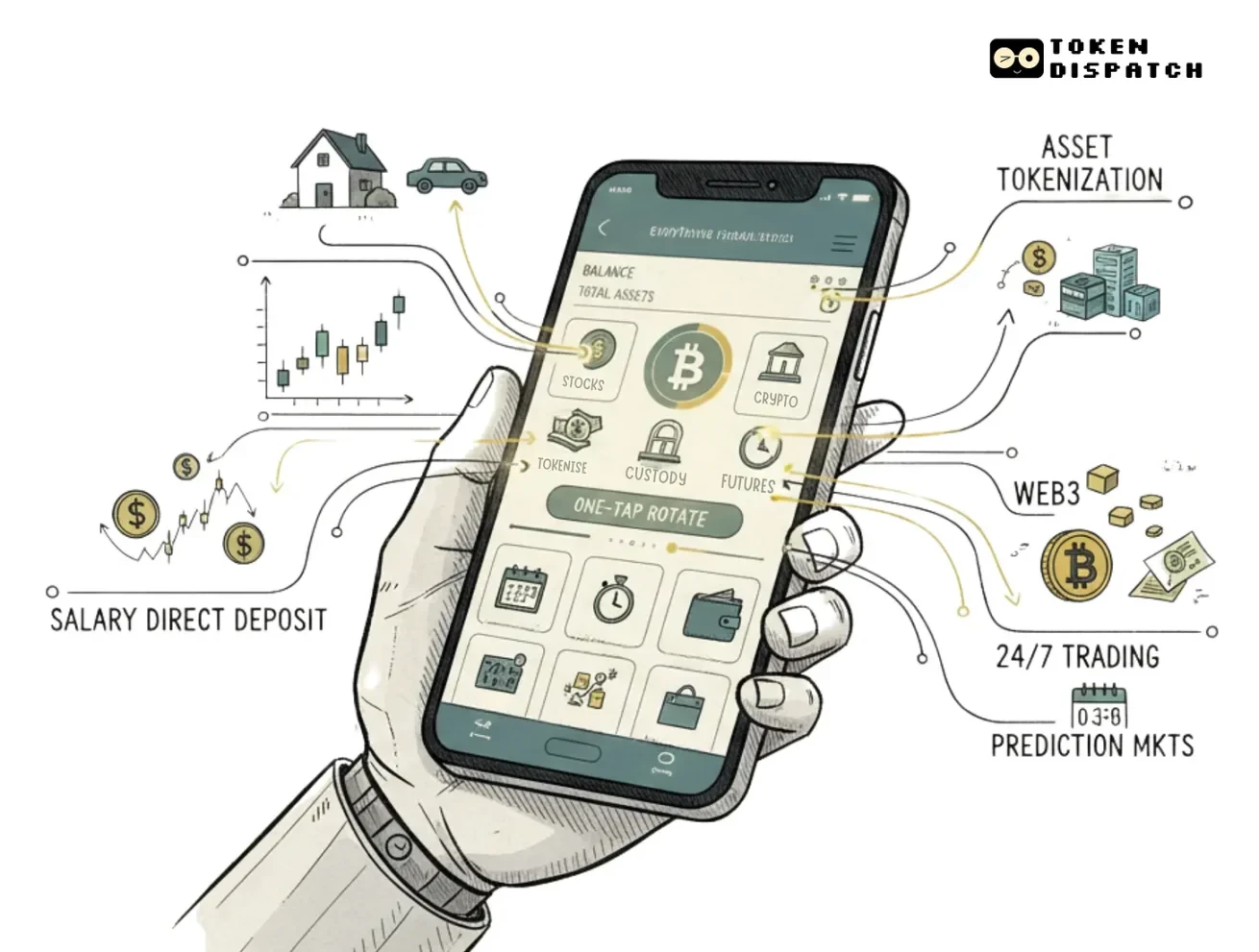
Photo by Nishil Jain
Original language: Luffy, Foresight News
Last week, Coinbase launched a brand-new product called Financial Future. Five major functions can be achieved with one application: 5x24 hours of stock trading, centralized exchange and chain-encrypted currency trading, futures and contracts for renewal, forecasting of markets, and a more artificial intelligence financial analyst. All functions can be operated via mobile phones, and user single account balances can be used interchangeably and instantaneously across asset classes。
In the recent past, Robinhod has been ahead of schedule: the launch in Europe of a token stock trade, 5x24 small-time goods trading, an encrypted currency interest-bearing service, and a 2026 online social trading feature, Robinhod Social。
THE PREVAILING DISCOURSE ON PLATFORM X INTERPRETS THIS TREND AS AN EVOLUTION OF "SUPER APPLICATIONS", BUT ONE OF THE KEY POINTS IS OVERLOOKED: IT IS NOT SIMPLY A FUNCTION SUPERIMPOSED, BUT RATHER A BREACH OF ARTIFICIAL BOUNDARIES BETWEEN FINANCIAL ASSET CATEGORIES AS A RESULT OF REGULATORY AND TECHNICAL CONSTRAINTS。
Why is it that, after 10 years of fragmentation, financial applications are on the verge of integration? What does this mean for the users and platforms in it? Next, we're officially on the subject。
The pain of fragmentation
Over the past decade, there has been a proliferation of financial science and technology applications, but most of them cover only a single segment of financial services, and the functions of stock trading, encrypted currency, payments, savings, etc. have been dispersed in different applications。
While this model provides users with more options and allows businesses to focus on the grinding of a single solution, it is problematic in its practical use。
You want to sell shares and buy encrypted money? The stock exchange is to be executed on Monday and the T+1 delivery is to be completed on Tuesday; cash withdrawals are then initiated, which takes 2-3 days for the bank account to be held; and transfer of funds to Coinbase, which takes 1-2 days. From "decisions to adjust funding allocations" to "funds actually landed", it took about five days. And in these five days, the investment opportunities that you're looking at are likely to have disappeared and the money is stagnating in a cumbersome process。
For example, on December 18, you wanted to buy bitcoin at $86,000, and eventually, due to process delays, you sold it at $90,000 five days later. This delay could be more costly for more volatile investment opportunities such as meme coins, first token issuances (ICOs) or first open equity (IPOs)。
THE PROBLEM OF FRAGMENTATION IS NOT LIMITED TO A SINGLE AREA. AN INDIAN INVESTOR WHO WANTS TO BUY SHARES IN BRITISH WEEDA WOULD HAVE TO DOUBLE THE KYC CERTIFICATION AND OPEN AN ACCOUNT WITH A BROKER SUPPORTING INDIAN USERS TO INVEST IN THE US SHARE, AND WOULD HAVE TO DEPOSIT ADDITIONAL FUNDS TO BUY THE STOCK ONLY。
We all have experienced such operational frictions, but until recently the infrastructure capable of addressing the problem has not evolved。
The cornerstone of change: infrastructure improvements
Three major structural changes have made possible the emergence of integrated financial platforms。
Decorate the time barrier
TRADITIONAL STOCKS CAN BE TRADED ONLY DURING THE NEW YORK STOCK EXCHANGE (NYSE) TRADING HOURS (9:30 A.M. TO 4 P.M. EASTERN UNITED STATES TIME, 5 DAYS A WEEK), WHILE ENCRYPTED CURRENCY IS TRADED SEVEN TIMES 24 HOURS WITHOUT INTERRUPTION. THE MONETIZATION OF SHARES ON THE SECOND TIER OF THE NETWORK PROVED THAT STOCK COULD THEORETICALLY BE TRADED AROUND THE CLOCK THROUGH SOUND TECHNICAL MECHANISMS。
Now, Robinhood has supported 5x24 hours of trading in tokenized shares in Europe, and Coinbase will follow this pattern。
Towards a clear regulatory framework
OVER THE PAST FEW YEARS, THE REAL BITCOIN ETF HAS BEEN SUCCESSFULLY LISTED, THE STABILIZATION PROCESS HAS ADVANCED, THE REGULATORY FRAMEWORK FOR MONETIZATION HAS ENTERED THE REVIEW STAGE AND THE FORECAST MARKET HAS BEEN APPROVED BY THE UNITED STATES COMMODITY FUTURES TRADING COMMISSION (CFTC). ALTHOUGH THE REGULATORY ENVIRONMENT IS NOT PERFECT, IT IS CLEAR ENOUGH TO GIVE THE PLATFORM THE CONFIDENCE TO DEVELOP MULTI-ASSET PRODUCTS WITHOUT FEAR OF BEING STOPPED ALTOGETHER。
Mobile wallet infrastructure mature
Embedded wallets are now able to process cross-chain complex operations seamlessly. The Privy platform, acquired by Stripe, allows users to create wallets through existing e-mails without needing to contact the notes; the recently online encrypted currency transaction application Fomo allows non-encrypted currency users to trade in a network without the need to manually choose a network, to trade in coins on the Taifung, Solana, Base, Arbitrum, etc., and to support apple payment deposits, and the backend automatically handles all complex processes, and users need to click on "purchase tokens" to do so。
Core logic of liquidity integration
The central driving force behind this change is the fragmentation of funds in different applications, which are essentially idle。
Under the integration model, the user is required to hold only one account balance: after the stock is sold, the money can be used immediately for the purchase of encrypted currency, without having to wait for the delivery of the window, the cash withdrawal period or the middle of the bank. The opportunity costs of the original five days have disappeared。
The platform for consolidating liquidity is more efficient. Because of deeper liquidity pools, they can provide better speed of implementation; because all transactions share the same base liquidity, they can support more transaction pairs; they can, like banks, provide a return on idle capital; and, because of reduced friction, they can generate more transaction revenue。
Integrated blueprint for Coinbase
Coinbase is the most typical example of this wave of financial consolidation. Established in 2012, it was initially a simple encrypted currency exchange that supported only the sale of bitcoin and the Ethera. In the following years, Coinbase has evolved into a fully-service secure currency platform by 2021, with the addition of new institutions such as trustees, pledge services, encrypted currency lending and interest products。
The pace of expansion has not stopped: the Coinbase Card, which supports the consumption of encrypted money, Coinbase Company, which provides payment solutions for businesses, and a two-storey block chain, Base。
On December 17, a new product was released, marking the full landing of Coinbase's "super-application" vision. Today, Coinbase has supported a 24-hour stock exchange and plans to launch an agency-oriented, real-world asset monetization service, Coinbase Tokenize, in collaboration with Kalshi, to integrate forecast markets, up-line futures and durability contracts, and to apply the Solana eco-decentralised exchange trading function. In addition, Base applications have been extended to 140 countries and strengthened social transaction experiences。

Coinbase is becoming an operating system of chain finance. Covering the transaction needs of all asset classes through a single interface and single account balances, the goal is to enable users to complete all financial operations without leaving the platform。
Robinwood is following a similar development path: starting with a commission-free stock deal, gradually adding encrypted currency transactions, providing 3 per cent cash return and 3.5 per cent deposit interest in gold subscription services, futures transactions, and then launching tokenized shares in Europe。
Both platforms are bet on the same core logic: users do not want to download different applications for stocks, encrypted currencies and derivatives, and they need a single account balance, a harmonized interface, and the ability of the funds to adjust their configuration immediately。
Social transactions: emerging differential competitiveness
The consolidation of assets addressed liquidity issues, but did not address the difficulties of finding assets by users。
How can users screen the subject matter of a transaction when there are millions of assets available on the market? How can you build your own portfolio
That's the value of social functions. The Coinbase Base application contains a dynamic flow of information that allows users to view others ' buy-in operations; Robinhod Project 2026 goes online, Robinhod Social; eToro has introduced social transactions since 2007 to pay 1.5 per cent of the assets held by a single trader as commission。
There are also a number of applications in the chain that explore social transactions functions, such as Fomo, 0xPPL and Farcaster. These applications allow users to view, follow and copy the investment targets of their friends。

Highlight page for Fomo
Social transactions allow users to view the behaviour of others in real time and copy them with one key. This has significantly reduced decision-making friction: it does not require independent research, but follows the trading strategies that it trusts. Once the platform has developed a stable community ecology — with users focusing on trading people and building personal reputations — it is difficult for users to move to other platforms, which creates a strong competitive barrier to trading applications and user stickiness。
The Centralized Exchange has been operating a documentary transaction function since 2022, but the usage rate is consistently below 2%. Whether mobile application platform bets improve the penetration of this function by optimizing user experience or whether they are right will determine whether social transactional functions can be truly differentiated and competitive or simply reduced to another ordinary function。
Pessimism: potential risks and controversy
Let us face the situation frankly: the intention of encrypted money was to decentralize finance, remove the middle link and allow users to take control of their assets。
Today, we are rebuilding central platforms: Coinbase controls asset hosting, transaction execution and social networking chains; Robinhod holds private keys to embedded wallets; and users need trust platforms to be solvent, secure and sustainable. All of this hides the risk of dealing with a counterparty。
Robinhood's monetized stocks are essentially derivatives for tracking stock prices rather than actual stocks. Once the platform is closed, the user holds only a piece of paper。
THE PROBLEM WITH GAMES ALSO BECOMES MORE SERIOUS: 7X24 HOURS OF TRADING MEANS THAT YOU CAN TRADE AT 3 A.M. EMOTIONAL IMPULSES; SOCIAL INFORMATION FLOWS WILL GIVE YOU THE FOMO PSYCHOLOGY WHEN HE SEES A MAN MAKING A PROFIT; PUSH NOTICES WILL ALERT EVERY MARKET TO FLUCTUATIONS IN REAL TIME. THIS IS ESSENTIALLY A SCALABLE CASINO PSYCHOLOGY THAT IS CAREFULLY OPTIMIZED BY DESIGNERS WHO KNOW HOW TO TRIGGER DOPAMINE REACTIONS。
Is this progress in the democratization of finance, or is it a system of exploitation that does not change medicine? This is a thought-provoking philosophical question。
The essence of the phenomenon
It took us 10 years to dismantle our financial services, on the assumption that debrisification could generate competition and more choices。
However, fragmentation has also proved to be inefficient: funds are idle, liquidity is dispersed, users have to hold more idle funds because of the cumbersome transfer process, and the new era is changing the situation。
Coinbase and Robinhod are becoming new banks: they control your salary, savings, investment and consumption patterns, control the execution of transactions, trust and access to assets, and intervene in every transaction. The only difference compared to traditional banks is that the interface is more beautiful, the trading market is open 24 hours a day, and deposit rates are 50 basis points higher。
The era of fragmentation is over, whether we are democratizing finance by lowering the threshold and improving efficiency, or simply replacing the gatekeeper and retaining the threshold itself. In the coming years, we will witness whether financial integration based on open bottom technologies will lead to better results than traditional banks from which we have fled, or whether it will simply replace Logo, which is targeted。
