
"AI CALCULATES THAT FIRE HAS ESCALATED: THE ORIGINAL COMPANY WANTS TO DIG BITCOIN IN SPACE."
AI ' S NEXT BATTLEGROUND OF CALCULUS IS EXPANDING INTO SPACE AND BECOMING A NEW DIRECTION FOR COMMERCIAL NARRATIVES。

ORIGINAL TITLE: "AS SOON AS THE BRITISH WEEDA AI SERVER WAS SENT TO THE SKY, THE SPACE STARTER WAS TARGETING BITCOIN FOR MINING."
Photo by Nancy, PANews
AI ' S NEXT BATTLEGROUND OF CALCULUS IS EXPANDING INTO SPACE AND BECOMING A NEW DIRECTION FOR COMMERCIAL NARRATIVES。
FOLLOWING THE SUCCESSFUL LAUNCH OF THE FIRST SPACE AI SERVER, A RECENT SPACE COMPUTING START-UP COMPANY PLANS TO PUT BITCOIN MINING INTO OUTER SPACE。
The plan is to exploit bitcoin in space this year
THROUGH THE FIRST HALF OF THE PUZZLE, THE PUZZLE MODEL, THE COMPETITION FOR AI ' S CALCULUS HAS TURNED TO ENERGY。Electricity, as a core resource in this competition, is rapidly becoming a scarce resource in the global computing battle。Such a shift has not only changed industry patterns, but has also directly recast the cost structure of the Bitcoin mining industry。
IN PARTICULAR, THE ONCE-STABLE BITCOIN MINERS ARE NOW TURNING TO THE AI-CALCULATED TRACK。BEHIND THIS TRANSITION ARE THE PRESSURES OF SURVIVAL BROUGHT ABOUT BY HALF OF BITCOIN, AS WELL AS THE SHRINKING OF PROFITS FROM INCREASED COMPETITION AND RISING ENERGY COSTS, AND, MORE IMPORTANTLY, THE HUGE WINDFALL BROUGHT ABOUT BY THE AI NARRATIVE。
With the benefits of bitcoin mining being squeezed by global energy competition, Starcloud proposed a bold plan to move bitcoin mining into space。
In a recent interview with HyperChange, Starclaud CEO Philip Johnston revealed that the company is currently focused on existing space computing and has a Bitcoin mining programme. Starcloud will carry on board the Starcloud-2 satellite, launched later in 2026, a number of ASIC hardware designed to mine bitcoin. If the program succeeds, Starcloud becomes the first world spacecraft to dig bitcoin in space。
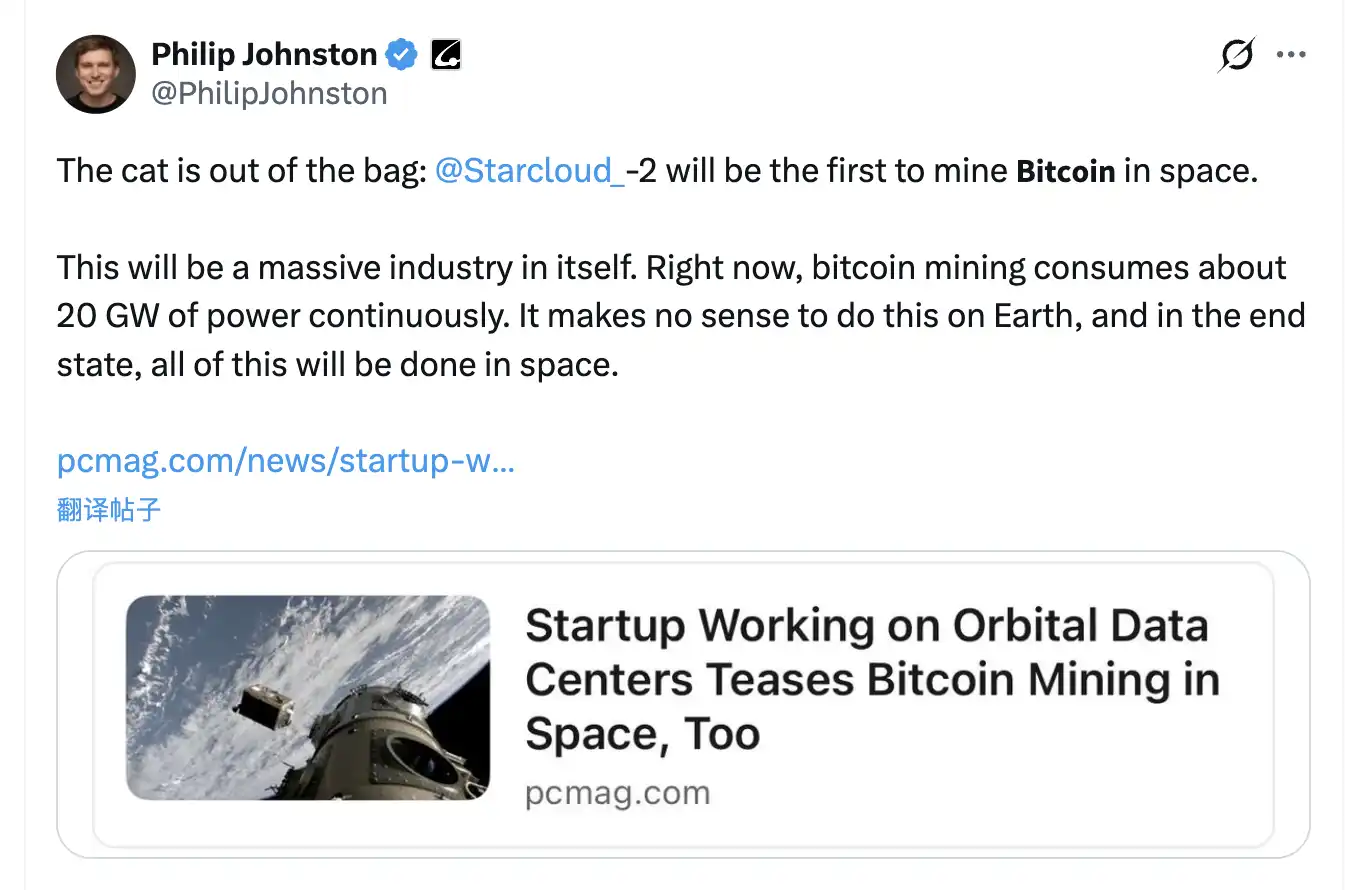
Johnston believes that space has multiple natural advantages over Earth。First, there is an unlimited and continuous supply of solar energy in space, which is more stable and less costly than renewable energy on Earth; at the same time, the environment in space is superior, temperature differentials and radiation, although extreme, can significantly reduce the heat-dispersion consumption of hardware and reduce the costs of cooling and the burden of maintaining equipment. The most important thing isBitcoin mining in space can avoid the growing energy bottlenecks, grid restrictions and regulatory pressures on the planet。CURRENTLY, ABOUT 20 GW ELECTRICITY ON EARTH IS USED FOR MINING IN BITCOIN, AND THIS LARGE-SCALE ELECTRICITY CONSUMPTION IS NO LONGER FEASIBLE ON THE GROUND. IN SPACE, THE USE OF SOLAR ENERGY FOR CHEAP ENERGY WOULD PROVIDE A COMPLETELY NEW SOLUTION FOR THE MINING OF BITCOIN。
Johnston added that the cost of mining equipment in Bitcoin usually ranges from $600 to several thousand dollars, well below the corporate GPU (usually over $30,000). This makes the economics of mining bitcoin in space extremely attractive。
Starcloud sees the mining of bitcoin in space as a "future business" that captures cheap energy through the use of solar energy in space and, frankly, is one of the reasons why it and other companies (including SpaceX) have built data centres in space. Space mining not only reduces costs significantly, but also provides a completely new pattern of resource acquisition for the global computing market。
The concept of mining in space was not first introduced. Last year. Intercosmic Energy has also indicated that bitcoin mining is being studied in space。
However, the challenge of mining bitcoin in space remains。Johnston also admitted that bitcoin mining in space remains economically unstable. At present, Bitcoin ASIC equipment can operate on any cheap source of energy, while the profitability of mining equipment may decline rapidly as new equipment is introduced。
Moreover, while the cost of launching has been declining year by year, sending hardware into space remains an expensive task. The start-up and maintenance costs of space mining, including launch, spacecraft integration, satellite communications and equipment upgrades, remain high compared to ground mines。
EVEN MORE PROBLEMATIC IS THE EXTREME HARDWARE REQUIREMENTS OF THE SPACE ENVIRONMENT. THE NEED FOR A STABLE OPERATION OF THE BITCOIN MINING ASIC EQUIPMENT UNDER EXTREME CONDITIONS SUCH AS HIGH RADIATION AND EXTREME TEMPERATURE VARIABILITY HAS PUT THE PERFORMANCE AND LIFETIME OF THE EQUIPMENT TO A SERIOUS TEST. MAINTENANCE AND UPGRADING OF EQUIPMENT WILL ALSO BE A MAJOR CHALLENGE, AS THE COST AND DIFFICULTY OF REPAIRING AND REPLACING HARDWARE WILL INCREASE SIGNIFICANTLY IN THE EVENT OF FAILURE。
Before that, a number of encryption circles had been exploring the commercial introduction of the block chain into space. For example, Blockstream, an older company of the Bitcoin community, has leased several geosynchronous orbit satellites since 2017 to broadcast the Bitcoin block chain data globally free of charge, even if there is a large-scale disconnection network (such as a natural disaster or an artificial blockade) on Earth, and if you have a small satellite pot (receivers), you can synchronize the Bitcoin books and complete the trade. SpaceChain installed its first commercial Etherak node on the International Space Station (ISS) as early as 2019. Early this year, Spacecoin, a new project focused on space commerce, also attracted market attention, using satellite networks to settle payments in encrypted currency。
So, in space mining, inputs may be far more profitable in the short term than in the present, and more symbolic, or rather, the initialist company, a narrative that attracts market attention。
FOR THE FIRST TIME IN HUMAN HISTORY, WE'VE SENT THE ENGLISH-WEDDA-AI SERVER INTO SPACE
Established in 2024, Starcloud, a former Lumen Orbit, has emerged as one of the first companies to propose a data centre in space within the global scientific community。
As a member of the Youngwida Accelerated Project, Y Combinator and Google Cloud Incubator, Starcloud does not simply move data centres to spaceIT AIMS TO BUILD INFRASTRUCTURE THAT SUPPORTS AI AND LARGE-SCALE COMPUTING, USING UNIQUE RESOURCES IN THE SPACE ENVIRONMENT。
At present, Starcloud has completed at least $21 million in financing, backed by prominent investment institutions such as NFX, Y Combinator, FUSE, Soma Capital, a16z and Redwood Capital。
Starcloud has taken a place in the space AI computing contest. Last November, Starclaud completed the first ever major space orbit model training, launched his own Starclaud-1 satellite through SpaceX Falcon 9, put NVIDIA H100 GPU into Earth orbit and successfully operated the open source of Google

When Philip Johnston saidSPACE AI IS NOT A BAD IDEA, AND THE CORPORATE GOAL IS TO ACHIEVE ENERGY COSTS IN ORBITAL DATA CENTRES 10 TIMES LOWER THAN IN TERRESTRIAL DATA CENTRES。
After the initial achievements, Starcloud's ambitions did not stop. Recently, the company submitted an application to the FCC for the deployment of a large constellation of 88,000 satellites to construct a distributed, space-based AI training and cloud computing platform. However, the challenge of translating this vision into reality is enormous. From the scale of funds, regulatory approval, launch capacity, orbital resource allocation to operational sustainability, this is not only a business competition, but also a systemic engineering challenge, each of which is fraught with uncertainty and complexity。
Not only Starcloud, as the demand for computing resources from the AI industry grows, more and more technology companies begin to seek new sources of computing, and space is becoming the focus of this competition. Google, for example, officially launched its solar catcher programme at the end of last year, announcing the launch of a self-study TPU AI chip into space with the aim of building a solar-powered prototype space data centre; recently, SpaceX, under the flag of Mask, submitted a request for the deployment of 1 million satellites in Earth orbit to construct an orbital data centre; and recently, the data storage and capacity disaster company Lonestar and the semiconductor and storage company Phiso launched, through SpaceX rockets, a data centre infrastructure to travel to the Moon。
As the space data centre concept moves from science fiction to realityA new infrastructure arms race is under way。ACCORDING TO MASK, IN FIVE YEARS' TIME, SPACE AI'S ANNUAL ADDITIONAL CALCULUS WILL REACH HUNDREDS OF GIVA; THE ANNUAL AI CALCULUS SENT INTO SPACE WILL EXCEED THE HISTORICAL SUM OF ALL AI ON EARTH。
AND BY THEN, AI'S MAIN BATTLEGROUND OF COMPUTING COMPETITION WILL REALLY MOVE TO SPACE. OVER THE NEXT FEW YEARS, WE WILL SEE MORE COMMERCIAL EXPLORATION AND TECHNOLOGICAL INNOVATION, AND SPACE MINING MAY BE JUST ONE OF THE ROAD STONES IN THIS WAVE。
