
Cuộc phỏng vấn mới nhất của Cobie: Thị trường tiền điện tử đang trải qua “sự phân biệt hình chữ K”
Sự khác biệt hình chữ K, sự phân bổ của cải không cân bằng và sự vắng mặt của một vòng tường thuật mới.
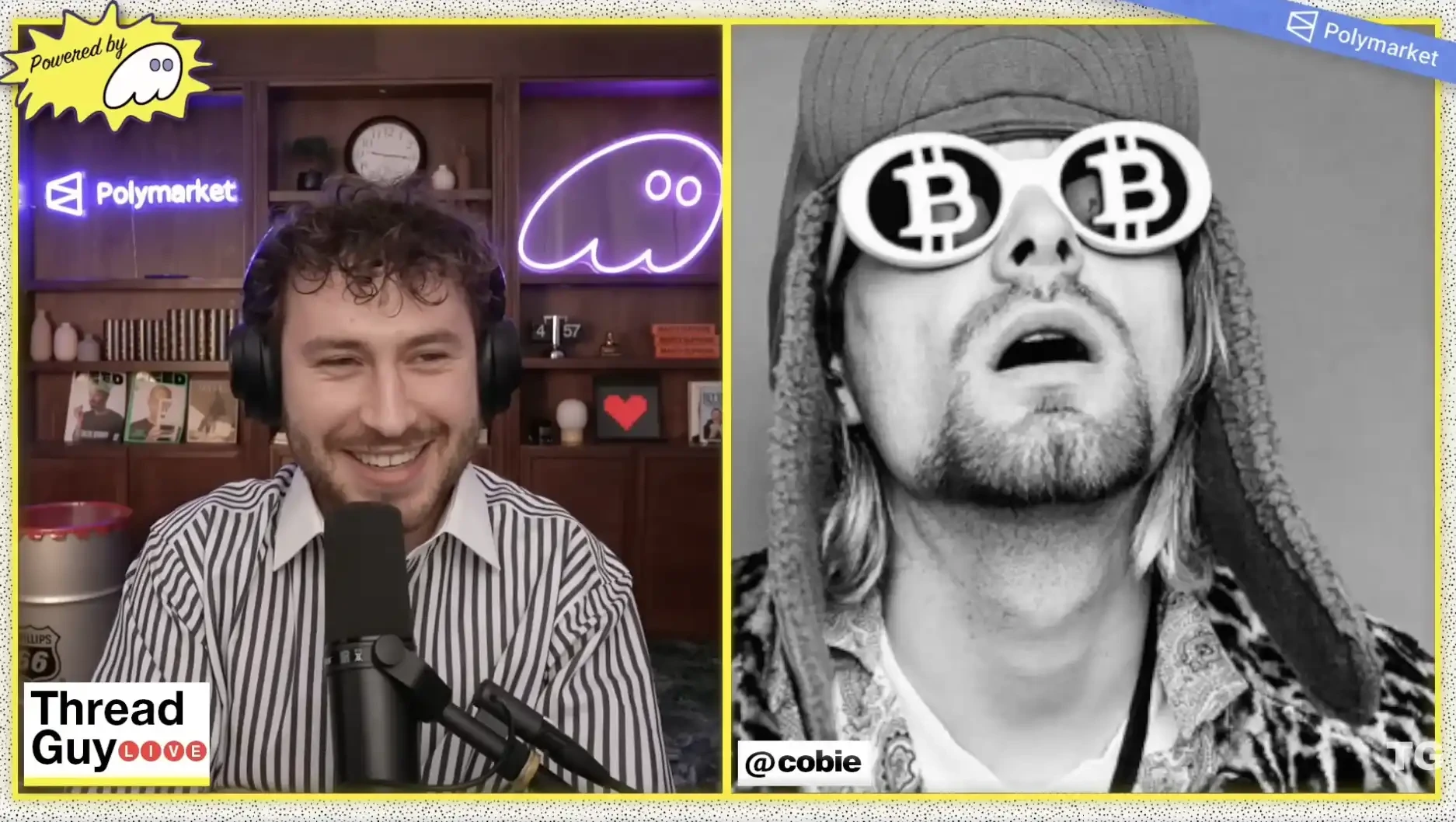
Tiêu đề video: Cuộc trò chuyện chưa được lọc với Cobie - Tiền điện tử, Thị trường, AI, Coinbase
Tác giả video: Thread Guy
Biên soạn bởi: Peggy, BlockBeats
Lưu ý của người biên tập: Bài viết này được tổng hợp từ cuộc trò chuyện dài giữa nhà giao dịch tiền điện tử Cobie và người sáng tạo nội dung Thread Guy.
Cobie (@cobie) là một trong những người kể chuyện thị trường mang tính biểu tượng trong cộng đồng tiền điện tử và đồng tổ chức podcast nổi tiếng UpOnly. Ông được biết đến với sự hiểu biết về chu kỳ thị trường, kinh nghiệm giao dịch và phong cách diễn đạt tương đối hạn chế nhưng sâu sắc, đồng thời đã tạo được ảnh hưởng ổn định trong ngành. Vào năm 2025, nền tảng Echo do anh sáng lập đã được Coinbase mua lại.
Thread Guy hoạt động trong hệ sinh thái mã hóa nơi nội dung và sản phẩm giao nhau. Anh điều hành nhiều dự án bao gồm CounterpartyTV, Phantom và Polymarket, đồng thời đảm nhiệm vai trò kép là người sáng tạo và xây dựng nội dung.
Cuộc trò chuyện này đã nhận được sự chú ý cao trong cộng đồng và nhiều lần được đánh giá là "một cuộc phỏng vấn dài chất lượng cao đã bị thất lạc từ lâu". Cuộc thảo luận không dừng lại ở điều kiện thị trường hay phán đoán giao dịch ngắn hạn mà chuyển sang một câu hỏi cơ bản hơn: Khi năng lực kỹ thuật và kỳ vọng thể chế của ngành mã hóa dần được hiện thực hóa, tại sao thị trường vẫn thiếu đà tăng trưởng? Và, dưới sự sai lệch cấu trúc này, các cá nhân nên định hướng lại bản thân như thế nào?
Cuộc trò chuyện này có thể được hiểu từ ba cấp độ.
Đầu tiên, đó là sự khác biệt về cấu trúc. Cobie đã đưa ra nhận định xuyên suốt bài viết: ngành công nghiệp mã hóa đang trải qua một "sự khác biệt hình chữ K" rõ ràng. Một mặt, các ứng dụng như stablecoin, thị trường dự đoán và giao dịch trên chuỗi đang bước vào hệ thống kinh tế thực, đồng thời các kịch bản sử dụng và quy mô người dùng tiếp tục mở rộng; mặt khác, tài sản mã thông báo mà các nhà đầu tư thông thường có thể tham gia lại yếu và nhu cầu ngày càng giảm.
Sự sai lệch giữa "ứng dụng đang phát triển nhưng tài sản không hiệu quả" đã gây ra sự tách biệt giữa các nguyên tắc cơ bản của ngành và trải nghiệm thị trường, đồng thời trở thành nguyên nhân cốt lõi của sự suy thoái hiện nay. Đối với các nhà đầu tư, câu hỏi không phải là “liệu có tiến bộ hay không”, mà là “liệu tiến độ đó có thuộc về họ hay không”.
Thứ hai, đó là sự lặp lại của những con đường. Nhìn lại con đường mở rộng của thị trường mã hóa trong mười năm qua, chúng ta có thể thấy một chu kỳ rất nhất quán: từ altcoin năm 2013, ICO năm 2017, đến DeFi và NFT vào năm 2021, cho đến meme coin gần đây, mỗi đợt tập trung dòng người dùng đều dựa trên cùng một cơ chế. Những người bình thường nhận được những lợi ích đáng kể trong một khoảng thời gian ngắn và điều này lan rộng.
Cốt truyện liên tục thay đổi nhưng động lực vẫn ổn định. Từ góc độ này, sự trỗi dậy hiện tại của AI không phải là sự cạnh tranh với tiền điện tử, mà giống như sự kế thừa của cùng một cơ chế: câu chuyện công nghệ mới + ngưỡng thấp hơn + trí tưởng tượng về việc “làm giàu nhanh chóng”. Sự di cư của vốn và tài năng về cơ bản là một dòng chu kỳ tự nhiên, chứ không phải là sự thất bại của một con đường duy nhất.
Thứ ba là tái thiết hệ thống phân phối. So với những biến động của chu kỳ và cảm xúc, những thay đổi sâu sắc hơn diễn ra trong cơ cấu phân bổ giá trị. Khi các công ty như OpenAI và SpaceX hoàn thành quá trình tích lũy giá trị quy mô lớn trong giai đoạn phát hành riêng lẻ, các nhà đầu tư thông thường ngày càng khó tham gia vào quá trình tạo ra của cải thực sự. Thị trường đại chúng đã dần thoái hóa thành một lối thoát thanh khoản hơn là điểm khởi đầu cho giá trị. Trong bối cảnh này, câu chuyện “tham gia mở” mà tiền điện tử từng được đặt vào bắt đầu đối mặt với nguy cơ bị hệ thống truyền thống hấp thụ hoặc thậm chí được xây dựng lại.
Nhưng đồng thời, Cobie cũng chỉ ra một con đường tiềm năng: Nếu cơ chế airdrop hiện tại trên chuỗi được mở rộng thành phương thức "phản hồi giá trị người dùng" phổ biến hơn, tức là người dùng nhận được phân phối vốn cổ phần trong quá trình tham gia sản phẩm và góp phần tăng trưởng, tiền điện tử vẫn có thể trở thành một thử nghiệm thể chế để chống lại xu hướng này.
Ngoài tất cả các cuộc thảo luận về cấu trúc, kết luận của Cobie là trực tiếp nhất: nếu bạn không còn tin tưởng vào giá trị lâu dài của ngành này, bạn nên rời đi; nếu bạn vẫn lạc quan về tầm quan trọng của nó trong vòng 5 đến 10 năm tới, bạn nên phân bổ dựa trên nhận định này thay vì bị tiêu hao liên tục bởi những biến động ngắn hạn.
Thị trường tiền điện tử chưa bao giờ là một hệ thống tạo ra sự giàu có ổn định mà gần hơn với một loạt các thử nghiệm lặp đi lặp lại. Mỗi câu chuyện và mỗi chu kỳ sẽ cơ cấu lại cách phân phối thu nhập và người tham gia. Khi con đường ngắn hạn không còn rõ ràng nữa, câu hỏi không còn là “điều gì sẽ xảy ra tiếp theo?” mà đúng hơn là: bạn vẫn tin rằng hệ thống này sẽ vẫn đáng tham gia vào một thời điểm nào đó trong tương lai.
Sau đây là tóm tắt cuộc trò chuyện (nội dung gốc đã được chỉnh sửa để dễ đọc và dễ hiểu):
TL;DR
- Crypto hiện đang trong tình trạng "trật khớp". Các ứng dụng thực sự có giá trị (stablecoin, thị trường dự đoán, giao dịch trực tuyến) đang phát triển nhanh chóng, nhưng các nhà đầu tư thông thường không thể có được mức thu nhập tương ứng, dẫn đến tâm lý cực kỳ chán nản.
- Mỗi đợt tăng lượng người dùng trong lịch sử về cơ bản đều xuất phát từ cùng một cơ chế - những người bình thường kiếm tiền trong một khoảng thời gian ngắn. Từ altcoin 2013, ICO 2017, NFT 2021 đến đồng meme, các câu chuyện đều khác nhau, nhưng logic cơ bản thì giống nhau.
- Thị trường đã chứng kiến sự "khác biệt hình chữ K": Một mặt, các ứng dụng và cơ sở hạ tầng ngày càng trở nên thực tế và quan trọng hơn; mặt khác, giá tài sản như mã thông báo, meme và tiền quản trị đã suy yếu và cảm xúc của các nhà đầu tư ngày càng tồi tệ.
- Rủi ro bị bỏ qua nhiều nhất hiện nay là: Giá trị của tiền điện tử có thể bị hệ thống tài chính truyền thống "tiếp quản" và tư nhân hóa, và người dân bình thường sẽ không thể tham gia vào việc tạo ra của cải thực sự (như OpenAI, SpaceX, v.v.).
- Theo trực giác, tiền điện tử thường hoạt động tốt nhất vào "thời điểm tồi tệ nhất", nhưng khi tất cả các lợi ích được hiện thực hóa (quy định, ETF, sự gia nhập của tổ chức), nó giống như một giai đoạn đỉnh cao hơn.
- Đối với các cá nhân, nếu bạn không còn tin tưởng vào giá trị lâu dài của tiền điện tử, bạn nên rời đi thay vì tiếp tục tiêu tốn bản thân ở đây; Nếu bạn tin rằng nó vẫn còn quan trọng trong 5-10 năm nữa, bạn nên phân bổ tài sản dựa trên nhận định này thay vì cố gắng làm giàu trong thời gian ngắn.
- Những người thực sự thành công trong dài hạn không phải là những nhà giao dịch năng nổ nhất mà là những người có phán đoán độc lập, nhận thức lặp đi lặp lại liên tục và "hài lòng".
- Tiền điện tử vẫn có giá trị lâu dài tiềm năng: Nó có thể trở thành một cơ chế phân phối mới cho phép người dùng kiếm phần thưởng trong khi tạo ra giá trị (tương tự như "nền kinh tế vốn sở hữu/airdrop trên chuỗi").
- Kết luận cuối cùng:Tiền điện tử không phải là một công cụ làm giàu nhanh chóng trong thời gian ngắn mà là một thử nghiệm có hệ thống được lặp lại định kỳ. Miễn là có thể tạo ra sự giàu có và câu chuyện, mọi người sẽ quay trở lại.
Nội dung phỏng vấn
Người chủ đề:
Này, dạo này bạn thế nào rồi?
Cobie:
Vừa rồi tôi thực sự đã phạm sai lầm. Tôi đang lướt Twitter và tưởng bạn đang mở Space (có lẽ tôi đã già) nên tôi muốn vào và nghe. Kết quả là tôi nhấp vào và thấy rằng bạn đang phát sóng trực tiếp. Tôi không biết Twitter có thể làm được điều này. Tôi đã nghĩ, ôi chúa ơi, tôi đã gần 40 tuổi khi xem trực tiếp Thread Guy.
Người chủ đề:
Có rất nhiều người đang xem, không chỉ riêng bạn. Những người có tiền cũng đang xem. Vậy gần đây bạn thế nào? Bạn khá im lặng trong thời gian này.
Cobie:
Tôi không hài hước lắm (cười). Nhưng nhìn chung thì ổn, không tệ.
Người chủ đề:
Mọi người đang hỏi khi nào UpOnly quay trở lại. Bạn đã làm gì trong vài tháng qua?
Lưu ý: UpOnly là một podcast về tiền điện tử do Cobie và Ledger đồng tổ chức từ năm 2020–2022. Chương trình chủ yếu được thực hiện dưới hình thức phỏng vấn, tập trung vào tường thuật thị trường, kinh nghiệm giao dịch và quan điểm của ngành. Nó có ảnh hưởng lớn trong thị trường tăng giá năm 2021 và được coi là một trong những nền tảng thảo luận quan trọng đối với cộng đồng tiền điện tử vào thời điểm đó.
Cobie:
Công việc, công việc thực sự.
Người chủ đề:
Bạn vừa đến làm việc tại Coinbase?
Cobie:
Thành thật mà nói, hiện tại tôi đang làm nhiều việc hơn trước đây. Trên thực tế, tôi đã muốn gia nhập Coinbase vài năm trước và thậm chí còn nói rằng tôi có thể làm việc đó với mức lương bằng 0, nhưng họ không muốn tôi. Theo quan điểm của tôi, có một số thứ “đòn bẩy cao” trong ngành này có thể thay đổi quỹ đạo tổng thể và làm tốt Coinbase là một trong số đó, vì vậy tôi muốn thử.
Và bạn nghĩ, tôi đã sử dụng Twitter được 10 năm, tôi phải làm điều gì đó thử thách và thú vị hơn thay vì ngày nào cũng nghĩ đến những câu chuyện cười.
Lưu ý: Cobie đã cố gắng gia nhập Coinbase nhưng không thành công trong những năm đầu của mình, nhưng sau khi nền tảng Echo mà anh thành lập được Coinbase mua lại vào năm 2025, anh đã tái gia nhập tổ chức cốt lõi này bằng cách được "sáp nhập vào hệ thống".
Người chủ đề:
Tôi có rất nhiều câu hỏi dành cho bạn, nhưng trước tiên hãy nói về thị trường tiền điện tử. Thành thật mà nói, tình trạng hiện tại không thú vị lắm. Với các vấn đề gần đây liên quan đến Arbitrum, Aave, LayerZero và Drift, tâm trạng về cơ bản đã chạm đáy. Bạn nghĩ gì về tiền điện tử hiện nay, đặc biệt là DeFi? Tiếp theo là gì?
Cobie:
Tôi nghĩ chúng ta có thể đang tiến gần đến DeFi 2.0.
Đối với tôi, điều khiến tôi lo lắng nhất lúc này là một số mô hình như Anthropic (hoặc AI thuộc loại đó) dường như có thể bắt đầu "tham gia" vào các hệ thống này. Điều này khiến DeFi trở thành một “nơi săn tài chính”. Nhưng mặt khác, một khi những mô hình này được phân phối rộng rãi hơn và không chỉ có thể được sử dụng bởi những kẻ tấn công mà còn cả những người xây dựng hệ thống, tình hình sẽ hoàn toàn khác. Vì vậy, tôi nghĩ đây là một điểm uốn và phiên bản DeFi trong tương lai thực sự khá thú vị.
Tâm trạng ở DeFi hiện tại thực sự rất tồi tệ. Ngoại trừ một vài dự án như Hyperliquid và Trade.xyz, về cơ bản không có gì đặc biệt thú vị. Nhưng bản thân các ví dụ này cũng khá thú vị—thực sự rất thú vị.
Người chủ đề:
Bây giờ bạn đã bắt đầu giao dịch dầu thô phải không?
Cobie:
Bạn đang kinh doanh dầu thô phải không? Điều đó thật tuyệt. Tôi sẽ mừng cho bạn nếu bạn có thể kiếm được tiền.
Người chủ đề:
Bạn có nhìn thấy con gấu ở phía sau tôi không?
Cobie:
Bây giờ bạn đang bắt đầu sắp xếp, điều này mang hơi hướng Mỹ.
Người chủ đề:
Đúng, kinh doanh dầu thô.
Cobie:
Vậy là bạn chuyển đến New York để làm công việc kinh doanh dầu thô? Con đường sống này khá thú vị.
Sự khác biệt hình chữ K: các ứng dụng đang phát triển nhưng tài sản đang thất bại
Người chủ đề:
Bạn vừa đề cập đến DeFi 2.0 và AI. Bây giờ nhiều người còn nghĩ bạn là AI (cười). Nhưng quay lại chủ đề, tại sao bạn vẫn muốn đầu tư vào Coinbase? Không phải bạn đã hoài nghi về tương lai của tiền điện tử sao? Nhiều người thực sự cảm thấy như vậy, bao gồm cả tôi - tôi đang giao dịch dầu thô, xem xét cổ phiếu và kinh doanh nhiều tài sản truyền thống khác nhau.
Cobie:
Bạn thực sự đang sử dụng cơ sở hạ tầng tiền điện tử để giao dịch tài sản không phải tiền điện tử, phải không?
Tôi nghĩ tiền điện tử hiện đang trải qua quá trình "phân biệt hình chữ K". Một mặt, “các ứng dụng gốc tiền điện tử” đang bùng nổ và thành công hơn bao giờ hết, nhưng những thành công này không được phản ánh qua giá tài sản mà các nhà đầu tư thông thường có thể mua.
Ví dụ: Polymarket đang hoạt động rất tốt và thị trường dự đoán đã trở thành một con đường thực sự, thậm chí giờ đây thậm chí còn hình thành cấu trúc độc quyền của Kalshi và Polymarket; stablecoin đang bắt đầu được sử dụng thực sự rộng rãi và các công ty như Doordash đang bắt đầu sử dụng stablecoin để thanh toán cho các tài xế. Những điều này thực sự xảy ra trong thế giới thực và rất quan trọng.
Vấn đề là, với tư cách là nhà đầu tư, bạn không thể mua những thứ này. Bạn không thể mua cổ phần của Stripe, vốn là cổ phần riêng tư; bạn không thể mua Polymarket; bạn không thể mua những thứ thực sự đang hoạt động tốt này. Đồng thời, bản thân các tài sản tiền điện tử đang giảm dần về nhu cầu và sự chú ý. Vì vậy, bạn cảm thấy thất vọng vì tự hỏi: "Vậy tôi nên mua gì?"
Crypto thực sự đang làm được rất nhiều điều mà nó đã hứa. Ví dụ: Hyperliquid, Trade.xyz và các thị trường trực tuyến khác nhau đều rất tuyệt vời và thậm chí có thể dự đoán giá mở cửa của ngày thứ Hai với sai số chỉ vài chục điểm cơ bản. Đây đã là một "thị trường thực sự" và nó hoạt động theo chuỗi.
Nhưng vấn đề là có sự mất kết nối giữa hoạt động của thị trường và tiến độ thực sự. Đồng meme không tăng và mã thông báo quản trị cũng không tăng nên mọi người đều nghĩ mọi thứ đều tồi tệ. Nhưng thực ra đó chỉ là do bạn không được “tiếp xúc” với những thứ thực sự tốt mà thôi.
Từ góc độ rộng hơn, tôi vẫn lạc quan về tiền điện tử. Nếu ngày càng có nhiều vốn vào chuỗi thì sớm muộn gì cũng sẽ có một chu kỳ điên cuồng khác, với sự phấn khích, bong bóng và một chút “ngu ngốc”. Nhưng đó là điều không thể tránh khỏi.
Người chủ đề:
Bây giờ bạn có vẻ rất lạc quan, điều này hơi bất thường (cười).
Cobie:
Tôi luôn lạc quan. Thành thật mà nói, tôi đã có rất nhiều khoảnh khắc bi quan trong đời, nhưng tôi chưa bao giờ thực sự được hưởng lợi từ chúng.
Có lẽ nếu hồi đó tôi bi quan hơn về FTX thì tôi đã không thua lỗ nhiều đến thế; có lẽ nếu tôi bi quan hơn về những NFT đó vào năm 2021 thì tôi đã không mua chúng.
Nhưng nhìn chung, bi quan không làm tôi thành công hơn.
Người chủ đề:
Được rồi, để tôi hỏi một vấn đề thực tế hơn. Hiệu suất hiện tại của Bitcoin thực sự không mạnh bằng các tài sản như vàng. Ban đầu, mọi người nên thảo luận về giá trị và khả năng chống rủi ro của nó, nhưng hiện tại thị trường chỉ đang thảo luận về số lượng Bitcoin mà Saylor và MicroStrategy nắm giữ.
Bạn có nghĩ đây là một rủi ro thực sự không?
Cobie:
Tôi không hề lo lắng chút nào cho đến một ngày tôi đến gặp nha sĩ. Nha sĩ hỏi tôi: "Bạn có mua cổ phiếu không?" Tôi nói tôi không biết nhiều về đầu tư. Anh ấy nói, "Bạn đã nghe nói về MicroStrategy chưa?" Tôi hơi hoảng sợ (cười).
Ông ấy có lẽ đã ngoài 70 và nói rằng ông chỉ nắm giữ hai cổ phiếu: 80% MicroStrategy; 20% Palantir. Tôi tự nhủ: Thế là xong, có lẽ mình phải tìm nha sĩ khác.
Đó là lần đầu tiên tôi nhận ra sự việc này đã “vỡ vòng tròn”. Những người quan tâm đến MicroStrategy trước đây về cơ bản là những người trong giới tiền điện tử hoặc trên Twitter. Nhưng bây giờ, nó đã bước vào thế giới thực.
Đôi khi tôi thậm chí còn nghi ngờ rằng tiền điện tử hoàn toàn không tồn tại, như thể nó chỉ là một thế giới được tưởng tượng trong đầu tôi. Mãi đến lúc đó tôi mới nhận ra, không, nó là sự thật và những người khác cũng biết điều đó.
Tất nhiên, cũng có khả năng ngay cả nha sĩ cũng là ảo ảnh (cười).
Thread Guy:
Vậy bây giờ bạn có thực sự lo lắng về Saylor và chiến lược của anh ấy không?
Cobie:
Tôi không thể nói là mình đặc biệt lo lắng, nhưng có vẻ như nó đang bắt đầu trở thành một “thứ lơ lửng trên đầu tôi”. Trước đây, mọi người đều nghĩ rằng Saylor là một món hàng đáng mua và tốt; nhưng bây giờ nó là một yếu tố đòi hỏi sự cảnh giác nhiều hơn.
Tuy nhiên, tâm lý này thực sự phụ thuộc vào giá cả. Khi giá giảm, mọi người nói: "Ồ, Saylor đang chạm đáy." Nhưng khi giá tăng lên, mọi người lại nói, "Ồ, Saylor thật tuyệt vời." Ví dụ, nếu bạn nghĩ về điều đó, mức cao nhất gần đây nhất có lẽ là sáu tháng trước. Tâm lý thị trường lúc đó hoàn toàn khác so với bây giờ.
Tôi luôn nghĩ rằng một trong những điều tuyệt vời về tiền điện tử là cảm xúc của bạn lúc này sẽ rất chân thực và thậm chí có thể khiến bạn cảm thấy rằng "không thể cảm nhận được điều gì khác". Nhưng nếu nhìn lại ba tháng trước, bạn sẽ thấy lúc đó mình có những cảm xúc hoàn toàn trái ngược.
Cá nhân tôi luôn cảm thấy bi quan không có ích gì cho mình nên tôi thích nhìn vấn đề lâu dài hơn và giữ thái độ lạc quan một chút. Có thể tôi đã sai, nhưng ít nhất đó là cách tôi luôn làm.
Người chủ đề:
Bạn đã gặp Saylor ngoài đời chưa?
Cobie:
Tôi đã cùng anh ấy ghi một podcast trong khoảng hai tiếng rưỡi. Trước khi ghi âm, bạn tôi có nhắn tin cho tôi và nói: “Cậu muốn nói chuyện gì?” Tôi nói, "Chúng ta hãy hỏi xem - Bitcoin có tốt không? Sau đó Saylor sẽ nói chuyện một mình trong ba giờ."
Sự việc hóa ra là như thế này, về cơ bản chúng tôi không nói gì, và anh ấy đã nói chuyện một mình trong vài giờ. Nhưng nó khá tuyệt (cười). Tôi cũng đã cố gắng mời anh ấy đến bữa tiệc mừng năm mới của tôi, nhưng tôi không thể tự mình đi được.
Người chủ đề:
Không phải bây giờ bạn gần như không bao giờ ra ngoài sao?
Cobie:
Thành thật mà nói, bây giờ tôi hầu như không ra ngoài. Nếu có đi chơi thì tôi cũng có thể đi, nhưng chủ yếu là tôi chỉ ở nhà.
Người chủ đề:
Bạn có phải là kiểu người hoàn toàn "trực tuyến" không?
Cobie:
Không hoàn toàn. Đôi khi tôi đi dạo - nhưng trong khu vườn của tôi. Điều chính là cố gắng tránh gặp người khác (cười).
Tại sao UpOnly ngừng cập nhật?
Người chủ đề:
Đây có phải là lý do UpOnly không quay trở lại? Mọi người đều thực sự muốn biết.
Cobie:
Bạn có biết có một câu nói tên là "Lời nguyền của album thứ hai" không? Ví dụ, việc một số ban nhạc thành công với album đầu tiên nhưng lại sụp đổ ở album thứ hai là điều rất bình thường. Tôi cảm thấy như đây là nơi tôi đang ở bây giờ.
Mỗi lần nghĩ đến việc bắt đầu lại podcast, tôi bắt đầu nghi ngờ mọi thứ: Tôi không biết liệu nó có còn thú vị như trước hay không; Tôi không biết phải nói về điều gì; Tôi không biết mời ai; và nhiều vị khách tôi mời trước đây đã phải ngồi tù (cười), và bây giờ tôi phải suy nghĩ nhiều hơn về việc mời người.
Quan trọng hơn, UpOnly tình cờ đang ở "giai đoạn thị trường tốt nhất" lúc bấy giờ: mọi người đều bị mắc kẹt ở nhà trong thời kỳ dịch bệnh; Bitcoin tăng từ 4.000 USD lên mức cao; Ethereum tăng từ 80 lên 4.000; tiếp theo là thị trường tăng giá NFT. Đó là thời điểm mọi người đều đang kiếm tiền và tâm trạng vô cùng lạc quan. Vì thế mọi người đều nhớ đến UpOnly rất rõ, không chỉ vì bản thân chương trình mà vì nó tình cờ xuất hiện vào thời điểm tốt nhất trên thị trường.
Nhưng bây giờ, thị trường nguội lạnh hơn, tâm trạng tồi tệ hơn, mọi người càng lo lắng và dễ tấn công lẫn nhau hơn. Sản xuất nội dung trong môi trường này thực sự là một vấn đề hoàn toàn khác. Vì vậy, tôi nghĩ sẽ thích hợp hơn nếu làm việc đó vào một "thời điểm thuận lợi".
Người chủ đề:
Nhưng nếu bạn không làm UpOnly, bạn thực sự để lại một "khoảng trống". Bây giờ không ai biết nên nghe giọng nói của ai.
Tôi nhớ ngày FTX gặp sự cố, tôi đang ở Spaces và mọi người hỏi bạn nghĩ gì. Lúc đó bạn đã nói "Điều này thật khủng khiếp" và không khí trong toàn bộ phòng trò chuyện ngay lập tức thay đổi. Vì vậy, đây không chỉ là vấn đề với bản thân chương trình mà còn với việc bạn đại diện cho một "tiếng nói trong ngành". Bây giờ bạn không đăng bài nhiều, GCR cũng không đăng, còn Hasu thì làm việc khác, cảm giác như bạn đã bước vào một giai đoạn mới.
Lưu ý: GCR (Gigantic Rebirth) là một trong những nhà giao dịch ẩn danh huyền thoại nhất trong thị trường tiền điện tử. Ông hoạt động tích cực trong chu kỳ 2021–2022 và được biết đến với nhiều nhận định chính xác về đỉnh thị trường và các bước ngoặt vĩ mô. Phong cách giao dịch của ông có đặc điểm là rủi ro cao, khả năng phán đoán chủ quan mạnh mẽ và các trò chơi tâm lý. Ông thường đảo ngược tâm lý thị trường thông qua các nhận xét của công chúng và được coi là “nhà giao dịch vĩ mô hàng đầu” trên Twitter về tiền điện tử.
Hasu là nhà nghiên cứu và phân tích chiến lược nổi tiếng trong ngành mã hóa. Ông từ lâu đã hoạt động tích cực trong các tổ chức như Paradigm và Flashbots. Lĩnh vực nghiên cứu chính của ông bao gồm mô hình kinh tế Bitcoin, cấu trúc thị trường và MEV. Được biết đến với lối viết chặt chẽ và có hệ thống, ông là một trong số ít những người dẫn đầu quan điểm trong ngành mã hóa thích "phân tích cơ học/học thuật".
Cobie:
Một mặt, chúng tôi quả thực đã già rồi (cười). Tôi thực sự không muốn trở thành kiểu người lúc nào cũng làm podcast, như Gary V (nhưng anh ấy là một chàng trai tốt, tôi không nói anh ấy xấu).
Lưu ý: Gary V (Gary Vaynerchuk) là một doanh nhân và nhà sáng tạo nội dung nổi tiếng người Mỹ. Anh nổi tiếng với sản lượng tần số cao và thương hiệu cá nhân. Trong những năm gần đây, anh cũng tham gia vào các dự án NFT và Web3.
Nhưng quan trọng hơn, môi trường hiện tại đã thay đổi. Mọi người sẽ "diễn giải quá mức" mọi điều bạn nói. Trước đây thì không như vậy, nhưng bây giờ tôi cảm thấy rất áp lực. Ví dụ, tôi từng đăng một dòng tweet đùa nhưng nhiều người đã giải thích nó rất nghiêm túc và thậm chí còn gửi tin nhắn riêng tư giận dữ.
Nhưng thực tế là nếu bạn đọc tất cả các dòng tweet của tôi thì có lẽ chỉ có 5% đúng và 95% sai. Chỉ là trước đây mọi người không có nhiều cảm xúc về những điều này. Giờ thì khác rồi. Thị trường trở nên khó khăn hơn, nhiều người mất tiền, sự chênh lệch thu nhập ngày càng nghiêm trọng, tâm trạng chung trở nên tồi tệ và mọi người trở nên lo lắng và nhạy cảm hơn. Trong trường hợp này, bạn thậm chí sẽ ít muốn nói chuyện hơn.
Bản chất của việc giới thiệu: Hãy để những người bình thường kiếm tiền trong thời gian ngắn
Người chủ đề:
Nhân tiện, tôi thực sự nghĩ rằng bạn thực sự có thể cắt bỏ vấn đề của Jeff và vấn đề của Shayne Coplan và đăng lại chúng, và điều đó sẽ bị coi là thất bại.
Nhưng tôi muốn hỏi bạn một số câu hỏi về "viên thuốc đen" về tiền điện tử.
Lưu ý: Jeff Dorman đề cập đến quan điểm đầu tư tiền điện tử giai đoạn đầu và Shayne Coplan đề cập đến các câu chuyện về ứng dụng thế hệ tiếp theo, chẳng hạn như thị trường dự đoán. Chúng được coi là những tập phim kinh điển của UpOnly.
"Viên thuốc đen" ban đầu là một khái niệm trong văn hóa Internet. Viên màu xanh có nghĩa là chọn tin vào câu chuyện hời hợt, viên màu đỏ có nghĩa là nhìn rõ thực tế và viên màu đen có nghĩa là nhìn rõ thực tế và đi đến kết luận "không có giải pháp/rất bi quan"
Một trong số đó là khi tôi mới bắt đầu giao dịch Top Shot và NFT vào năm 20 hoặc 21, tôi cảm thấy Internet đang sụt giảm. Những người đang vận chuyển hoặc đầu cơ vào giày thể thao sẽ tự nhiên chuyển sang tiền điện tử. Bởi vì tất cả những người tài năng nhất, những cơ hội thú vị nhất, những trò chơi mới nhất và hấp dẫn nhất vào thời điểm đó đều thuộc về tiền điện tử.
Nhưng bây giờ tôi đang nghĩ, điều gì sẽ xảy ra vào năm 2026, để những người năng động và tài năng nhất trong thế hệ trẻ sẽ bị thu hút trở lại tiền điện tử? Bởi vì bây giờ có cảm giác như chúng ta đã hoàn toàn mất đi nhóm người mới này. Ngày nay, bất kể chúng ta đang thực hiện các dự án hay sản phẩm, mọi người dường như đều đang nhặt những mẩu tin lưu niệm. Ngược lại, nhiều người thông minh và thông minh nhất đã chuyển sang làm AI hoặc xây dựng nền tảng fintech để làm những việc khác không trực tiếp liên quan đến tiền điện tử.
Nhưng vào năm 2021 và 2022, những người này đáng lẽ phải đến với tiền điện tử. Bạn có nghĩ rằng điều này sẽ thay đổi? Bạn có nghĩ điều gì khác sẽ xảy ra trong tiền điện tử để mang lại nhóm tài năng mới đó không? Điều gì có thể mang lại những tài năng mới cho ngành?
Cobie:
Tôi nghĩ, về cơ bản... bạn nhìn lại một số sự kiện giới thiệu quan trọng trong lịch sử. Có một chu kỳ altcoin lớn vào năm 2013, và ít nhất đối với tôi, đó là chu kỳ lớn đầu tiên mà tôi thực sự tham gia. Vào thời điểm đó, làn sóng altcoin quy mô lớn đầu tiên đã xuất hiện, có lẽ là hơn một trăm xu. Đó là “mùa altcoin” thực sự đầu tiên trong ký ức của tôi. Nó mang đến một làn sóng vốn mới và khiến nhiều người lần đầu tiên quan tâm đến những điều này.
Lưu ý: sự kiện giới thiệu = nút "người dùng mới tham gia thị trường tiền điện tử" quy mô lớn; Altcoin (đồng tiền thay thế) đề cập đến các tài sản tiền điện tử khác ngoài Bitcoin, thường có tính biến động cao hơn và động lực tường thuật mạnh mẽ hơn và hầu hết được coi là tài sản rủi ro và đầu cơ trong thị trường tiền điện tử.
Và nếu bạn muốn mua altcoin vào thời điểm đó, trước tiên bạn phải nắm giữ Bitcoin, vì thời điểm đó không có stablecoin và Bitcoin là cặp giao dịch cơ bản trên các sàn giao dịch tập trung. Bây giờ là năm 2017, đang là mùa ICO. Bạn phải giữ Ethereum trong vòng đó vì Ethereum đã trở thành cặp giao dịch cơ bản. Vào năm 2021, bạn có DeFi Summer và sau đó là làn sóng NFT. Sau đó còn có phiên bản meme coin, chắc là từ năm 2023 đến nay... mặc dù bây giờ có thể gần hết rồi phải không?
Người chủ đề:
Không, kết thúc rồi.
Cobie:
Trời ạ, tôi nghĩ mọi chuyện sẽ kết thúc ở đó với Melania.
Lưu ý: Đồng xu Melania đề cập đến một đồng xu meme sử dụng Melania Trump (Đệ nhất phu nhân của Donald Trump) làm hình ảnh hoặc câu chuyện
Người chủ đề:
Đó gần như là nụ hôn cuối cùng. Tất nhiên bạn cũng có thể nói rằng nó đã chết với Ben Pasternak, nhưng tôi cảm thấy người cuối cùng thực sự là Melania. Rốt cuộc, bạn không thể tạo ra một đồng meme lớn hơn Trump, phải không? Đó rõ ràng là phần cuối của câu chuyện này, và không có cách nào để vượt qua nó.
Lưu ý: Ben Pasternak là một doanh nhân bước vào lĩnh vực mã hóa từ Internet tiêu dùng. Việc anh tham gia vào việc phát hành tiền tệ mang thương hiệu cá nhân và các thử nghiệm thu hút sự chú ý thường được coi là điểm mốc để câu chuyện về đồng meme chuyển từ văn hóa ẩn danh sang "nhân cách hóa"
Cobie:
Đúng. Đôi khi tôi thấy một số người thực sự tin tưởng sâu sắc. Họ tweet mỗi ngày, cực kỳ lạc quan và đặc biệt tin tưởng vào điều đó. Kết quả là, giờ đây họ bắt đầu ra ngoài để đánh giá thị trường và phân tích những thứ khác. Chỉ có một ý nghĩ xuất hiện trong đầu tôi: Bạn có thực sự nghiêm túc với những gì bạn đang nói bây giờ không? Bạn đang nói sự thật hay chỉ đang nói những điều vô nghĩa?
Thread Guy:
Ý tôi là, tôi đã rất hào hứng trong vài tuần.
Cobie:
Đúng vậy. Nhưng nếu bạn nhìn lại tất cả những khoảnh khắc làm quen này, chúng đều có một điểm chung: rất nhiều người đã kiếm được rất nhiều tiền trong một khoảng thời gian ngắn và những người bình thường cũng có thể tham gia.
Tôi nghĩ AI bây giờ có cảm giác hơi giống thế này. Mọi người sẽ nghĩ: Tôi mua một chiếc máy Mac, cài đặt một số Claude và một số công cụ, sau đó tôi có thể kinh doanh và kiếm được nhiều tiền, như thể chiếc máy sẽ tự động giúp tôi tạo dựng một doanh nghiệp. "Kiếm tiền từ sở thích tài chính/Internet mới trong thời gian rảnh rỗi" - sức hấp dẫn này hiện đang thực sự tăng lên.
Về việc liệu sẽ có một "bước ngoặt" khác đối với tiền điện tử hay không, liệu thương hiệu của nó có bị ảnh hưởng quá nặng nề hay không và thời gian tiếp theo là 5 năm hay 10 năm nữa, tôi thực sự không biết. Nhưng tôi thích nhìn nó một cách lạc quan hơn: lịch sử sẽ lặp lại, và không có lý do gì để không lặp lại nó.
Và mọi người rất sáng tạo. Ai đó đã phát minh ra trang trại thực phẩm DeFi; ai đó đã nghĩ ra đủ thứ lộn xộn thực sự hiệu quả; thì tôi cho rằng ai đó sẽ phát minh ra những thứ mới trong tương lai.
Lưu ý: "trang trại thực phẩm" dùng để chỉ loạt dự án "canh tác năng suất" được đặt theo tên "thực phẩm" trong DeFi mùa hè năm 2020.
Nếu ai đó thực sự nghĩ ra một điều mới và mọi người đều kiếm được nhiều tiền từ thứ đó, thì chắc chắn sẽ có một làn sóng lớn những người theo đuổi theo đuổi. Thương hiệu, cảm xúc, định vị thị trường, những thứ này thực sự thay đổi rất nhanh. Một thứ mà ngày nay vẫn bị coi là “đáng xấu hổ”, “bị công chúng ghét bỏ” và “tất cả chỉ là trò lừa đảo” có thể sẽ sớm được coi là “thứ mới hơi khác một chút”.
Cảm xúc của tôi về NFT thực sự rất rõ ràng. Tôi có nhiều người bạn bình thường đã mua ICO vào năm 2017 và sau đó họ coi toàn bộ tiền điện tử là “lừa đảo”. Bởi vì cuối cùng những "đồng xu ô tô bay" họ mua đã không giao được ô tô bay.
Ngay khi NFT ra mắt, họ đã nói ngay: "Không, không, không, cái này khác, tôi đang sưu tầm nghệ thuật." Đối với họ, ở một mức độ nhất định, điều này đã trở thành một chuyện khác. Những lời phàn nàn trước đây về việc “Tôi sẽ không bao giờ chạm vào tiền điện tử nữa” đã ngay lập tức được xóa bỏ bằng cách mua Art Blocks và nhiều NFT khác nhau.
Vì vậy, tôi vẫn thích một phán đoán rất đơn giản: miễn là mọi người bắt đầu kiếm tiền và hạnh phúc trở lại, họ sẽ quay trở lại và tiền điện tử sẽ trở nên thú vị trở lại.
Thread Guy:
Làn sóng NFT đó thực sự rất đặc biệt. Tôi đã không sống qua năm 2017, nhưng đối với tôi, NFT là lần đầu tiên tôi thực sự cảm thấy như có một lớp người triển khai hoàn toàn mới - cho dù bạn gọi họ là người sáng tạo, nghệ sĩ, người mua, nhà giao dịch, bất cứ thứ gì - tham gia vào tiền điện tử nhờ NFT. Và tôi nghĩ lần tiếp theo điều này xảy ra sẽ thực sự là làn sóng AI vào năm 2024.
Tất nhiên cuối cùng thì đó là một thảm họa và nó không kéo dài lâu, nhưng thực sự đã có khoảng thời gian ba tháng mà một nhóm các nhà phát triển AI thực sự cảm thấy: “Nếu tôi xuất bản mọi thứ trên Solana, tôi có thể kiếm tiền nhanh hơn nhiều so với việc bắt đầu công việc kinh doanh của riêng mình”. Cảm giác đó kéo dài trong vài tháng.
Sau đó, khi Trump coin đạt đến đỉnh cao cuối cùng, tôi nhớ rất rõ: Tôi bắt đầu phát sóng trực tiếp một ngày sau khi Trump coin được phát hành, và đột nhiên có nhiều khán giả mới đến phòng phát sóng trực tiếp. Bạn thấy đấy, hiện tại trên Twitch chỉ có khoảng 600 người, nhưng hôm đó có rất nhiều người đến bất ngờ. Họ thậm chí còn không biết ví Phantom là gì. Họ bước vào và hỏi, "Đó là cái gì vậy?" Họ không biết bạn, họ không biết tôi và họ không biết chuyện gì đã xảy ra trong vòng kết nối này trước đây. Họ mới đến đây lần đầu tiên vì họ thấy đồng xu Trump xuất hiện trực tuyến.
Vì vậy, tôi nghĩ rằng cứ khoảng ba năm một lần, sẽ có một thời điểm "một lượng lớn người mới" trong lĩnh vực tiền điện tử.
Bạn nghĩ điều gì sẽ xảy ra tiếp theo? Cổ phiếu trên chuỗi, cổ phiếu được mã hóa có thể làm được điều này không? Hợp đồng vĩnh viễn của Hyperliquid có ổn không? Liệu mô hình “sử dụng đòn bẩy cao để giao dịch nhiều tài sản khác nhau trên chuỗi”, như Hyperliquid và Trade.xyz, có trở thành câu chuyện lớn tiếp theo không? Có một “trò chơi” mới về tiền điện tử đang được xây dựng hay nó đã sẵn sàng?
Cobie:
Lý do khiến tôi đặc biệt thích Trade.xyz và Hyperliquid là vì chúng mang lại một nguồn vốn mới cho chuỗi.
Đây là nhóm người trước đây có thể chưa từng chạm tới blockchain nhưng giờ họ đã quen với việc vận hành trên chuỗi. Một khi một lượng vốn lớn thực sự được tập trung vào chuỗi, khi độ biến động của tài sản truyền thống giảm dần, tiền sẽ tự nhiên bắt đầu tìm nơi mới để đi. Và đây thường là lúc các trang trại thực phẩm, DeFi hoặc những thứ mới khác bắt đầu xuất hiện.
I don’t think the people who invented DeFi, NFT, Wonderland, and TIME will eventually be satisfied with just buying a little tokenized equity.
But I still think tokenized equity is cool because it can fulfill a more important role: bringing people on the chain.
After there is more wealth on the chain, people will start to use the blockchain to do things that are slightly more related to the real economy, instead of just staying in a "self-referential high-leverage sandbox".
But to be honest, I never guess what the "next thing" will be.
If you had told me in 2020 that the next big opportunity would be monkey pictures, I would have said, "That doesn't sound right."
If you had told me in 2019, the next thing would be food farms, I would have said, "That doesn't sound right."
If you had told me in advance friend.tech If it gets popular, I'll also think, "This doesn't sound right."
So I never know what the next thing is going to be.
My own mental model on this matter is more like: in crypto, you have to isolate the risks and then try something truly new. It’s not that I chase everything.
If you chase everything, you will end up chasing a bunch of forks and fall into a lot of bad projects. But if something is really new, instead of thinking desperately about "why it won't work", it's better to give it a try first.
If you had treated Hyperliquid like this, you might have ended up becoming a millionaire from the airdrop. The same goes for friend.tech. The same goes for the monkey head portrait.
Every time a new thing comes out, most people's first reaction is: "This is stupid, this makes no sense, this can't happen." But you actually need to reverse this thinking: What if it works? Wouldn't that be cool? So should I buy some first, try it out, or use the product first?
This is basically what I do now. Every time I see something weird and new, I try it out to see if it really is an important new direction.
Cobie:
As for the AI season... Bro, saying those people are developers is an exaggeration. It's like giving them medals that don't belong to them.
Thread Guy:
There are still a few people who really do things.
Cobie:
Maybe.
Thread Guy:
Truth Terminal was indeed quite interesting at the time. You can always admit this, right?
Note: Truth Terminal is an experimental project that combines AI agent and crypto narrative. It participates in market discussions through automatically generated content and is regarded as a short-cycle attempt at the integration of AI and crypto in 2024.
Cobie:
No.
Thread Guy:
Aren’t you willing to admit this? Goat was pretty cool back then.
Cobie:
Ugh, man...
Thread Guy:
Okay, I have one last negative question about crypto. It’s not a negative, it’s just crypto’s “black pill” problem. I won’t say this word after asking this. I have something else to ask you later. Here it is: If you’re coming in like me in 2021, you’ll find that pretty much every crypto bullish narrative you could have ever imagined has essentially materialized.
Trump stood on the stage and shouted that the United States will buy the remaining Bitcoins; there is a strategic Bitcoin reserve; Gensler is gone; there is the "GENIUS" bill, and we hope there will be a clearer regulatory framework soon; we have ETFs; there are institutional buying and retail buying; almost all large technology companies are talking about on-chain stocks and asset tokenization.
It is equivalent to say that, except for speculation, all the factors you can think of to be bullish on crypto have now appeared almost at the same time. The irony is that for crypto, what is lacking most is speculation.
So in the end you can’t help but wonder: Could crypto from beginning to end be just a tool used by TradFi to put its assets on the chain? All that really matters is Bitcoin; everything else we’ve ever created—altcoins, memes, NFTs, DeFi, and all the experiments in between—has been a total failure.
The world will continue to move forward, but it will no longer bring these things with it. Projects like Tempo, and other similar "walled gardens", will be chained on their own terms; and in the end we are left with these remnants. Is this something you would think about?
Cobie:
This is actually the "K-type differentiation" problem I just mentioned.
We built all these technologies, first a self-circulating, high-leverage sandbox; regulators spent ten years trying to kill it; and then suddenly, these things became "acceptable" and "cool" again. Then big companies come in and take away all the value, basically privatizing it.
I think this is a real risk, and it is already happening in some cases. At the same time, the crypto-native stuff has been having a hard time in recent years. In pursuit of income, they have begun to take more risks.
But there is a counter-intuitive thing: when all conditions become "perfect", it looks like a good exit point. For example, if you have $10 billion in Bitcoin and you’ve had it for many years. Now you have a pro-crypto president, and then you have all those conditions that you just mentioned that seem to be perfect for this asset.
The counter-intuitive thought would be: Can it be better from here? Should I sell it now instead?
In my opinion, when crypto has always performed best, people will ask: "Can it get worse?" "This is already so bad, how can it get worse?"
Thread Guy:
It's the kind of time when "it's bad enough".
Cobie:
Yes. Crypto tends to perform best during difficult times. Because at that time, people's inner beliefs will be stronger, and they will feel: "It's so miserable now, so this is a good opportunity." Then people will start to trade in advance of the arrival of "good days."
But when the good times really come, everyone will assume that prices should rise straight up. But new buyers may not really think so. Instead, old holders will start to think: "Is it possible to be better than now?" "Have we got everything we once wanted?"
In my mind, crypto actually needs a clearer "headwind environment." A clearer counterpoint is needed. For example, the stronger the "anti-crypto army" is, the more it can unite everyone. When faced with doom and despair, people tend to be more optimistic.
But ultimately, I don’t know. Many people may think that I will draw some worldview conclusions based on a particularly advanced analytical framework. But the reality is simpler - I just think this thing is cool.
I feel good now. I am quite happy and optimistic about the future. So I will continue to be bullish. I have been a long since 2012.
Thread Guy:
You always mention this K-type differentiation. What if it comes to young talents?
I have been thinking of a type of article recently, which talks about the state of capitalism in the late American empire: those with the most power are rushing to the "corner of plenty", trying to extract as much value as possible before everything ends.
You will see the Trump family issuing meme coins; Donald Trump Jr. bought a drone company before the war; Pete Hegseth investigated defense-related topics before the war; and then there are a bunch of companies desperately trying not to go public and keep them private as long as they can. By the time SpaceX goes public, the valuation may already be US$1.5 trillion; and for people like Evan Spiegel, Snap's stock price has dropped 99%, and he still has a net worth of US$20 billion, just by continuously diluting it.
Everyone has the same feeling: you have to rush to the top as quickly as possible—in fact, it’s not just the top 20%, but the top 0.1%—the faster the better, take as much as you can, and then leave as quickly as possible. So what should young people do in this K-shaped differentiated world?
Cobie:
The coolest thing about the world right now is that you can start a business alone and achieve amazing results within six months. This kind of thing is becoming more and more common now.
Of course, examples like OpenClaw are the most exaggerated: one person may get results worth billions of dollars in a month. For those who are creative and can build things, the limitations in the past were: you have to form a team; you don’t know the right people; you need capital to support those people; and you were not born in Silicon Valley.
But things are different now. I would say this, a huge "equalizer of opportunity" has emerged. Now everyone has one more chance to do things that were impossible before.
I think in the next few years, there will be a large wave of young people building AI-driven companies, and these companies will really create great value. I even think that in the next few years, more unicorns will be born in a year than at any time in history.
This actually changes the economics of being an early employee. Being an early employee before was actually quite a scam in a sense. Because you are taking risks close to the founder's level, but the return may be only one-twentieth or even one-fiftieth of the founder's.
But now, companies need fewer people, burn less money, have less dilution, and exit faster. So if you are a founding engineer, or a very early employee, the risk-benefit ratio actually becomes extremely cost-effective. Because you can know faster whether this company will succeed or not. If I were your age - how old would you be now?
Thread Guy:
24.
Cobie:
Pretty much.
If I were your age, I would probably do one of two things: Either I would make something by myself, or I would make it with a few friends. What used to take 10 to 20 people to do, now maybe three people are enough to do. Or, I would go find the smartest person I know and find a way to join their company, in any role.
I would say: "You can do whatever you want." I almost said fluffer, but what I actually wanted to say was fixer. The bottom line is: let me help you get things done and get the company running.
I think I will do one of these two things.
As for the financial market, I have always thought that crypto will become more and more like the market; but now, on the contrary, the traditional market is becoming more and more like the crypto market. Now this is all crazy.
So I think there are still a lot of inefficiencies in the market, and there are still many opportunities for those who are willing to think and use their brains.
The Evolution of Traditional Markets: Everything Starts to Trade Like Crypto
Thread Guy:
Okay, I want to guide you a little bit in this paragraph, because one of my favorite topics to talk about is: everything starts to trade like crypto. And you're definitely seeing that trend now, right?
For example, the behavior of oil prices during this war, and the trading methods of silver and gold a few months ago, are really becoming more and more like crypto. Coupled with Trump's current "Midas-like" influence, one sentence can swing the market back and forth: bad news will be released after the market closes on Friday, good news will be released two minutes before the market opens, and bad news will be released just after the market closes. In the past few days, some car stocks have soared by 700%, and the short squeeze has been particularly severe. It feels like almost everything is trading more and more like crypto these days.
How do you understand the evolution of the market from when you first started trading to the current stage?
Cobie:
To be honest, I basically try to stay away from these markets. I always felt like a fish in that kind of market—and with the dumbest money on the table. So unless it is a very long-term configuration, I generally don't touch it. For example, I bought a lot of gold many years ago.
Someone seemed to have asked me a few years ago, what are the five largest positions besides crypto. I remember that they included gold, Palantir, etc., but I have forgotten the specifics. In short, if it is a long-term allocation, I am relatively confident in my asset allocation judgment.
But once these things start trading like crazy, I try not to touch them. Like the Trump coin thing - oh no, you were there.
Thread Guy:
Dude, are you going to say this conclusion in front of a thousand people?
Cobie:
I made a mistake. Bạn có điên không?
Thread Guy:
If this is really your opinion, you should watch that video. Anyone who hasn’t seen it should really check it out.
Cobie:
I was kidding. But imagine, if you are just an ordinary person, you see Libra in the dentist's office one day, and think: "Wow, Libra is going up, I should buy some." But as soon as you buy it, it goes down, and you will just look confused and ask: What happened?
To be honest, this is how I feel in the traditional market. I'm like that person who bought Libra and can't figure out what's going on. So if it's for trading, I basically won't touch those markets.
I think every market actually has its own "character", and I am more familiar with the character of Bitcoin. This sounds a bit strange, but I roughly know how Bitcoin will move and how it will react under what circumstances. But once you visit a new market, you have no idea what its character is. It makes a lot of really outrageous moves, and you think, "Well, I might not be able to play this."
So I prefer to stay in things I'm familiar with than anything else. If I really want to FOMO into something else, I'll limit the risk to a very small amount.
Essentially, I open a very small position first to avoid impulsively opening a large position later. As for those who really follow the market full-time and are deeply involved-the people you know know better than me, or at least are more similar to me than I am now ten years ago-I think the current environment should be a quite profitable environment for them.
But what I think about most now is actually the kind of "betrayal" in the private equity market. I really think it’s a very bad thing that companies like SpaceX, Anthropic, and OpenAI have grown from zero to a trillion dollars, or even trillions of dollars, but ordinary people have not been able to share in this kind of wealth creation.
This kind of nepotism and old friends club model to a certain extent means that the proceeds are privatized to a small group of people in Silicon Valley. In other words, as long as you are in that circle, you are qualified to invest in these things; if you are not in that circle, you are not. The losses and costs are socially borne by everyone else.
Now the public market is becoming more and more like a "last liquidity outlet", which is actually more and more like crypto. The same thing happened to crypto before: VCs raised the valuation one after another. The project had just raised US$100 million, and when the token was launched two days later, it was directly valued at US$16 billion. So it feels like some kind of social promise has been broken.
Originally, what everyone believed was that you work hard and earn money at work, and then you can invest the money in companies that create wealth and share the rewards of their growth. But this is no longer true.
If you were in the 1970s, assuming you thought Apple was a cool company, you could buy Apple stock. If you're right and you're smart enough, you can share in the upside of Apple's wealth creation.
But now? You may only be able to go to a certain platform and buy an Anthropic derivatives position, and that thing may not even really correspond to the underlying equity; or you may be able to take a perpetual contract position on some eventualities.
In short, it has become very difficult for ordinary people to have access to the real wealth being created. And there are three such "generational level" companies right in front of you. In a sense, there is probably close to $5 trillion in value that has been privatized.
And I think this kind of thing will eventually lead to social revolution. Almost every period in history is like this: first there is a period of peace; then the elite begins to gradually lose touch with the general public; then society begins to become unstable; then the public overthrows the elite - whether it is eating them or hanging them, that's the plot anyway.
So I think about this a lot, especially when looking at private markets. Because this seems, almost like, a complete betrayal of the capitalist system itself. It became "Capitalism will only work for you if you are friends with the people in Silicon Valley."
Of course, if I were friends with those people in Silicon Valley, I would be very willing to do so. So don’t get me wrong, I’m not saying I’m going to eat you. If you can give me some project share, I will stop talking about this right away. We can make a deal.
Thread Guy:
Deal. So what if you are an ordinary person and can only trade liquid markets?
Cobie:
What if I were an ordinary person? Tôi cũng không biết.
Thread Guy:
For example, these people listening now, they will think: "Cobie, please, tell me what to do." For the vast majority of people who did not get Anthropic's Series A shares, they can only trade in the liquid market.
But the current environment is: the best things can be privately owned as long as they can, and they should be delayed until they can no longer be delayed; by the time ordinary people can come across them, they may already be valued at US$1.5 trillion, and they can only pursue them with leverage.
What would you do in a liquid market? Are you simply not going to play? Or do other varieties? Or how to deal with it?
Cobie:
There is a high probability that I just won’t play. Yes, I didn’t get an early share of Anthropic, so I probably wouldn’t touch it.
The hard part about this is that a company like Anthropic is really special. They almost define a whole new way of working and are completely divergent from the way companies operate today.
So in a sense, it is entirely possible for you to look back 50 years later and say regretfully: "Oh my God, you didn't buy it when it was only a trillion dollars? Doesn't that mean you didn't buy 'God' at that time? What on earth were you thinking?"
Looking back at that time, it may seem particularly ridiculous. And your answer may just be: "Because I was buying Terminal Token at that time, and I thought the hat dog would come back, so I allocated my money there."
So, yes, Anthropic is one of the few that makes me think: "Maybe... maybe I should buy a small amount first, so as not to really want to buy a big position later."
Thread Guy:
What about the "social consequences" you just mentioned? Do you think people at the bottom of the K-shaped differentiation can really spark some kind of social revolution? Your previous answer is actually quite strong.
Cobie:
I mean, this has happened over and over again throughout history. First there was a period of peace; then the society began to turmoil due to the gap between rich and poor; then the elite was overthrown. This cycle keeps repeating itself.
So it seems almost inevitable to me that it will happen again. The only uncertainty is: how long it will take.
And in my opinion, the emergence of AI is not slowing down this process, but seems to be accelerating it.
Of course, you can also argue the other way around. You can say that AI will bring about an era in which "everyone is more equal"; you can also say that AI will only make the slope of the K-shaped differentiation steeper and more exaggerated. Eventually there will be an elite class and a lower class.
But what is interesting is that there is actually a logic that favors crypto. Because the way we do airdrops now is actually somewhat absurd: you pretend that you want to use a product that you don’t want to use at all, just to get some tokens and sell them later. You don’t really see much of it, and you don’t really want to use it. It’s just that everyone pretends to be optimistic and waits to receive tokens.
Of course, occasionally there will be situations like Hyperliquid: everyone is really optimistic about it, so they don’t want to sell it after they get the token. It would be interesting if you extrapolated this model to real-world startups.
Imagine a world where value is actually created by users, and that value will eventually flow back to users.
For example, in the early days of Facebook, if you were an early user, you actually created a lot of value for Facebook: you helped it with its cold start; you gave it product feedback; your social network brought early spread and growth, and you were very valuable to Facebook, but all you got in the end was "you can use Facebook itself" and nothing else.
I can definitely imagine a world where it will be more like today’s crypto airdrop logic, but it will be applied to more real-world companies’ entrepreneurship and consumer businesses.
In other words: the value created by users will be given back to users in some form when the company goes public. In a sense, this can even be seen as capitalism’s answer to “universal basic income.” If you use the product and you are a heavy user, then you can get a portion of the value in return. In other words, as long as you participate in economic activities, value will flow back to the participants themselves.
This is a very interesting crypto bullish narrative. Because crypto is really well-suited to do this, and it's global. Of course, it will take a very brave company to actually push it.
Thread Guy:
What will be the tipping point? What would it take for this to really happen?
Cobie:
Yes, I would think like this in my mind: Do you think if Hyperliquid had not done the airdrop, there would be results like today?
Thread Guy:
I mean, maybe, after all, the product itself is really too powerful. But I think one of the key effects of airdrops is that you will have a large number of evangelists, and these people are precisely the top traders and the people who can bring the most capital flows, and they will endorse your products. So strictly speaking, without airdrops, at least it wouldn’t be what it is today.
Cobie:
I mean, there's certainly no definite answer to this. After all the product itself is really great and they do make stuff really well. But at the same time, a lot of that "mass base", supporters, and loyalty, I think, do come from this design of shared ownership and shared upside.
So in my mind, Hyperliquid is almost the true flagship success story of the airdrop model. Because before that, if you ask me to name a particularly successful airdrop case, I can’t even think of it.
So you will think about it, what will be the next business that can achieve similar effects? That is, its outcome must rely to some extent on an airdrop, or in the case of a traditional company, some kind of equity distribution. Without this step, it might not have grown into what it is now.
I don’t know either, but it’s really worth thinking about. Why didn't we do that then?
I can think of five reasons right away. First of all, once you issue a token, the income model corresponding to the token is usually very jumpy and strange, and it may not be suitable for tokens to be used to undertake it. For another example, do you want to be a “token founder”? In fact, these types of questions need to be thought about seriously.
We actually considered at that time: Should we do an on-chain IPO? In other words, instead of airdropping tokens, real equity is put on the chain and distributed in a similar way to airdrops. We have seriously considered these possibilities. It's just that the company probably wasn't mature enough to actually implement these things at the time.
Then the merger came earlier than expected. And judging from the stage the company was at at the time, that was actually a very good result. So I also think, if I start a business again in the future, will I seriously consider this model from Day 1?
Of course, I may be too old to start a business again. I am now in my thirties, and I don’t know if I still have that kind of “starting from scratch” fire in my body. I feel like that energy dies out sometimes and then comes back.
But if I were to do it again, I would seriously think about it: Should I make this part of the plan from day one? And, what kind of business form is suitable for this?
And I think there is a high probability that it will not be a crypto project. Because crypto’s token holding structure and gaming dynamics are so strange. To me, this model is more suitable for a non-crypto consumer business.
But at the same time, when you are really running a company, all you can think about is: how to increase revenue, decrease costs, and make users more satisfied. These large structural designs often seem like huge distractions.
Cobie's Legendary Buy Wall
Thread Guy:
Okay, this next question is completely off topic, but since you're here, I've been meaning to ask it. Can you tell me the story behind that buy wall tweet? I've really been wondering, just any part of it that you can tell. That happened before I got into the scene. Can you tell the whole story again?
注: buy wall 发生在 2020 年 3 月(疫情暴跌 /「312 崩盘」附近),当时市场暴跌(BTC 快速下跌),Cobie 判断接近底部,挂出一笔很大的买单(buy wall),然后发了一条推文(大写、情绪很强),然后去睡觉了。结果市场几乎就在那个位置见底,价格迅速反弹,这条推文被广泛传播
Cobie:
你是说那个 Covid buy wall?
Thread Guy:
对,就是那个。 Please, tell me the whole story. Let’s start from the beginning – what you were doing at the time, what your approximate net worth was, what the whole process was like. Tôi thực sự muốn biết.
我在 crypto 圈里每碰到一个 OG 都会问这个故事,而且每个人讲的版本都不一样。
Cobie:
说实话,现实版本其实没那么神,不如你脑补的那个版本酷。 But I'll tell you anyway, but the version you imagined is probably more handsome.
Thread Guy:
行,那你讲吧,求你了。
Cobie:
我当时就在伦敦家里。 The market started to plummet that day. I was trading full-time at the time, so I set up a lot of price alerts that would wake me up whenever the market plummeted.
我记得那天大概凌晨一点左右,警报把我震醒了。 I went downstairs and made a cup of tea, then went back to bed to watch the market. At first glance, it is a huge red line that falls directly outside the screen. My first reaction was: This looks like a bottom.于是我就挂了一个买单,大概挂在现价下方 2% 到 3% 的位置,大概是 4600 美元附近。
你问单子有多大?基本上就是我当时所有的稳定币余额。 That is, pretty much all the money I have in crypto. Not my entire net worth, but basically all the funds I had on-chain in USD at the time. I put the money on a wall at once and went back to sleep.
第二天醒来一看,单子大概只成交了 5%。 The price never came back to near where I was. I was like, that's it, I missed the whole bottom. I went to bed after placing the order, but when I woke up the next day, the price had increased by 50%; two days later, it had increased by almost 60%.
但我那个买墙甚至都没完全成交。 In the end, only about 80% of the transactions were completed. For the rest, I could only chase the price and buy it directly at the market price. In fact, it doesn’t matter anymore.
Thread Guy:
那条推文是在什么时候发的?
Cobie:
我下单之后就发了推,然后去睡觉了。 The order basically started to be traded within a few minutes after I tweeted it, but I was not awake at all. I remember that I would lie down after sending a tweet, occasionally looking at my phone while half asleep and half awake, and then send another message. Basically, I was posting in a daze.
但每次市场出现那种单根 K 线跌 50%、60% 的崩盘时,我反而会特别兴奋。 I would get very excited all of a sudden. Because in my opinion, that's not a "real sale." It’s not like someone sits there and clicks the mouse carefully and says, “Okay, I’ve decided to sell now.”而是他们被迫卖给你。
也就是说,你获得了一个非常罕见的机会:你是在从一个根本不想卖的人手里买东西,只是他被强平了、被迫卖给你。
所以我当时特别兴奋,这大概也是为什么那条推文全是大写字母。 And I have relatively high confidence in that position, and I feel that it is probably the bottom area in the sense of a macro cycle. Even if it can fall further in the future, I think the transaction at this price is already very good.
所以,本质上,我就是在市场那个精确低点附近的五分钟里发了推。 And my buy order is theoretically almost at that lowest point. But everyone will always deify this matter. In fact, it is essentially good luck. I didn’t have much money at that time and my net worth was not very high.
所以这根本不是大家想象中那种「一个超级买墙拯救了市场」的故事。 It was just all the money I had on the chain at the time, and I wasn’t even fully đóng cửa. So in my opinion, there is actually less aura (mystery) in this matter, and it is even a bit the other way around.
Cobie:
顺便说一句,「aura」这个词我觉得现在已经不行了。因为当像我这种年纪、我这种朋友类型的人都已经学会自然地说「aura」了——说明这个词已经彻底过气了。 I now know how to use the word correctly and even checked Urban Dictionary to make sure I wasn’t using it wrong. But once you get to this stage, it's over. So we can no longer say this word.
Thread Guy:
好,那以后我帮你更新一套新的词。
Cobie:
我的客户端现在还在一边说一边往下跌呢。
Thread Guy:
我一直会想一个问题:很多最早那批 crypto Twitter 的人,现在其实都不怎么在了,对吧? Like you, although you are still here, you really don't post much; GCR doesn't post much either; many people of that generation have either disappeared, stopped talking, or were later exposed as committing fraud. So a lot of OG crypto Twitter stuff seems to be just gone. It has not been written into history, nor has it been made into any documentary or drama. A lot of the early stuff just dissipated.
这种感觉其实挺奇怪的。 I know I came in late, but I feel like it would have been great if I had come in 2020 - when I was 19. For me, crypto Twitter was an education.所以我对它其实一直有一点感情。
那你觉得,史上最伟大的 crypto 交易员是谁?我是指那种 crypto Twitter 原生、不是你自己、但你觉得最顶级的那种人。 In other words, who are the top five traders in your mind and do you think the strongest traders have ever appeared in the crypto circle?
Cobie:
我觉得这有点像我刚刚说的「专辑」问题——每个人都有自己的赛季。 It's like a show that was great in the third season, but then suddenly sucked in the fourth season. I think Su Zhu’s peak will be probably 2020 or 2021. The guy even really sold it at the top. As a result, I don’t know why, but I bought it back too early with full leverage, and then it was liquidated all the way down. So you feel...ugh.
GCR 当然也算,GCR 可能像某种智能生物资产一样。 He is very good at psychological warfare. Many times he will deliberately say things that are not true because he hopes that some kind of rumor about himself will leak out so that he can use it to see something else. Tôi cũng không biết. I wouldn't be surprised if it turned out he was a former CIA, or ex-CIA, doing shitposts there while doing this.
关于 GCR 的传闻特别多。 Moreover, many destructive rumors were actually deliberately released by him himself, in order to stop others from bothering him, or to make everyone think that he was not so cool.
Thread Guy:
哇,真的假的?
Cobie:
他真的是个特别怪的人。
Thread Guy:
有具体例子吗?
Cobie:
有。
比如有一次,他故意放风说自己在用 Binance 内部消息。 Because at that time, there was a group of people in the circle who kept an eye on exchange currency listing information. If you have a certain information channel, of course you don’t want others to know it, otherwise others will join you in grabbing orders, and your alpha will be compressed. For example, if you find information exposed by a certain API, you can see in advance that a certain asset may be listed on the exchange. If others know that you discovered this path, they will look for the same vulnerability, and you will have more competitors.
所以他会故意说,自己是靠「内部人」拿消息。 In this way, competitors will not trace the information path he is actually using.
而实际上,他可能只是盯住了交易所某个页面上的细节变化,看到某个数字变了,然后推断出另一个资产要上架了,于是再去拉 API 看看到底是什么。 But he deliberately said that he had an insider to protect his alpha.
结果现在所有人都在说他背后有 ByteDance 内线。 But he didn't care at all.
所以如果你问我,2021、2022 年最强的,我肯定会说 GCR。 There is also a person named "Advice BTC".他是那种会赚得特别多、然后又彻底爆掉的人。 He died in 2020.
Thread Guy:
天啊。 RIP.
Cobie:
对,真的是 RIP。 Advice BTC is a bit like Su Zhu. In fact, many of the people I mentioned have this in common: they dare to take risks that I dare not take myself. I admire this kind of person very much. But they usually explode in the end.
所以我有时候又会想:也许我这样稍微「保守一点」、稍微「无聊一点」也没什么不好。
我觉得 Light 其实现在在 crypto 里的活跃程度,比以往任何时候都更高。 And from what I know, 2025 might still be his best year. So I would rank Light very high as well. There are also some people who actually have no "persona" or public image. And I think that "having a persona" is itself adverse selection to a certain extent.
Thread Guy:
那像 DegenSpartan 这种呢? Many people also admire him very much.
Cobie:
所有人都觉得那是我。 Once I even took a picture of my hat and sent it to him, asking him to post it for me, because everyone always joked about this and said we were the same person. But he later came out on his own.
Thread Guy:
他算是「出山」之后依然很稳的那种吧。
Cobie:
我其实没怎么和 DegenSpartan 的轨迹重叠过。 I didn’t really start to know him as a person until probably 2021. And I wasn’t originally in the circle of synthetics/gods he was in at the time. So to be honest, I don't know exactly what he did.
还有一些人,你有时候会觉得他聪明得吓人;但有时候你又会忍不住想:这人到底是不是地球上最大的傻子? Tôi thực sự không thể nói được. Is he doing this on purpose, or is he really like that? Because sometimes he will do the smartest thing you have ever seen in your life, and the next second he will make you completely doubt your life.
还有 Trade.xyz 的 Shoku,我觉得他也是那种「代际级」的天才。 He was extremely successful at several completely different things at the same time. I actually get annoyed by people like that - that kind of polymath.
Thread Guy:
我都不知道那个词是什么意思。
Cobie:
就是「通才」那种人。 He speaks many languages and can do many completely different things, all at a very high level. And I would think, man, I can barely do one or two things at a "normal human level."
所以像 Shoku 这种人真的挺让我烦的,因为他好像在什么方面都比我强。 Of course, this kind of "annoyance" is not a serious kind of annoyance.
Thread Guy:
那这些真正做成了的人——我们就说 crypto 交易员吧——他们之间有没有什么共同点? Maybe let’s not talk about those who finally blew up, but those who actually made money and kept it. What do they have in common?到底怎么才能在 crypto 里赚到 1 亿美元?
Cobie:
我觉得他们最共同的一点,就是:他们都非常自驱,而且有很强的主见。 They are not the kind of people who scroll through crypto Twitter and think, “Everyone else is saying this, so what trade should I make?” They all have their own judgment and are active thinkers.
他们会从第一性原理出发,去想:这件事会对市场产生什么影响? Why? Then they will write down their judgments and go back to see the final results.
就像训练 AI 一样,你得不断给自己增加训练数据,去搞清楚:我上次到底哪里做对了、哪里做错了、为什么。 Then improve it next time.
这些最强的人身上都有这个闭环:他们好奇、创造性强、会从第一性原理思考,而且会不断递归式地升级自己对世界的心智模型。
至于那些最后爆掉的人,问题通常也很简单:他们承担了太多风险。而那些赚到了又守住了的人,反而有点像……其实我觉得我自己可能也更偏这一类。 I'm a little timid. The times when I was really "risk-on" in my life were only four or five times. And I haven’t used leverage much for half a decade, or even longer.
我觉得那些赚到又守住的人,通常都有一个共同点:他们会对自己已经拥有的东西感到满足。
在 crypto、在金融市场里,很容易出现一种情况:你明明已经是百万富翁、多百万富翁,或者至少有六位数资产了,但你仍然会觉得:「我过得很差,我很穷。」原因只是:旁边那个人比你更多。
我记得 2021 年就很明显。 Like Three Arrows, at that time they basically came out of nowhere around 2019 or 2020. And I have been doing crypto since 2012. As a result, in just one year, their net worth was far behind me; and not long after, the gap might be 15 times or 100 times again.
我当时会忍不住想:「我是傻子吗?」「我做了这么久,为什么别人一下子就把我远远甩开?」「是不是我不够激进?不够聪明?不够会操作?」然后你就会开始产生那种嫉妒、比较的心态。明明那已经是我做金融市场以来最好的一年了,但我脑子里想的全是:「为什么别人赚得比我多那么多?」
我觉得这种心态是非常有毒的。 And I was very lucky that I quickly came out of that state.
你得学会对自己已经拥有的东西心怀感激,不要为了追赶你想象中「别人所在的位置」,或者追赶那个「如果我每一步都做对了,本该成为的自己」,去承担过度的风险。
你也不能老拿自己的「想象净资产历史高点」当基准。 For example, if I can make 80% this year, that’s already an excellent result. Even if you make a steady profit of 20% every year, you are already among the best investors in history. So, if someone makes 50 times their money in a year and isn't happy as a result, that seems particularly ridiculous to me.
而我认识的大多数真正「赚到了又守住了」的人,通常只是单纯地:对自己已经拥有的生活感到满足,也为自己能够拥有这样的生活而高兴。
Thread Guy:
你会不会反思,自己在互联网上变成了「Cobie」这件事? Do you regret becoming the level Cobie you are now? Because I would think, if I can be recognized when I walk on the street, then if you walk on the streets of New York, you should be recognized easily.
而且你刚刚也说了,你现在不太愿意随便发自己的想法,因为它会产生很多二阶、三阶影响——会改变别人的判断,甚至影响他们的金融决策,而这些原本都不是你发个玩笑或者随口表达观点时真正想造成的结果。
所以你会后悔自己变成「Cobie」吗?
Cobie:
其实不会。 Because a lot of things in my life now are because of that stupid Twitter account I opened. So if I regretted it, it would appear very ungrateful.
不过我偶尔会后悔做播客。 To be honest, I don’t think that was necessarily necessary for me, and I’m not really sure what upside it brought me. A lot of times I feel like that's more of a downside for me. For example, many strange people appeared later, and even a few people who were a bit like stalkers came to the house where I used to live.
你问我为什么当时要做? It’s a pandemic, man. I was bored at home all day with nothing to do. And there weren’t any good podcasts at the time, so everyone just listened to Bankless.
Cobie:
不过你可能比我更容易被认出来,因为你的脸和头发都太怪了。
Thread Guy:
所以你才让我一开始就开 Discord 视频是吧? I don’t know why you insist on doing that, I think you just want to see what I look like.
Cobie:
对。 You know what Shrek looks like when he becomes human in "Shrek"?你有点像那个,所以大家可能才会觉得:「我好像在哪见过这个人。」然后突然想起来:「哦对,他有点像……」反正我现实里大概也就被认出来过三四次吧。 This actually doesn't happen very often.
当然,我本来也不怎么出门,而且我很多时间都待在一些根本没人看 UpOnly 的国家。 In addition, I cut off all my hair, so now people basically can’t recognize me. Yes, I've cut it all off.
Thread Guy:
哇,恭喜。 This is a big life decision, and it's not easy to make.
Cobie:
该长大了。 It's time to grow up, it's time to cut it all off. But since the cut, I've had no luck. Every time I opened a position, I opened the opposite direction, and every time I tried, I was immediately slapped in the face. It feels like something has disappeared along with the hair.
Thread Guy:
那确实像是一个时代结束了。 I can understand why you feel this way.
Cobie:
不过现在没人知道我长什么样了。
接下来再稍微整点脸、搞点 looksmaxxing,那就更彻底了。
Thread Guy:
这是 Coinbase 的要求吗? Can't grow a beard or something?
Cobie:
你看看 Brian 就知道了。 You basically have to become a clone of Brian.这样如果哪天 Brian 想退下来,就有一个新的 Brian 可以直接插上去接班。 No, I'm kidding, I'm kidding.
注:指 Coinbase CEO Brian Armstrong
不过说真的,我不后悔变成 Cobie。 Occasionally I regret something I have written or posted before, but there is nothing I can do about it. When I was your age, I probably regretted many more things than you did. But you look a lot more mature than I did when I was 24 or 25 years old.
Thread Guy:
你 24 岁的时候在干嘛?
Cobie:
嗑药吧,我也不知道。
Thread Guy:
很多吗?
Cobie:
对。 I was generally quite directionless at that time. That was about seven or twelve years ago. This was around the time I first started getting into crypto, maybe even a little earlier, maybe I was messing around around 22 years old. In short, I was a little directionless at the time, doing some messy startups and doing some messy things, but I didn’t really know what I wanted to do or why I wanted to do it.
而 crypto 当时之所以对我那么有吸引力,就是因为它像一个很好玩的金融爱好。 It feels like a game to me, and I can keep learning until I am good at it.它有点像是把我那种无处安放的精力,集中到了一个我真正觉得有意思的东西上。
反正我当时肯定没有像你现在这样:在纽约公寓里,穿着衬衫,开着专业摄像头,桌上摆着一桶油,还有 Polymarket 和 Phantom 的赞助。
Thread Guy:
这衬衫是新的,顺便说一句。 I haven't even finished the cufflinks yet, I'm still figuring out how to do it.
Cobie:
你这身看起来有点像……你们美国学校食堂里那种打饭阿姨。
Thread Guy:
就是 cafeteria 里那种?
Cobie:
对,你们怎么叫那种人?
Thread Guy:
不知道,可能就叫 lunch lady 吧。
Cobie:
对,你现在就有点那个感觉。
Thread Guy:
行吧。 So let me ask you this: If you go back to 2014, 2016, or any year, what was the first thing you bought over $5,000 after you made money? What is your first real "big purchase"?
Cobie:
说实话,我平时不怎么买东西。 You're asking the wrong person this question, I'm really bored in this area.我之前倒是跟了一波 Mac mini 的 hype,买了几台 Mac mini 给 OpenClaw 用,但现在已经没什么用了。
Thread Guy:
那条推文是真的吗? Not true?
Cobie:
当然不是真的。 You know I was just talking nonsense.
不过我最近确实买了东西。 My monitor flickered a few days ago, so I bought two XDRs or something. Anyway, one costs about 10,000 US dollars, and I don’t know the exact amount. Oh, it should be Studio Display.
完全没有理由。 They are almost identical to my original monitors, no difference at all.但其中有一台稍微闪了一下,我立刻就想:「行,我显然需要两台新显示器了。」
总之,就是这样。 Other than that, I'm really bored and don't buy much.
个体策略:在不确定周期中如何选择路径
Thread Guy:
好,那最后我就问你两个问题,然后放你走。
第一个,首先真的谢谢你来。 This time is legendary. I won’t praise you too much, but thank you anyway. I feel like a lot of people haven’t heard your voice in a long time.
那你有没有什么想对 crypto 说的「收尾的话」? It's not a farewell, it's just the kind of words I want to leave to this circle.现在很多人都像在撞墙一样,不知道下一步该怎么办,脑子里全是「我到底该干嘛」。 So do you have a final judgment or a concluding thought on what will happen next for crypto?
Cobie:
不错,你这个问题问得像是在给我或者 crypto 写悼词一样(笑)。 In the past few years, especially after FTX, I feel that everyone has become more short-term, more anxious, and more panicked.
可能原因就是,市场里缺少那种持续的、轻松赚钱的机会。 Now whenever the market falls, everyone will feel: "It's over, it's really over this time." And every time the market rises, they can't really enjoy it, because all they think about is "Should I sell at the top now?" This state may be useful for some people, but it is actually quite draining for most people.
我自己的看法是:把视角拉到五年、十年。 If you feel that there is something in this industry that is likely to become important in five or ten years, then you should allocate some funds according to your own judgment.
但如果你本质上对这一切都是看空的,只是因为怀念过去那种「轻松赚钱的快感」才留在这里,那你真的应该去找个别的爱好。 Now you can play Pokémon cards, star cards, One Piece cards, or work on AI agents or other things.
如果你对这个行业的一切都是真正看空的,而且每天待在这里只会让你更烦、更不开心,那你为什么还在这?如果你不相信这些东西未来会重要,那就别在这里浪费时间。 But if you believe they will be important in the future, then configure them according to this belief.
crypto 很容易给人一种错觉:「我要很快就发财了,这太简单了,我三个月就能变成千万富翁。」但现实是,它确实是一个不错的财富积累方式,只是没你想的那么快。 In the blink of an eye, you will find that you have been in this industry for several years, and then you slowly start to make some progress.
如果你本来就不相信自己在做的事情,那花四五年时间在这里其实是非常糟糕的一件事。 Because you will doubt yourself every day. So you have to judge for yourself – instead of just listening to what people on the internet have to say, especially those with faces like cats, hair like broccoli, or people dressed as Coke bottles.
Thread Guy:
说得太好了。
好,最后一个问题,我问一个有点自私的。 I don't want to "praise you" too much, and I didn't praise you much at the beginning, but to be honest... you are actually my role model in a sense.
在 crypto 里,很少有人能做到:既赚到钱,又守住了钱;既没有失去底线,还能体面地收场。 Many people become very cynical after being around for a long time because all they see is liars winning and liars making money. But you are one of the few. It doesn't matter what others say, but you are indeed the one who got to this position relatively "cleanly".
而且你也帮过我很多。 Although I never spoke about these personal conversations live, you did give me a lot of advice during my somewhat chaotic time in 2025. No matter what I am doing, how to do it, how to do it better, or how to look at the future, you have given me a lot of help. So I'm really grateful.
那我想问的是:能不能给我一点个人建议? Also, how do you think this whole set of "financial media + live broadcast + trading + content creation" will develop in the future?
Cobie:
我觉得有两点。 First, I think it is good to help others. Although this is actually a flaw in my life: I'm a bit like a golden retriever - I assume everyone means well. I feel like everyone wants to do the right thing and do good; if someone wants to be friends with me, it's just because I'm a nice person.
但现实其实不是这样。 I have also experienced being betrayed and cheated several times. But even so, I still feel that if someone could give me some advice when I was at certain stages, I would be very grateful. So I tend to take the initiative to contact others and help others. I think this way of being kind and open to strangers will only make your life richer and more interesting.
所以总体来说,我还是觉得保持乐观、愿意帮助别人、愿意和人连接,是一种很好的生活方式。
至于你说的「金融媒体 + 内容」这件事,我觉得挺有意思的。 You should have also seen the recent acquisition of AI podcast companies.
现在其实有一个很明显的分层:一类是那种超级大流量的播客,比如 Call Her Daddy 这种,有几百万听众。 But the problem is, the value of each user is actually very low - what can you sell them? Nước hoa? Even if it is as large as Joe Rogan, he has many users, but the commercial value of each user may only be a few dollars.
但另一边,是那种非常垂直的金融内容。比如刚刚被 OpenAI 收购的那个创业公司,他们的用户虽然少,但每个用户可能价值一万美元。 So you will find that: number of users vs user value are two completely different models.
而且这些高价值用户,往往也是最早进入某个趋势的人。 So they themselves are also a very good growth group. I think that in the next three to five years, a "top figure in the financial content field" is likely to emerge. Just like Andrew Tate represents a style in a certain track, there will be one person who becomes the representative of "open trading, public display of one's profits and losses and life".
很多现在在看直播的人,其实都在经历这种生活——但还没有人把它真正「做成内容」。未来可能会出现一个年轻人,用一种更酷的方式,把这件事表达出来。 Moreover, this person not only produces good content, but is also very powerful in the market - a bit like "Magnus Carlsen in the financial market".
既有个性,又真的很强。 I even began to suspect that it might be the man named Leopold.
Thread Guy:
那家伙最近是真的离谱。
Cobie:
对,他明显是那种极有天赋的人。 It’s just that he hasn’t moved too far in the direction of content yet.
所以未来的形态到底会是:一个媒体公司去采访这些人;还是这些人自己成为内容本身——现在还不好说。
但可以确定的是,越来越多人想通过自己的方式赚钱,而这类人往往会聚集在内容创作者周围。
你想想 BitBoy。 In 2021, it only took him one year to go from zero to millions of fans. And to be honest, his content isn’t particularly top-notch. Then if there is someone in the future who has better content, better timing, and better market environment, a "10x version" phenomenon is likely to emerge. It might even trigger some kind of market-level volatility. Of course, it’s also possible that the person will end up in jail (laughs).
所以,如果你以后采访到这种人,记得提前声明:你只是提供平台,并不代表你支持他。 Otherwise, one day I will commit a fraud, and you may also be implicated.我也不知道为什么会这样,但当年我就是这么被连带的。
Thread Guy:
要真出事我就去找 Brian。 Brother, thank you very much. This time it was wonderful. This Cobie interview always comes at the right time. Bạn thực sự tuyệt vời. Bạn còn muốn nói gì nữa không? Câu cuối cùng?
Cobie:
我也爱你。
Thread Guy:
好兄弟,回头见。
(转向观众)我跟你们说,他说得真的太对了——每个人都想交易,每个人都想赚钱,每个人都想参与投机。 This is what we are doing. This is the center of speculation. Everyone wants to find a way to "make it" on the Internet. Đó là lý do tại sao chúng tôi ở đây.
