Ray Dalio: The world is sliding towards the "big cycle" of war
We are in a world war that will not end in the short term。
The Big Thing: We Are In A World War That Isn't Going To End Anytime Soon.
This post is part of our special coverage Syria Protests 2011
Original by Peggy, Block Beats
Editor: While the market is still pricing repeatedly around the short-term issues of "how long will the conflict last" and "where will oil prices rise?", the article tries to pull the perspective back to a longer timescale. According to Ray Dalio, founder of the Bridge Water Foundation, the current series of regional conflicts is being conflated into an unnamed “world-class conflict”, which evolves in logic closer to the cycle of the night before the great war in history。
Through the "big cycle" perspective, the article breaks the current situation down into a series of parallel structural changes: the reclassification of the camp, the escalation of trade and capital conflicts, the "weaponization" of critical corridors, the parallel development of multi-war zone conflicts, and the gradual subjugation of the domestic political and financial system. In this framework, the American-Iranian conflict is no longer just a Middle East issue, but rather an entry point for observing the re-establishment of the global order. How it will affect the trust of allies, resource allocation and strategic decision-making will spill over into the wider regions of Asia and Europe。
Of even greater concern is the repeated emphasis on a neglected variable: the success or failure of a war does not depend on absolute strength, but rather on the ability of the parties to sustain long-term consumption. This judgement shifts the analysis from "who is stronger" to "who can last longer" and places the United States in a more complex position – both as the most powerful country today and as the most "extension" of global commitments。
In the author's view, the current implicit assumption in the market — the short-term end of the conflict and the return to order — may itself be the greatest miscalculation. Historical experience has shown that wars often have no clear starting point, but have evolved from economic, financial and technological conflicts and have emerged simultaneously in multiple regions. The path of potential conflicts listed in the appendix (the Middle East, the Russian Federation, the Korean peninsula, the South China Sea) also points to the same issue: the real risk is not whether a given conflict has broken out, but whether it has begun to interact with one another。
As the world moves from a “ruled order” to a “power order”, conflict will no longer be the exception, but may become a new norm. Understanding this shift is the starting point for judging all future variables。
The following is the original text:
I wish you well in this challenging period. At the same time, I would like to make it clear that the picture that follows from these observations is not one that I want it to be; it is based only on the information that I know and on the set of indicators that I use to objectively judge reality, which leads me to believe that it is closer to the real picture。
As an investor engaged in global macro investment for more than 50 years, and in response to the changes that have taken place, I have had to study all the factors that have affected the market over the past 500 years. In my opinion, most people tend to focus on and respond to events that attract the most attention. It is precisely those factors that are driving the current situation and determining the way forward。
For the time being, the most important thing is that the war between the United States, Israel and Iran is only part of the world war we are in, which will not end soon。
Of course, what happens next in the Strait of Hormuz? In particular, whether its control of movement would be taken from Iran, and what countries would be willing to pay in human and financial terms, would have a profound global impact。
Moreover, there are a number of issues of equal concern: whether Iran still has the capability to harm neighbouring countries with missiles and nuclear weapons threats; how many troops the United States will contribute and what they will perform; how the price of gasoline will change; and the upcoming United States midterm elections。
All these short-term issues are important, but they also make people lose sight of what is really bigger and more critical. More specifically, because most people are accustomed to looking at things in the short term, it is now widely expected — and the market is priced accordingly — that the war will not last long and that everything will return to “normal” once it is over。
But there is hardly any discussion of the fact that we are in the early stages of a world war that will not end soon. Just because I have a different framework for judging the situation, I would like to explain the reasons below。
The following are some of the main issues that I think really require attention:
Issues of concern
One, we're in a world war that won't end soon
This may sound a little exaggerated, but one thing is undeniable: we are living in a highly interconnected world where there are many hot wars at the same time (such as the Russian-European-American war; the Israeli-Gaza-Lebanon-Syrian war; the Yemen-Sudan-Saud-UA Emirates war, which also involves Kuwait, Egypt, Jordan and other interested countries; and the United States-Israel-GCC-Iran war). Most of these wars involve major nuclear-weapon States. In addition, there are a large number of important “non-hot wars” occurring simultaneously, namely, trade wars, economic wars, capital wars, technological wars and geo-impact disputes, in which almost all countries are involved。
Together, these conflicts constitute a very typical global war, similar to the world war of history. The world wars of the past, for example, have often been made up of a number of interrelated wars, which often have no clear starting date and no clear declaration of war, but have slipped into a state of war without realizing it. These past wars eventually converged into a typical mechanism of world war dynamics and interacted with each other; the current wars are also emerging in the same structure。
This mechanism of war dynamics has been described in detail in Chapter VI of the book “Principles for responding to a changing world order”, published about five years ago. If you want to see a more complete description, you can read that chapter, which is about the trajectory we're going through right now, and about what happens next。
2. It is important to understand how the parties stand and how they relate to each other
It is not difficult to judge objectively how the parties stand. We can see clearly through various indicators, such as the relationship between formal treaties and alliances, the United Nations voting records, the statements of leaders and the actions they actually take. For example, you can see that China stands with Russia, which stands with Iran, Korea, Cuba; this group of forces is largely opposed to the United States, Ukraine (the latter with most European countries), Israel, the GCC countries, Japan and Australia。
These alliances are essential for judging the future situation of the parties concerned and must therefore be taken into account when observing the current situation and advancing the future. We have, for example, been able to see the expression of this camp relationship in the actions of China and Russia at the United Nations on the question of whether Iran should open the Strait of Hormuz。
For example, it is not true that many people say that China will be particularly hurt once the Strait of Hormuz is closed. Because of the mutually supportive relationship between China and Iran, it is likely that oil destined for China will remain accessible; at the same time, China’s relations with Russia will ensure that China receives oil from Russia. In addition to this, China itself has a large number of other sources of energy (coal and solar) and has large oil reserves, which can be used for approximately 90 to 120 days. It is also worth noting that China consumes 80 to 90 per cent of Iran's oil production, which further strengthens the power base in relations between China and Iran. Taken together, China and Russia seem to be rather relative economic and geopolitical winners in this war. With regard to the oil and energy economies, the United States is in a relatively advantageous position because it is itself an energy exporter, which is quite advantageous。
There are many ways to measure these alliances, including United Nations voting records, economic linkages and important treaties. They're basically in the same pattern as what I described above. (If you are interested in looking at these major representative treaties, refer to Appendix 1. Similarly, if you want to know what major wars exist or are likely to occur in the present, and how my system of indicators judge their probability of occurring or escalating over the next five years, reference may be made to Appendix 2
3. To study similar cases in history and compare them with the current situation
This approach has rarely been adopted, but it has been and is extremely valuable to me and may be so to you。
For example, it is not difficult to see either a number of similar cases in history or a logical evolution: The United States, the dominant force of the post-1945 world order, how it behaved in the war with Iran, how much money and military equipment it would spend and how much it would spend, and how much it had protected or failed to protect its allies, will be closely observed by other countries, which will greatly influence how the world order will change in the future. Most importantly, we know that the outcome of this war between the United States — Israel — and now the GCC countries — and Iran will have a significant impact on what other countries, particularly in Asia and Europe, will do next, which in turn will profoundly influence how the world order evolves。
These changes will take place in ways that have been repeated in history. By looking at history, for example, we can easily identify over-expanding empires, and can establish indicators to measure their over-expanding extent and see how they are damaged by over-expanding. Now, it's natural to see what's happening in America: The US now owns 750 to 800 military bases in 70 to 80 countries (by the way, there is only one in China) and has a global, costly and highly vulnerable security commitment。
At the same time, history has made it clear to us that the inability of over-expanding Powers to successfully fight two or more simultaneous wars inevitably raises doubts as to whether the United States has the capacity to fight on another front — for example, in Asia and/or Europe。
Therefore, I will naturally reflect further on what the current war with Iran means to the geomorphology of Asia and Europe and what it means to the Middle East itself. For example, I would not be surprised if there were some problems in Asia in the future to test and expose whether the United States is willing to meet the challenge. It will be difficult for the United States to respond robustly by then, because it has invested a great deal of restraining commitment in the Middle East, coupled with a lack of public support for Iran’s war as it approaches mid-term elections, making it very unrealistic to fight another war on another front。
This dynamic may lead to the result that other countries, while observing the evolution of relations between the United States and the Islamic Republic of Iran, will re-engineer their own judgement and behaviour, thus contributing to the reshaping of the world order. For example, the leaders of those countries that have deployed United States military bases within their borders and have long relied on United States security commitments are likely to learn from experience and adapt their strategies to the actual experiences of countries in the Middle East that are equally dependent on United States protection in this conflict. Similarly, countries that are located close to key straits, strategically important, or where United States military bases are deployed in potential conflict areas, such as Asia, where a Central American conflict could erupt, will follow closely the development of the Iranian war and draw their own conclusions。
I can say with certainty that such thinking is taking place in the real world of national leadership and that similar situations have occurred repeatedly in a similar phase of the “large cycle”. These judgements and adjustments by leaders are part of a classic set of evolutionary paths to large-scale war — a process that has been repeated and is now taking place. In combination with the current situation and against this classic cycle of international order and conflict, I think we have moved to step 9. Do you feel the same way
Here are the broad steps of this classic evolutionary path:
• The economic and military power of the dominant world Powers has begun to decline in relation to the emerging Powers, which have come closer together and have confronted differences at the economic and military levels。
:: The economic war has escalated dramatically, as evidenced by sanctions and trade embargoes。
:: The emergence of economic, military and ideological alliances。
:: Increased proxy wars。
• Fiscal pressures, deficits and rising debt, especially in the dominant countries where fiscal expansion has been excessive。
Key industries and supply chains are gradually controlled by the Government。
• Trade throats are "weaponized"。
• The accelerated development of new war technologies。
• Conflict in the multi-war zone began simultaneously。
• The call within countries for a high degree of loyalty to the leadership and the silence of opposition to counter-war or other policies — as Lincoln quoted in the Bible: “A divided country cannot last forever”, especially in times of war。
• The outbreak of direct military conflict between major Powers。
:: To support the war, taxes, debt issuance, currency transfers, foreign exchange controls, capital controls and financial repression have increased significantly, and in some cases markets have even been closed. (For investment logic in times of war, reference may be made to Chapter VII of the Principles Responding to a Changing World Order
• Ultimately, one side overcomes the other, establishes a new order and is designed by the winner。
Many of the indicators that I have followed indicate that we are at a stage of a “big cycle” in which the monetary system, part of the internal political order and the geopolitical order have collapsed。
These signals suggest that we are in a period of transition from the " pre-conflict phase" to the "conflict phase " , which is roughly similar to the historical point between 1913-1914 and 1938-1939. These indicators, of course, are not accurate projections, nor are the scenarios and time nodes that they depict with certainty。
These indicators are more a pointer. History has taught us that there is often no clear starting point for war (unless major military events such as the assassination of Grand Duke Ferdinand, the German invasion of Poland, and Pearl Harbor trigger a formal declaration of war), and that economic, financial and military conflicts have usually taken place before a formal war. Major wars are often predicted by a series of signals, such as:
1) the beginning of the depletion of the arms and resource reserves
2) Rising fiscal spending, debt, currency transfers and capital controls
3) Learning from each other ' s strengths and weaknesses by observing conflicts
4) Overexpanding dominant Powers are forced to deal with scattered and far-off cross-line conflicts。
All of these factors are essential, and the relevant indicators that I have observed are enough to alert people。
During this cycle, the typical evolutionary path of conflict is not decomposition, but escalation. So much depends on the course of the American-Iraq conflict. For example, there have been more doubts about whether the United States will meet its defence commitments; at the same time, the perception that nuclear weapons have both defensive and offensive capabilities is pushing policymakers to discuss more of the acquisition of nuclear weapons, the expansion of nuclear stockpiles and the strengthening of missile and anti-missile systems。
Once again, I do not mean that the situation will continue to deteriorate along this cycle, culminating in a comprehensive world war. I do not know what will happen next, and I still hope that the world will finally be built on win-win relationships, not destroyed by win-win relationships. I have also been promoting this result in a way that I can. For example, over the past 42 years, I have enjoyed very good long-term relations with senior policymakers in both China and the United States — as well as with some outside the system. So, in the past, and especially in this period of high confrontation, I have also been trying to support a win-win relationship in a way that is acceptable and acceptable to both sides. This is due, on the one hand, to my feelings for everyone on both sides and, on the other hand, to the fact that win-win relations are clearly far better than win-win relations. Although it is becoming more and more difficult now, some believe that "my enemy's friend is my enemy"。
When the “big cycle” comes to this stage, that is, before the outbreak of the Great War, the fundamental contradictions that cannot be resolved through compromise tend to push the cycle forward in a round until it ends in violence. It is therefore important to understand this typical large-cycle structure and to keep abreast of what is happening in reality. I've provided you with this analytical framework so that you can use it to look at what I see and see what you're dealing with。
IN CONTRAST, I THINK THERE IS A PARTICULAR NEED TO SEE THAT THE WORLD ORDER HAS EVOLVED FROM A WORLD ORDER BASED ON MULTILATERAL RULES, DOMINATED BY THE UNITED STATES AND ITS ALLIES (E.G. G7), TO A WORLD WHERE THERE IS NO SINGLE DOMINANT FORCE TO MAINTAIN ORDER AND WHERE THERE IS GREATER ADHERENCE TO "THE MIGHT IS THE TRUTH". THIS MEANS THAT WE ARE LIKELY TO SEE MORE CONFLICTS. ANY MAN WHO HAS STUDIED HISTORY REALIZES THAT TODAY'S WORLD ORDER IS CLOSER TO THE STATE OF MOST OF THE PRE-1945 HISTORY THAN THE POST-WAR ORDER THAT WE KNOW; THE MEANING BEHIND IT IS ALSO VERY SIGNIFICANT。
4. As history has repeatedly shown, determining which country is more likely to win does not depend most reliably on who is stronger, but rather on who can suffer more for longer
This is clearly also one of the key variables in the war between Iraq and the United States. The President of the United States assured the American public that the war would end in a few weeks, when oil prices would fall and life would return to normal and prosperous conditions. However, there are many measurable indicators of whether a country can sustain suffering in the long term, such as the level of popular support (especially in democratic countries) and the ability of government leaders to maintain control (especially in weaker power regimes)。
In war, victory does not come automatically when the enemy is weakened, but only when the other side surrenders. Because you can't destroy all your enemies. During the Korean War, when China fought with its own power far weaker than that of the United States, which possessed nuclear weapons, Mao Zedong said: "They cannot kill us all." The phrase is simple: as long as people continue to fight, the enemy cannot really win the war. The lessons of Viet Nam, Iraq and Afghanistan are well known. The real victory is that the winning party can escape and ensure that the failing party does not pose a threat. The United States still appears to be the most powerful country in the world, but at the same time it is the most overstretched and the most vulnerable of the major Powers in the long term of suffering。
Five, it's all going on in a typical "big cycle" way
The so-called "typical large-cyclical approach" refers to events driven by five major forces: large-scale cyclical fluctuations between the monetary order and the economy; the breakdown of the political and social order caused by wealth gaps and the fragmentation of values; the breakdown of the regional and world order caused by wealth gaps and the division of values; significant technological advances that have been used for both peace and war purposes, and the accompanying financial bubbles, which usually eventually break down; and natural events such as droughts, floods, epidemics, etc。
I don't want to go into a more cumbersome narrative here to explain how the "big cycle" works, how these five forces drive change, and the 18 bottom determinants behind them. But I suggest that you understand this framework, and that you read my book, or the same YouTube video, Principles for Responding to the Changing World Order。
6. Having a good set of indicators and keeping track of them is of great value
Many of the indicators that I have used to track the evolution of these situations have been described in the Principles for Responding to a Changing World Order. In particular, I recommend chapter VI, " Large cycles of external order and disorder " . If you also want to understand changes in the investment dimension that are almost inconceivable in times of peace but often in times of war, I also recommend chapter VII, Understanding Investment in War from a Large Cycle Perspective. I've recently shared these chapters online, where you can read them。
That is my overall assessment of the larger picture to date. Because this set of judgments affects not only my investment decisions, but also what I do in other areas of my life, I will go further on to these issues. As mentioned earlier, the text is accompanied by two appendices: one on information on relevant alliances between States and the other on a brief overview of major conflicts that currently exist or are potential。
Appendix
Appendix 1: Relevant treaties
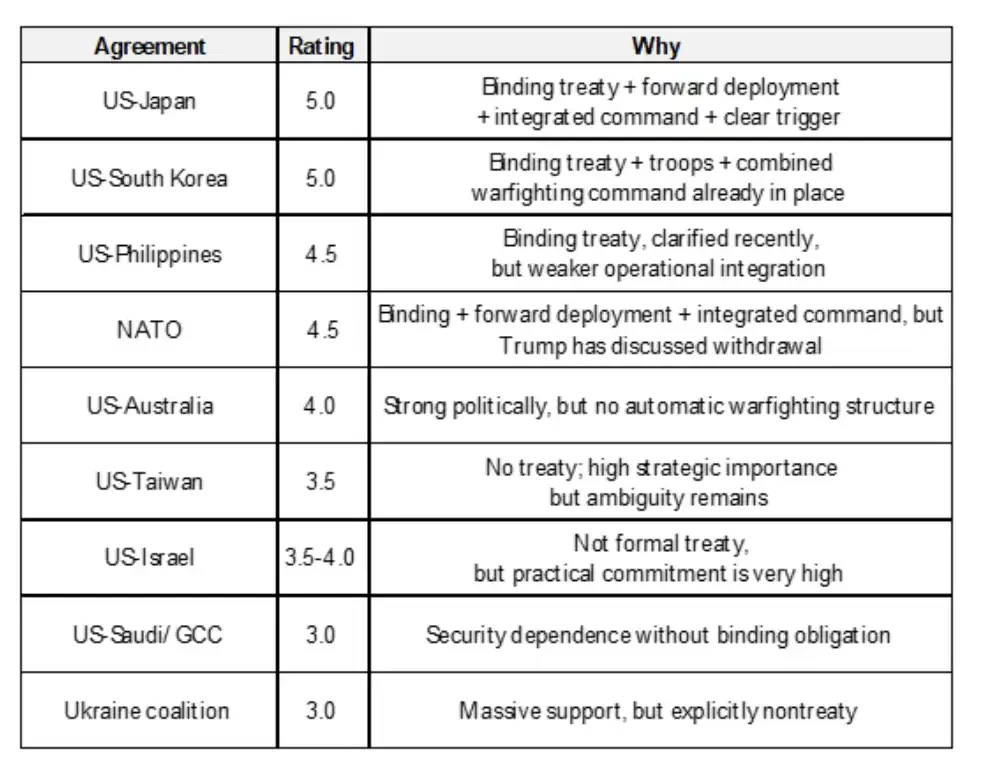
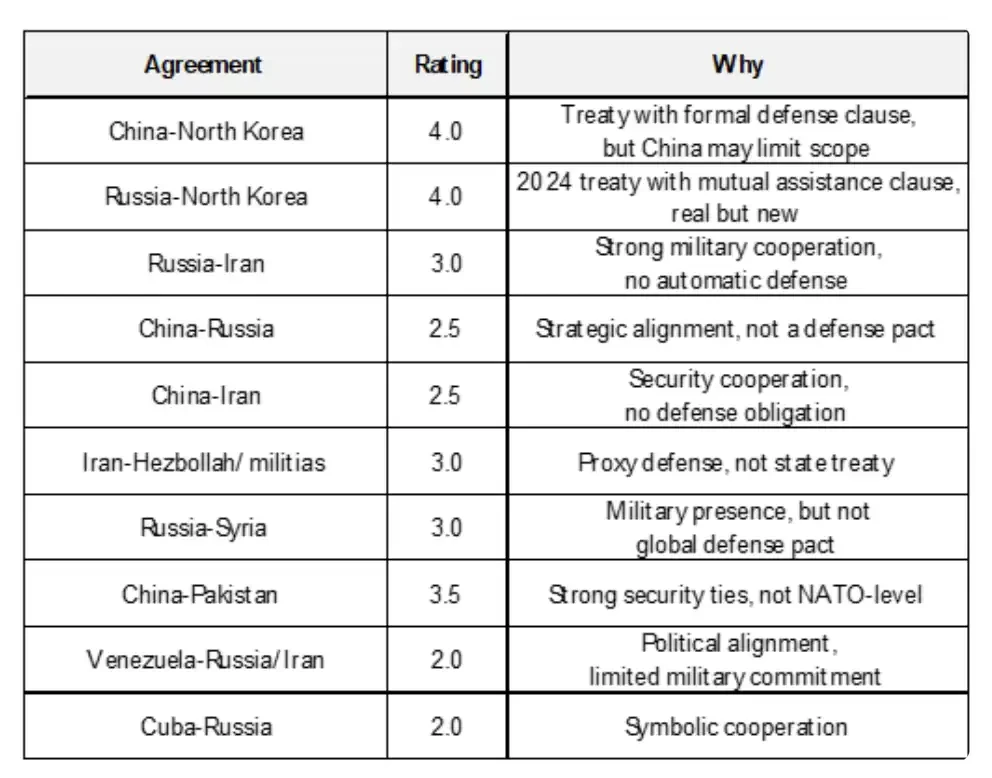
The following are some of the treaties that I consider to be the most important, including the ratings of the intensity of the commitments they imply: 1-5, and a brief description of each treaty. Overall, other indicators of alliance — such as leaders' statements and actual actions — are generally consistent with the relationship reflected in those treaties. However, it is also becoming increasingly clear that all these treaties, especially those relating to the United States, are subject to change and that real action will ultimately have more weight than the text of the agreement itself。
Key United States Treaties:
C-R-I-Key Treaties:
Appendix 2: There has been a war with potential
The following are some of the most important ongoing or potential wars that I believe have taken place, including my brief judgement of the situation and my assessment of the probability of an outbreak or escalation into a military conflict over the next five years。
Iran-United States-Israel war
This has been a full-scale war and appears to be escalating, with all parties depleting their resources on an ongoing basis. The variables that need to be focused on include:
(a) who ultimately controls the strait of hormuz, iranian nuclear material and iranian missiles
(b) the human and financial costs that countries are willing to pay to win the war
(c) the satisfaction of participating states with their alliances
(d) whether iran ' s allies (e.g., the dprk) will be directly involved in the war or support iran through military sales, or whether there will be an outbreak of conflict in asia, thus forcing the united states to choose between fulfilling its commitments and choosing inaction
(e) the restoration of peace and security in the gulf region。
Ukraine-NATO-Russia direct war
This is an active war involving almost all major military powers (except China) and is extremely risky. However, the fact that for three years the conflict has not yet extended the scope of Ukraine is a relatively positive signal that a larger war has been temporarily avoided. Currently, Russia is fighting directly against Ukraine, which NATO is providing arms support at great financial cost, while European military spending and preparations for war against Russia are on the rise. The absence of direct involvement by NATO and the fear of nuclear war on all sides have temporarily contained the escalation of the conflict. Risk signals requiring attention include Russian attacks on NATO territories or supply lines, direct NATO military involvement and accidental clashes between the Russian side and NATO member States. I do not believe that these events are likely to take place and lead to an expansion of the war, which is about 30 to 40 per cent over the next five years。
North Korean War
The Democratic People ' s Republic of Korea is a highly provocative nuclear State and has demonstrated its will to fight for its allies when it confronts the United States. It has missiles that can carry nuclear warheads and strike at the United States mainland (although the current reliability is limited), but this capability will increase significantly over the next five years. The DPRK has close ties with China and Russia and could become an effective proxy. At the same time, the DPRK is extremely radical in demonstrating and developing missile capabilities, but does not tend to sell related weapons to other countries. I think the probability of some form of military conflict over the next five years is 40-50 percent。
South China-Philippines-China-United States conflict
There is a NATO-like defence treaty between the United States and the Philippines, and there have been numerous confrontations between China's maritime police and the Philippines, which may further involve United States naval cruises. The threshold for triggering conflict is indeed very low — for example, when a ship crashes, when China attacks a Philippine ship, when a blockade is imposed, or when a missile incident occurs — the United States will face pressure to comply with its treaty obligations. However, United States domestic voters may not necessarily support such a military intervention, which would plunge the United States leadership into extremely difficult and symbolic choices. I think the probability of this conflict occurring over the next five years is about 30 percent。
Overall, in these potential conflicts, there is at least one probability of occurring in the next five years, which, in my view, exceeds 50 per cent。
