
Dialogue American finance minister Scott Bessent, deconstructs the world imagination under the 2026 macromog
Collapse & Compiled: DeepwaterTechFlow
Guest: Scott Bessent, United States Treasury Secretary
Moderator: Wilfred Frost
The Master Invester Podcast with Wilfred Frost
Original title: Scott Bessent: Inside Trump’s Treasury; War Costas; & Why Bond Market is King
Date broadcast: 13 March 2026
Summary of highlights
Scott Bessent (United States Treasury Secretary and one of the most successful global macro investors of his generation) came to the Treasury Department, Cash Room, and had a rare and very wide-ranging conversation with Wilfred Frost, across markets, geopolitics, and public services。
From his present identity, Scott has deconstructed why with a near-deductive perspective85% of the consensus is just meaningless noiseand the real excess returns (and the underlying motives behind the policy) are hidden in “ 15% “ world imagination &rdquo。
not only did he revisit the &ldquao behind the classic battles such as empty yen; the cognitive gap &rdquao; and for the first time, he was exposed as &ldquao under the geo-conflict and energy fog of 2026; the bond market lifeguard &rdquao;Survival philosophy. If you want to see the macro truth that most people ignoreAnd understand why he warned not to let himself slip out of the edge of the snowboard, and the next summary of views would be the cognitive threshold you must cross。
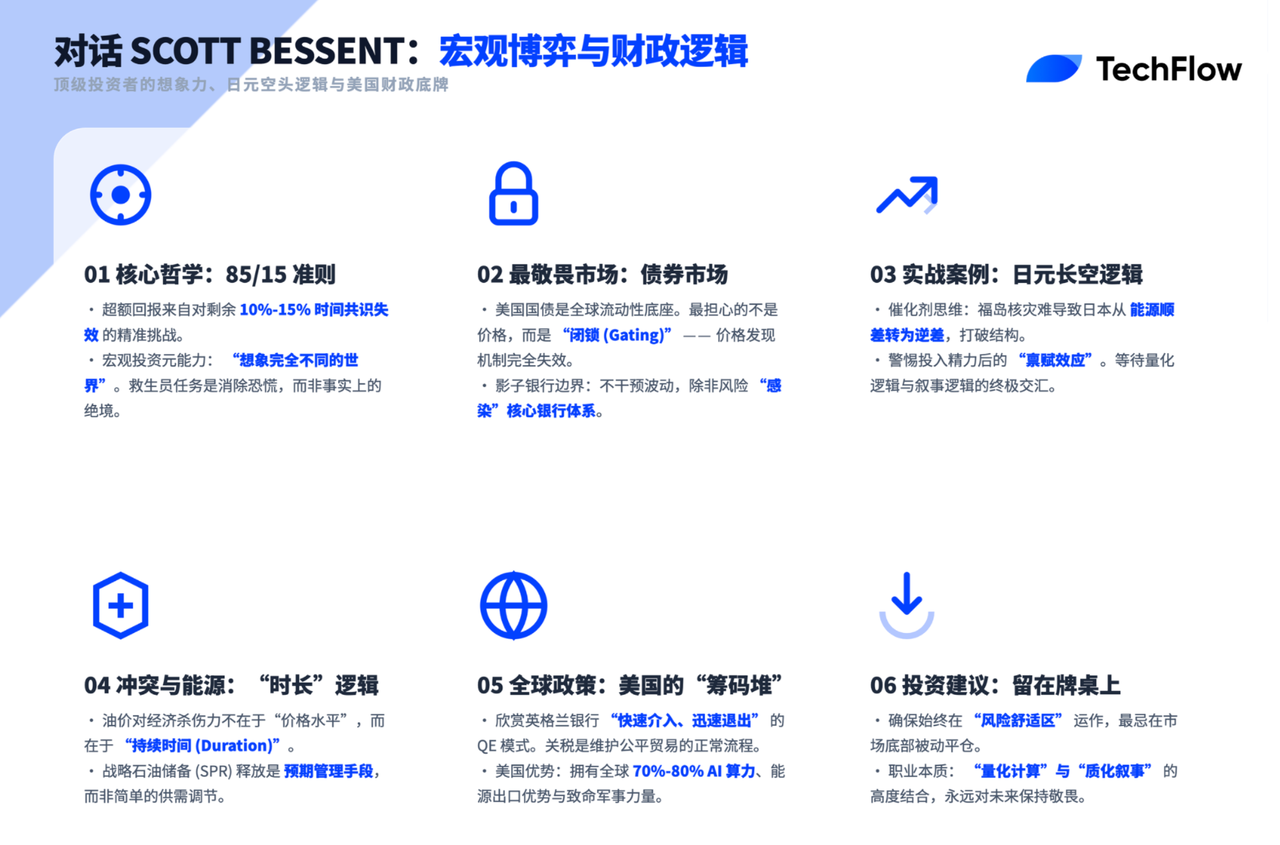
Summary of outstanding views
on “ consensus ” with “ huge return ”
In most cases, the market consensus is right, about 85% to 90% of the time, and the momentum of the market is justified. But what is really important is that when things begin to turn to, or when you can imagine a different outcome, it is when it comes to challenging consensus that there is a huge return。
about “ imagination ” and investment logic
my father has a collection of science fiction novels … &herlip; this taught me how to imagine a completely different world. in the area of finance, this capacity is important. you need to be able to imagine a different state of the world and believe that it can happen。
It is really important that you imagine a different state of the world and predict when, why and how it happens, and that you judge whether the market has underestimated that possibility and acted accordingly。
about &ldquao; japanese yen empty &rdquao; and abenomics
I do not know whether these policies will work for the Japanese economy, but this will be a rare market situation。
my team and i have always had the advantage of having an idea &lsquao after an in-depth study; putting it on hold; and waiting for the right moment。
on &ldquao; bond market &rdquao; and &ldquao; real risk &rdquao;
Ultimately, the most important is the bond market. The United States Treasury debt market is the deepest, most liquid and most secure market in the world, and in this building we are the custodians of this market。
in my 35-year career, the real moment of alarm was when the market was completely closed — — when the price discovery mechanism was destroyed or when the market was threatened by “ gate &rdquo。
in-depth observations on &ldquao; oil prices &rdquao
I believe that the key is not the level of oil prices, but its duration. If you look back at history, even in 2008, oil prices rose to a record $147, but the question is how long this high price has been going on。
a metaphor for “ lifeguard &rdquo
As lifeguards, you find that sometimes drowning people try to drag you down, and that happens in investment and politics. But ultimately your goal is to save them and bring them back to safe shore. In fact, many drowning people need only realize that they can stand up and be saved. In many cases, people in crisis are mainly concerned with panic。
Core recommendations for investors
be aware of the risks you can take and ensure that you always operate in comfort zones. do not let yourself & ldquo; slip out of the edge of the snowboard & rdquo; — — i.e. do not put yourself in the position of being forced to sell at the bottom of the market or to chase up at the top。
You never know what's gonna happen。
on “ shadow bank ”
It is not my duty to directly regulate shadow banks, but to ensure that their interaction with the regulated banking system and the insurance industry does not lead to systemic risks. At present, although we have observed some fluctuations, there is no indication of systemic problems in the shadow banking system. However, we continue to monitor to prevent any potential risks from spreading to the regulated financial system。
Scott Bessent's thought background: lifeguard metaphors, science fiction and world imagination Power
Wilfred Frost:Welcome to Master Invester Podcast, a guest today from the United States Secretary of the Treasury, Scott Bessent, who is not only a heavyweight in the global financial world, but also one of the greatest investors of our time. In the 1990s and 2000s, he worked for 20 years in Soros Fund Management and eventually became Chief Investment Officer (CIO). In 2015, he created his own hedge fund, Key Square, and then embarked on the path of public service as the current Minister of Finance。
Before going further, I would like to quote from your interview with the Financial Times in October 2025. You said: “ unlike most of my predecessors, I have very healthy doubts about elite institutions and elite views, and I don't think they do. But I have a healthy fear of the market. I'm impressed with that. Is that the guiding principle behind your shift from investment to politics
Scott Bessent:
Yes, I think it is a core principle of my investment:In most cases, the market consensus is right, about 85% to 90% of the time, and the momentum of the market is justified。But what is really important is that when things begin to turn to, or when you can imagine a different outcome, it is when it comes to challenging consensus that there is a huge return。
In my careerSome of the most significant successes are often on the opposite side of the elite view。For example, Japan was once thought never to be free of deflation and low growth, &ldquao; lost decades &rdquao; will continue, but when I met Abe Shinzo, I thought he might be a catalyst for change。
So I've been looking for where consensus might go wrong. We need to ask ourselves: is there a problem with the existing framework? Did we miss anything
Wilfred Frost: Since you have such a healthy fear of the market, which one is most important? In the end, is it the bond market that you fear most
Scott Bescent:
Yes, and ultimately the most important is the bond market. The United States Treasury debt market is the deepest, most liquid and most secure market in the world, and in this building we are the custodians of this market。
We are committed to maintaining market transparency while ensuring that markets are sufficiently resilient at the operational and settlement levels. After last year’s liberation Day, and now in the face of the Iranian conflict, the market has worked and settled very smoothly, a constant focus of our attention。
Wilfred Frost: Is there a moment of concern or tension in the bond market? Like last April or January
Scott Bescent:
As I mentioned earlier, there may be operational challenges at those times, but I will focus on the bond market every day。Markets always fluctuate, but we are more concerned with their continuity and functioning。In my 35-year careerthe real panic is when the market is completely closed;— when the price discovery mechanism is destroyed or the market is threatened by “ gate ” (gating)。Our concern is to ensure that markets are sustainable, that there are buyers and sellers, and that there is a smooth deal。
Wilfred Frost: You once wanted to be a lifeguard, a computer scientist and even a journalist. You then entered the financial sector, initially as a bank analyst in Brown Brothers, but eventually you chose global macro investment as a career orientation. Have you ever considered lifeguards as a permanent occupation
Scott Bescent:
No, but it's not a long-term occupation. Lifeguards have a short career, either because of physical constraints or because of prolonged exposure to sunlight。As lifeguards, you find that sometimes drowning people try to drag you down, and that happens in investment and politics。But ultimately your goal is to save them and bring them back to safe shore. In fact, many drowning people need only realize that they can stand up and be saved. Many timesPeople are in crisis mainly because of panic。
Wilfred Frost: So, as a macro-investor, you need to not only predict what the world is likely to be, but also to judge whether the market has mispricing these forecasts. Do you think that the key to successful investment is to discover such mispricing
Scott Bescent:
I've often been asked a question: “ what makes you ready for your career? My answer usually goes back to childhood. My father has a large collection of science fiction, which is probably the largest collection of — &mdash in South Carolina; although this standard is not high. He used to read it to me when I was a kid. I keep saying that before I can find Chicago on the map, I know how to point to Alpha Centauri。
It taught me how to imagine a completely different world. In the area of finance, this capacity is important. You need to be able to imagine a different state of the world and believe that it can happen. As the legendary macro investor Bruce Kovner says:“ i have the ability to imagine a different state of the world and believe that it may happen. ”
So what really matters is whether you can imagine a different state of the world and predict when, why and how it happens, and you need to judge whether the market has underestimated that possibility and acted accordingly。
Yen Long Line for empty logic construction and financial director identity conversion
Wilfred Frost: Between 2010 and the early 2020s, the yen was very strong and the exchange rate was once below 80. You've been doing this deal for 10 years, and you've finally seen the yen devalued to about 150! Can you share with us what you saw in 2011 or 2012 (no matter when you specifically started the deal) that nobody else saw
Scott Bessent:
It's backTimingProblem. In psychology, there is a large psychological deviation called &ldquao; &rdquao; (Endowment Bias). When you devote a lot of time and energy to something, there is a strong urge to implement it immediately. And I think that my team and I have always had the advantage of being able to put an idea &ldquao behind an in-depth study; set aside &rdquao; and get up and wait for the right time, as is the case with the yen deal。
The first time I went to Japan was in 1990, before and after the peak of the solar index. I stayed at the famous Okura Hotel in Tokyo for about three months, at $500 a night, and in 2011 the same room would only cost $350. This amply illustrates the long-term stagnation and weakness of the Japanese economy。
I have witnessed the rise in Japan ' s economy, and I have experienced its decline, and I have been following its development even as it has stalled for so long. The year 2011 was an important turning point. On 11 March of that year, Japan experienced the Fukushima nuclear disaster, which was a devastating tragedy, including an earthquake, a tsunami and the threat of near-nuclear collapse。The decision of the Japanese Government at that time to shut down all nuclear reactors showed me a potential catalyst。
UNTIL THEN, IT HAD BEEN VERY DIFFICULT TO DO THE EMPTY YEN, BECAUSE JAPAN HAD A HUGE CURRENT ACCOUNT SURPLUS OF 3 PER CENT OF GDP. HOWEVER, WHEN JAPAN SHUT DOWN ITS NUCLEAR REACTOR, THEY HAD TO START IMPORTING LARGE QUANTITIES OF FOSSIL FUELS, WHICH LED TO A CURRENT ACCOUNT SHIFTING FROM SURPLUS TO DEFICIT。
Even so, the exchange rate of the yen was still between 78 and 83, without significant changes. Until one day, one of my Japanese friends, — — — Mr. Funabashi-san, a senior Japanese journalist, thinker and policy expert, — called me and said: “ there was a man named Abe Shinzo, who was Prime Minister and may now be back on the table. His campaign stands for &lsquao; the revival of the Japanese economy and national power &rsqua; and he will promote an economic policy agenda centred on re-inflation. ”
This message has opened my mind, because I knew that the Bank of Japan was about to open three vacancies on the board. This means that the new Prime Minister will have the opportunity to restructure the central bank’s leadership, including the new president, which has long been dominated by deflators or low-inflation factions, with the potential for a major policy shift. From that moment on, all the factors began to be right。
Wilfred Frost: I remember you mentioned in an interview with Capital Allocators Podcast in November 2024 that your boss George Soros had asked you: “ Abenomics and whether these policies would work for the Japanese economy? ”
and i'm impressed by your answer, — — you say: “ i don't know, but this is going to be a rare market situation. &rdquao; your judgment has proved correct, and you made a lot of money in this deal. but now that you have changed from an investor to a policymakers, you need to assess “ whether policies can really land & rdquo; not just judge “ whether market pricing is wrong & rdquo; is this a big change for you
Scott Bescent:
with regard to japan and abenomics, &ldquao; three arrows &rdquao; the policy has indeed been a great success. initially, it had had an immediate effect at the market level. over time, while japan ' s policy implementation has been as prudent and gradual as ever, and may be slower than westerners would have preferred, they have made remarkable efforts to reshape the economic and investment environment。
For example, they have improved shareholder equity, capital return (Return on Capital) and encouraged female participation in the labour market through &ldquao; &rdquao; and Womennomics. It is important to know that Japan ' s labour market has been virtually non-mobility for a long time, but they are actively promoting change and, overall, Japan has achieved remarkable results in reshaping its economy。
Wilfred Frost: Now, as a policymaker, not an investor, do you need to ignore the pricing of the market and focus more on the real landing of policies
Scott Bescent:
I still have access to information from markets, which sometimes reflect important signals。but my role now is more to think about &ldquao from a policy perspective; what can be done, what should be done, and what can be done &rdquao; and to predict the real impact of these policies on the economy and the market。
for the past 30 years, my work has been to gather as much information as possible about the intentions of policymakers — — sometimes even trying “ eavesdropping ” and the content of their meetings. but now that i am sitting at the policy-making table, i need to judge the feasibility of policies, the way they are implemented and the potential market response。
— — whether after last year's liberation, or about the current iranian conflict; —I try to think from the perspective of market participantsI don't know. I would ask myself: If I were an investor, what kind of guidance would I want from policymakers? How can a clear framework be provided to markets, to the American public and to other policymakers around the globe without disclosing any significant and confidential information
Wilfred Frost:from being a very successful, very rich investor, owning the business, to becoming a policymakers now, there is still a need to report to the president — — is this a difficult transition for you
Scott Bescent:
I am no stranger to working with others, and our cabinet team is excellent, especially in this high-pressure environment, where we all have demonstrated a very high level of professionalism. Our field of operations has a series of morning meetings every day, and the team has performed very well, but under the current circumstances, they have done even more。
In a sense, I think I've been preparing for this job for a long time. In the past, when I attended G7 or G20 meetings as an investor, I knew a lot of central bankers and treasurers. At the time, their mission was “ &rdquo pacing; investors like me, and now I work with them as peers and colleagues to discuss policy。
Global energy and geopolitics game: Scott Bessent on the Iranian conflict and US economic strategy
Wilfred Frost: WTI crude oil prices are now around US$ 94.95. It was less than $60 at the beginning of the year, while it surged to $114 to $115 earlier this week. For the United States economy, what level of oil prices will begin & ldquo; & rdquo
Scott Bescent:
i do not think that the key lies in the price of oil & ldquo; the level & rdquo; but in it & ldquo; the duration & rdquo。If you look back at history, even in 2008, oil prices rose to a record $147, but the question is how long this high price has been going on。
President Trump ' s energy policy has provided a great buffer to the United States. Liquid fuel production in the United States, including crude oil and natural gas, is currently at an all-time high. In addition, natural gas prices are relatively stable, and they directly affect energy costs and the billing expenses of residents。
the first task of the president is to weaken iran ' s military capabilities, including its missile capabilities, manufacturing capabilities, air force and navy, in particular its military projection capabilities beyond its borders. at the same time, the president is determined to eliminate iran's capacity as the primary mastermind of global terrorism。
Wilfred Frost: The United States Government and the International Energy Agency (IEA) recently announced the release of strategic oil reserves, the largest release operation in history. In the short term, however, this does not seem to have had a significant impact on the rise in oil prices. How do you see this
Scott Bescent:
WE NEED TO LOOK AT THIS IN THE LONGER TERM, AND MARKETS ALWAYS REFLECT FUTURE EXPECTATIONS AHEAD OF SCHEDULE. LAST SUNDAY, OIL PRICES SOARED BY $30, BUT THEN THE FINANCIAL TIMES REPORTED THAT IEA WAS CONSIDERING RELEASING 300 TO 400 MILLION BARRELS OF STRATEGIC RESERVES, THE DAY WE SAW THE LARGEST SINGLE-DAY PRICE REVERSAL IN HISTORY。
THIS MONDAY, WE CONVENED A MEETING OF G7 FINANCE MINISTERS, WHICH FOCUSED ON ENERGY. SUBSEQUENTLY, MINISTERS OF ENERGY MET ON TUESDAY AND, FINALLY, AT THE LEADERS' MEETING ON WEDNESDAY, THE PRESIDENT CONFIRMED THE DECISION TO RELEASE 400 MILLION BARRELS OF STRATEGIC RESERVES ON AN UNPRECEDENTED SCALE。
Wilfred Frost: Nevertheless, oil prices are still about $50 higher than at the beginning of the year. If this situation continues, will consideration be given to sending naval escorts for tankers through the Strait of Hormuz
Scott Bescent:
Such possibilities have been in our planning, and we have developed relevant scenario analyses, including a programme by the United States Navy or the League of Nations to escort tankers through the Strait of Hormuz. In fact, a number of tankers are already passing, including oil tankers with Iranian and Chinese flags, and we know that Iran has not planted mines in the Strait。
Wilfred Frost: Will the number of ships passing through the Strait of Hormuz improve from now on
Scott Bescent:
once military conditions permit, the united states navy — — possibly within the framework of the league of nations; — will escort ships safely through the strait of hormuz, for which we have planned for months or even weeks to ensure the success of the operation。
Wilfred Frost: I have a few questions about this war. Can you tell us about the war's current & ldquo; daily running costs & rdquo; what is it? 1 billion dollars a day or 10 billion dollars
Scott Bescent:
I'm not directly tracking the day-to-day running costs of the war because in the United States, the Treasury Department and the Management and Budget Office are separate. That is why we call it Finance Minister Treasury Secretary, not Finance Minister Finance Minister. But according to the data published today, the cumulative cost is about $11 billion。
Wilfred Frost: How long do you expect this war to last? Can America’s finances withstand such pressure
Scott Bescent:
THE $11 BILLION IS INDEED A HUGE SUM, BUT WE HAVE SET ASIDE ENOUGH FISCAL BUFFERS FOR IT. WE ARE NOT WORRIED ABOUT FUNDING. INDEED, FOREIGN DEMAND FOR US TREASURY BONDS HAS CONTINUED TO GROW OVER THE PAST YEAR, AND THE US TREASURY DEBT MARKET HAS PERFORMED WELL, BEING THE ONLY G7 COUNTRY IN A 10-YEAR BOND MARKET WITH DECLINING YIELDS。
Wilfred Frost: Last question: The United States Government has recently granted 30 days of exemption to Indian refineries to purchase Russian oil. Does that mean that Russia benefits from this conflict? What do you think about that
Scott Bescent:
this is indeed unfortunate, but we must take into account the availability of supplies. we're issuing a 30-day exemption because these russian tankers are already at sea and this is a fast source of energy for indian refineries. from another perspective, the oil could eventually flow to china. we therefore hope that this benefit will be limited to one & ldquo; a very short period & rdquo。
new oil price normal and gold revaluation: the fed needs to look for &ldquao in the liquidity trap; thin &rdquao; programme
Wilfred Frost: Let's talk about the Fed and the short- and long-term directions of domestic policy. First, in the short term, do you think that current oil price fluctuations will affect the pace of the Fed ' s policy easing
Scott Bescent:
this requires a balance between multiple factors, and i think the fed may fear that rising energy prices will push up inflation expectations; but, on the other hand, they also need to observe that the effects of rising oil prices on the economy are short-lived & ldquo; power & rdquo; or long-term & ldquo; kinetic & rdquo; declining. if only short-term shocks, the economy could rebound quickly。
It is also worth noting that if oil prices are below $60 at the beginning of the year and the conflict ends in favour of the United States, in the medium term we may enter a new pattern of lower oil prices。
Wilfred Frost: If the Fed has to raise interest rates in the future and your debt management is now more dependent on the issuance of short-term national debt, will you consider turning to more long-term national debt issues
Scott Bescent:
WE WILL WORK CLOSELY WITH THE FED TO COORDINATE DEBT MANAGEMENT STRATEGIES. AS TO WHETHER THE FED WOULD RESTART QUANTITATIVE EASING (QE), AT PRESENT THIS POSSIBILITY IS FAR FROM EVEN WORTH DISCUSSING。
Wilfred Frost: You are a pro-British who lived a long time in England. Do you appreciate the operating model of the Bank of England rather than that of the Fed
Scott Bescent:
The Fed and the Bank of England are very different institutions, and the Fed is a larger and more decentralized organization with multiple regional Feds and board members, with only a few members having the right to vote. In contrast, the structure of the Bank of England was more centralized, divided into the Monetary Policy Committee and the Executive Committee, with only the Governor participating in the work of the two committees。
Wilfred Frost: The Bank of England model has several features, such as the inflation target being a 1 per cent zone up and down, rather than routine measures such as QE requiring the approval of the Treasury Secretary. Do you think these features are worthy of the Fed
Scott Bescent:
I think setting inflation targets is a point of reference, but I do not think that the Fed needs to fully adopt the Bank of England model. As far as QE is concerned, I do believe that Bank of England operations are more in line with the nature of unconventional measures. The Bank of England briefly intervened in the market at the beginning of the new epidemic, stabilizing the functioning of the British Treasury debt and then quickly withdrawing. The Federal Reserve, on the other hand, continued to buy assets over the next four years, which may be one of the reasons for this。
Wilfred Frost: The United States owns large reserves of gold, but their book value is still based on an obsolete price of $42/ounce, while the current market price exceeds $5,000/ounce. If the value of gold is reassessed and hedged, could it provide an opportunity to reduce the Fed ' s balance sheet while avoiding a liquidity crisis
Scott Bescent:
I THINK THIS IS TWO COMPLETELY INDEPENDENT THINGS. IF THE FED WERE TO ADJUST ITS BALANCE SHEET, THEY WOULD NEED TO SIGNAL WELL IN ADVANCE AND DEVELOP A DETAILED PLAN. WE ALSO NEED TO RE-EXAMINE THE BALANCE SHEET IMPACT OF BANKING REGULATION SINCE THE GLOBAL FINANCIAL CRISIS (GFC), PARTICULARLY WITH REGARD TO THE PEER MARKETS AND RESERVE SYSTEMS。
currently, the fed operates a high reserve model, but in the future may switch to a more & ldquo; thin & rdquo; that is, bank-to-bank provision. this shift requires time and deliberate planning。
Wilfred Frost: You had the opportunity to chair the Federal Reserve, but ultimately chose to remain as Finance Minister. Why do you think the Minister of Finance is better suited to your role
Scott Bescent:
I like to interact with my cabinet colleagues, and the role of the Minister of Finance allows me to be directly involved in the formulation and implementation of national policies。
As Secretary of the Treasury, my duties include maintaining the global dominance of the United States dollar, managing the country ' s debt and operating the United States sanctions system. These tasks concern not only the economy but also national security. I believe that these efforts are particularly important in this particular period of history。
Wilfred Frost: Private Credit has recently received attention. Should problems arise in this area, should the consequences be borne by those investors who profit from the market, rather than by the Government
Scott Bescent:
That's why we call it “ Shadow Banking ” (Shadow Banking System). It does not belong to the traditional regulated banking system。
It is not my duty to directly regulate shadow banks, but to ensure that their interaction with the regulated banking system and the insurance industry does not lead to systemic risks. At present, although we have observed some fluctuations, there is no indication of systemic problems in the shadow banking system. However, we continue to monitor to prevent any potential risks from spreading to the regulated financial system。
geopolitical collaboration and &ldquo under tariff pressure; iranian threats ” new consensus
Wilfred Frost: You have lived in England for many years, with a deep understanding of &ldquao; special relationships &rdquao. Recently, President Trump expressed displeasure with Britain, stating that the British Prime Minister was not Winston Church. What do you think of this assessment
Scott Bescent:
President Trump expressed concern about some delays, in particular with regard to the use of the Diego Garcia airbase. As B2 bombers in the United States require additional flight time and air refuelling, this intangiblely increases risk. The President, as the Commander-in-Chief of the United States Army, has always been the primary task of protecting the lives of the military, and is therefore very sensitive to any behaviour that may increase risk。
Wilfred Frost: Do you think Britain puts American lives at risk
Scott Bescent:
We have a very deep historical relationship with Britain, and I am confident that we can overcome these differences and get back on track. But it is true that the Prime Minister was late on the issue of investing resources in the region, but I am confident that our long-standing relationship with Britain will withstand short-term fluctuations and that we will eventually be back on track。
Wilfred Frost: Will the launch of new tariff investigations over the past year and a half, particularly the recent announcement of multi-country allies, including EU member States, Switzerland, Singapore, Korea and Norway, affect ally support to the United States? Especially at this critical juncture in the ongoing war。
Scott Bescent:
if normal tariff levels were to return to normal, some countries would be allowed to “ to stand on the opposite ” they would not have been our true allies. we are currently implementing a global tariff level of 10 per cent, and the countries that have signed trade agreements with us want to keep the status quo。
It needs to be clarified that these tariff surveys are part of normal business processes. The Supreme Court ruled that the President could not use the International Emergency Economic Powers Act (IEPA) to levy customs duties, but we could re-establish the tariff system through section 301 (Section 301) or section 122 (Section 122) of the Trade Act. These measures are aimed at ensuring a fair trading environment, not at allies。
Wilfred Frost: Are you worried about US policy style — — e.g., acting first without the full consent of the allies — can be interpreted as “ US isolation ” not “ US priority &rdquo
Scott Bescent:
I DON'T THINK SO. IN A RECENT CONVERSATION WITH THE G7 LEADERS, LEADERS EXPRESSED SUPPORT FOR UNITED STATES ACTIONS IN THE MIDDLE EAST AND CONGRATULATED US ON OUR SUCCESS IN WEAKENING THE IRANIAN THREAT。
In addition, on the Strait of Hormuz, a number of States have expressed their willingness to provide demining ship support and to participate in the establishment of an international coalition to ensure safe passage by sea. No country wants the Iranian regime to continue in its present form. The Arab States of the Gulf region in particular were shocked by the Iranian attack, which made them aware that the situation would be even more dangerous if Iran ' s military capabilities were further enhanced。
Wilfred Frost: You mentioned the need for investment & ldquo; the right to take risks & rdquo; From this point of view, do you think that today's United States &ldquao on the global stage; chips &rdquao; is smaller than ever
Scott Bescent:
On the contrary, I think that the United States is stronger today than it was in the past. We have achieved dominance in energy, moving from an energy importer to an exporter; we continue to lead the world in technology, especially in the area of artificial intelligence, where the United States now holds 70 to 80 per cent of the global calculus; and our military strength has reached unprecedented levels, stronger and more lethal than ever before。
ON THE ECONOMIC FRONT, THE UNITED STATES HAS GROWN MUCH FASTER THAN EUROPE. FOR EXAMPLE, THE EU CELEBRATES 0.3 PER CENT GDP GROWTH, AND WE EXPECT THE UNITED STATES TO ACHIEVE 3 PER CENT GROWTH, ALMOST 10 TIMES THAT OF EUROPE, ONCE THE CURRENT CONFLICT IS OVER。
Wilfred Frost: But is it a concern that United States debt levels are rising and oil reserves are declining
Scott Bescent:
THE SHARE OF DEBT IN GDP IS INDEED ON THE RISE GLOBALLY, A LEGACY OF THE GLOBAL FINANCIAL CRISIS AND THE NEW EPIDEMIC. HOWEVER, IN TERMS OF RELATIVE STRENGTH, THE UNITED STATES CONTINUED TO OUTPERFORM OTHER COUNTRIES IN TERMS OF DEBT MANAGEMENT AND ECONOMIC GROWTH。
Waiting to quantify the intersection with narratives in the risk comfort zone
Wilfred Frost: Last question, can you offer our audience a central investment and career proposal
Scott Bescent:
with regard to career advice, i would like to tell you that you can never predict what will happen in the future. when i graduated from yale university in 1980, i wanted to be a journalist or computer scientist, but finally it was found that the investment was a combination of calculations “ quantification ” partial and narrative “ qualitative ” and, in part, it was fascinating。
as for investment, my proposal is to be clear about the risks that we can take and to ensure that we always operate in comfort zones. do not let yourself ski out of the edge of the snowboard ” — — that isDo not put yourself in a position where they are forced to sell at the bottom of the market or to chase up at the top。
Wilfred Frost: Do you think that United States action in the Middle East is already & ldquo; Sliding out & rdquo
Scott Bescent:
Absolutely not. We are moving faster than planned, and Iran's military capabilities are being eroded. It is uncertain whether Iran ' s supreme leader has been incapacitated or threatened internally。
Wilfred Frost: Do you think there might be a change of regime in Iran in the next few days
Scott Bescent:
Our goal is clear: to reduce Iran ' s military capabilities, to prevent it from manufacturing atomic weapons and to limit its external military projection capabilities. However, once operations begin, the situation tends to evolve beyond expectations and generate its own dynamics。
