
USDC IS THE ONLY AI TOKEN
Author of article:Vaidik Mandloi
Articles compiled:Block unicorn
At this point, somewhere on the Internet, a software is running a full-fledged business。
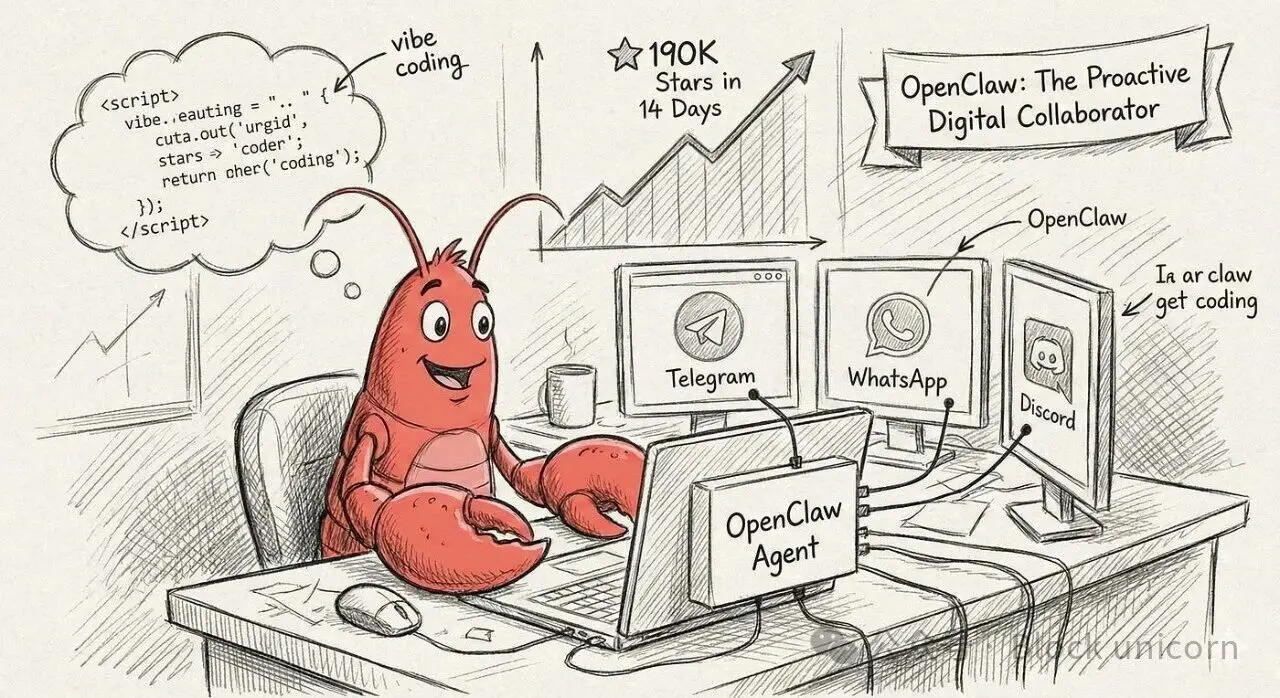
His name is..FelixI don't know. His company is calledOpenClawI don't know. Felix sold a 29-dollar PDF on how to make money using artificial intelligence. It's ironic, because it's Felix who makes the money, and it's the PDF that teaches you how to make the money. It runs an Internet store called Clawmart. It's on the phone with voice API. When it encounters work that it cannot perform, it hires another customer online to pay for his work and then continues his day-to-day work。
When I last checked, Felix earned about $195,000. Its monthly operating cost is approximately $1,500, almost entirely for LLM use. From a legal point of view, the company was a C-type company owned by Nat Eliason, who was hardly involved in the operation. He is not involved in any day-to-day decision-making; he only has this artificial intelligence agent. Please note this. This is a software with a “barrel” and a truly automated and evolving enterprise. It covers its own infrastructure costs every month. It does not need anyone to be self-sustaining by intervening。

Felix's story is just a microcosm. And there's a bigger example. One nameMedviThe company, which had earned $401 million in revenue in its first year of operation, had only two employees. Other companies operate 24 hours a day, 24 hours a day, with an artificial intelligence agent who never sleeps, never stops and has almost zero operating costs。
Now, the interesting part comes。
Now, if you walk into an encrypted money forum, you'll hear the same thing: the next hot topic is “Agent intelligence agents”. A “artificial intelligence chain” would be able to pull its head in the area of de-centre finance, as it had in the area of the ETA. Pick your target, hold your tokens and wait for it to go up. This is the story that all industry leaders and venture capitalists are selling, and the argument that all analysts have spared no effort to repeat in podcasts。
This thing is totally fucked. Because it was invented by those whose work depended on the importance of the answer, and it was about to hurt again the group who had lost the last round of L1 coins. Look at CoinGecko's AI proxy index; it's down 75% in the past year. Most of the tokens listed above have fallen by 90 per cent and continue to lose。
BECAUSE THE TRUTH IS: THE REAL AI TOKEN IS THE STABLE CURRENCY -- USDC, USDT, USDS -- AND THEY HAVE WON. LET ME EXPLAIN WHY。
Software is now a company
To understand all this, we need to go back to 1937. That year, an economist, Ronald Koss, wrote a paper that raised a very stupid question: “What does it mean to be a company?”
Consider that, if the free market is really the most effective way to do anything, every task within the company can theoretically be outsourced. A freelancer is found in each line of codes, a freelancer is found in every client phone call and a freelancer is found in every invoice received. You can pay for the assignment, you can be fired at any time, and you can minimize the cost。
So why doesn't anybody really do it? Because it is even more expensive to operate, even when it appears to be a low cost. Finding the right person takes time, negotiating the contract takes time, ensuring that the job is actually completed, while tracing officers take time, money and usually lawyers。
Ronald called this friction a “transaction cost”. Once these costs are high enough, it would be more cost-effective to stop negotiating with the outside world and instead form their own teams. A person is hired to pay him and to work on Monday, which is faster and cheaper。
But in the latter age, this logic no longer applies. Today, the cost of employing intelligent bodies is much lower than most of the tasks undertaken when the company was first established. Now, you can hire a coded smart body that works 24 hours a day, never resigns, never tires, never demands a raise. Now, the reason for supporting the formation of a 50-person development team is purely nostalgia。
The only obstacle to all normalization today is the outdated legal and compliance framework. OpenClaw was named after Nat because Delaware did not accept the LLC document signed by software agents. If this is cancelled, Felix is actually a company. It earns money, spends money, makes decisions and reinvests the money it earns。
And that's where encrypted money starts taking on the burden. Because Felix couldn't open an account at Morgan Chase. It cannot be verified through KYC. It is also unable to sign the W-9 form. In fact, no matter how much revenue the software generates, Chase Morgan would not open bank accounts for any software program, and the Bank Secrecy Act meant that even if they wanted to do so, they could not do so legally。
There are no problems with USDC encrypted wallets. You only need to generate a private key, and then fill your wallet with a stable currency. Just one step, you give the agency all the financial capabilities you need. It receives payments from clients, pays for tools, hires other agents and continues to operate backstage after the owner has ceased to pay attention. All other components in the proxy technology warehouse, such as LLM, the hierarchy and the instrument it calls, are negotiable. But encrypted wallets are the core. Without it, Felix can only become a regular chat robot agent。

I have often seen on Twitter some opponents of the Stabilisation Currency put forward such arguments — yes, the Stabilisation Currency is good, but why should ordinary people use it? A father living in Louisiana with three children, with a check account at Chase Bank, insurance at the Federal Deposit Insurance Company, a debit card that can be used at the Publix supermarket, and an automatic repayment of the mortgage, would never transfer the money to a self-directed wallet that would require notes。
Honestly, it is. He won't. He has no reason to do so. But the whole debate was off the point. In this storyHe was never a client. The client is a softwareIN ITSELF, IT DOES NOT HAVE THE RIGHT TO LEGALLY HOLD BANK ACCOUNTS. THIS AGENT DOES NOT REQUIRE THE GUARANTEES OF THE FEDERAL DEPOSIT INSURANCE CORPORATION (FDIC). IT CAN'T GET THE FDIC'S SECURITY. IT IS THE IDEAL STABLE CURRENCY USER BECAUSE IT HAS NO CHOICE。
The chain is now a supplier
Well, half the arguments have been settled. Now in the second part, many people may have to be angry about it。
For many years, the encrypted currency Twitter ring has been arguing about which chain wins in the realm of artificial intelligence: the Etherject. Solana? Every week, there's a 2,000-word article that lists all kinds of trade-offs, groceries, and finally gives the winners in their minds. Because they don't even know how smart people work。A smart body does not care about which chain, but only chooses the one that is least costly and best suited to the task at hand。
Imagine that Felix is on an ordinary working day:
-
10 a.mFelix needs to send another agent a micropayment of $0.003 for quick data queries. Felix choose Base or Solana. Why? Because the fees are only a fraction of a cent。
-
In an hourFelix needs to settle $50,000 with the vendor. The situation is completely different. This time Felix chose the Ether Workshop because the final recognized premium of $50,000 was sufficient to offset the gas costs。
-
In an hourFelix is required to pay a Lagos freelancer in United States dollars. Felix chose to use USDT on Tron, because Tron's stable currency transactions in 2025 would reach $3.3 trillion, while the Etheraf would be about $1.2 trillion, and Nigeria's trading corridor would perform better on Tron than any other platform。

The three payments took place in three completely different payment chains, and Felix did not care what the link was. For software agents, the payment chain is simply a tool。
Logistics companies have no particular preference for carriers for the same reason. No one will argue between UPS and FedEx which is better. You will only choose which will accomplish the task at a lower cost and at a faster rate, on a given route, at a given time. This is the upcoming relationship between each supply chain and each major application. The agent is only doing the math, and the best supply chain for the current calculation will be used。
Stripe realized this earlier than most encrypted money companies. Stripe and Paradigm have recently invested $500 million in a project calledTempoThe new chain, which is based solely on stable currency. Stripe doesn't want you to know which chain your payments are settled through. It is concerned only with the successful liquidation of payments and is inexpensive and secure。That is the direction of all future chains — invisible pipelines。
This leads to what I think is the most disproportionate metadata currently priced in encrypted currency。
AI DIARY CEMETERY
In 2025, CoinGecko ' s AI proxy index dropped sharply from $13.5 billion to $3.5 billion, evaporating $10 billion. Virtuals, aai16z, and all the "autonomous proxy platforms" coins created by the AI concept began to collapse, which was the pattern of these concepts when they lost their new buyers. This will happen sooner or later. The market has come to realize that these tokens have no actual application scenario for AI or AI agents。

It is the other end that truly embodies the economic value of the agent. OnlyUSDCOne, the 18.3 trillion dollar chain settlement was achieved in 2025. The total sum of all stable currencies is about $33 trillion, which is comparable to the sum of Visa and MasterCard。
By January 2026, the monthly turnover of stable currency alone had exceeded $10 trillion. PayPal's PYUSD circulation jumped from $1.2 billion to $3.8 billion in less than a year. Surprisingly, Cloudflare has introduced its own stability coin. The stabilization currency settlement project launched by Visa reached $4.5 billion per annum by mid-January。
There are layers of protocol that support the operation of the system. Coinbase changed an idle HTTP state code named 402x 402, a small agreement allowing payment between agents. By December, x402 had processed over 100 million payments from agents. The average amount paid was 20 cents, with a daily turnover of approximately $30,000. That sounds pathetic, but it is exactly the typical growth trajectory of all the payment channels you know and like in the first six months, before the outbreak began. Stripe started testing x402 on the Base platform in February. MasterCard, in partnership with Star Shower Bank and the Bank of Daehua Singapore, launched a pilot agency payment project in Singapore. Google Cloud added x 402 to its agent ' s payment agreement as one of the clearing channels。
Almost all of these real, ongoing and online transactions have not had an impact on the growth of the AI proxy token index. It is true that a small number of coins associated with x 402 have obtained small purchases in the process, but the overall index has not changed. Because market prices are completely wrong. It's still trying to predict which agent will win, just as it used to predict which doggy coin's mascot is cuter。But the real deal lies in having the “track” that every agent must use, whether alive or dead. And now, these “tracks” are stable currencies。
The crack in the paper
Frankly, I would also like to tell you the possible shortcomings of this argument. Otherwise, I'm just selling another paper on artificial intelligence agents, and I'm just removing all the bad parts。
The biggest loophole of all is..AttributabilityI don't know. Imagine this: Felix signed a contract with another broker, transferred $1 million and the other party breached the contract. So who's gonna be sued? Felix is not a legal person, so you can't sue him. Nat did not authorize that amount, and may not even know about it, and to be honest, even if he wanted it, he might not be able to return to what Felix was thinking。
The hosting platform of Felix cannot really provide compensation for a system that no one can fully understand. Insurance companies have also begun to withdraw compensation. The occupational liability insurance policy quietly reclassified the agent's error as a “systematic software drift”, effectively denying compensation。
If you look closely at the current legal provisions, it becomes clear that most enterprise-level artificial intelligence agreements set the vendor ' s liability ceiling at a 12-month SaaS fee. This means that, in the event of a catastrophic event, anyone can recover the cost of subscriptions from artificial intelligence suppliers for the past year at best. At the same time, the average cost of data leaks in the United States is expected to reach $10.22 million per event by 2025. There is a huge gap between the actual risks that may arise and the scope of the contract coverage, and at present no one has identified who should bear this portion of the loss。
All companies without a founder still need to register a person ' s name on the document in order to obtain legal protection until it is clear who is responsible for the agent ' s fault. But even if such a risk exists, the big picture remains。The company is gradually melting into software, while the block chain is the router layer of software. Both layers eventually collapse down to a stable currencyFor in the entire technology warehouse, only a stable currency can be held, used, earned and understood independently by the agent。
Where does the money go
So what are the real benefits of all this if the block chain becomes a supplier and the proxy token is basically a graveyard
I mean it is about reputation and top of process. Prior to the signing of a six-digit contract between the other agent and Felix, it was necessary to verify that Felix was truly solvent. The agent ' s risk of default must be assessed as Moody ' s bond assessment, only faster than the machine, because the agent ' s trade is machine-level. There must be people who pass between the three chains, and neither the payer nor the payee needs to know or care about which chain is specifically charged. Moreover, at present, in this area, whatever seed-stage start-up companies eventually win will have more value than any AI coin that has ever been issued。
And that's what nobody wants to hear. The infrastructure that really wins in the proxy economy looks boring. It is like a pipe installation, and there is no make-up at the time of the issuance of a token or empty-dropped mining head。
Dragonfly's Haseeb Qureshi's word has been echoing in my mind. He said that encrypted money was never designed for humans. He was right. Human beings were never its target users. All of the dispersed users who complained about assistive words, gas fees or wallet users were right. This product is not for them because it was not designed for them. It was born for the future。
What follows is a software with wallets, real customers and real income. It's been in operation for about two years, and by the time you read the paper, it had invoiced somewhere and consumed stable coins. At the same time, the market is arguing which block chains will win artificial intelligence, which proxy coins will grow 100-fold, and which investment strategy the wind-out agencies will turn to in the third quarter。
At the same time, a stable currency, with a volume of $18.3 trillion in transactions over the past year, is almost unsupported in the area of encrypted currency。THIS ARTIFICIAL INTELLIGENCE TOKEN IS USDC. EVERYTHING ELSE IS BOGUS。
That's it for today. See you in the next article
